

Weeping Santa Rosa Plum Tree
Written with AI assistance, edited and checked against horticultural sources.
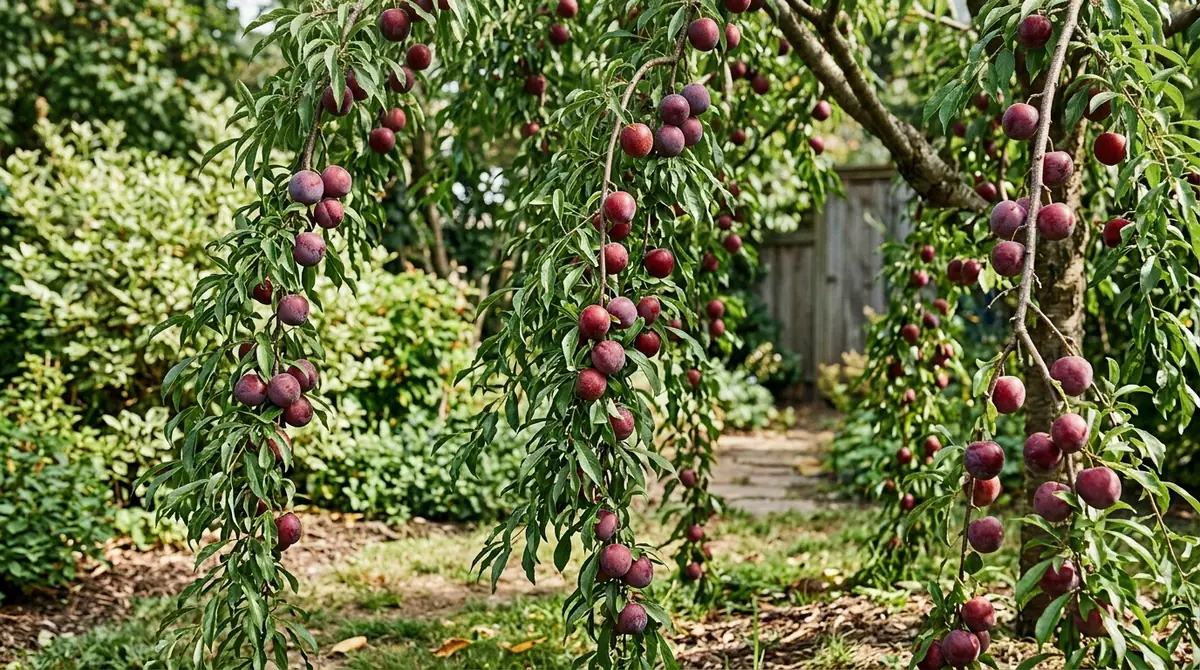
I still vividly remember standing in a gardener's courtyard in Sonoma County back in 2014, staring in disbelief at a weeping Santa Rosa plum tree that looked like a cascading waterfall of edible ruby-red jewels. The homeowner had tried treating it like a standard upright fruit tree, topping the weeping branches out of sheer habit, and had inadvertently destroyed its exquisite, umbrella-like silhouette. I spent the next two hours coaching them through corrective pruning, teaching them how to honor the tree's natural pendulum-like growth habit while maximizing sunlight penetration for maximum fruit yield. That afternoon cemented my obsession with the weeping Santa Rosa plum—a breathtaking cultivar that marries ornamental landscape drama with the legendary, sweet-tart fruit quality of the classic upright parent. I have since specified this tree in dozens of high-end residential designs, learning its quirks, its hunger for specific soil amendments, and its distinct pruning requirements through hands-on field experience.
1. Botanical Overview & Natural Habitat

Botanically, it belongs to the Rosaceae family. The foliage emerges in early spring as vibrant, light-green lanceolate leaves, maturing to a rich dark green before offering brilliant golden-yellow tones in autumn. Before the leaves fully unfurl, the tree bursts into a dense cloud of fragrant, stark-white blossoms that provide an invaluable early-season forage source for native pollinators and honeybees.
In terms of landscape utility, it functions brilliantly as a living sculpture. When designing outdoor living spaces, I often utilize it as a dramatic focal point or pair it with low-growing perennials, keeping in mind the lessons outlined in my guide on creative landscaping ideas around tree roots to ensure the root zone remains healthy and unburdened by heavy turf. The fruit that follows the spring bloom is identical to the classic Santa Rosa: clingstone drupes measuring roughly 2 to 2.5 inches (5 to 6 cm) in diameter, featuring purplish-red skin dusted with pale dots and translucent, amber-pink flesh that is intensely aromatic, sweet at the skin, and delightfully tart near the pit.
2. Essential Environmental & Care Requirements
To successfully cultivate a weeping Santa Rosa plum, you must match its physiological needs with your local climate and garden microclimate. While it is remarkably resilient, it demands specific environmental parameters to thrive and produce heavy crops of high-quality fruit.
| Parameter | Optimal Condition | Common Mistake | Why It Matters |
|---|---|---|---|
| Hardiness Zones | USDA Zones 5 through 9 | Planting in zones with extreme, unbuffered winter lows | Extreme sub-zero temperatures can damage graft unions and kill flower buds. |
| Chill Hours | 300 to 400 hours below 45°F (7°C) | Planting in frost-free subtropical climates | Insufficient winter chilling prevents proper dormancy break, resulting in poor blooming and fruiting. |
| Sun Exposure | Full sun (minimum 6 to 8 hours of direct light daily) | Shading under larger canopy trees | Lack of sunlight reduces sugar content in fruit and invites fungal pathogens. |
| Soil pH | 6.0 to 7.0 (slightly acidic to neutral) | Planting in heavy, compacted clay without amendments | Poor drainage leads directly to root rot and oxygen starvation. |
| Watering Depth | 12 to 18 inches (30 to 45 cm) per irrigation event | Frequent, shallow surface watering | Deep watering forces roots downward, enhancing drought tolerance and structural stability. |
Soil preparation is non-negotiable. This tree detests "wet feet." If your native garden soil is heavy clay, you must amend the planting hole extensively with organic compost and ensure proper grading to divert standing water away from the trunk. For regional specificities on fruit tree care, I frequently consult the UC Master Gardener Program Guidelines, which offers exceptional, science-based advice on stone fruit management.
💡 Pro-Tip: When selecting your weeping Santa Rosa plum at the nursery, inspect the graft union located at the top of the trunk. Ensure it is completely healed, smooth, and free of oozing sap or swelling galls, as a compromised graft is the number one cause of sudden tree failure in weeping stone fruit cultivars.
3. Step-by-Step Cultivation, Feeding & Propagation
Establishing a weeping Santa Rosa plum requires precision. Because this tree is a grafted specimen, the placement of the root collar and the maintenance of the weeping canopy dictate its long-term health. Follow this strict step-by-step protocol for planting and early establishment:
- Site Selection and Soil Testing: Choose a full-sun location with well-draining soil. Test the soil pH to ensure it falls between 6.0 and 7.0. Clear all grass and weeds in a 4-foot (1.2 meter) circle around the planting site to eliminate root competition.
- Digging the Planting Hole: Dig a hole 3 times wider than the nursery container, but no deeper than the root ball itself—typically 12 to 18 inches (30 to 45 cm). The top of the root ball must sit 1 to 2 inches (2.5 to 5 cm) above the surrounding grade to account for natural settling.
- Positioning the Tree: Center the tree in the hole. Ensure the graft union faces away from prevailing high winds to prevent strain on the structural joint.
- Backfilling: Backfill with a 50/50 mix of native soil and aged organic compost. Tamp down gently with your hands or boots every 6 inches (15 cm) to eliminate large air pockets without compacting the soil excessively.
- Initial Deep Watering: Build a 3-inch (7.5 cm) high soil basin in a circle around the outer edge of the root ball. Slowly saturate the root zone with 10 to 15 gallons (38 to 56 liters) of water to settle the soil particles around the roots.
- Mulching: Apply a 3-inch (7.5 cm) layer of organic wood mulch across the root zone to conserve moisture and regulate soil temperature. Keep the mulch strictly pulled back 4 inches (10 cm) away from the trunk bark to prevent collar rot.
- Staking and Structural Support: Install two low, flexible nursery stakes parallel to the root ball for the first 12 months if the trunk exhibits significant whip-like movement in high winds. Avoid tying the trunk rigidly; allow slight sway to encourage trunk caliper thickening.
Feeding should be approached conservatively. Apply a balanced, slow-release organic fruit tree fertilizer in early spring just as bud break occurs. Avoid high-nitrogen synthetic fertilizers, which trigger a flush of succulent, disease-prone vegetative growth at the expense of fruit production. For broader insights into maintaining tree health and vigor across diverse species, review my detailed guide on the total guide to moringa why you should grow the miracle tree or drumstick vegetable.
4. Common Problems, Pests & Troubleshooting
Even with meticulous care, stone fruit trees face periodic threats from pests and environmental pathogens. Recognizing symptoms early is the key to preventing catastrophic crop loss or tree decline.
Fungal Pathogens
Brown rot (Monilinia fructicola) is the most pervasive enemy of the weeping Santa Rosa plum. It attacks blossoms during damp spring weather, turning them brown and gummy, and later infects maturing fruit with concentric rings of tan spores. To combat this, remove all mummified fruit left on the branches or ground over winter. For comprehensive diagnostic strategies and organic fungicide treatments, reference my dedicated breakdown on how to identify and treat common fruit tree diseases.
Insect Pests
Aphids and peach twig borers frequently target the tender new growth of Japanese plums. Aphids cause leaves to curl downward, secreting sticky honeydew that attracts ants and fosters black sooty mold. Spray infested branch tips with horticultural oil in late winter to smother overwintering eggs, or release beneficial ladybugs and lacewings during the active growing season.
⚠️ Important Caution: Never prune your weeping Santa Rosa plum during wet autumn or winter rainstorms. Pruning wounds left exposed to moisture during rainy periods act as an open doorway for bacterial canker (Pseudomonas syringae), which can rapidly girdle branches and kill major sections of the weeping canopy. Always prune in late spring or dry summer weather.

5. Frequently Asked Questions
Can I grow a weeping Santa Rosa plum tree in a container on my patio?
Yes, absolutely. Because the tree is top-grafted onto dwarfing or semi-dwarfing rootstock, it adapts exceptionally well to large containers. Select a container with a minimum diameter and depth of 24 inches (60 cm) to accommodate the root system. Ensure the container has multiple drainage holes, and use a high-quality, fast-draining potting mix blended with perlite. Keep in mind that potted fruit trees require more frequent irrigation and annual top-dressing with fresh compost.
How do I prune a weeping fruit tree without ruining its shape?
Pruning a weeping form requires a mindset opposite to that of upright trees. Your goal is not to clear the center for light, but to maintain the graceful curtain of branches. Annually remove the "3 Ds": dead, damaged, and diseased wood. Next, trim any vigorous, upright-growing shoots (water sprouts) that occasionally erupt from the top of the graft union, as these will sap energy from the weeping branches. Finally, thin out crossing or overcrowded weeping branches to ensure good air circulation through the interior canopy, and trim any branches touching the ground to prevent soil-borne fungal splash.
Does the weeping Santa Rosa plum need a cross-pollinator to produce fruit?
The weeping Santa Rosa plum is classified as partially self-fertile, meaning it will produce a modest crop of fruit entirely on its own. However, for maximum fruit yield and commercial-grade harvests, planting a compatible cross-pollinator nearby is strongly recommended. Ideal pollination partners include other Japanese plum varieties that bloom at the same time, such as 'Beauty', 'Mariposa', or standard 'Santa Rosa', planted within 50 feet (15 meters) to facilitate honeybee flight paths.
How long does it take for a newly planted tree to bear its first fruit?
When starting with a standard 1-year or 2-year nursery whip or potted specimen, you can typically expect your first light crop of plums in year two or three. Full commercial bearing capacity—where the weeping branches are heavy enough to sway gracefully under the weight of the fruit—is usually achieved by years four through five, provided the tree receives consistent watering, annual fertilization, and adequate sunlight.
Related Guides
- Weeping Larch Tree
- Will a Lemon Tree Survive Winter
- Money Tree New Leaves Drooping
- Why is My Money Tree Drooping
- Why is My Money Tree Dropping Leaves
- What is the Drip Line of a Tree
- Grafted Avocado Tree
- Colvilles Glory Tree Colvillea Racemosa Growing Guide
📋 Table of Contents ▼ Click to expand
Tags:
Keep reading
🌿 Related Plants You Might Like






PlantSavvyWorld
Editorial team
PlantSavvyWorld is an independent botanical education project. Articles are drafted with AI assistance, then edited and checked against university extension services, botanical garden collections and other published horticultural sources.