

Weeping Larch Tree
Written with AI assistance, edited and checked against horticultural sources.
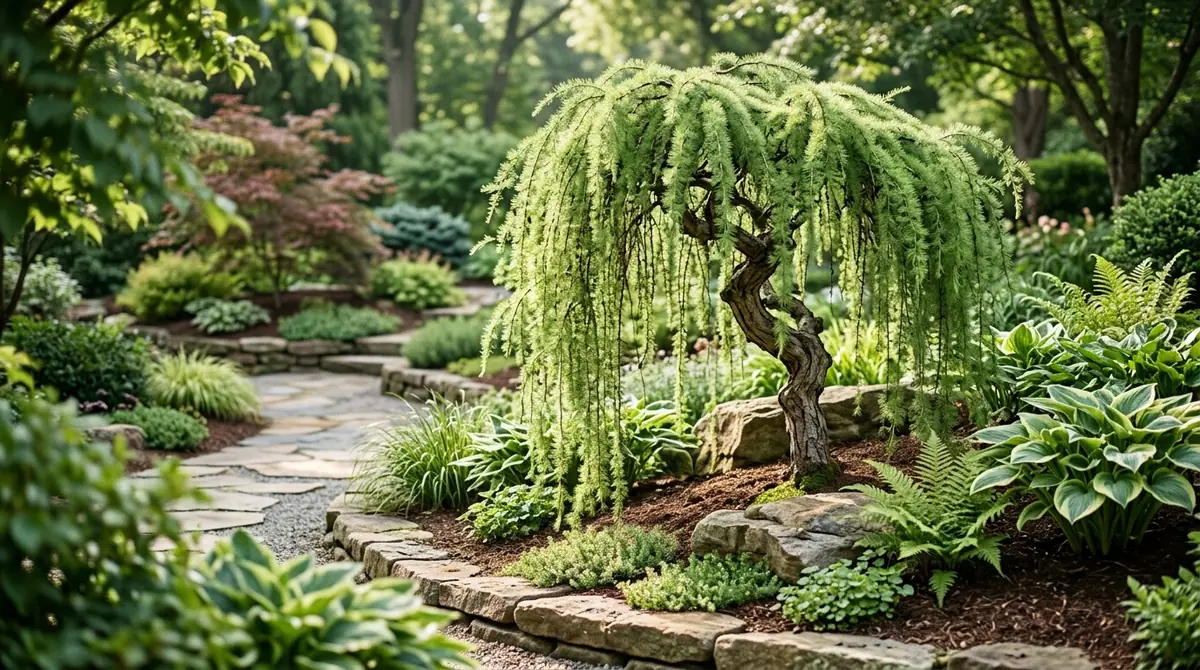
I first encountered Larix decidua 'Pendula' on a biting cold November morning in a gardener's neglected courtyard garden. Every other plant around it wore the dead, static brown of late autumn, but this architectural cascade of naked, pendulous branches looked like a piece of living ironwork against the frost. When spring arrived, those same weeping switches burst into a haze of electric-green needles, only to drop them again in October after turning a brilliant, buttery gold. Working with deciduous conifers requires a shift in how you look at garden design, and the weeping larch is the crown jewel of that botanical contradiction.
1. Botanical Overview & Natural Habitat

In cultivation, the weeping larch is almost always a grafted specimen. Growers take scion wood of a weeping cultivar and graft it onto a straight rootstock of European or Japanese larch at a specific height, usually ranging from 4 to 8 feet (1.2 to 2.4 meters). Because the trunk height is fixed at the point of the graft, your tree will not grow taller; instead, the weeping branches cascade downward, pooling on the ground or weeping gracefully over retaining walls.
The needles emerge in soft, densely packed clusters (fascicles) numbering 30 to 40 per spur, measuring approximately 1 to 1.5 inches (2.5 to 3.8 cm) in length. They emerge a vibrant, fresh spring green, darken slightly through summer, and ignite into a rich golden-yellow before abscising in late autumn. Small, attractive pinkish-red female strobili (cones) appear in spring alongside the new needles, maturing into woody, 1-inch (2.5 cm) brown cones that often persist on the tree through winter.
For those expanding their architectural repertoire beyond conifers, pairing your larch with structural marvels like the Colvilles Glory Tree Colvillea Racemosa Growing Guide can create striking seasonal contrasts in larger mixed borders.
2. Essential Environmental & Care Requirements
Understanding the native sub-alpine habitat of the weeping larch dictates how you must treat it in a domestic landscape. These trees detest stagnant heat, heavy clay, and atmospheric pollution.
| Parameter | Optimal Condition | Common Mistake | Why It Matters |
|---|---|---|---|
| Sunlight | Full sun (6 to 8+ hours daily) | Planting in partial or heavy shade | Reduces needle density, fades autumn color, and invites fungal pathogens. |
| Soil Type | Loamy, sandy, well-draining soil | Heavy, waterlogged clay soils | Larch roots rot quickly in standing moisture; they require consistent aeration. |
| Soil pH | Slightly acidic to neutral (6.0 to 7.0) | Highly alkaline or severely acidic extremes | Locks out vital micronutrients, stunting shoot extension. |
| Watering | 1 inch (2.5 cm) of water weekly during establishment | Frequent, shallow surface watering | Encourages shallow root development instead of deep, drought-resilient anchoring. |
| Hardiness | USDA Zones 2 through 6 (potentially 7 with cool summers) | Planting in USDA Zones 8–10 | Larches require winter chill hours to reset their dormancy cycle; intense southern heat causes dieback. |
💡 Pro-Tip: When planning your landscape layout around a weeping larch, remember that its naked winter silhouette requires careful foreground and background placement. Avoid placing it against busy, competing structures; instead, let it stand clear against an evergreen backdrop or an open lawn where its cascading habit can cast dynamic shadow patterns. If you are struggling with ground treatments beneath its weeping skirt, consider reviewing strategies for Creative Landscaping Ideas Around Tree Roots to prevent compaction and root suffocation.
3. Step-by-Step Cultivation, Feeding & Propagation
Planting a container-grown or balled-and-burlapped weeping larch requires precision, as grafted trees are vulnerable to transplant shock and stem damage at the union point.
- Select and Prepare the Site: Choose an open, sunny spot with excellent natural drainage. Dig a hole 2 to 3 times wider than the root ball, but crucially, keep the depth equal to the height of the root ball so the top of the root mass sits 1 to 2 inches (2.5 to 5 cm) above the surrounding soil grade. Never bury the graft union.
- Incorporate Minimal Amendments: Slide the tree out of its container and gently tease out any circling roots. Backfill with native soil rather than heavy compost; amending the planting hole too richly creates a "bathtub effect" that traps water around the roots.
- Establish Initial Irrigation: Saturate the root zone thoroughly with 5 gallons (19 liters) of water immediately after backfilling. Apply a 3-inch (7.6 cm) layer of organic wood mulch in a wide circle, keeping the mulch pulled 4 inches (10 cm) away from the trunk to prevent collar rot.
- Implement a Watering Schedule: Provide 1 inch (2.5 cm) of water per week for the first growing season (approximately 120 days). Reduce frequency once established, though mature trees still require deep soakings during prolonged summer droughts.
- Manage Spring Nutrition: Apply a balanced, slow-release granular fertilizer formulated for trees and shrubs just as the buds begin to swell in early spring (typically March or April in USDA Zone 5). Avoid high-nitrogen fertilizers, which trigger soft, susceptible stem flushes.
- Prune and Train for Shape: Perform structural pruning strictly in late winter while the tree is completely dormant. Remove any crossing branches, dead wood, or rogue vertical shoots (water sprouts) that attempt to grow from the weeping canopy. If you want to train the central leader higher, stake a vigorous young upright shoot vertically until it reaches your desired height, keeping in mind the original graft height remains fixed.
⚠️ Important Caution: Never remove the lower "skirt" of branches unless they are diseased or dead, simply to clear the ground. The weeping architecture of Larix decidua 'Pendula' relies on these cascading sweeps pooling on the turf or mulch. Over-lifting or "limbing up" a weeping larch destroys its natural aesthetic, leaving an awkward umbrella shape rather than a graceful cascade.
4. Common Problems, Pests & Troubleshooting
Even with meticulous care, weeping larches can occasionally succumb to environmental stressors or opportunistic insects. Because larches drop their needles naturally every autumn, beginners frequently panic in October, mistaking normal golden dormancy for a fatal disease. Check the twigs: if buds are plump and green beneath the bark, your tree is simply preparing for winter.
True issues, however, require swift identification:
- Larch Sawfly (Pristiphora erichsonii): The larvae of this pest feed gregariously on emerging needles in late spring, capable of defoliating a tree within weeks. Look for clustered caterpillars with black heads. Handpick light infestations or apply targeted treatments using Bacillus thuringiensis (Bt) or spinosad.
- Larch Casebearer (Coleophora laricella): Tiny larvae mine inside the needles, causing them to turn brown and hollow out in spring. Manage by applying dormant horticultural oils in early spring before bud break to smother overwintering larvae.
- Phytophthora Root Rot: Caused by poor drainage and heavy soils. Symptoms include premature needle drop, sparse spring flush, and dark, water-soaked inner bark at the root crown. Prevent this entirely by avoiding waterlogged sites; once established, root rot is exceedingly difficult to reverse. For broader insight into managing fungal and environmental blights on woody plants, consult resources on How to Identify and Treat Common Fruit Tree Diseases.
- Sunscald: Young grafted specimens with thin bark can suffer from winter sunscald when freezing daytime temperatures are followed by sharp nighttime drops. Wrap vulnerable trunks in white tree wrap from November through March.

5. Frequently Asked Questions
Will a weeping larch stay the same height forever?
Yes. Because the weeping form is created by grafting a pendulous scion onto a standard rootstock at a specific height (typically 4 to 8 feet / 1.2 to 2.4 meters), the trunk will not grow taller. The canopy will widen and pool on the ground over time, but the vertical height of the tree is permanently locked at the point of the original graft union.
Why are my weeping larch needles turning brown in the summer?
Summer browning usually indicates drought stress, root damage, or pest activity such as the larch casebearer. Larches require consistent moisture during hot weather. If the soil has dried out completely, needles will scorch, turn brown, and drop prematurely. Deeply soak the root zone and check for tiny caterpillars or needle miners.
Do I need to rake up the fallen needles in autumn?
While you do not strictly have to rake them up, clearing fallen larch needles from your lawn is recommended. Larch needles form a dense mat as they decompose, which can smother underlying turfgrass. However, you can easily sweep them up and add them to your compost pile, where they break down nicely alongside other organic garden waste.
Can I grow a weeping larch in a container on my patio?
You can successfully grow a weeping larch in a large container (minimum 20-gallon / 75-liter capacity with excellent drainage holes) for several years. Ensure you use a high-quality, bark-based potting mix rather than garden soil. Keep in mind that container-grown trees are more vulnerable to freeze-thaw cycles in winter; protect the pot with insulation or move it to a sheltered microclimate if you garden in USDA Zone 3 or colder.
For additional horticultural references on deciduous conifers and arboriculture standards, explore the resources provided by the Royal Horticultural Society.
Related Guides
- Weeping Santa Rosa Plum Tree
- Will a Lemon Tree Survive Winter
- Money Tree New Leaves Drooping
- Why is My Money Tree Drooping
- Why is My Money Tree Dropping Leaves
📋 Table of Contents ▼ Click to expand
Tags:
Keep reading
🌿 Related Plants You Might Like






PlantSavvyWorld
Editorial team
PlantSavvyWorld is an independent botanical education project. Articles are drafted with AI assistance, then edited and checked against university extension services, botanical garden collections and other published horticultural sources.