

How to Know If a Palm Tree is Dead
Written with AI assistance, edited and checked against horticultural sources.
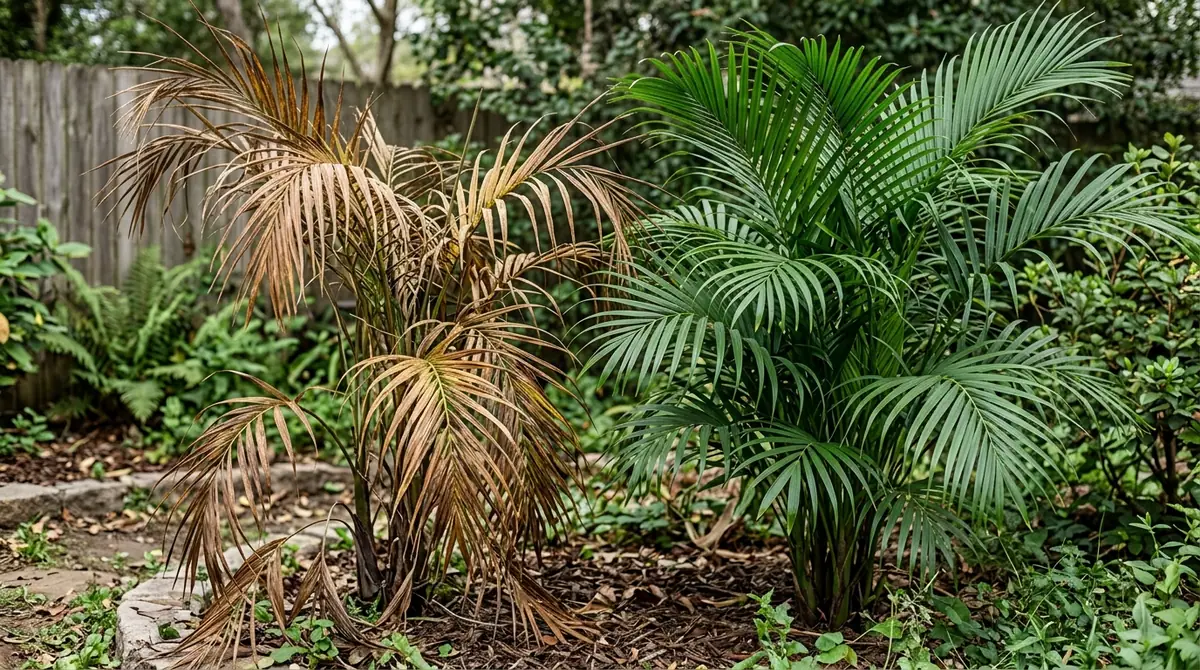
Standing at the edge of a gardener's sprawling South Florida courtyard three years ago, I stared up at what they swore was a completely dead Royal Palm (Roystonea regia). Its fronds hung limp and brown like a wet broom, and the neighborhood association was already threatening fines for a perceived eyesore. But when I reached up to slice open the base of the crown shaft with my hori-hori knife, I found firm, creamy-white tissue and a faint, sweet smell of living sap. That palm is still shading their patio today. Diagnosing a palm tree requires looking past cosmetic distress to assess the single growth point that dictates life or death: the apical meristem. Here is how you can accurately determine whether your palm tree is past saving or simply fighting for its life.
1. Botanical Overview & Natural Habitat

This structural difference changes everything about how a palm grows and how it dies. If a dicot loses half its bark or experiences trunk damage, it can often compartmentalize the wound and generate new wood around it. If a palm’s single apical meristem is destroyed by freezing temperatures, systemic fungal pathogens, or mechanical trauma, the entire tree will die, even if its lower trunk remains completely upright and green for months.
Understanding this botanical reality helps explain why drooping, yellowing fronds do not automatically mean your palm is dead. Fronds are merely disposable solar panels. A palm will readily sacrifice its oldest fronds—shedding them naturally or drawing mobile nutrients out of them during times of environmental stress—while protecting its central spear leaf.
Natural habitats for palms range from the humid tropical rainforests of Southeast Asia to arid desert oases and coastal salt-spray zones. Many species, such as the Date Palm (Phoenix dactylifera), evolved in regions with extreme temperature swings and minimal rainfall, developing deep root systems and waxy frond cuticles to minimize transpiration. Others, like the Royal Palm, thrive in swampy muck where soil saturation is constant. When we transplant these diverse species into suburban landscapes, our primary job as designers is to mimic these native parameters as closely as possible. When parameters fail, the palm falters, often masquerading as dead when it is merely dormant or severely stressed.
2. Essential Environmental & Care Requirements
To prevent misdiagnosing a stressed palm as a dead one, you must understand the exact environmental thresholds that keep these monocots alive. Palms are notoriously sensitive to minor shifts in soil chemistry, irrigation volume, and thermal minimums.
Temperature thresholds are the most common culprit behind sudden palm decline. While cold-hardy species like the Windmill Palm (Trachycarpus fortunei) can withstand freezing temperatures down to 10°F (-12°C), tropical favorites like the Coconut Palm (Cocos nucifera) suffer irreversible cell damage and terminal bud rot when exposed to temperatures below 30°F (-1°C) for more than a few hours.
| Parameter | Optimal Condition | Common Mistake | Why It Matters |
|---|---|---|---|
| Soil Drainage | Highly porous, sandy loam with rapid percolation | Planting in heavy, compacted clay that retains water | Waterlogged roots quickly succumb to Phytophthora and Thielaviopsis root rot fungi. |
| Irrigation Volume | Deep watering every 7 to 10 days once established | Frequent, shallow sprinkling that wets only the topsoil | Shallow watering encourages surface root development, leaving the plant vulnerable to drought and tip-over. |
| Nutrient Balance | 8-2-12 + 4Mg slow-release palm specialty fertilizer | Using high-nitrogen lawn fertilizer with zero micronutrients | High nitrogen causes rapid, weak growth that strips the palm of vital potassium, leading to deficiency necrosis. |
| Planting Depth | Root flare completely flush or slightly above soil grade | Burying the root ball too deep ("volcano mulching") | Deep planting suffocates the trunk base, inviting collar rot and sealing off oxygen to upper roots. |
Soil nutrition is another frequent battleground. Unlike broadleaf trees that can extract micronutrients from a wide soil footprint, palms require a steady supply of potassium, magnesium, manganese, and iron. Potassium deficiency is often mistaken for drought stress or lethal fungal infections; older fronds turn yellow with necrotic tip spotting, and the deficiency steadily marches upward toward the crown. If you mistake this for a dead tree and rip it out, you are discarding a plant that simply needed a targeted dose of soluble potassium sulfate. For broader insights into how woody plants handle structural stress, consult this guide on creative landscaping ideas around tree roots.
3. Step-by-Step Cultivation, Feeding & Propagation
When you suspect a palm is dead, you must perform a systematic diagnostic protocol before reaching for the chainsaw. Never judge a palm solely by the color of its canopy.
- Perform the Visual Canopy Scan: Look directly at the center of the crown where new fronds emerge. Locate the newest, unopened spear leaf. If the spear leaf is standing erect, firm, and green, the apical meristem is alive. If the spear leaf is brown, shriveled, and leans at an unnatural angle, proceed to the next step.
- Execute the Pull Test: Grasp the central spear leaf firmly with your gloved hand and give it a steady, moderate tug. If the spear leaf resists or remains firmly anchored inside the crown shaft, the meristem is alive, and the tree is recovering from shock. If the spear leaf slides out effortlessly like a wet cigar, accompanied by a foul, rotting odor, the meristem is dead.
- Inspect the Trunk Tissue: If the pull test is inconclusive, use a clean, sharp blade to make a shallow, horizontal nick (no deeper than 0.5 inches or 1.3 cm) into the outer trunk tissue or crown shaft. Healthy tissue will be moist, white, or light green. Dead tissue is dark brown, black, spongy, or dry and hollow.
- Examine the Root Zone: Dig down 4 to 6 inches (10 to 15 cm) at the drip line of the palm. Healthy palm roots are thick (typically pencil-thick or thicker), white, or light tan, and firm to the touch. Roots that are paper-thin, brown, black, and slough off their outer cortex when touched indicate advanced root rot.
- Evaluate Environmental History: Review the past 30 days. Did the area experience a hard frost below your hardiness threshold? Was there a construction project that severed major lateral roots? Correlating physical symptoms with timeline triggers prevents premature disposal.
💡 Pro-Tip: When performing the pull test, a slight slide does not always mean total death. If the pulled spear is green and firm at its base where it detached, spray a copper-based fungicide down into the empty cavity immediately. This kills the opportunistic bacteria thriving in the damp cavity and frequently saves palms that would otherwise rot from the top down.
For those interested in diversifying their tropical landscape with other resilient species, consider exploring the Colvilles Glory Tree Colvillea Racemosa Growing Guide for architectural overhead canopy options.
4. Common Problems, Pests & Troubleshooting
When a palm appears to be dying, the underlying cause is rarely old age. It is typically a pest, a pathogen, or poor cultural practices working in tandem.
⚠️ Important Caution: If you suspect your palm is infected with Fusarium oxysporum or Lethal Yellowing phytoplasma, do not prune green fronds with unsterilized tools. These systemic pathogens are easily transmitted from tree to tree via contaminated saws and pruning shears. Dip all cutting tools in a 10% bleach solution or a quaternary ammonium compound between every single cut.
Fungal pathogens are the leading cause of sudden palm mortality. Thielaviopsis paradoxa causes trunk rot, creating soft, weeping depressions on the trunk that smell faintly of fermented fruit. Once the fungus girdles the trunk or reaches the terminal bud, recovery is impossible. Similarly, Ganoderma butt rot attacks the lower 3 to 4 feet (0.9 to 1.2 m) of the trunk, eventually producing a shelf-like, woody fruiting body known as a conock. If you spot a Ganoderma conk on a landscape palm, the tree is structurally compromised and should be removed promptly to prevent property damage.
Insect pests also mimic terminal decline. The Palm Weevil (Rhynchophorus species) bores deep into the crown shaft, feeding on the tender meristem tissue. By the time you notice yellowing fronds, the larvae have usually tunneled through the growth point.

5. Frequently Asked Questions
Can a palm tree come back to life after all its fronds turn brown?
Yes, absolutely. If the central growing point (the apical meristem) and the newest spear leaf are still firm and green, the palm can survive the complete loss of its older fronds. Palms regularly shed old lower fronds as part of their normal growth cycle or in response to temporary drought and cold stress.
Why is the center of my palm tree mushy and foul-smelling?
A mushy, foul-smelling crown indicates advanced bud rot, usually caused by Phytophthora fungi or bacteria that entered the meristem following freeze damage or heavy rain. When standing water collects in the tight leaf axils of a stressed palm, pathogens multiply rapidly, liquefying the tender growth tissue. If the center pulls out easily with a foul odor, the tree cannot recover and must be removed.
How long does it take for a dying palm tree to show symptoms?
The timeline depends heavily on the stressor. Cold damage often manifests as wilting and browning within 48 to 72 hours of a hard freeze. Conversely, systemic fungal infections like Ganoderma or nutritional deficiencies like severe potassium depletion can take 3 to 12 months of slow, progressive decline before the canopy collapses entirely.
Is it safe to leave a dead palm tree standing in the yard?
No. Standing dead palms pose a severe safety hazard. Once the trunk tissue dies and dries out, or conversely, becomes waterlogged and rotted from the inside, the structural integrity fails rapidly. Palms do not decay slowly like hardwood trees; they tend to snap abruptly under moderate wind loads or collapse vertically into themselves. For guidelines on removing or repurposing woody plants safely, reference resources like the Royal Horticultural Society (RHS) for expert arboricultural pruning and removal standards.
Related Guides
- How to Remove Palm Tree Stump
- How to Know When a Verruca is Dying
- Will a Lemon Tree Survive Winter
- Money Tree New Leaves Drooping
- Why is My Money Tree Drooping
- Zuni Crape Myrtle Tree
- Weeping Larch Tree
- Cinnamon Tree Care
📋 Table of Contents ▼ Click to expand
Tags:
Keep reading
🌿 Related Plants You Might Like
PlantSavvyWorld
Editorial team
PlantSavvyWorld is an independent botanical education project. Articles are drafted with AI assistance, then edited and checked against university extension services, botanical garden collections and other published horticultural sources.