

How to Remove Palm Tree Stump
Written with AI assistance, edited and checked against horticultural sources.

1. Botanical Overview & Natural Habitat
To remove a palm stump, you must first understand why it behaves the way it does. Palms belong to the family Arecaceae, order Arecales, and are monocotyledons (monocots), making them closer cousins to grasses and lilies than to traditional hardwood trees.
Unlike dicot trees, palms lack a vascular cambium layer and do not produce true wood, rings, or secondary growth. Instead, a palm trunk is composed of primary vascular bundles embedded in a spongy, fibrous parenchymatous matrix. When a palm is cut down, this matrix does not rot quickly via traditional fungal wood-decay processes. Furthermore, palm root systems are entirely adventitious. They do not have a central taproot or lateral woody roots that taper down; instead, thousands of uniform, fibrous roots—typically measuring between 0.2 inches to 0.6 inches (0.5 cm to 1.5 cm) in diameter—emerge directly from the base of the stem (the root initiation zone), spreading outward up to 50 feet (15 meters) and downward to depths of 3 feet to 36 inches (90 cm) depending on the species.
In their natural tropical and subtropical habitats—ranging from humid coastal strands to arid desert oases—palms evolved this fibrous root architecture to anchor themselves against hurricane-force winds and absorb moisture rapidly across sandy or porous soils. When severed, these roots do not resprout new shoots (unlike hardwood stumps that send up suckers), but the massive underground root mass retains enormous amounts of moisture, making the stump heavy, dense, and remarkably resilient against standard decay.
2. Essential Environmental & Care Requirements
When managing a landscape that has recently featured a palm tree, or preparing the site for new plantings, understanding the environmental conditions of the stump zone is critical. Decaying palm root masses change soil dynamics dramatically.
| Parameter | Optimal Condition | Common Mistake | Why It Matters |
|---|---|---|---|
| Soil Moisture | 40% to 60% volumetric water content | Saturating the area to "rot" the stump | Excess water attracts vector pests like mosquitoes and accelerates anaerobic rot without breaking down the dense fibers. |
| Soil pH | 6.0 to 7.5 | Adding extreme acidic amendments | Palms prefer neutral to slightly alkaline soils; radical pH swings stunt subsequent plantings in that footprint. |
| Temperature | 70°F to 95°F (21°C to 35°C) | Attempting chemical rotting in winter | Biological decomposition slows down dramatically below 55°F (13°C). |
| Excavation Depth | 12 to 24 inches (30 to 60 cm) | Shallow surface scraping | Leaves behind dense root mats that interfere with future landscaping and utility trenching. |
For gardeners looking to transition their tropical spaces into diverse food forests or alternative botanical setups, understanding plant health is vital—much like maintaining crops detailed in our Total Guide to Moringa Why You Should Grow the Miracle Tree or Drumstick Vegetable.
💡 Pro-Tip: Never attempt to burn a palm stump using chemical accelerants like gasoline or kerosene. Because palm trunks are packed with silica and dense fibers, they do not burn clean like hardwood; instead, they smolder for days, creating subterranean fire pockets that can ignite surrounding organic matter and ruin your soil microbiome.
3. Step-by-Step Cultivation, Feeding & Propagation
While we aren't growing the palm here, we are dismantling its remnants. Removing a palm stump requires the right sequence of mechanical or biological steps. Below is the field-tested protocol for complete extraction.
- Assess the Stump Size and Species: Determine the diameter of the stump. Smaller species like the Pygmy Date Palm (Phoenix roebelenii) can be removed manually, whereas massive Canary Island Date Palms (Phoenix canariensis) or Washingtonias require mechanical intervention or professional grinding.
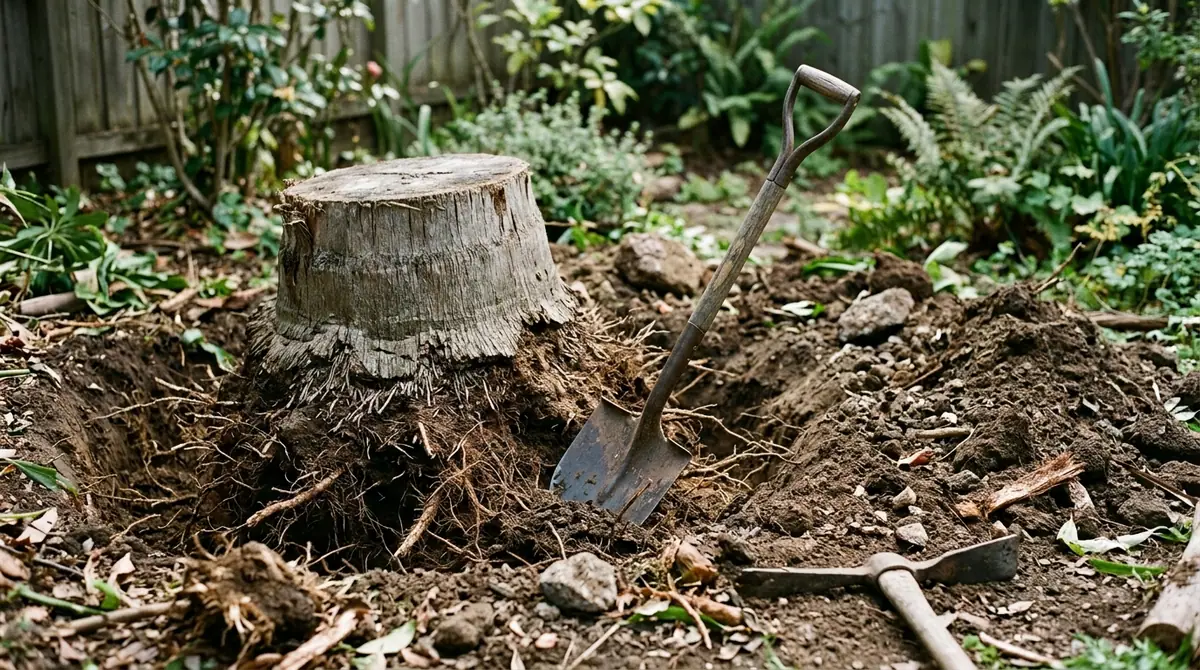
- Clear the Surrounding Soil: Using a sharp shovel and a mattock, dig a trench 12 inches (30 cm) deep around the perimeter of the stump, clearing away dirt to expose the upper root collar and primary root insertion points.
- Sever the Root Ball Connections: Use a reciprocating saw with a demolition blade or a sharp axe to cut through the radiating fibrous roots approximately 6 inches to 12 inches (15 cm to 30 cm) away from the main trunk base.
- Deploy Mechanical Leverage or Grinding:
- Option A (Grinding): Rent a dedicated stump grinder. Grind the palm stump down to at least 12 inches (30 cm) below grade. Note: Keep your grinder teeth moving steadily, as palm fibers tend to shred rather than chip cleanly.
- Option B (Manual/Winching): If the stump is small to medium, attach a heavy-duty chain to the base and use a high-capacity truck winch or farm jack to pull the root ball upward while severing remaining downward roots with a sharpened spade.
- Manage the Residual Cavity: Fill the resulting hole with a 50/50 mix of native topsoil and coarse compost. Tamp it down in 6-inch (15 cm) lifts to prevent major settling over the next 30 to 60 days.
For those interested in branching out into other exotic landscape specimens once the space is cleared, consult resources on unique trees like the Colvilles Glory Tree Colvillea Racemosa Growing Guide. Furthermore, if your garden planning involves other woody plants, always screen for pathogens by reviewing guidelines on How to Identify and Treat Common Fruit Tree Diseases.
⚠️ Important Caution: Palm fibers are exceptionally stringy and will quickly clog or bind standard chainsaw chains if you attempt to cut the stump flush at ground level using a standard timber saw. Always use specialized carbide-tipped blades or a dedicated stump grinder to avoid dangerous kickbacks.
4. Common Problems, Pests & Troubleshooting
When a palm stump is left to decay naturally in a landscape, it frequently becomes a magnet for secondary issues. Because the spongy parenchymatous tissue retains moisture, it acts as an incubator for pests and pathogens.
- Pest Infestations (Weevils and Beetles): Decaying palm stumps are prime breeding grounds for pests such as the South American Palm Weevil (Rhynchophorus palmarum) and the Palmetto Weevil (Rhynchophorus cruentatus). If left unmanaged, emerging adults will attack nearby healthy palms in your landscape.
- Fungal Proliferation: Saprophytic fungi like Ganoderma species frequently colonize decaying palm root systems. While some are harmless decomposers, certain strains can persist in the soil and attack the root collars of newly planted landscape trees.
- Uneven Ground Settling: As the massive underground network of fibrous roots slowly decomposes over 1 to 3 years, large sinkholes can form in your lawn or garden bed. Always top-dress the area regularly with organic compost to bridge these voids as they appear.

5. Frequently Asked Questions
Will a palm tree stump grow back after you cut it down?
No. Unlike dicot trees that possess a cambium layer capable of producing epicormic shoots and suckers, palms have a single apical meristem (bud) located at the crown. Once the top of the palm and its growing tip are removed, the trunk cannot regenerate new fronds or grow back. The remaining stump will eventually die and decompose.
How long does it take for a palm stump to rot naturally?
A palm stump typically takes anywhere from 3 to 7 years to decompose completely on its own. Because palm trunks are composed of dense, spongy fibers and silica rather than true wood, standard wood-rotting fungi break them down much slower than hardwood tree stumps.
Can I use stump remover chemicals on a palm stump?
Chemical stump removers (which are usually potassium nitrate based) are largely ineffective on palm stumps. These commercial products are designed to accelerate the oxidation and breakdown of lignin-rich hardwood. Because palms lack true wood and lignin, chemical treatments will not speed up the decomposition of palm fibers in any meaningful way.
What is the fastest way to get rid of a palm tree stump?
The fastest and most reliable method is mechanical stump grinding. Renting a commercial-grade stump grinder allows you to reduce the entire root crown and top 12 inches (30 cm) of the root system to wood chips in less than an hour, completely clearing the footprint for immediate replanting or landscaping.
Related Guides
- How to Know If a Palm Tree is Dead
- What to Do After Stump Grinding
- Will a Lemon Tree Survive Winter
- Money Tree New Leaves Drooping
- Why is My Money Tree Drooping
📋 Table of Contents ▼ Click to expand
Tags:
Keep reading
🌿 Related Plants You Might Like






PlantSavvyWorld
Editorial team
PlantSavvyWorld is an independent botanical education project. Articles are drafted with AI assistance, then edited and checked against university extension services, botanical garden collections and other published horticultural sources.