

Money Tree New Leaves Drooping
Written with AI assistance, edited and checked against horticultural sources.
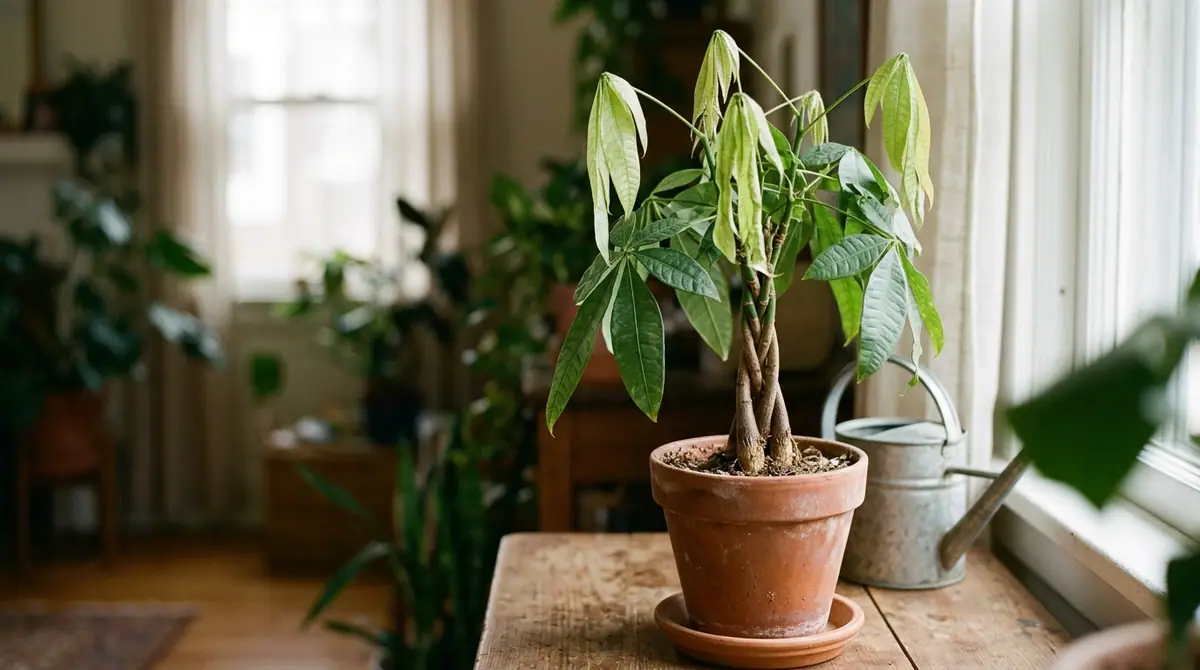
Last Tuesday, a gardener named Sarah texted me a photo of her prized Pachira aquatica, its crown of tender, chartreuse new foliage hanging like wet paper towels. She panicked, assuming the plant was dying. I drove out to her sunlit living room, slid my finger 2 inches (5 cm) into the damp potting mix, and immediately found the culprit: a dense, soggy root zone suffocating from overwatering. Her established leaves were stiff and glossy, but those delicate, emerging shoots dropped first because they lack the thick cuticle layer and carbohydrate reserves of mature foliage. I see this exact panic every spring. Let us examine precisely why your money tree new leaves are drooping and how to restore structural integrity to your plant.
1. Botanical Overview & Natural Habitat

Understanding this wild lineage explains why indoor cultivation is tricky. In the wild, Pachira aquatica grows up to 60 feet (18 meters) tall with a swollen trunk base (a caudex) that stores water to survive periodic droughts between seasonal inundations. When you bring this plant indoors, you isolate a tropical floodplain tree into a climate-controlled room with low humidity and artificial light cycles.
When your money tree grows new leaves, these immature structures require high turgor pressure—the hydrostatic pressure within plant cells against the cell wall—to expand fully and harden. Because new tissue has undeveloped vascular pathways compared to mature leaves, any disruption in water uptake, root health, or ambient humidity manifests instantly as a pathetic, drooping canopy tip. If you are interested in maximizing utility from other resilient plant investments, you might also enjoy reading our guide on Homegrown Vegetables That Save the Most Money.
2. Essential Environmental & Care Requirements
To keep new growth upright and vigorous, you must replicate the optimal microclimate of a Neotropical river basin indoors. The following parameters dictate whether your money tree thrives or struggles.
| Parameter | Optimal Condition | Common Mistake | Why It Matters |
|---|---|---|---|
| Light | 6–8 hours of bright, indirect light | Placing in deep shade or direct scorching sun | Insufficient light halts photosynthesis needed to fuel cell wall hardening in new shoots. |
| Watering | Allow top 2 to 3 inches (5 to 7.5 cm) to dry out completely | Keeping soil constantly soggy or letting it dehydrate for 30+ days | Overwatering rots fine feeder roots, cutting off water supply to emerging, high-demand leaves. |
| Temperature | 65°F to 80°F (18°C to 27°C) | Exposing to drafts below 55°F (13°C) or AC vents | Cold drafts shock juvenile vascular tissues, causing immediate wilting and collapse. |
| Humidity | 50% to 70% relative humidity | Indoor air dropping below 30% in winter | Low humidity pulls moisture from tender new leaves faster than roots can supply it. |
| Soil Mix | Fast-draining peat-perlite-bark blend | Heavy, compacted potting soil holding water | Roots require oxygen; dense soil suffocates them, leading to root rot and top-end drooping. |
💡 Pro-Tip: When checking soil moisture, never rely on a surface glance. Use a wooden chopstick pushed 3 inches (7.5 cm) deep into the pot. If any wet soil or dark dampness clings to the wood when pulled out after 10 seconds, withhold water for another 48 to 72 hours.
For comprehensive botanical insights on tropical tree maintenance, consult the University of Florida IFAS Extension resource library.
3. Step-by-Step Cultivation, Feeding & Propagation
When drooping new leaves signal stress, swift intervention saves the canopy. Follow this precise protocol to diagnose, correct, and nourish your money tree back to health.
- Assess and Unpot: Gently slide the money tree out of its container. Brush away loose soil to inspect the root system. Healthy roots are firm and pale; rotting roots are brown, mushy, and foul-smelling.
- Prune Damaged Tissue: Use sterilized shears (dipped in 70% isopropyl alcohol) to snip away any completely rotted roots. If the drooping new leaves are papery, translucent, or entirely limp, trim them off to redirect energy to healthy secondary nodes.
- Repot in Fresh Substrate: Plant the money tree in a pot with adequate drainage holes, using a mix of 50% high-quality potting soil, 30% perlite or pumice, and 20% orchid bark. Ensure the root flare sits level with the soil surface—never bury the trunk deeper than it was originally grown.
- Flush and Stabilize: Water the newly potted plant thoroughly until water runs freely from the drainage holes, then discard the excess in the saucer. Move the plant to a location receiving bright, indirect light between 70°F and 75°F (21°C to 24°C).
- Establish a Feeding Schedule: Once new, upright growth resumes after approximately 14 to 21 days, apply a balanced, water-soluble houseplant fertilizer (diluted to half-strength) every 4 weeks during the active growing season (spring through summer). Cease fertilization entirely in fall and winter.
⚠️ Important Caution: Never remove the rubber band or tape wrapped around the lower trunks of braided money trees unless you notice it is actively cutting into expanding bark and causing structural girdling. Removing support prematurely can cause the individual stems to flop apart permanently.
If you enjoy cultivating woody, utility-focused species alongside your indoor ornamentals, take a look at our deep dive on the Total Guide to Moringa Why You Should Grow the Miracle Tree or Drumstick Vegetable.
4. Common Problems, Pests & Troubleshooting
Drooping new leaves are a symptom, not a diagnosis. To fix the issue permanently, you must differentiate between watering errors, environmental shocks, and biological infestations.
Root Rot vs. Underwatering
Both conditions cause drooping, but the context differs. Underwatered plants have dry, pulling-away soil and leaves that feel papery and brittle. Overwatered plants feature wet, heavy soil, yellowing lower leaves, and soft, drooping new growth that feels waterlogged. If root rot is present, apply a dilute hydrogen peroxide rinse (1 part 3% hydrogen peroxide to 4 parts water) to the root ball after pruning to oxidize lingering fungal spores.
Pest Pressure
Tender, newly emerged leaves are prime feeding targets for sap-sucking insects like spider mites, scale, and mealybugs. Because these pests inject toxins or drain cell sap, they compromise the structural rigidity of juvenile stems, causing them to twist and droop. Inspect the undersides of leaves and leaf axils with a 10x jeweler's loupe. Wipe infested areas with a microfiber cloth dipped in insecticidal soap or horticultural oil every 7 days for a 21-day cycle.
Environmental Shock
Rapid shifts in temperature—such as placing a money tree near a drafty window in winter or a scorching radiator—cause sudden cellular collapse in expanding shoots. Maintain ambient temperatures above 65°F (18°C) and keep plants away from forced-air heating and cooling vents. For creative ideas on how to incorporate trees and roots into broader interior or exterior designs, explore our guide on Creative Landscaping Ideas Around Tree Roots.

5. Frequently Asked Questions
Why are my money tree's new leaves drooping and turning black?
Black, drooping new leaves almost always indicate severe overwatering or a sudden drop in temperature below 50°F (10°C). When roots suffocate in waterlogged soil, they die back and cannot supply water to the top of the plant. The tender new leaves succumb first, turning black and mushy due to secondary bacterial or fungal infections. Immediately check the roots, prune away black, rotting sections, and repot into dry, well-draining soil.
Should I cut off drooping money tree leaves?
Yes, if the leaves are completely limp, discolored, or mushy. Once a leaf's cellular structure collapses, it will not recover or stand back up. Snip it off cleanly at the base of the petiole using sterilized shears. This prevents the plant from wasting metabolic energy trying to repair non-functional tissue and encourages it to push out a fresh, healthy replacement shoot.
Can low humidity cause a money tree's new growth to droop?
Absolutely. Indoor humidity levels often drop below 30% during winter heating seasons. Because new leaves lack a fully developed waxy cuticle, they lose moisture rapidly through transpiration. If the surrounding air is too dry, water evaporates from the juvenile leaves faster than the roots can deliver it, causing them to droop and curl downward. Increase humidity to 50%–70% using a cool-mist room humidifier.
How often should I water my money tree to prevent drooping leaves?
Water your money tree thoroughly only when the top 2 to 3 inches (5 to 7.5 cm) of soil are completely dry. On average, this translates to every 7 to 14 days during the spring and summer growing season, and every 3 to 4 weeks in the dormant winter months. Always water until liquid drains freely from the bottom of the pot, and never let the pot sit in standing water inside a cachepot.
Related Guides
- Why is My Money Tree Leaves Drooping
- Why is My Money Tree Drooping
- Why is My Money Tree Dropping Leaves
- Homegrown Vegetables That Save the Most Money
- Indoor Plant Leaves Curling Inward
- Weeping Santa Rosa Plum Tree
- Flamin Fury Peach Tree
- Lime vs Lemon Tree
📋 Table of Contents ▼ Click to expand
Tags:
Keep reading
🌿 Related Plants You Might Like



PlantSavvyWorld
Editorial team
PlantSavvyWorld is an independent botanical education project. Articles are drafted with AI assistance, then edited and checked against university extension services, botanical garden collections and other published horticultural sources.