

Why is My Money Tree Leaves Drooping
Written with AI assistance, edited and checked against horticultural sources.
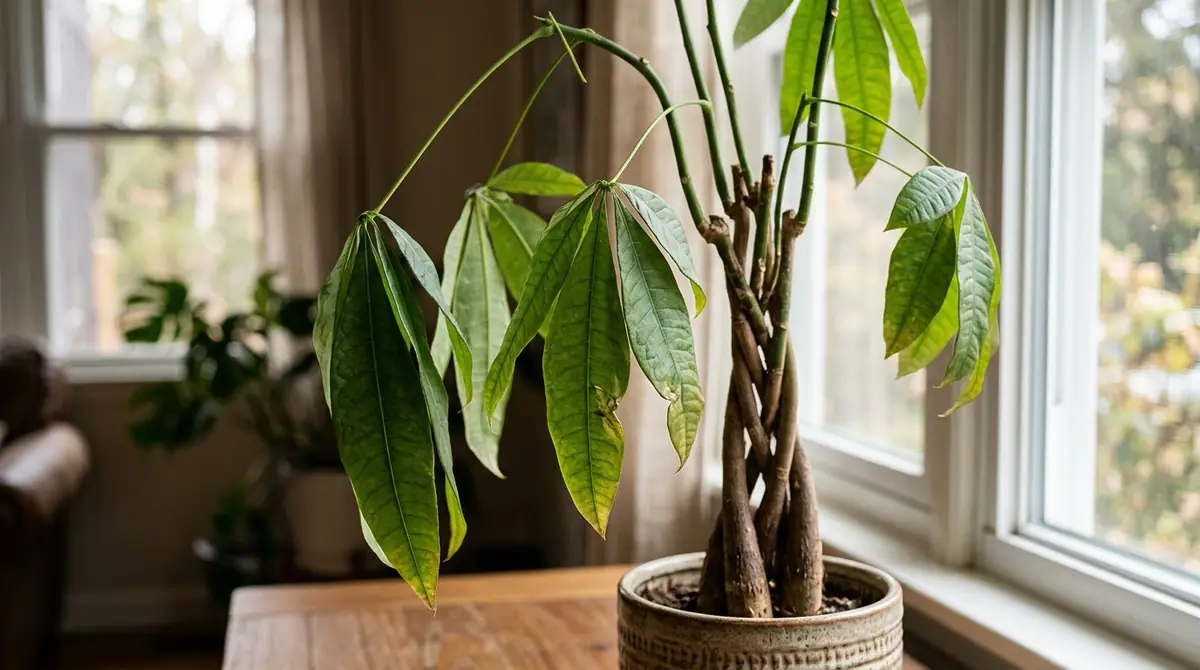
Last Tuesday morning, I walked into my studio workspace and found my largest braided money tree weeping. Its glossy, palmately compound leaves were dangling limply from their stems like damp handkerchiefs. My first instinct, forged by decades of botanical fieldwork, was to check the soil moisture. I sank my index finger 2 inches (5 cm) into the pot. It felt bone dry. But as I lifted the nursery container, I realized the drainage hole was blocked by a compacted plug of root ball and heavy clay soil, causing water to pool invisibly at the absolute bottom of the container. The roots had drowned, suffocated, and rotted—yet the upper foliage was drooping from drought stress because the compromised root system could no longer push water upward.

1. Botanical Overview & Natural Habitat
To understand why your money tree leaves are drooping, you must first understand the native biology of Pachira aquatica, commonly known as the Malabar chestnut, Guiana chestnut, or money tree. Native to the freshwater swamps, floodplains, and wetland riparian zones of Central and South America—stretching from southern Mexico down to northern Brazil—this tropical tree evolved alongside dynamic water cycles.
In its natural habitat, Pachira aquatica experiences seasonal monsoons where its lower trunk and roots are periodically submerged in standing water. However, when planted indoors in containers, these plants face a radically different set of physical laws. While they love moisture, they despise stagnant, anoxic soil that lacks oxygen. The thick, swollen lower trunk—often referred to as a caudex—acts as a natural water-storage vessel, designed to buffer the plant through short dry spells between seasonal floods.
Morphologically, the money tree produces palmate leaves featuring 5 to 7 (and occasionally up to 9) delicate leaflets radiating from a central stem. When turgor pressure inside these cellular structures drops due to water imbalance, temperature shock, or light deprivation, the structural integrity fails, resulting in the characteristic downward droop. If you are comparing indoor tropical care challenges, understanding these survival mechanisms is just as crucial as managing creative landscaping ideas around tree roots outdoors or troubleshooting outdoor crops like why your cucumber leaves are turning yellow and how to fix them. For a deeper dive into the broader classification of tropical specimens, consult the Missouri Botanical Garden Plant Finder.
2. Essential Environmental & Care Requirements
Replicating a Central American floodplain in a modern living room requires precise environmental controls. When any of these parameters shift outside the optimal range, leaf drooping is usually the very first symptom the plant displays.
| Parameter | Optimal Condition | Common Mistake | Why It Matters |
|---|---|---|---|
| Soil Moisture | Dry top 2 to 3 inches (5 to 7.5 cm) before watering | Keeping soil perpetually soggy or bone-dry for weeks | Extremes cause root rot or dehydration, breaking turgor pressure in leaves. |
| Light Exposure | Bright, indirect sunlight (6+ hours daily) | Direct scorching sun or deep, dark corners | Low light halts photosynthesis; harsh sun burns and curls foliage. |
| Temperature | 65°F to 80°F (18°C to 27°C) | Placing near AC vents, heaters, or drafty windows | Thermal shock causes sudden cellular collapse and leaf drop. |
| Humidity | 50% to 60% relative humidity | Dry indoor air from winter heating (below 30%) | Low humidity accelerates transpiration, leading to crispy, drooping tips. |
| Soil Composition | Fast-draining aroid or tropical mix (perlite/bark) | Dense, heavy potting soil retaining water | Suffocates roots and prevents oxygen exchange, leading to pathogen buildup. |
Managing these factors requires attentiveness. For instance, if you are looking to diversify your home growing projects into food production, the meticulous environmental balance required for tropicals mirrors the dedication needed when cultivating homegrown vegetables that save the most money or managing a total guide to moringa why you should grow the miracle tree or drumstick vegetable. For official horticultural guidelines on container-grown tropical trees, you can reference the Royal Horticultural Society (RHS).
3. Step-by-Step Cultivation, Feeding & Propagation
When your money tree is actively drooping, corrective horticultural action must be systematic. Do not guess; follow this step-by-step protocol to diagnose and revive the plant.
- Perform the Finger-Depth Test: Push your index finger 2 to 3 inches (5 to 7.5 cm) deep into the potting medium. If the soil feels wet and heavy at that depth, withhold water immediately. If it feels completely dry and crumbly, underwatering is your culprit.
- Inspect the Drainage and Root System: Gently slide the plant out of its nursery pot. Examine the root mass. Healthy roots are firm, pale, and flexible. Rotted roots are brown, mushy, and emit a sour, anaerobic odor.
- Prune Damaged Tissue: Using sterilized pruning shears (wiped with 70% isopropyl alcohol), trim away any entirely dead, black roots and severely yellowed or limp drooping leaves. This redirects the plant's remaining energy toward healthy growth nodes.
- Repot with Fresh Substrate: If root rot is present, wash away the old, contaminated soil under lukewarm water. Repot the money tree into a clean container with drainage holes using a well-aerated mix consisting of 60% high-quality potting soil, 20% perlite, and 20% orchid bark.
- Calibrate Watering Schedules: Water thoroughly until liquid runs freely from the bottom drainage holes, then empty the catch saucer after 15 minutes. Do not water again until the top 2 inches (5 cm) are completely dry.
- Adjust Light and Ambient Climate: Move the plant to an east- or bright north-facing window where it receives gentle, indirect illumination for at least 6 hours per day. Keep ambient temperatures steady between 68°F and 75°F (20°C and 24°C).
💡 Pro-Tip: If your money tree has a braided trunk, check the base of the braid for a hidden rubber band or plastic tie. Commercial nurseries often bind the stems tightly with rubber bands to maintain the braided shape before shipping. As the tree grows, these bands girdle the trunk, cutting off nutrient transport and causing sudden, irreversible leaf drooping. Remove them immediately if found.
4. Common Problems, Pests & Troubleshooting
Beyond basic watering and lighting errors, drooping money tree leaves can signal secondary environmental stressors or pest infestations.
Underwatering vs. Overwatering Symptoms It is a common diagnostic trap: both too much water and too little water cause drooping leaves. However, the accompanying symptoms differ. Underwatered money trees feature dry, crispy leaf edges alongside limp stems, and the potting soil will have shrunk away from the interior walls of the container. Overwatered money trees exhibit soft, pale-green or yellowing drooping leaves, mold growth on the soil surface, and a damp, heavy root zone.
Pest Pressures Stressed money trees are prime targets for sap-sucking insects. Spider mites thrive in the dry indoor air that often plagues winter environments. Look for fine, silky webbing on the undersides of the leaves and tiny stippling marks. Scale insects appear as small, immobile brown bumps along the stems and leaf veins. Treat minor infestations by wiping down the foliage with a solution of insecticidal soap or neem oil diluted to a 1% concentration.
⚠️ Important Caution: Never apply horticultural oils or leaf-shine products to a money tree while it is actively suffering from severe drought stress or root rot. The plant's stomata are already stressed, and coating the leaves with heavy oils will suffocate the remaining green tissue, accelerating leaf drop.

5. Frequently Asked Questions
Why is my money tree drooping after I just watered it?
If your money tree droops immediately after watering, it is almost certainly suffering from root rot or compacted, suffocating soil. When roots rot, they lose the structural and hydraulic capacity to absorb water. Adding more water to an already saturated container deepens the anoxic conditions, causing further cellular collapse and making the plant appear even more limp.
Should I cut off drooping leaves on a money tree?
You should cut off leaves that are completely yellow, brown, or mushy, as they will not recover and can invite fungal pathogens. However, if the leaves are merely green and limp from temporary drought stress, leave them attached. Once you rehydrate the soil, turgor pressure will often restore them to an upright position within 24 to 48 hours.
How often should I actually water a money tree?
There is no fixed calendar schedule because indoor humidity, temperature, and pot size dictate drying rates. Instead of watering every 7 days, check the soil depth. Water thoroughly only when the top 2 to 3 inches (5 to 7.5 cm) are completely dry to the touch. In winter, this might mean watering every 14 to 21 days; in summer, every 7 to 10 days.
Can a money tree recover from severe drooping?
Yes, provided the primary caudex and root crown are still firm and healthy. Even if every single leaf drops off, a money tree can push out brand-new growth from dormant nodes along the trunk once the underlying environmental stressor—whether it is root rot, thermal shock, or extreme dehydration—is fully corrected.
Related Guides
- Money Tree New Leaves Drooping
- Why is My Money Tree Drooping
- Why is My Money Tree Dropping Leaves
- Homegrown Vegetables That Save the Most Money
- Indoor Plant Leaves Curling Inward
- Cinnamon Tree Care
- What is the Drip Line of a Tree
- Grafted Avocado Tree
📋 Table of Contents ▼ Click to expand
Tags:
Keep reading
🌿 Related Plants You Might Like






PlantSavvyWorld
Editorial team
PlantSavvyWorld is an independent botanical education project. Articles are drafted with AI assistance, then edited and checked against university extension services, botanical garden collections and other published horticultural sources.