

Why your Cucumber Leaves Are Turning Yellow and How to Fix Them
Written with AI assistance, edited and checked against horticultural sources.
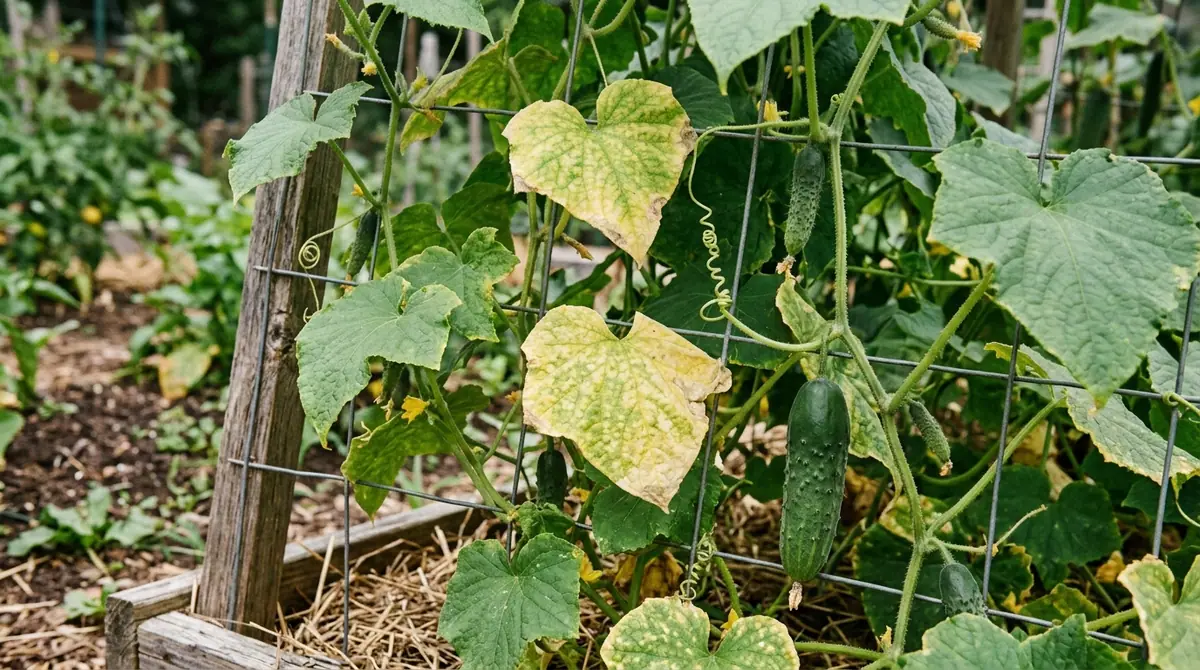
Last Tuesday morning, I walked out to my south-facing trial beds with my coffee cup in hand, only to find that my prize-winning slicing cucumbers—a heavy-yielding heritage variety called 'Marketmore 76'—had developed an unmistakable, aggressive yellow mottling across their lower leaves. My heart sank just a bit. I know this sight all too well. Growers panic, immediately reaching for high-nitrogen fertilizers or harsh chemical fungicides. But in 90% of cases, yellowing cucumber leaves are simply botanical distress signals telling us something specific has gone awry beneath the soil line or within the microclimate. Let's diagnose and fix this together, starting with how these incredible plants are built to grow.
1. Botanical Overview & Natural Habitat

Understanding this wild heritage explains why cucumbers throw tantrums in our gardens. They feature large, broad leaves designed to capture maximum sunlight for rapid photosynthesis, but this massive surface area also means they transpire moisture at an astonishing rate. Their root systems are predominantly shallow and fibrous, spreading roughly 18 to 36 inches (45 to 90 cm) laterally, with a taproot that can dive down 3 to 4 feet (90 to 120 cm) if soil conditions allow.
When yellowing occurs—a physiological condition known as chlorosis—it means chlorophyll production has stalled or existing chlorophyll is breaking down. Because cucumber leaves are solar panels powering both vine growth and heavy fruit production, any disruption to the plant's vascular system, root zone, or nutritional uptake immediately shows up as yellowing tissue. Whether it's interveinal chlorosis signaling a magnesium deficiency or necrotic spotting from fungal spores, reading the pattern of the yellowing is your first diagnostic tool.
2. Essential Environmental & Care Requirements
To keep your cucumber foliage a vibrant, deep emerald green, you must mimic their native Himalayan margin habitat. Deviate from these parameters, and yellow leaves will quickly follow.
| Parameter | Optimal Condition | Common Mistake | Why It Matters |
|---|---|---|---|
| Soil Temperature | 70°F to 85°F (21°C to 29°C) | Planting when soil is below 60°F (15°C) | Cold soil halts root function, preventing nutrient uptake and causing systemic yellowing. |
| Air Temperature | 75°F to 88°F (24°C to 31°C) | Exposing vines to sudden frost or extreme heatwaves above 95°F (35°C) | Extreme heat or cold shocks the vascular system, inducing leaf drop and chlorosis. |
| Watering Depth | 1 to 2 inches (2.5 to 5 cm) per week, deeply | Frequent, shallow surface watering | Encourages shallow root growth, making plants highly vulnerable to drought stress and yellowing. |
| Soil pH | 6.0 to 6.8 | Allowing soil to drop below 5.5 or rise above 7.5 | Locks out essential micronutrients like iron and magnesium, directly causing interveinal chlorosis. |
| Sunlight | Full sun, 6 to 8 hours daily | Planting in heavy shade or crowded rows | Insufficient light starves lower leaves, triggering natural senescence and yellowing. |
For deep-dive guidance on setting your plants up for success right from the start, check out my guide on When to Transplant Cucumber Seedlings: Stop Root Shock & Boost Growth.
💡 Pro-Tip: Always water the soil directly at the base of the plant using drip irrigation or a soaker hose. Splashing soil onto the lower leaves is the number one vector for splashing fungal spores like downy mildew up from the dirt, which starts the dreaded yellow-lesion cycle.
3. Step-by-Step Cultivation, Feeding & Propagation
Correcting current yellow leaves requires treating the root cause, but robust future care prevents it from returning. Follow this proven step-by-step protocol in your garden:
- Assess and Amend the Soil Profile: Test your soil pH to ensure it sits squarely between 6.0 and 6.8. If it is overly acidic, incorporate agricultural lime. Work in a generous 3-inch (7.5 cm) layer of aged compost to improve microbial life and drainage.
- Establish a Consistent Watering Regimen: Provide a reliable 1 to 2 inches (2.5 to 5 cm) of water weekly. Dig your finger down 2 inches (5 cm); if it feels dry at that depth, it is time for a deep, slow soak that penetrates 8 to 12 inches (20 to 30 cm) into the earth.
- Prune for Air Circulation: Remove the lowest 12 inches (30 cm) of foliage once the vines reach 3 to 4 feet (90 to 120 cm) in length. This eliminates older leaves that are naturally shading out and prone to soil-borne pathogens.
- Implement a Balanced Feeding Schedule: Feed your cucumbers every 14 days during peak vegetative growth using a balanced, water-soluble organic fertilizer. Ensure it includes secondary macronutrients like magnesium and calcium to prevent nutrient-deficiency chlorosis.
- Apply Protective Mulch: Lay down a 2-inch (5 cm) layer of clean straw, shredded hardwood, or untreated grass clippings around the base of the plants, keeping the mulch 1 inch (2.5 cm) away from the actual stem to prevent collar rot. This stops soil splashing and moderates root temperatures.
⚠️ Important Caution: Avoid high-nitrogen synthetic fertilizers when treating yellow leaves unless a soil test specifically confirms a nitrogen deficiency. Pumping excess nitrogen into stressed cucumber plants triggers explosive, tender leaf growth that attracts aphids and spider mites, worsening the overall decline.
4. Common Problems, Pests & Troubleshooting
When troubleshooting yellow leaves, look closely at the pattern of the discoloration. The pattern tells the diagnostic story:
- Lower Leaves Turning Uniformly Yellow: This is typically normal plant senescence or nitrogen deficiency. As the vine prioritizes new growth and fruit production, it sacrifices older, shaded leaves. If it's a deficiency, side-dress with blood meal or organic compost.
- Interveinal Chlorosis (Yellowing Between Green Veins): This points squarely to a magnesium or iron deficiency, often triggered by a soil pH that is too high or too low, locking those nutrients out. Foliar spray with liquid kelp or chelated iron for a quick fix, while adjusting your long-term soil pH.
- Angular Yellow Patches Bounded by Leaf Veins: This is the classic hallmark of Downy Mildew (Pseudoperonospora cubensis), an oomycete pathogen. The upper leaf shows angular yellow spots, while the underside develops a grayish, fuzzy spore mass during humid weather. For official management protocols, consult the University of Minnesota Extension Plant Disease Database.
- Mottled Mosaic Pattern with Distorted Leaves: If the yellowing appears as a mosaic of light and dark green patches alongside puckered, curled leaves, your plant likely has Cucumber Mosaic Virus (CMV). There is no cure for CMV; immediately bag and discard the infected plant to protect the rest of your crop.
- Stippled Yellow Leaves with Fine Webbing: Flip the leaf over. If you see tiny moving specks and fine silken threads, you are dealing with a two-spotted spider mite infestation thriving in hot, dry conditions. Blast them off with a strong jet of water and apply insecticidal soap or horticultural oil.

5. Frequently Asked Questions
Can yellow cucumber leaves turn green again?
No. Once a leaf cell has lost its chlorophyll and turned completely yellow or brown, it cannot regenerate green pigment. Your goal should be to diagnose the underlying stressor, correct it so the damage does not spread to new growth, and safely prune away severely yellowed leaves to improve overall plant airflow.
Should I cut off yellow leaves from my cucumber plants?
Yes, if a leaf is more than 50% yellow, diseased, or resting directly on damp soil, clip it off cleanly at the main stem using sterilized pruners. Removing these compromised leaves redirects the plant's energy toward healthy foliage and fruit while eliminating potential breeding grounds for fungal spores and pests.
Is overwatering or underwatering causing my cucumber leaves to turn yellow?
Both can cause yellowing, but they present differently. Underwatering causes leaves to turn crispy, dry, and yellow at the edges before dropping off entirely. Overwatering suffocation causes lower leaves to turn uniformly pale yellow and limp, accompanied by soggy, waterlogged soil and potential root rot. Check your soil moisture depth before adjusting your watering schedule.
Do yellow cucumber leaves mean I need to add fertilizer?
Not necessarily. While a lack of nitrogen, magnesium, or iron can cause chlorosis, over-fertilizing can burn the delicate fibrous roots, leading to nutrient lock-out and subsequent yellowing. Always check soil moisture, pH, and pest presence before applying any fertilizer amendments.
Related Guides
- How to Care for Indoor Orchids to Make Them Bloom Again
- When to Repot Cucumber Seedlings
- Best Cucumber Varieties
- Indoor Plant Leaves Curling Inward
- Money Tree New Leaves Drooping
📋 Table of Contents ▼ Click to expand
Tags:
Keep reading
🌿 Related Plants You Might Like



PlantSavvyWorld
Editorial team
PlantSavvyWorld is an independent botanical education project. Articles are drafted with AI assistance, then edited and checked against university extension services, botanical garden collections and other published horticultural sources.