

Why is My Money Tree Dropping Leaves
Written with AI assistance, edited and checked against horticultural sources.
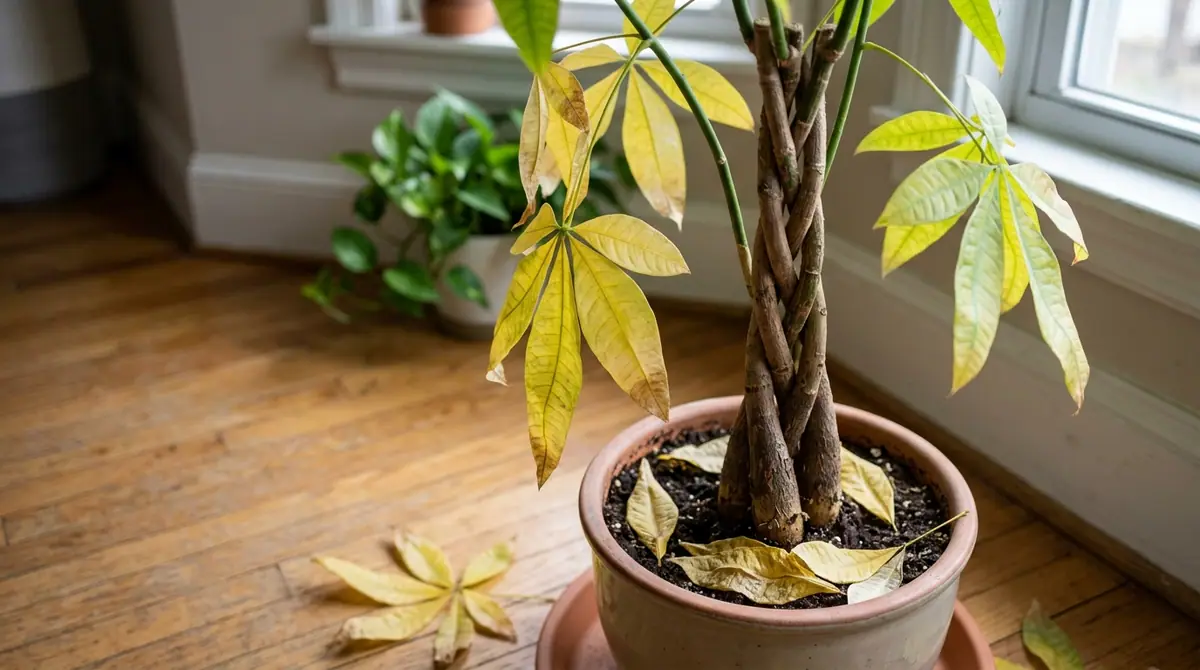
Last Tuesday, a gardener named Sarah texted me a photograph that I receive at least three times a week during the seasonal transition months: a pristine, braided Pachira aquatica sitting atop a ceramic pot, surrounded by a depressing green carpet of dropped, yellowing leaves. She swore she had only watered it when the soil felt dry, yet the plant was staging a dramatic defoliation protest. I can tell you immediately that your money tree is not dying—it is communicating. When a money tree drops leaves, it is reacting to a sudden shift in its microclimate, watering schedule, or light matrix. Let us decode what your plant is telling you and fix it permanently.
1. Botanical Overview & Natural Habitat

Botanically, Pachira aquatica is a pachycaul tree, meaning it features a thick, water-storing trunk capable of swelling at the base to buffer against periods of irregular moisture. This swollen caudex is the plant’s biological survival mechanism against drought, but it is frequently misunderstood by indoor growers who mistake the tree for a true desert succulent. The iconic braided trunks you see in garden centers are not a natural growth habit; commercial growers twist three to five young, flexible green saplings together while they are young and pliable so they fuse into a striking ornamental focal point as they mature.
Understanding this tropical wetland heritage explains why the plant drops leaves at the slightest provocation. It is biologically wired for stability—stable warmth, stable light, and stable humidity. When we bring Pachira aquatica into modern climate-controlled homes with fluctuating HVAC systems, dry winter air, and erratic watering routines, the tree responds by shedding its oldest or most vulnerable leaves to conserve energy and moisture. If you are looking to diversify your indoor growing projects with other high-value, functional species, you might also enjoy exploring our guide on Homegrown Vegetables That Save the Most Money for sustainable productivity.
2. Essential Environmental & Care Requirements
Recreating a tropical wetland microclimate inside a living room requires precision. Let us examine the exact thresholds your money tree demands to halt leaf drop completely.
| Parameter | Optimal Condition | Common Mistake | Why It Matters |
|---|---|---|---|
| Light | Bright, indirect sunlight (4 hours daily) | Direct scorching sun or dim dark corners | Direct light burns delicate tropical foliage; low light halts photosynthesis, causing yellowing leaf drop. |
| Watering | Deep watering when top 2 to 3 inches (5 to 8 cm) are dry | Frequent, shallow sips or chronic waterlogging | Shallow sips starve deep roots; waterlogging rots the root system, killing foliage instantly. |
| Temperature | 65°F to 80°F (18°C to 27°C) | Placing near drafty AC vents or hot radiators | Rapid temperature swings shock tropical cell structures, triggering instantaneous leaf abscission. |
| Humidity | 50% to 60% relative humidity | Dry indoor air below 30% (common in winter) | Low humidity causes crispy brown leaf tips and aggressive leaf shedding as moisture evaporates too fast. |
Light is often the primary culprit when leaves start raining down. Your Pachira aquatica needs bright, indirect light—ideally positioned two to four feet away from an east- or unblocked west-facing window. If placed in a dark corner, the plant cannot manufacture enough sugars, so it selectively aborts leaves it can no longer support. Conversely, harsh direct southern sun will scorch the palmate leaves, leaving bleached, papery patches that eventually drop.
Watering technique is equally critical. You should never water your money tree on a strict calendar schedule, such as "every Tuesday." Instead, use your finger to test the soil depth. Insert your finger a full 2 to 3 inches (5 to 8 cm) into the potting mix. If it feels dry and crumbly at that depth, it is time to water. When you water, do so thoroughly until excess liquid streams freely from the container's drainage holes, then empty the saucer within 15 minutes. Never let the pot sit in standing water, as stagnant moisture suffocates roots and causes root rot—a condition you can learn to diagnose across other sensitive garden species in our guide on How to Identify and Treat Common Fruit Tree Diseases.
3. Step-by-Step Cultivation, Feeding & Propagation
If your money tree has dropped half its leaves, resetting its cultivation protocol is the fastest way to halt the decline. Follow this rigorous step-by-step sequence to rehabilitate your plant:
- Assess the Root Zone: Gently slide the plant out of its nursery pot. Inspect the roots. Healthy roots are firm, light-colored, and flexible. If you encounter dark, mushy, foul-smelling roots, you are dealing with root rot. Use sterile shears dipped in 70% isopropyl alcohol to trim away all decayed tissue.
- Repot into Well-Draining Substrate: Replant the tree in a custom soil blend consisting of 50% high-quality organic potting soil, 25% coarse perlite or pumice, and 25% orchid bark. This ensures superior aeration and mimics the loose, alluvial soils of its native habitat. Ensure your pot has at least one functional drainage hole.
- Establish the Watering Rhythm: Water the newly potted tree thoroughly until water runs out the bottom. Do not water again until the top 3 inches (8 cm) of soil are completely dry. For a standard 8-inch (20 cm) diameter pot, this typically equates to watering every 10 to 14 days in summer, and every 18 to 25 days in winter.
- Position for Optimal Lighting: Place the container in an area receiving bright, indirect light. Avoid moving the plant frequently; money trees despise sudden changes in their light orientation and will drop leaves simply from being relocated across a room.
- Implement a Balanced Feeding Schedule: Feed your money tree only during its active growing season (spring through late summer). Dilute a balanced, water-soluble houseplant fertilizer (such as a 10-10-10 or 20-20-20 formula) to half-strength and apply it once every 30 days. Never fertilize a stressed or recovering plant, as chemical salts will burn compromised roots.
💡 Pro-Tip: If your braided money tree came with a rubber band, zip tie, or florist tape binding the stems tightly just beneath the soil line, cut it off immediately. Commercial growers use these bindings to force the braid shape during propagation, but if left in place as the tree matures, they girdle the trunk, cut off nutrient transport, and cause sudden, catastrophic leaf drop from the top down.
4. Common Problems, Pests & Troubleshooting
When diagnosing leaf drop, the physical appearance of the fallen leaf tells the exact story of what went wrong.
- Yellow Leaves with Soft Stems: This points directly to overwatering and incipient root rot. The roots can no longer transport nitrogen and water efficiently, causing older leaves to yellow, droop, and fall off. Stop watering immediately, check drainage, and consider a soil refresh with the perlite-bark blend outlined in our cultivation protocol.
- Dry, Crispy Green Leaves: If your money tree is dropping green leaves that feel brittle and dry, your home’s relative humidity is too low, or the plant is experiencing a hot air draft from a heating vent. Group plants together to create a local micro-climate humidity zone, or run a cool-mist humidifier nearby to maintain 50% relative humidity.
- Sudden Defoliation After Moving: Did you recently purchase the plant, bring it home, or move it from a dark office to a bright living room? Money trees are notoriously prone to shock when their environment changes. This is known as environmental acclimation drop. Do not panic; maintain consistent care, and the tree will push out new growth adapted to its new surroundings within 30 to 45 days.
Pests can also trigger leaf drop by draining plant sap and weakening the vascular system. Inspect the undersides of the leaves and the leaf axils for microscopic webbing, sticky honeydew, or tiny cotton-like masses.
⚠️ Important Caution: Never apply heavy horticultural oils or insecticidal soaps to a money tree while it is actively suffering from severe drought stress or root rot. The plant's natural cuticle is already compromised; applying chemical treatments to a stressed specimen will cause immediate chemical burn, accelerating leaf drop and potentially killing the plant. Treat root health first, pests second. For broader agricultural insights on managing tough woody crops and sustainable tree care, consult the specialized resources provided by the Royal Horticultural Society (RHS) and the University of Florida IFAS Extension.

5. Frequently Asked Questions
Should I cut off the yellow leaves on my money tree?
Yes, you should gently prune away completely yellow or dead leaves using clean, sterile shears. Once a leaf turns entirely yellow, its chlorophyll has degraded beyond recovery, and the plant is no longer deriving any photosynthetic benefit from it. Removing these leaves redirects the plant's metabolic energy toward pushing out fresh, healthy shoots and also improves air circulation around the lower canopy, preventing fungal issues.
Can a money tree recover from losing all its leaves?
Yes, Pachira aquatica is remarkably resilient due to the massive reserves stored in its swollen caudex (trunk). If the root system is still healthy and free of rot, a completely defoliated money tree can bounce back entirely. Stop watering excess, ensure bright indirect light, and wait. Within 21 to 45 days, dormant buds along the woody stems will activate, and new green shoots will emerge.
Why are the leaves on my money tree turning brown and crispy at the tips?
Crispy brown tips are the classic botanical symptom of low humidity or underwatering. Indoor heating and air conditioning strip moisture from the air, causing the delicate tips of the palmate leaves to dry out faster than the roots can supply water. Increase ambient humidity by placing the pot on a pebble tray filled with water (making sure the bottom of the pot sits above the water line) or running a room humidifier.
How often should I water my money tree to prevent leaf drop?
You should never water on a fixed calendar interval; instead, water whenever the top 2 to 3 inches (5 to 8 cm) of soil are completely dry to the touch. In a typical indoor climate, this usually means watering every 10 to 14 days during the spring and summer growing seasons, and every 18 to 25 days during the cooler autumn and winter months when metabolic rates slow down significantly. Always allow excess water to drain completely out of the bottom of the pot.
Related Guides
- Money Tree New Leaves Drooping
- Why is My Money Tree Leaves Drooping
- Why is My Money Tree Drooping
- Homegrown Vegetables That Save the Most Money
- Indoor Plant Leaves Curling Inward
- Zuni Crape Myrtle Tree
- Weeping Larch Tree
- Cinnamon Tree Care
📋 Table of Contents ▼ Click to expand
Tags:
Keep reading
🌿 Related Plants You Might Like



PlantSavvyWorld
Editorial team
PlantSavvyWorld is an independent botanical education project. Articles are drafted with AI assistance, then edited and checked against university extension services, botanical garden collections and other published horticultural sources.