

Why is My Money Tree Drooping
Written with AI assistance, edited and checked against horticultural sources.
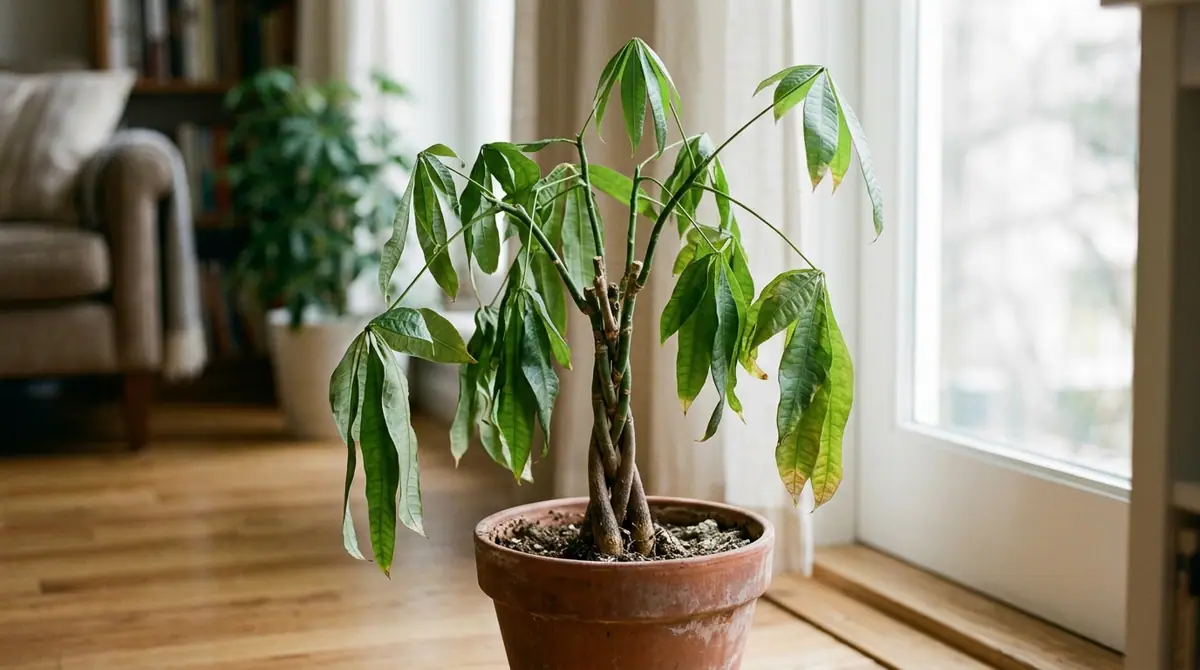
Last Tuesday, a frantic gardener texted me a photo of her beloved Pachira aquatica—its iconic braided trunk leaning sideways, and its glossy, palmately compound leaves hanging limply like wet paper umbrellas. She swore she was doing everything right, watering it precisely every Monday. But as I pulled back the top 1 inch (2.5 cm) of soil, a wave of sour, stagnant air hit me. Her roots were drowning, suffocating in a dense, waterlogged peat brick. Seeing a drooping money tree is heartbreaking, but it is also one of the most reliable diagnostic signals in interior landscaping. When a plant loses its architectural integrity and sags, it is shouting for a specific correction in its environment. Let us dive deep into the biology of Pachira aquatica and diagnose why your money tree is drooping, step by clinical step.
1. Botanical Overview & Natural Habitat

In a natural river basin, moving water constantly oxygenates the root zone. In a nursery pot or your living room, stagnant water breeds anaerobic bacteria that rot the roots, cutting off water transport to the canopy and causing that characteristic wilt. The plant's famous braided trunk—almost always crafted by commercial growers who weave multiple seedlings together while they are pliable—serves as a temporary water-storage reservoir. When the root system fails due to overwatering, underwatering, or thermal shock, the entire hydraulic system collapses, resulting in limp, drooping stems. Understanding this evolutionary history helps us realize that indoor survival requires mimicking the tropical floodplain balance of moisture and aeration. For broader context on managing woody species in constrained environments, you might find parallels in our guide on Creative Landscaping Ideas Around Tree Roots.
2. Essential Environmental & Care Requirements
When diagnosing a drooping money tree, evaluating its baseline environmental parameters is your first line of defense. Pachira aquatica demands specific tolerances to maintain turgor pressure in its cellular walls. If any of these parameters fall outside optimal ranges, drooping is often the immediate physical symptom.
| Parameter | Optimal Condition | Common Mistake | Why It Matters |
|---|---|---|---|
| Soil Moisture | Dry top 2 to 3 inches (5 to 7.5 cm) before watering | Watering on a strict calendar schedule | Prevents root rot while ensuring adequate hydration |
| Lighting | Bright, indirect sunlight (6+ hours daily) | Placement in deep dark corners or harsh, direct sun | Direct sun scorches leaves; low light halts photosynthesis and weakens stems |
| Temperature | 65°F to 80°F (18°C to 27°C) | Exposure to drafts below 55°F (13°C) or AC vents | Cold stress causes cellular collapse and sudden leaf drop |
| Humidity | 50% to 70% relative humidity | Placing near dry heat vents or radiators | Low humidity desiccates leaf margins, leading to limp, crispy foliage |
Light intensity directly governs transpiration. If a money tree is moved from a bright sunroom to a dim interior office, its metabolic rate plummets. The roots continue to absorb moisture faster than the leaves can transpire it, water accumulates, cells burst, and the stems begin to sag. Conversely, if light is adequate but humidity drops below 40%, the plant loses water faster through its leaves than the roots can supply, causing a drought-induced droop that looks remarkably similar to overwatering. For a fascinating comparison with another resilient, utility-focused tree species, review our Total Guide to Moringa Why You Should Grow the Miracle Tree or Drumstick Vegetable.
💡 Pro-Tip: Never rely on the surface appearance of your potting mix. Invest in a 10-inch (25 cm) moisture meter or use your index finger. Push it past the knuckle to a depth of 2 inches (5 cm). If the soil clings moistly to your skin, step away from the watering can.
3. Step-by-Step Cultivation, Feeding & Propagation
If your money tree is actively drooping, you need a systematic recovery protocol to revive it. Follow these steps to diagnose subterranean damage, reset soil conditions, and restore structural rigidity.
- Perform a Root and Trunk Inspection: Gently slide the money tree out of its container. Shake away loose soil to inspect the root ball. Healthy roots are firm, light-colored, and fragrant. Rotted roots are brown, black, mushy, and emit a foul, sulfurous odor. Also, squeeze the lower trunks; if they feel soft and hollow, the rot has spread upward.
- Prune Damaged Tissue: Using sterilized shears wiped with 70% isopropyl alcohol, trim away all rotting, mushy roots. If any of the braided trunks are completely rotted through, you may need to unbraid and discard the dead stems to save the healthy survivors. Cut off severely drooping, yellowed, or necrotic leaves to redirect the plant's remaining energy.
- Repot into Well-Araining Media: Discard the old, compacted soil. Plant the money tree in a fresh, high-drainage mix consisting of 40% high-quality potting soil, 30% coarse perlite or pumice, and 30% orchid bark. Choose a container with at least one generous drainage hole that is only 1 to 2 inches (2.5 to 5 cm) wider than the root ball.
- Establish the Soak-and-Dry Watering Method: Water the newly repotted tree thoroughly until water runs freely out of the bottom drainage holes. Let the pot drain completely for 15 minutes. Do not water again until a wooden chopstick inserted to the bottom of the pot comes out clean and dry, which typically takes 10 to 14 days indoors.
- Optimize Feeding Schedule: Wait at least 6 to 8 weeks after repotting before applying any fertilizer. Once the plant shows new upward growth, apply a balanced, water-soluble liquid houseplant fertilizer (such as a 10-10-10 formulation) diluted to half-strength once every 4 weeks during the active growing season (spring and summer). Withhold fertilizer entirely during autumn and winter.
When the structural integrity of your woody plants is compromised, it pays to understand how other resilient trees recover from environmental shock. For instance, when dealing with outdoor woody ornamentals, arborists often reference guidelines from institutions like the Royal Horticultural Society (RHS) for proper pruning and root remediation techniques.
⚠️ Important Caution: Never let your pot sit in a saucer filled with standing runoff water. This creates an artificial water table at the base of the pot, suffocating the lower roots and guaranteeing a recurrence of the droop within 7 days.
4. Common Problems, Pests & Troubleshooting
When a money tree droops, pests and secondary infections often exploit the plant's weakened immune system. Before assuming your issue is purely cultural, check for these specific culprits.
- Root Rot (Phytophthora & Pythium): This is the number one cause of a drooping money tree. Symptoms include sudden, severe drooping accompanied by yellowing lower leaves, soft black stems, and a foul-smelling soil surface. Treatment requires immediate unpotting, root pruning, and repotting into dry, sterile media. You can also consult resources from the University of Florida IFAS Extension for detailed management of tropical plant root pathogens.
- Spider Mites (Tetranychus urticae): These microscopic arachnids thrive in warm, dry indoor air. They puncture plant cells, sucking out chlorophyll and leaving the leaves mottled, dusty, and eventually drooping. Look for fine, silky webbing along the undersides of the leaves and at the leaf axils. Treat by wiping leaves down with insecticidal soap or horticultural oil every 5 to 7 days for three cycles.
- Scale Insects: These immobile pests look like small, brown, raised bumps along the stems and leaf veins. They secrete sticky honeydew that attracts sooty mold, weakening the plant until the canopy sags. Scrape them off gently with a soft toothbrush dipped in rubbing alcohol, then apply a systemic insecticide if the infestation is severe.
- Underwatering Shock: If you have neglected watering for weeks, the soil will shrink away from the sides of the pot and become hydrophobic. The leaves will hang down like limp rags and turn crispy at the tips. Submerge the entire pot in a basin of room-temperature water for 30 minutes to rehydrate the root ball completely, then allow it to drain fully.

5. Frequently Asked Questions
Can a drooping money tree recover?
Yes, absolutely. If the drooping is caused by underwatering, mild overwatering, or low humidity, the plant will often bounce back within 24 to 48 hours after you correct the environmental stress. Even if root rot has set in, aggressive pruning of the dead roots, treating the remaining healthy tissue, and repotting into fresh, airy soil can save the plant, though it may take several weeks to push out new canopy growth.
Should I cut off drooping leaves on a money tree?
You should remove any leaves that are completely yellow, brown, or mushy, as these will not recover and can invite fungal pathogens. However, if a leaf is simply sagging downward due to mild underwatering or light stress but remains green and firm, leave it attached. Once you restore proper watering or lighting conditions, the turgor pressure within those cells will often normalize, and the leaf will lift back up.
How often should I water my money tree to prevent drooping?
There is no universal calendar day for watering because indoor humidity, temperature, and pot size dictate drying rates. Instead, water your money tree only when the top 2 to 3 inches (5 to 7.5 cm) of soil are completely dry to the touch. For an average 8-inch (20 cm) pot in a home kept at 70°F (21°C), this usually translates to every 10 to 14 days in winter and every 7 to 10 days in summer.
Why is my money tree drooping after I just repotted it?
This is known as transplant shock. When you repot a plant, microscopic root hairs are inevitably disturbed or torn, temporarily disrupting the plant's ability to take up water. To help it recover, place the plant in bright, indirect light, avoid direct afternoon sun, maintain high ambient humidity around the canopy, and resist the urge to fertilize for at least two months while the root system re-establishes itself.
Related Guides
- Money Tree New Leaves Drooping
- Why is My Money Tree Leaves Drooping
- Why is My Money Tree Dropping Leaves
- Homegrown Vegetables That Save the Most Money
- Will a Lemon Tree Survive Winter
- Flamin Fury Peach Tree
- Lime vs Lemon Tree
- Zuni Crape Myrtle Tree
📋 Table of Contents ▼ Click to expand
Tags:
Keep reading
🌿 Related Plants You Might Like


PlantSavvyWorld
Editorial team
PlantSavvyWorld is an independent botanical education project. Articles are drafted with AI assistance, then edited and checked against university extension services, botanical garden collections and other published horticultural sources.