

Zuni Crape Myrtle Tree
Written with AI assistance, edited and checked against horticultural sources.
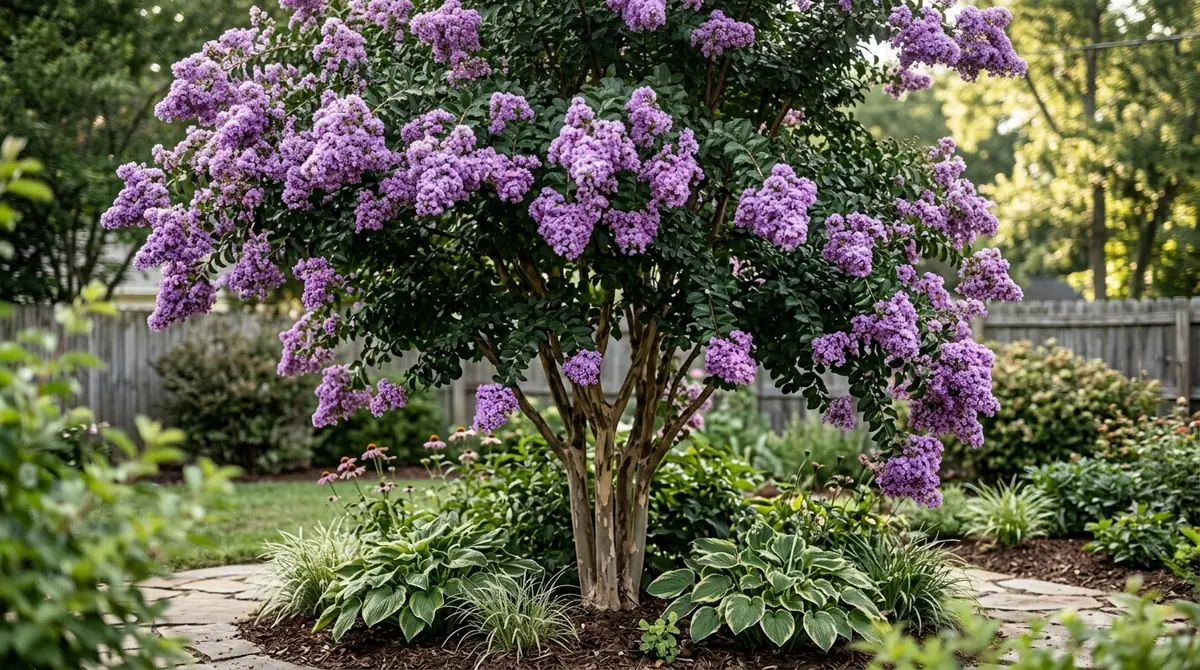
Standing in a gardener's south-facing suburban courtyard in mid-August, the asphalt radiating a blistering 98°F (37°C), I watched standard crepe myrtles drop their scorched leaves into the dust while mildew choked their neighboring branches. Yet, right beside them, a specimen of the Zuni Crape Myrtle stood completely pristine, draped in brilliant lavender-purple panicles with cinnamon-colored bark peeling back like fine parchment. That afternoon cemented my lifelong professional respect for this specific hybrid. I have specified hundreds of cultivars across hardiness zones, but when a gardener needs reliable summer color without the high maintenance of disease-prone selections, the Zuni Crape Myrtle remains my gold standard.

1. Botanical Overview & Natural Habitat
The Zuni Crape Myrtle (Lagerstroemia indica x fauriei 'Zuni') is a deciduous, multi-stemmed shrub or small tree resulting from the groundbreaking hybrid-breeding program initiated by the United States National Arboretum in the mid-20th century. Dr. Donald Egolf crossed the traditional, mildew-susceptible Asian species Lagerstroemia indica with the exceptionally resilient, upright Japanese species Lagerstroemia fauriei. The resulting Zuni cultivar inherits the best traits of both parents: the striking exfoliating bark and superior fungal resistance of L. Fauriei, combined with the intense flower color and compact growth habit of L. Indica.
Botanically, Zuni is classified as a medium-sized deciduous multi-stemmed tree, maturing typically to a height of 10 to 15 feet (3 to 4.5 meters) with a spread of 10 to 12 feet (3 to 3.6 meters). Its canopy forms an attractive, rounded to vase-shaped silhouette. The leaves are alternate or sub-opposite, simple, elliptic to oblong, measuring 1.5 to 3 inches (3.8 to 7.6 cm) in length. They emerge in spring with a reddish-bronze tinge, mature to a dark glossy green throughout the summer, and transition into rich orange-red and yellow tones in autumn before dropping.
The standout aesthetic feature is its exceptional bark. As the trunk expands over its 30 to 50-year lifespan, the outer layer peels away in thin, papery sheets to reveal a smooth, mottled inner bark that shifts from cinnamon-brown to a clean, pale beige. Blooming from mid-summer through early fall, Zuni produces terminal panicles filled with vivid medium-purple flowers. These long-lasting blooms provide vital late-season forage for local pollinators, including native bees and butterflies, bridging the nectar gap when many spring-flowering trees have finished their cycles.
When designing landscapes around trees with aggressive root systems, like those discussed in our guide on creative landscaping ideas around tree roots, it is important to note that the Zuni Crape Myrtle possesses a well-behaved, non-invasive root architecture. This makes it exceptionally companion-friendly for underplantings such as perennials and ornamental grasses.
2. Essential Environmental & Care Requirements
To unlock the full ornamental potential of your Zuni Crape Myrtle, you must match its environmental preferences. Zuni is hardy across USDA Zones 6 through 9, tolerating winter low temperatures down to -10°F to 0°F (-23°C to -18°C). When temperatures dip past -10°F (-23°C), the plant may experience dieback to the crown, but it typically resprouts vigorously from the base in spring.
Sunlight is non-negotiable. Zuni demands full sun, defined as a minimum of 6 to 8 hours of direct, unfiltered sunlight daily. Planting this tree in partial shade or heavy woodland canopies drastically reduces flower production, mutes the vivid purple color of the panicles, and leaves the foliage damp for too long, inviting fungal spores.
| Parameter | Optimal Condition | Common Mistake | Why It Matters |
|---|---|---|---|
| Sunlight | Full sun (6–8+ hours daily) | Planting in partial shade | Drastically reduces blooms and invites powdery mildew |
| Soil pH | 6.0 to 6.5 (slightly acidic) | Highly alkaline soils (>7.5) | Induces iron chlorosis and stunts nutrient uptake |
| Soil Drainage | Well-drained loams or sandy clays | Heavy, waterlogged clay | Causes root rot (Phytophthora species) and sudden decline |
| Watering | 1 inch (2.5 cm) of water weekly post-establishment | Frequent, shallow sprinkling | Encourages shallow root systems vulnerable to drought |
Soil composition dictates long-term vigor. While Zuni is remarkably adaptable to clay, loam, and sandy soils, it strictly requires well-drained conditions. If you are gardening in heavy regional clay, amending the native backfill with organic compost and ensuring positive site grading prevents water pooling. For deeper horticultural insights on managing plant health and preventing regional pathogen outbreaks, consult the University of Florida IFAS Extension.
💡 Pro-Tip: If your Zuni Crape Myrtle exhibits interveinal chlorosis (yellowing leaves with green veins) in mid-summer, do not immediately apply a nitrogen fertilizer. This is almost always caused by alkaline soil locking up available iron. Apply elemental sulfur or chelated iron to drop the pH into the optimal 6.0–6.5 window, and watch the foliage green up within 14 days.
3. Step-by-Step Cultivation, Feeding & Propagation
Planting a Zuni Crape Myrtle correctly sets the trajectory for decades of low-maintenance beauty. Follow this precise field-tested sequence to establish your specimen:
- Site Selection and Hole Preparation: Select a location with full sun and good drainage. Dig a planting hole that is 2 to 3 times wider than the root ball, but maintain the exact same depth as the container. Never dig deeper than the root ball, as settling causes the trunk collar to sink below grade.
- Root Inspection and Conditioning: Gently slide the plant out of its container. Use a sterile hori-hori knife or pruning shears to vertically slice through any circling roots at 90-degree intervals. This breaks the root-bound cycle and forces lateral root expansion into the surrounding native soil.
- Positioning and Backfilling: Place the tree in the center of the hole, ensuring the root flare (where the trunk broadens into the root system) sits 1 to 2 inches (2.5 to 5 cm) above the surrounding soil line. Backfill with a 50/50 mix of native soil and well-aged organic compost. Tamp down gently with your hands or feet every 6 inches (15 cm) of backfill to eliminate large air pockets.
- Initial Watering: Saturate the root zone slowly with 5 gallons (19 liters) of water to settle the soil particles around the fine root hairs.
- Mulching: Apply a 3-inch (7.6 cm) layer of shredded hardwood mulch across the planting circle, extending outward to the drip line. Pull the mulch 3 inches (7.6 cm) away from the actual trunk stems to prevent collar rot and rodent nesting.
- Maintenance Feeding: Zuni requires minimal feeding once established. Apply a balanced, slow-release granular fertilizer (such as a 10-10-10 or organic equivalent) once in early spring just as bud break occurs. Avoid high-nitrogen fertilizers after mid-summer, as this forces tender late-season growth that cannot harden off before autumn frosts.
- Propagation Protocol: To propagate Zuni clones, take semi-hardwood cuttings in early summer (June through July). Snip 6-inch (15 cm) terminal stems, strip the lower foliage, dip the basal end in 0.8% indole-3-butyric acid (IBA) rooting hormone powder, and insert them into a 50/50 perlite and peat moss propagation bench. Keep the medium consistently moist under intermittent mist; roots typically form within 21 to 30 days.
⚠️ Important Caution: Never commit "crape murder"—the disastrous horticultural practice of topping or shearing mature crape myrtles back to thick knuckle stubs. This practice ruins the natural vase-shaped architecture, encourages weak, structurally unsound sucker growth, and leaves massive open wounds vulnerable to wood-boring insects.
4. Common Problems, Pests & Troubleshooting
Even though the Zuni Crape Myrtle was specifically bred to withstand the environmental pressures that plague older cultivars, it is not entirely invincible. Understanding how to diagnose and treat common ailments keeps your landscape specimen thriving.
Powdery Mildew (Erysiphe lagerstroemiae) is the classic crape myrtle disease. While Zuni possesses strong genetic resistance compared to standard Lagerstroemia indica varieties, extreme humidity combined with shade can still trigger a white, powdery fungal film on new leaves and flower buds. Treat active outbreaks with horticultural oils, neem oil, or copper-based fungicides applied at 7-to-14-day intervals until symptoms clear.
Crape Myrtle Aphids (Tinocallis kahawaluokalani) are tiny, pale yellow insects that feed on the undersides of leaves, excreting sticky honeydew that subsequently fosters black sooty mold. While unsightly, aphids rarely kill a mature tree. Introduce beneficial predatory insects like lady beetles and lacewings, or wash colonies off the foliage with a strong stream of water from a garden hose.

5. Frequently Asked Questions
How fast does a Zuni crape myrtle grow?
The Zuni Crape Myrtle exhibits a moderate growth rate, typically adding 12 to 24 inches (30 to 60 cm) of height and spread per year under optimal conditions. It reaches its mature height of 10 to 15 feet (3 to 4.5 meters) in approximately 6 to 8 years, after which growth slows as the trunk thickens and the distinctive exfoliating bark develops.
When should I prune my Zuni crape myrtle?
The best time to prune your Zuni Crape Myrtle is during late winter or early spring (January through March) before the plant breaks dormancy. Focus your cuts entirely on removing the "3 Ds": dead, damaged, and diseased wood. You should also selectively thin out crossing branches in the interior of the canopy to improve air circulation and sunlight penetration. For authoritative botanical care standards, reference the guidelines maintained by the Royal Horticultural Society.
Is the Zuni crape myrtle drought tolerant once established?
Yes, once established over a period of 1 to 2 growing seasons, the Zuni Crape Myrtle displays high drought tolerance. Its deep root system allows it to withstand extended dry spells without supplemental irrigation, though extended droughts will slightly shorten the duration and intensity of its summer bloom cycle.
Can I grow a Zuni crape myrtle in a container on a patio?
While Zuni is one of the more compact crape myrtle selections, its mature size of 10 to 15 feet makes long-term container culture challenging unless you commit to aggressive root pruning every 2 to 3 years. If you choose to grow it in a pot, select a container with a minimum diameter of 24 inches (60 cm) filled with a well-draining, soil-based potting mix, and ensure it receives full sun all day.
Related Guides
- Will a Lemon Tree Survive Winter
- Money Tree New Leaves Drooping
- Why is My Money Tree Drooping
- Why is My Money Tree Dropping Leaves
- How to Know If a Palm Tree is Dead
📋 Table of Contents ▼ Click to expand
Tags:
Keep reading
🌿 Related Plants You Might Like




PlantSavvyWorld
Editorial team
PlantSavvyWorld is an independent botanical education project. Articles are drafted with AI assistance, then edited and checked against university extension services, botanical garden collections and other published horticultural sources.