

Lime vs Lemon Tree
Written with AI assistance, edited and checked against horticultural sources.
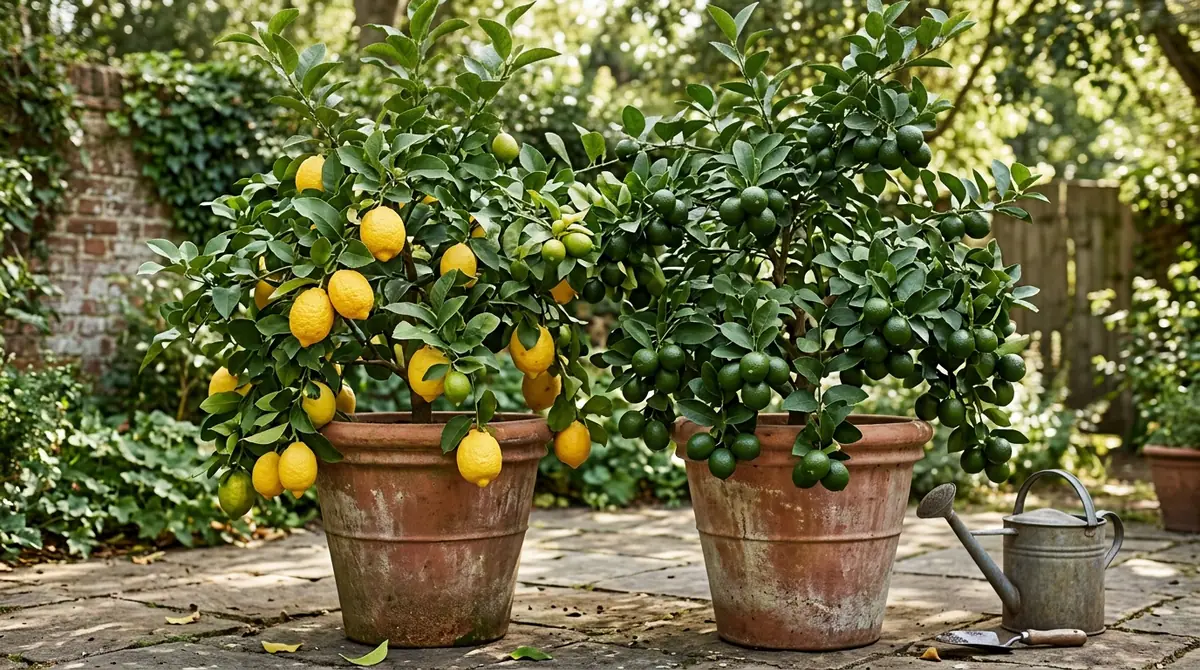
Standing in my Zone 9b trial garden last February, clutching a clipboard while a sudden 28°F (-2°C) frost warning threatened to ruin my citrus harvest, I had to make a frantic choice. My containerized Eureka lemon was shivering under a frost cloth, while my neighboring Key lime tree was already showing leaf curl from the dropping mercury. Every season, growers regularly askemon tree in their landscape, assuming these sunny yellow and green jewels are interchangeable. They are not. Choosing between them dictates your watering schedule, your pruning geometry, your frost protection strategy, and how you design the surrounding hardscape.

1. Botanical Overview & Natural Habitat
To understand how citrus behaves in a designed landscape, we must look to its evolutionary origins. Lemons (Citrus limon) and limes (primarily Key limes, Citrus aurantiifolia, and Persian limes, Citrus × latifolia) belong to the Rutaceae family, but their wild ancestors evolved under distinct microclimates in the foothills of the Himalayas and the tropical forests of Southeast Asia.
Lemons developed in regions characterized by distinct wet and dry seasons with moderate Mediterranean-like warmth. They naturally grow into vigorous, thorny small trees reaching 15 to 20 feet (4.5 to 6 meters) tall if left unpruned. Their foliage is deep green with a purplish tint on new flush growth, and the blossoms possess a rich, sweet fragrance that signals pollinators from yards away.
Limes, conversely, are fundamentally tropical and subtropical understory plants. Key limes form dense, bushy, spreading shrubs or small trees maxing out around 10 to 12 feet (3 to 3.6 meters) tall, armed with sharp, unforgiving thorns. Persian limes are larger, reaching 15 to 20 feet (4.5 to 6 meters), but are sterile triploid hybrids that produce seedless fruit.
Both species interact distinctively with surrounding garden ecosystems. If you are managing complex yard layouts, you must account for their aggressive, fibrous root systems when planning paths, patios, or companion plantings—strategies I often outline when exploring Creative Landscaping Ideas Around Tree Roots. Furthermore, maintaining healthy citrus requires vigilance against fungal and bacterial pathogens, principles you can adapt from standard protocols found in How to Identify and Treat Common Fruit Tree Diseases.
2. Essential Environmental & Care Requirements
While both citrus types demand intense sun and sharp drainage, their tolerances for cold, humidity, and moisture diverge significantly. Limes are tropical princesses; they despise freezing temperatures and demand high ambient humidity to set heavy fruit loads. Lemons are tougher through transitional weather, tolerating brief dips into the high 20s (°F) and thriving in drier summer air, provided their root zones remain evenly moist.
To help you balance these parameters in your garden design, refer to the agronomic breakdown below:
| Parameter | Optimal Condition | Common Mistake | Why It Matters |
|---|---|---|---|
| Soil pH | 6.0 to 7.5 (Slightly Acidic to Neutral) | Planting in heavy, unamended clay | Citrus roots suffocate quickly; alkaline soils lock out essential iron and manganese. |
| Sunlight | 8 to 10 hours of direct sun daily | Placing under partial canopy shade | Insufficient light plummets sugar content in fruit and reduces floral bud initiation. |
| Watering Depth | 18 to 24 inches (45 to 60 cm) per irrigation | Frequent, shallow surface sprinkling | Deep watering forces roots downward, anchoring the tree and building drought resilience. |
| Minimum Temp | Limes: >32°F (0°C); Lemons: >28°F (-2°C) | Leaving unprotected during sudden freezes | Cell walls rupture when frozen, destroying cambium layers and killing fruit crops instantly. |
💡 Pro-Tip: When planting containerized citrus on a paved patio, elevate the pots on pot feet at least 2 inches (5 cm) off the ground. This ensures the drainage holes never plug with soil or algae, preventing the root rot that kills more backyard citrus than any pest.
For comprehensive regional climate data and localized planting calendars, consult the University of California Agriculture and Natural Resources Citrus Guidelines.
3. Step-by-Step Cultivation, Feeding & Propagation
Establishing a thriving citrus specimen requires precision. Whether you are installing a Lisbon lemon or a Bearss lime, follow this rigorous step-by-step planting protocol to guarantee establishment success:
- Site Selection and Soil Testing: Select a location receiving unobstructed southern exposure. Test the soil percolation rate by digging a hole 12 inches (30 cm) deep, filling it with water, and ensuring it drains at a rate of at least 1 to 2 inches (2.5 to 5 cm) per hour.
- Excavation Geometry: Dig a hole 3 times wider than the nursery container, but keep the depth strictly equal to the root ball height. The root flare—where the trunk widens into the primary roots—must sit 1 to 2 inches (2.5 to 5 cm) above the surrounding grade.
- Unbinding the Root Mass: Carefully slide the tree from its container. Use a sterile hori-hori knife or pruning shears to score matted roots vertically in 4 distinct places, gently teasing outward any circling roots to prevent girdling.
- Backfilling and Settling: Place the tree in the center of the excavation. Backfill with native unamended soil (or a 10% mix of native soil and well-aged compost). Tamp down gently with your hands or boots to eliminate large air pockets, but never pack the soil tight.
- Basin Construction and Initial Irrigation: Build a 4-inch (10-cm) high soil berm in a circle 3 feet (0.9 meters) in diameter around the drip line. Flood this basin slowly with 5 gallons (19 liters) of water to settle the soil around the root hairs.
- Mulching Protocol: Apply a 3-inch (7.5-cm) layer of coarse organic mulch, such as shredded bark, across the basin. Maintain a 4-inch (10-cm) clearance zone completely free of mulch around the trunk trunk-flare to prevent collar rot.
Feeding schedules must align with active seasonal growth flushes. Apply a balanced, slow-release citrus fertilizer containing added iron, zinc, and manganese three times a year: in early spring just before bloom, in mid-summer, and in early fall.
⚠️ Important Caution: Never apply high-nitrogen synthetic fertilizers late in the autumn. Late-season fertilization triggers tender vegetative flushes that are instantly destroyed by the first frost, inviting bacterial pathogens into the wounded canopy.
4. Common Problems, Pests & Troubleshooting
Even with pristine care, citrus trees face a gauntlet of environmental and biological stressors. Diagnosing these issues early separates a bountiful harvest from a defoliated stick.
- Leaf Yellowing (Chlorosis): If leaves turn bright yellow while veins remain dark green, your tree is signaling an iron or zinc deficiency, usually caused by soil pH creeping above 7.5. Correct this with a chelated iron soil drench applied in early morning.
- Citrus Leaf Miner: These microscopic moth larvae tunnel inside leaves, leaving silvery, winding trails that curl foliage. Prune off severely damaged tips and spray with organic horticultural neem oil during the evening hours to avoid frying leaves in the sun.
- Citrus Greening (HLB): Transmitted by the Asian citrus psyllid, this devastating bacterial disease causes mottled leaves, asymmetrical, sour fruit, and eventual tree death. Inspect new flush growth monthly with a hand lens for tiny, 45-degree-angle feeding psyllids. For international biosecurity standards and pest identification keys, review resources provided by the Royal Horticultural Society Citrus Advice.
- Fruit Drop: It is entirely normal for citrus trees to shed up to 80% of their pea-sized baby fruits in late spring; this is nature's self-thinning mechanism. However, sudden dropping of larger green fruit points directly to erratic watering fluctuations or extreme root temperature swings.

5. Frequently Asked Questions
Can I grow a lime tree and a lemon tree in the same container?
No. Citrus root systems are fiercely competitive. Planting two distinct trees in a single pot will result in root entanglement, nutrient starvation, and the eventual suppression or death of the weaker specimen. Give each tree its own container measuring at least 20 to 24 inches (50 to 60 cm) in diameter.
Which is more cold hardy, a lime tree or a lemon tree?
Lemons are generally more cold-hardy than limes. Most common lemon varieties (like Eureka and Meyer) can withstand temperatures down to 25°F to 28°F (-4°C to -2°C) with minimal damage. Key limes, on the other hand, suffer severe tissue damage and defoliation the moment temperatures hit 32°F (0°C).
Why is my indoor potted lemon tree dropping all its leaves in winter?
Indoor winter leaf drop is almost always caused by a combination of low indoor humidity, reduced light levels from short days, and damp soil sitting against the roots from overwatering. Move the plant within 2 feet (0.6 meters) of your sunniest south-facing window, run a pebble tray humidifier nearby, and let the top 3 inches (7.5 cm) of soil dry out completely between waterings.
Do lime and lemon trees need cross-pollination to produce fruit?
Almost all commercial citrus varieties—including Eureka lemons, Persian limes, and Key limes—are self-fertile. They possess complete flowers containing both male and female organs, meaning a single tree will produce abundant fruit without needing a companion tree nearby.
Related Guides
- Will a Lemon Tree Survive Winter
- Money Tree New Leaves Drooping
- Why is My Money Tree Drooping
- Why is My Money Tree Dropping Leaves
- How to Know If a Palm Tree is Dead
📋 Table of Contents ▼ Click to expand
Tags:
Keep reading
🌿 Related Plants You Might Like






PlantSavvyWorld
Editorial team
PlantSavvyWorld is an independent botanical education project. Articles are drafted with AI assistance, then edited and checked against university extension services, botanical garden collections and other published horticultural sources.