

Curling Leaves on Hydrangea
Written with AI assistance, edited and checked against horticultural sources.
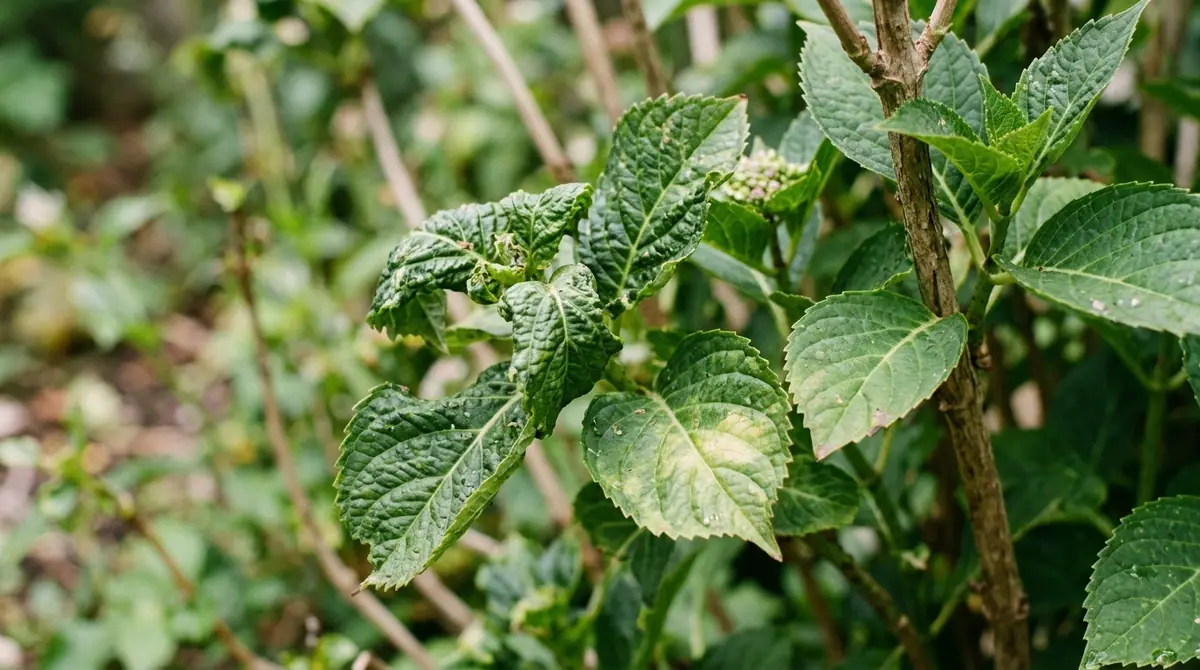
I stood in trial gardens last July under a punishing 92°F (33°C) afternoon sun, staring at my prized Hydrangea macrophylla 'Endless Summer'. Its once-lustrous, deep green foliage had suddenly curled upward, the leaf margins crisping into brittle parchment while the soil surface felt bone-dry down to 2 inches (5 cm).
1. Botanical Overview & Natural Habitat
To understand why a hydrangea leaf curls, we must first look at where these plants evolved. Most cultivated hydrangeas—including Hydrangea macrophylla (mopheads and lacecaps), Hydrangea paniculata (panicle hydrangeas), Hydrangea arborescens (smooth hydrangeas, like 'Annabelle'), and Hydrangea quercifolia (oakleaf hydrangeas)—are native to the dappled understories of temperate forests in Asia and the Americas, or along moist stream banks.
In their natural habitats, hydrangeas experience high ambient humidity, rich organic soil that retains moisture without waterlogging, and protection from the scorching midday sun. Their broad, thin leaves are evolutionarily adapted to capture maximum light in shady, low-light canopies.
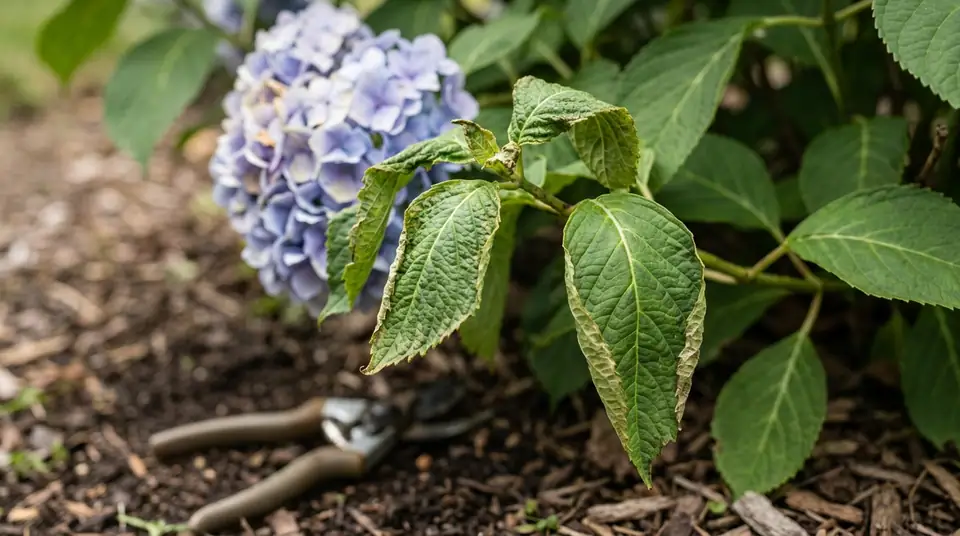
Consequently, these thin leaves possess a high transpiration rate. When environmental conditions cause water loss through the leaves to outpace the root system's ability to pull water up from the soil, the plant experiences hydraulic failure. The leaf cells lose turgor pressure, causing the margins to cup inward or roll upward as a protective mechanism to reduce surface area exposed to drying air and sun.
Understanding this woodland understory heritage explains why a hydrangea planted in a baking, exposed western exposure reacts with immediate, aggressive leaf curling. For a deeper dive into how plant foliage reacts to environmental stressors and nutrient imbalances, you might find my guide on Why your Cucumber Leaves Are Turning Yellow and How to Fix NFTs and Gardens insightful, as many cellular distress signals cross plant families.
2. Essential Environmental & Care Requirements
Preventing and reversing leaf curl requires replicating the plant's ideal ecological niche. Let us examine the parameters that keep hydrangeas thriving.
| Parameter | Optimal Condition | Common Mistake | Why It Matters |
|---|---|---|---|
| Light Exposure | Morning sun (2–4 hours) with afternoon shade | Full, scorching afternoon sun (12 PM–5 PM) | Intense UV and heat trigger rapid transpiration, collapsing leaf cells and causing margin curl. |
| Soil Moisture | Consistently moist, evenly damp 1 inch (2.5 cm) down | Alternating between drought and flood cycles | Erratic watering stresses root hairs, inhibiting water uptake and forcing leaves to curl defensively. |
| Soil pH | 5.2–5.5 for blue blooms; 6.0–6.2 for pink blooms | Highly alkaline soil (> 7.0) | Extreme pH locks out essential micronutrients like iron and manganese, causing chlorosis and distorted growth. |
| Ambient Humidity | 50% to 70% relative humidity | Arid, dry wind or indoor air conditioning blasts | Low humidity accelerates leaf water loss, outstripping the hydraulic capacity of woody stems. |
Water management is the single most frequent culprit behind curling leaves. Hydrangeas derive their very botanical name from hydor (water) and angeion (jar), translating roughly to "water vessel." When temperatures spike above 85°F (29°C), a mature Hydrangea macrophylla can transpire gallons of water daily. If your soil dries out past a depth of 2 inches (5 cm), the fine feeder roots—which absorb the vast majority of water and nutrients—begin to die back. When you finally water them after a dry spell, the damaged root system cannot supply the canopy, resulting in permanent leaf margin necrosis and upward cupping.
3. Step-by-Step Cultivation, Feeding & Propagation
When curling leaves indicate an unhappy plant, or when you are establishing new specimens, following a strict cultivation protocol ensures long-term vigor. Here is my proven step-by-step framework for planting, feeding, and maintaining healthy hydrangeas.
- Site Selection and Soil Prep: Choose a location receiving 3 to 4 hours of gentle morning sun and complete protection from harsh afternoon winds. Dig a hole twice as wide as the nursery container but no deeper than the root ball (typically 12 to 18 inches / 30 to 45 cm deep). Amend native soil with a 30% volume of well-rotted leaf mold or compost to boost moisture retention.
- Planting and Root Teasing: Gently tease out any circling roots from the container periphery. Set the plant so the top of the root ball sits 0.5 inches (1.2 cm) above the surrounding soil grade to account for settling. Backfill halfway, tamp lightly to remove air pockets, water thoroughly, then finish backfilling.
- Mulch Application: Apply a 3-inch (7.5 cm) layer of shredded hardwood bark or pine straw across the root zone. Keep the mulch 2 inches (5 cm) away from the main woody stems to prevent crown rot and fungal colonization.
- Targeted Irrigation Scheduling: Install a drip irrigation ring or use a soaker hose beneath the mulch line. Deliver 1 inch (2.5 cm) of water per week, split into two deep soakings. During heatwaves exceeding 90°F (32°C), increase watering frequency to every 48 hours, checking soil moisture manually at a 2-inch (5 cm) depth before irrigating.
- Balanced Nutritional Management: Apply a slow-release, balanced organic fertilizer (such as a 10-10-10 or specialized acid-loving formula) in early spring just as leaf buds swell. Avoid high-nitrogen synthetic fertilizers, which push succulent, tender foliage that is structurally weak and highly susceptible to curling and aphid infestations.
- Propagation via Softwood Cuttings: To propagate healthy, true-to-type replacements in early summer (June or July), take 4-to-6-inch (10-to-15-cm) cuttings from non-flowering lateral shoots. Strip the lower leaves, dip the base in rooting hormone powder, and stick them into a sterile 1:1 perlite and peat medium. Maintain high humidity under a clear dome, and roots will typically form within 21 to 28 days.
💡 Pro-Tip: If your hydrangeas suffer from chronic midday wilting and leaf curl despite adequate soil moisture, your plants are experiencing "transpirational lag." The ambient air is simply pulling water out of the leaves faster than the stems can push it up. Spraying the surrounding garden air with a fine mist using a garden hose nozzle during peak afternoon heat temporarily raises local humidity and cools the leaf surface, instantly stopping the physiological trigger for leaf curl.
4. Common Problems, Pests & Troubleshooting
When leaf curl persists despite proper watering and light levels, inspect the foliage closely for biological agents, chemical damage, or systemic disease.
⚠️ Important Caution: Never apply systemic insecticides or horticultural oils to hydrangeas when ambient temperatures exceed 85°F (29°C) or in direct midday sun. The combination of chemical residue and high heat causes severe phytotoxicity, burning leaf margins and exacerbating leaf curl into irreversible necrosis.
Sucking Pests (Aphids and Spider Mites)
Aphids and two-spotted spider mites congregate on the undersides of hydrangea leaves, piercing plant cells and sucking out sap. This cellular damage causes leaves to pucker, curl downward, and yellow.
- Diagnosis: Inspect leaf undersides with a 10x jeweler's loupe. Look for tiny, pear-shaped soft-bodied insects (aphids) or fine webbing accompanied by stippling (spider mites).
- Remediation: Blast the foliage with a forceful stream of water from a garden hose to physically dislodge pests. For stubborn infestations, apply insecticidal soap or horticultural neem oil, ensuring complete coverage of leaf undersides during the cool evening hours. For broader context on managing sap-sucking garden pests and maintaining lush, unblemished foliage, review extension resources like the Royal Horticultural Society Hydrangea Pest Guide.
Herbicide Drift
Glyphosate and synthetic auxin herbicides used on neighboring lawns can drift onto hydrangea foliage via wind. Even microscopic amounts cause dramatic downward leaf curling, strapping, twisting, and severe yellowing.
- Diagnosis: Leaf distortion appears suddenly across one side of the plant facing a lawn boundary, with new growth emerging severely stunted or ribbon-like.
- Remediation: Immediately rinse foliage with clean water. Unfortunately, systemic herbicide damage cannot be reversed; prune out severely affected stems and provide optimal water and fertilizer to encourage clean, adventitious replacement shoots. For comprehensive guidelines on safe pesticide application limits, consult the University of Minnesota Extension Yard and Garden.
Fungal Pathogens (Powdery Mildew and Cercospora Leaf Spot)
While powdery mildew usually presents as a white, talcum-like coating, early-stage infections and fungal leaf spots can cause localized tissue contraction and leaf curling.
- Diagnosis: Look for circular purple-brown spots with lighter centers or dusty white patches accompanied by distorted leaf margins.
- Remediation: Remove and destroy heavily infected leaves. Improve air circulation by pruning interior crossing branches, and apply a copper-based fungicide or liquid sulfur spray preventatively every 10 to 14 days during humid periods.
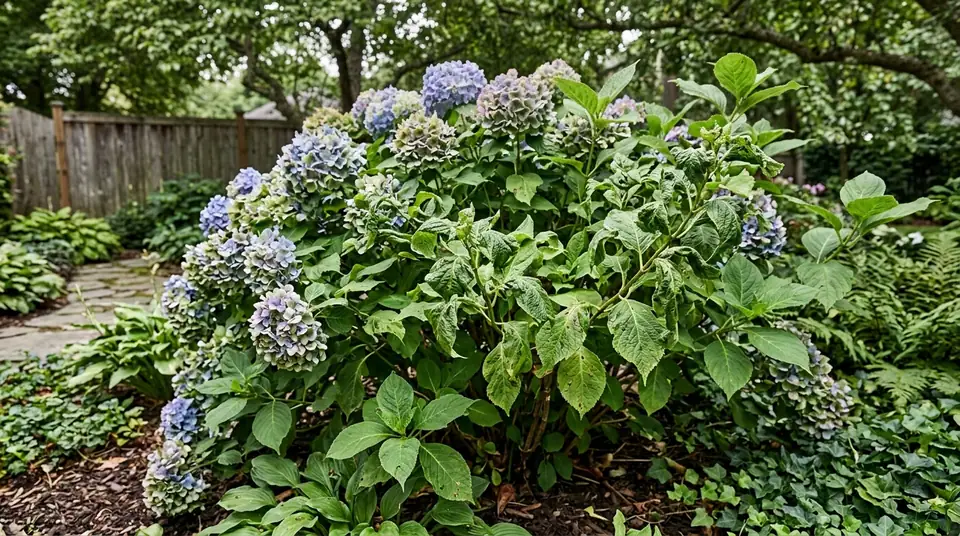
Lush hydrangea shrub with drooping blooms and curled leaves in a garden bed
5. Frequently Asked Questions
Why are my hydrangea leaves curling upward into tight cups?
Upward curling combined with dry, crispy leaf margins is the classic sign of moisture stress and excessive heat. When the roots cannot supply water fast enough to match transpirational loss in the sun, the leaf cells lose turgor pressure and roll inward to conserve moisture. Check your soil moisture 2 inches (5 cm) down; if it is dry, initiate a deep watering schedule immediately.
Can overwatering cause hydrangea leaves to curl?
Yes. While underwatering causes dry, crispy curls, overwatered or waterlogged hydrangeas suffer from root rot. When roots drown in compacted, poorly drained soil, they suffocate and die, rendering them unable to transport water to the canopy. This mimics drought stress, causing leaves to feel limp, cup downward, and turn pale green or yellow before curling and dropping off.
Will curled hydrangea leaves uncurl once I water them?
Mildly wilted or cupped leaves will often recover and flatten out within 12 to 24 hours after a thorough, deep watering. However, if the leaf margins have already turned brown, crisp, or necrotic, those damaged cells will not regenerate. Prune off severely damaged leaves to tidy the plant's appearance and allow the energy to be redirected toward fresh, healthy growth.
How do I know if pests are causing my hydrangea leaves to curl?
Turn the curled leaves over and inspect the undersides closely. If you see sticky residue (honeydew), tiny green or black insects, fine webbing, or stippling (tiny white dots), pests are likely the cause. Aphids and spider mites are the primary culprits behind distorted, curled foliage on hydrangeas. Wash them away with a strong spray of water and treat with insecticidal soap if the population persists.
Related Guides
- Indoor Plant Leaves Curling Inward
- Money Tree New Leaves Drooping
- Why is My Money Tree Dropping Leaves
- Why is My Money Tree Leaves Drooping
- Trees with Round Leaves
📋 Table of Contents ▼ Click to expand
Tags:
Keep reading
🌿 Related Plants You Might Like



PlantSavvyWorld
Editorial team
PlantSavvyWorld is an independent botanical education project. Articles are drafted with AI assistance, then edited and checked against university extension services, botanical garden collections and other published horticultural sources.