

When to Water After Granular Fertilizer
Written with AI assistance, edited and checked against horticultural sources.
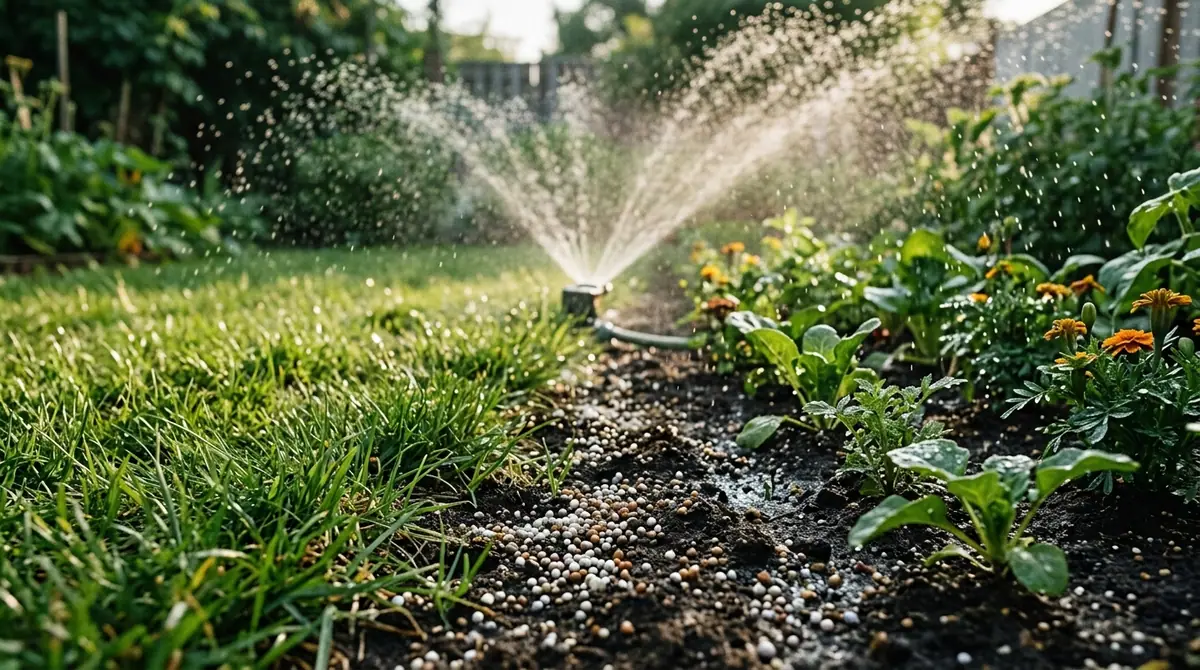
Last Tuesday, while walking a gardener through their newly established perennial border in Zone 7b, I noticed a chalky white crust forming around the base of their prize hydrangeas. The gardener had broadcasted a heavy layer of slow-release granular 10-10-10 fertilizer three days prior, completely omitting the post-application irrigation step. The result? Chemical leaf burn along the lower foliage margins and un-dissolved fertilizer prills sitting uselessly on top of baked, hydrophobic soil. Granular fertilizers are an exceptional tool in landscape design, but their efficacy hinges entirely on a single, frequently botched metric: timing your water.
1. Botanical Overview & Natural Habitat

When we apply synthetic or organic granular fertilizers, we are artificially concentrating mineral salts (nitrogen, phosphorus, potassium, and micronutrients) into dry solid forms. In their native habitats—whether the rich, damp floor of a temperate deciduous forest or the arid, nutrient-pulsed soils of chaparral biomes—plants rely on rain events to dissolve these deposits. Without moisture, granular fertilizers are chemically inert and physically hazardous.
The soil profile acts as a complex exchange medium. Cation Exchange Capacity (CEC) measures how well soil can retain and exchange positively charged nutrient ions like calcium ($Ca^{2+}$), magnesium ($Mg^{2+}$), and potassium ($K^{+}$). Sandy soils possess a low CEC (often 1 to 5 meq/100g), meaning they let nutrients wash right through them. Clay and organic-rich loam soils boast a high CEC (20 to 50+ meq/100g), holding onto nutrients tightly. When you add granular fertilizer without immediate or delayed watering depending on the formulation, you disrupt this delicate chemical balance. Dry granules sitting on the surface volatilize nitrogen into the atmosphere as ammonia gas, losing up to 40% of their nutritive value within 4 days if temperatures exceed 85°F (29°C) and soils are bone dry. Furthermore, high concentrations of undissolved salts create a hypertonic environment. Water rushes out of the plant roots through osmosis to balance the solute concentration, resulting in physiological drought, cell collapse, and classic fertilizer burn.
2. Essential Environmental & Care Requirements
Mastering the mechanics of when to water after granular fertilizer requires balancing soil moisture, ambient temperature, microbial activity, and root zone depth.
| Parameter | Optimal Condition | Common Mistake | Why It Matters |
|---|---|---|---|
| Post-Application Irrigation Volume | 0.5 to 0.75 inches (1.2 to 1.9 cm) of water | Dribbling the surface with a spray bottle or flooding past 3 inches (7.6 cm) | Too little leaves salts stranded at the surface; too much leaches nitrates below the root zone. |
| Timing Window | Within 24 hours of application (immediate for quick-release; up to 48 hours for slow-release) | Waiting 4 to 7 days in dry weather | Delayed watering leads to nitrogen volatilization and localized root dehydration. |
| Soil Temperature | 55°F to 85°F (13°C to 29°C) | Applying during a freeze or heatwave above 90°F (32°C) | Microbial breakdown stalls in cold soils; high heat combined with dry fertilizer accelerates salt burn. |
| Root Zone Target Depth | Upper 6 to 8 inches (15 to 20 cm) for established plantings | Applying surface pellets without incorporating into the top 1 inch (2.5 cm) | Nutrients must reach active feeder roots rather than sitting idle on top of the mulch layer. |
Understanding soil temperature and moisture dictates whether your fertilizer will feed your plants or poison them. For instance, when designing edible kitchen gardens, timing is everything. If you are timing your seasonal crops—such as figuring out When to Plant Carrots in Zone 8a or deciding When to Plant Beets in Utah—you must prep your soil fertility weeks in advance. Applying high-nitrogen granules right next to tender, newly germinated root crops will cause severe root distortion and fork-rooting due to salt shock.
Similarly, when transitioning heavy feeders into the ground, like working out When to Transplant Tomatoes or timing When to Plant Brussel Sprouts in Zone 7, granular amendments must be thoroughly worked into the soil profile and watered down to a depth of 6 inches (15 cm) at least 5 to 7 days before the transplant date. This prevents "hot spots" of concentrated fertilizer from burning vulnerable, newly cut root systems.
3. Step-by-Step Cultivation, Feeding & Propagation
Applying granular fertilizer correctly is a methodical engineering process. Follow this exact sequence to ensure maximum nutrient uptake without root damage.
- Assess Soil Moisture Baseline: Check the top 2 inches (5 cm) of soil with your finger or a moisture meter. The soil should be moderately moist—never bone dry and never waterlogged. If the soil is parched, apply a light pre-watering 24 hours before fertilizing to prep the soil colloids.
- Calculate Application Rates: Measure your square footage and weigh your granular fertilizer strictly according to product label instructions. Over-application cannot be fixed with extra water and will ruin your soil microbiology.
- Incorporate or Distribute: Broadcast the granules evenly around the drip line of your plants, keeping them at least 3 to 6 inches (7.5 to 15 cm) away from direct contact with woody stems, tree trunks, or crown foliage. For garden beds, lightly rake the granules into the top 0.5 inches (1.3 cm) of soil to prevent surface runoff and caking.
- Execute Immediate Post-Application Irrigation: Turn on your irrigation system, soaker hose, or hand-wand. Deliver exactly 0.5 inches (1.2 cm) of water uniformly across the treated area. You can measure this by placing a straight-sided tuna can under your watering zone.
- Monitor and Hold: Check the soil daily for the next 3 days. Ensure the top 3 inches (7.6 cm) retain consistent moisture without becoming soggy. Avoid heavy supplemental watering that could leach nutrients past the 12-inch (30 cm) root zone.
💡 Pro-Tip: If you are managing warm-season turfgrass or ornamental borders during a dry summer spell, always choose an uncoated sulfur-coated urea or polymer-coated slow-release fertilizer. Water it in immediately with 0.75 inches (1.9 cm) of water to activate the release mechanism safely, and avoid fertilizing altogether if daytime temperatures are forecasted to exceed 90°F (32°C) for three consecutive days.
When expanding your edible landscape—such as planning When to Plant Bok Choy Zone 7 or figuring out When to Plant Pumpkins in Southern California—incorporate your granular organic or synthetic fertilizers during the final tillage stage, ensuring they are deeply integrated and irrigated thoroughly before any seeds or plugs go into the dirt. For deeper guidance on plant nutrition and soil science principles, consult the Royal Horticultural Society Soil and Fertilizers Guide and the University of California Integrated Pest Management Program.
4. Common Problems, Pests & Troubleshooting
Even experienced landscapers occasionally misjudge fertilizer and water schedules. Here is how to diagnose and correct the most common failures:
- Symptom: Marginal Leaf Burn and Scorching
- Cause: Granular fertilizer was applied to dry soil and left unwatered, or direct contact occurred between the fertilizer prills and the plant crown.
- Correction: Flush the soil immediately with a heavy, slow soak (1 inch / 2.5 cm of water) to drive the excess salts deep past the root zone. Prune away severely scorched foliage to prevent secondary fungal infections.
- Symptom: Algae Crust and White Powder on Soil Surface
- Cause: Over-watering immediately after applying a heavy chemical fertilizer, causing nutrients to float to the top and crystallize as the sun bakes the surface.
- Correction: Break up the surface crust gently with a hand cultivator to improve gas exchange, and reduce watering frequency while maintaining proper volume.
- Symptom: Sudden Yellowing (Chlorosis) Despite Recent Fertilizing
- Cause: Under-watering. The granules are sitting dry on top of the soil or mulch layer, meaning zero nitrogen has dissolved into the root zone.
- Correction: Water the area thoroughly right away. If using a slow-release product encased in sulfur or resin, check if the coating has hardened due to extreme drought; if so, scratch the granules into the soil and irrigate deeply.
⚠️ Important Caution: Never apply granular fertilizers to frozen or snow-covered ground. When the snow melts, the high concentration of nitrogen and phosphorus will run off directly into local storm drains, creeks, and ponds, causing severe aquatic eutrophication and algae blooms while starving your plants of needed nutrients.

5. Frequently Asked Questions
What happens if I don't water after putting down granular fertilizer?
If you fail to water after applying granular fertilizer, the product remains chemically inactive and stranded on the soil surface. Quick-release nitrogen fertilizers will lose significant amounts of nitrogen to the atmosphere via volatilization within days. Furthermore, if rain eventually hits the dry granules without proper soil integration, the sudden high concentration of soluble salts will draw moisture directly out of your plant roots, causing severe chemical burn and root desiccation.
Can I just let the rain water in my granular fertilizer?
Relying entirely on natural rain is risky unless you are 100% certain a steady, gentle rain of at least 0.5 inches (1.2 cm) will fall within 12 to 24 hours of your application. If a forecasted storm turns into a torrential downpour, the rushing water will wash your un-dissolved granules right off your garden beds, eroding your soil and polluting local waterways. If a light, scattered shower occurs instead, it may only wet the surface, dissolving the outer shell of the fertilizer without pushing the nutrients down to the root zone, creating a crust.
How long can granular fertilizer sit before it must be watered?
As a general rule, quick-release synthetic granular fertilizers should be watered within 12 to 24 hours. Slow-release or polymer-coated fertilizers offer a slightly wider window, typically up to 48 hours, because their protective coatings prevent immediate high-salt spikes. However, leaving any fertilizer unwatered for more than two days during dry, warm weather significantly reduces its effectiveness and increases the risk of surface volatilization.
How much water do I need to apply after granular fertilizer?
You should apply roughly 0.5 to 0.75 inches (1.2 to 1.9 cm) of water immediately after spreading granular fertilizer. For hand-watering with a hose, this generally translates to a steady, deep soak for about 15 to 20 minutes per zone, ensuring the water penetrates down through the top 6 inches (15 cm) of soil where the primary feeder roots reside. Avoid using a high-pressure nozzle blast that will dislodge and pool the granules into dense clumps.
Related Guides
- Fertilizer for Daylilies
- Fertilizer for Plumerias
- How to Use Coffee Grounds As Organic Fertilizer for Tomatoes
- Can Cannas Grow in Water
- Water Hibiscus Plant
📋 Table of Contents ▼ Click to expand
Tags:
Keep reading
🌿 Related Plants You Might Like






PlantSavvyWorld
Editorial team
PlantSavvyWorld is an independent botanical education project. Articles are drafted with AI assistance, then edited and checked against university extension services, botanical garden collections and other published horticultural sources.