

When to Start Strawberries Indoors
Written with AI assistance, edited and checked against horticultural sources.
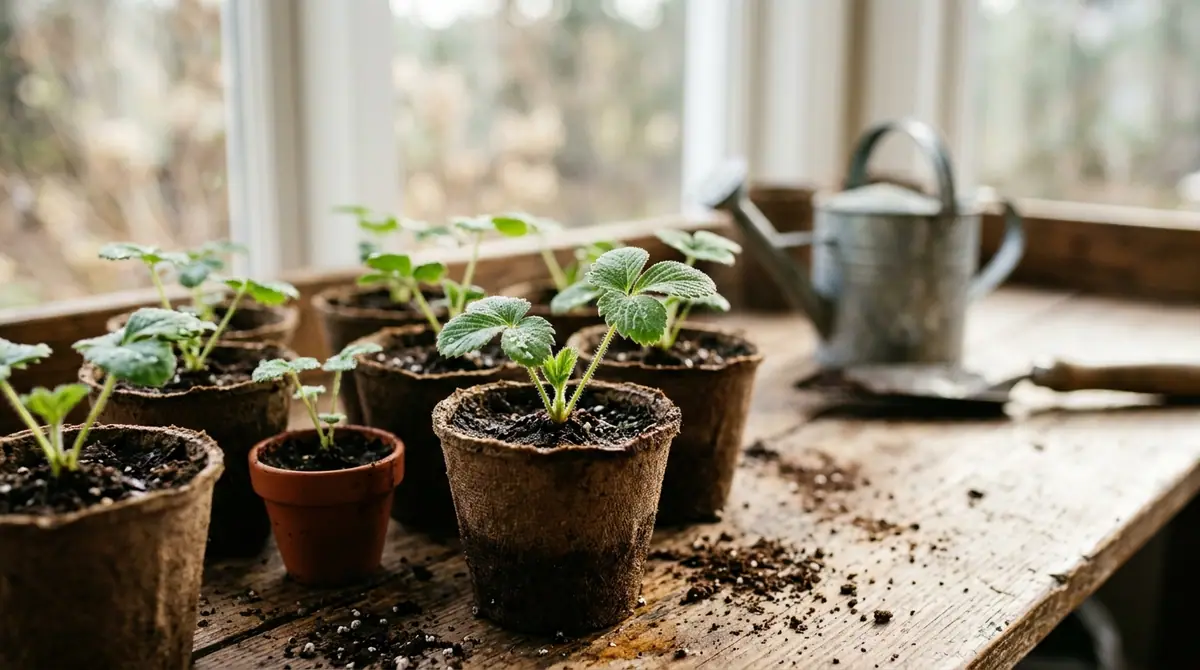
'Alexandria' alpine strawberry seeds are so tiny they look like specks of ground pepper. Starting them too early indoors leaves growers wrestling with leggy, root-bound seedlings beneath weak spring windowsills, while starting them too late means missing out on that precious first-year harvest. Timing the indoor start for strawberries comes down to working backward from your region's final spring frost date, accounting for a notoriously slow germination window and a deliberate juvenile phase.

1. Botanical Overview & Natural Habitat
Cultivated strawberries (Fragaria × ananassa) and their alpine ancestors (Fragaria vesca) belong to the Rosaceae family. Botanically speaking, what we call the fruit is actually an enlarged receptacle tissue dotted with dry, single-seeded fruits known as achenes—those tiny exterior specs that confuse so many indoor growers.
In their natural woodland and meadow habitats, wild strawberries rely on a winter chilling requirement, or vernalization, followed by lengthening spring photoperiods and rising soil temperatures to break dormancy, flower, and set fruit. When we grow strawberries from seed indoors, we are artificially replicating these wild signals. We must mimic the cool winter transition, provide optimal light, and manage a seed coat that requires light to trigger germination. Understanding this wild ancestry dictates our indoor calendar: because strawberry seedlings develop slowly during their first eight to ten weeks, you must initiate seeds indoors 10 to 12 weeks before your area's average last spring frost date. This typically places the indoor start window between January and mid-March, depending entirely on your USDA Hardiness Zone.
2. Essential Environmental & Care Requirements
To successfully take strawberries from indoor trays to thriving garden transplants, you must dial in your indoor microclimate. Strawberry seeds and young seedlings have zero tolerance for erratic moisture or heavy, waterlogged soils.
You need a sterile, fine-textured seed-starting medium composed primarily of peat moss, coco coir, and perlite. Avoid dense garden soil, which compacts easily and suffocates delicate root hairs. Ambient indoor temperatures should remain steady between 65°F and 70°F (18°C to 21°C) during germination, dropping slightly to 60°F to 65°F (15°C to 18°C) once true leaves emerge.
Light is perhaps the most critical factor. Strawberry seeds require light exposure to break dormancy, meaning you should press them gently onto the surface of your growing medium rather than burying them deep. Once sprouted, they demand 14 to 16 hours of high-intensity LED grow lighting daily, positioned 2 to 4 inches (5 to 10 cm) above the foliage to prevent stretching.
| Parameter | Optimal Condition | Common Mistake | Why It Matters |
|---|---|---|---|
| Germination Temp | 65°F – 70°F (18°C – 21°C) | Placing trays in cold, dark basements | Cold prevents enzymatic activation; darkness inhibits light-sensitive seeds. |
| Seed Depth | Surface sown (0 inches / 0 cm) | Burying seeds 0.25 inches (0.6 cm) deep | Deep burial starves the achenes of light, halting germination. |
| Light Duration | 14 – 16 hours daily | Relying on weak north-facing windowsills | Insufficient light yields leggy, weak seedlings prone to damping-off. |
| Soil pH | 5.5 to 6.5 | Using alkaline or unamended heavy garden loam | High pH locks out essential micronutrients like iron and manganese. |
For authoritative guidance on testing and adjusting your soil pH for optimal berry production, consult the Oregon State University Extension Service, which provides rigorous horticultural data on small fruit establishment.
3. Step-by-Step Cultivation, Feeding & Propagation
Starting strawberries from seed requires patience, meticulous timing, and a steady hand. Follow this proven protocol to take your plants from tiny achenes to robust garden-ready specimens.
- Calculate Your Timeline: Count backward 10 to 12 weeks from your average last spring frost date. For Zone 6, this usually means starting seeds in early February.
- Prepare the Trays: Fill sterile plug trays or shallow flats with your pre-moistened coco coir and perlite seed-starting mix. Tamp the surface lightly to create a firm, flat bed.
- Sow the Seeds: Scatter the tiny strawberry seeds across the surface of the medium. Press them down gently with a dry finger or the flat bottom of a glass to ensure good seed-to-soil contact, but do not cover them with soil.
- Provide Stratification (Optional): If your seed packet notes low germination rates, place the sown, covered trays in a refrigerator at 34°F to 38°F (1°C to 3°C) for 14 to 21 days before moving them to warmth to break deep dormancy.
- Maintain Moisture & Humidity: Cover the trays with a clear humidity dome or plastic wrap to lock in moisture. Mist the surface daily with a fine-spray bottle using room-temperature water. Never let the surface dry out.
- Germination & Lighting: Watch for sprouts in 14 to 30 days. The moment you see green, remove the humidity dome and turn on your grow lights, keeping them 2 to 4 inches (5 to 10 cm) above the seedlings for 16 hours a day.
- Prick Out and Pot Up: When seedlings develop two sets of true leaves (usually around week 6), carefully transplant them individually into 2-inch (5 cm) pots using a slightly richer potting mix.
- Begin Weak Feeding: At week 8, feed the seedlings every two weeks with a balanced organic liquid fertilizer diluted to one-quarter strength.
- Harden Off: Two weeks before your target outdoor planting date, begin the hardening-off process by moving the plants outdoors to a sheltered, shady spot for a few hours a day, gradually increasing their exposure to direct sunlight and wind.
💡 Pro-Tip: Strawberry seeds require patience; do not panic if you see zero action on day 10. While tomato seeds pop up in a week, strawberry achenes can take up to a full month to break dormancy. Keep the surface consistently moist and keep your lights on schedule—perseverance is the secret to high germination rates.
⚠️ Important Caution: Never bury strawberry seeds below the soil surface during sowing. Unlike beans or squash, strawberry seeds are photoblastic, meaning they require a direct interaction with light to signal the embryo that it is safe to break dormancy. Burying them even 0.1 inches (0.25 cm) deep can cause permanent dormancy failure.
For additional insight into how delicate root systems behave during these early transitions, you can review my methodologies in When to Transplant Cucumber Seedlings: Stop Root Shock & Boost Growth.
4. Common Problems, Pests & Troubleshooting
Indoor strawberry propagation is not without its hurdles. Because seedlings spend weeks under high humidity domes and warm lights, they are prime candidates for fungal pathogens and physiological disorders.
Damping-off disease is the single greatest threat to indoor strawberry starts. Caused by soil-borne fungi like Pythium or Rhizoctonia, it strikes at the soil line, causing the delicate stem to turn translucent, pinch inward, and topple over. To prevent this, always use sterile containers, ensure your growing medium is well-drained, and run a small oscillating fan near your propagation trays to maintain continuous air circulation. If you notice white fungal threads or sudden seedling collapse, immediately remove affected plants, back off on watering, and dust the soil surface with pharmaceutical-grade cinnamon, which possesses natural antifungal properties.
Another common issue is chlorosis—yellowing of the new leaves while the veins remain green. This is almost always a sign of iron deficiency caused by an incorrect soil pH or overwatering, which locks out nutrient uptake. Check that your potting mix pH sits comfortably between 5.5 and 6.5, and allow the top 0.5 inches (1.3 cm) of soil to dry out between waterings.

5. Frequently Asked Questions
Can I start strawberry seeds indoors in January?
Yes, you can start strawberry seeds indoors in January if you live in a colder climate (USDA Zones 4 through 6) where your last spring frost does not occur until mid-to-late May. Starting in January provides the long 10-to-12-week runway these slow-growing seedlings require to establish a robust root system before outdoor transplanting. If you live in a warmer climate (Zones 8 through 10), starting in January is unnecessary and will result in overgrown, stressed indoor plants; growers in warmer zones should instead start seeds between November and December or purchase dormant bare-root crowns.
Why are my indoor strawberry seedlings growing so tall and skinny?
Leggy, stretched-out strawberry seedlings are a direct indicator of insufficient light intensity or lights positioned too far away from the canopy. When seedlings have to stretch to find photons, their stems weaken and they become highly susceptible to lodging and damping-off. Ensure your LED or T5 fluorescent grow fixtures are hung precisely 2 to 4 inches (5 to 10 cm) above the foliage and run them for 14 to 16 hours every single day. If your fixtures cannot be adjusted, lower the trays by placing blocks underneath them until the correct distance is achieved.
Do I need to chill strawberry seeds in the fridge before planting?
While modern day-neutral and alpine strawberry cultivars will germinate at room temperature without cold treatment, cold stratification significantly improves overall germination rates for many traditional June-bearing varieties. To stratify your seeds, sow them onto moist soil in your seed tray, seal the entire tray inside a plastic bag, and place it in your refrigerator (34°F to 38°F / 1°C to 3°C) for 14 to 21 days. After this chilling period, move the tray directly to a warm, brightly lit indoor setup (65°F to 70°F / 18°C to 21°C) to trigger synchronized sprouting.
How many true leaves should my strawberry plants have before I transplant them outdoors?
Your indoor-started strawberry seedlings should have at least 4 to 6 fully developed true leaves and a sturdy stem roughly the thickness of a pencil lead before you attempt to transplant them into the garden. This developmental threshold is typically reached 10 to 12 weeks after germination. Rushing the outdoor move before the root system has filled a 3-inch (7.5 cm) container will leave the plants vulnerable to transplant shock, wind damage, and soil-borne pathogens. Always complete a 7-to-10-day hardening-off process to acclimate them to outdoor UV rays and temperature fluctuations before digging final holes in your landscape beds.
Related Guides
- How to Grow Strawberries from a Strawberry Indoors
- When to Start Tomatoes Indoors Zone 6
- When to Start Tomato Seeds Indoors Zone 6
- When to Start Stock Seeds Indoors
- When to Start Squash Seeds Indoors
- When to Plant Strawberries in Tennessee
- When to Plant Strawberries in Seattle
- When to Plant Strawberries in Arkansas
📋 Table of Contents ▼ Click to expand
Tags:
Keep reading
🌿 Related Plants You Might Like

PlantSavvyWorld
Editorial team
PlantSavvyWorld is an independent botanical education project. Articles are drafted with AI assistance, then edited and checked against university extension services, botanical garden collections and other published horticultural sources.