
When to Start Cabbage Seeds Indoors
Written with AI assistance, edited and checked against horticultural sources.
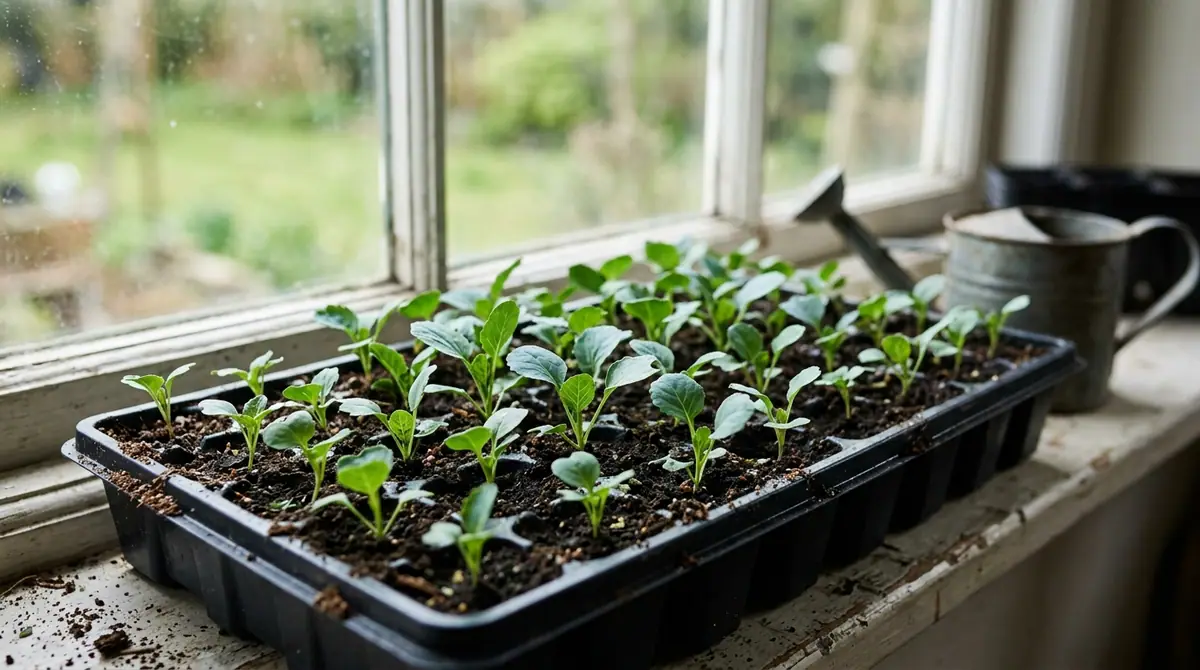
I was scraping damp potting mix off my fingernails last March, staring out at a landscape still locked in frozen gray mud, when I realized my first batch of spring cabbage seedlings had gone completely translucent and leggy. I had started them four weeks too early on a dim windowsill, forcing them to stretch desperately for weak sunlight while temperatures indoors baked them at a cozy 75°F (24°C). That painful batch of weak, spindly stems taught me a definitive lesson that I preach today on PlantSavvyWorld: mastering when to start cabbage seeds indoors is entirely about balancing your local last-frost date with a precise countdown clock. Get the timing wrong, and your brassicas will either suffer root-lock in tiny cell trays or bolt before they ever form a proper, dense head.
1. Botanical Overview & Natural Habitat

Unlike heat-loving crops that require indoor setups months in advance—similar to how you might approach warm-season crops or even when timing how to germinate eggplant seeds fast: heat, moisture & 7-day protocol—cabbage demands a much tighter window. Because cabbages transition through a vegetative rosette phase before tight leaf layers compress into a terminal head, planting them out too late in spring exposes the maturing heads to high summer temperatures that trigger bitter flavors and premature bolting. Conversely, starting them too early means your indoor lights cannot match full solar radiation, resulting in weak stems vulnerable to damping-off fungi.
Understanding this wild heritage allows us to reverse-engineer the ideal indoor schedule. Cabbage seeds germinate rapidly in cool to moderate soil, and seedlings develop robust root systems remarkably fast. For a standard spring harvest, you should calculate backwards from your average last spring frost date and start your seeds indoors precisely 4 to 6 weeks before that benchmark. For a reliable autumn or winter harvest in milder climates, seeds are sown directly outdoors or started in mid-summer, much like the precision needed when tracking when to plant onions in southern california (zone 9 & 10 planting calendar) or scheduling crops using regional frameworks like when to plant strawberries in kansas: zone 6a/6b seasonal calendar.
| Parameter | Optimal Condition | Common Mistake | Why It Matters |
|---|---|---|---|
| Indoor Seed Timing | 4 to 6 weeks before last frost | Starting 10+ weeks early | Prevents root-bound, leggy, woody transplants |
| Germination Temp | 45°F to 85°F (7°C to 29°C) | Keeping trays above 85°F (29°C) | Extreme heat drastically reduces emergence rates |
| Growing-On Temp | 55°F to 60°F (13°C to 15°C) | Placing in warm, dark living rooms | Cool air prevents leggy, weak stem elongation |
| Seed Sowing Depth | 0.25 to 0.5 inches (0.6 to 1.3 cm) | Burying deeper than 1 inch (2.5 cm) | Deep planting starves the cotyledons of required light energy |
| Transplant Hardening | 7 to 10 days of gradual exposure | Direct move from indoors to full gale | Prevents sunscald, wind snap, and physiological shock |
2. Essential Environmental & Care Requirements
Creating the microclimate required to grow stout, vigorous cabbage transplants requires deliberate control over three variables: light intensity, ambient temperature, and root-zone moisture.
Light is the single most frequent point of failure for indoor growers. Cabbage seedlings require a minimum of 14 to 16 hours of intense light daily. Standard window sills—even south-facing ones during late winter—fail to deliver the lumen output necessary to keep stems short and stocky. Suspend full-spectrum LED shop lights 2 to 3 inches (5 to 7.5 cm) above the top of the foliage, raising the fixtures daily as the plants gain height. If you notice your seedlings leaning or looking pale, they are starving for photons.
Temperature management is equally critical. While seeds germinate fastest at 70°F to 75°F (21°C to 24°C), the moment those green loops break the soil surface, you must drop the ambient room temperature down to 55°F to 60°F (13°C to 15°C) during the day and down to 45°F to 50°F (7°C to 10°C) at night. This cooling-off period mimics early spring conditions, signaling to the plant that it is safe to bulk up its stem diameter rather than racing upward.
Soil moisture must remain consistent without crossing into waterlogged stagnation. Use a sterile, fine-textured seed-starting mix composed primarily of peat moss, vermiculite, and perlite. Heavy garden soil will compact in cell trays, suffocating delicate root hairs and inviting fungal pathogens. When watering, bottom-water your seed trays by setting them in a shallow basin of water for 20 minutes, allowing the soil medium to wick moisture upward before draining completely.
To deepen your understanding of brassica physiology and regional cultivation schedules, consult the comprehensive guides provided by the University of Minnesota Extension on vegetable crop management.
3. Step-by-Step Cultivation, Feeding & Propagation
Growing exceptional cabbages indoors is a mechanical process that rewards precision and strict adherence to a timeline. Follow this exact sequence to ensure your transplants are primed for rapid garden establishment.
- Calculate Your Sowing Window: Locate your region's average last spring frost date. Count backward precisely 35 to 42 days (5 to 6 weeks). This is your target weekend for sowing.
- Prepare the Trays and Medium: Fill clean, sanitized multi-cell seed trays (with individual cell volumes of at least 2 cubic inches) with pre-moistened seed-starting mix. Press the soil down gently to eliminate large air pockets.
- Sow the Seeds: Drop one or two seeds per cell at a depth of 0.25 to 0.5 inches (0.6 to 1.3 cm). Cover lightly with vermiculite or fine-sifted mix to retain surface moisture.
- Initiate Germination: Mist the surface lightly with a spray bottle, cover the trays with a clear plastic humidity dome to trap vapor, and place them in a warm area. Check daily; emergence typically occurs within 3 to 10 days at 65°F (18°C).
- Adjust Environment Post-Emergence: The second you see green loops emerge, remove the humidity dome immediately, place the trays directly under your grow lights, and drop the room temperature to 55°F to 60°F (13°C to 15°C).
- Thin to One Strong Seedling: When the first true leaves appear (roughly 14 days after sowing), use sterile snips to clip away the weaker seedling in any cell where two sprouted. Never pull them out, as tugging disturbs the root system of the remaining plant.
- Initiate Gentle Feeding: Once true leaves are established, dilute a balanced, water-soluble organic fertilizer to one-quarter strength and apply it via bottom-watering once every 10 to 14 days.
- Harden Off the Transplants: Seven to ten days before your planned outdoor planting date, begin moving your seedlings outside for a few hours daily into a sheltered, shady spot. Gradually increase their exposure to direct sunlight and wind until they can stay outside overnight.
- Transplant into the Garden: Plant your hardened-off seedlings deep—burying them up to the base of their first true leaves—spaced 12 to 18 inches (30 to 45 cm) apart in nutrient-rich, well-draining garden soil enriched with aged compost.
💡 Pro-Tip: If your indoor cabbage seedlings begin to look slightly pale or yellow before it is time to plant them out, do not panic and blast them with heavy synthetic fertilizers. Instead, give them a single dose of liquid kelp extract. The natural cytokinins in kelp stimulate lateral root branching and chlorophyll production without pushing weak, sappy top-growth that will struggle during the transition to the garden.
For growers expanding their indoor seed-starting operations to include root crops or perennials, proper timing and handling are equally vital, whether you are managing delicate berry stock like how to grow strawberries indoors: from fruit seeds to sweet berries or orchestrating vegetative transitions similar to when to transplant cucumber seedlings: stop root shock & growth.
4. Common Problems, Pests & Troubleshooting
Even with careful planning, indoor seed starting presents biological hurdles. Identifying issues early allows you to correct course before your crop is compromised.
- Leggy, Stretched Stems: If your seedlings look like spindly threads, your lights are too far away, or your ambient room temperature is too high. Lower your grow lights to 2 inches (5 cm) above the foliage, add a small oscillating fan to run on low speed to simulate wind stress (which thickens stems), and turn down the thermostat.
- Damping-Off Fungus: If seedlings suddenly pinch at the soil line and collapse overnight, soil-borne fungi (Pythium or Rhizoctonia) have attacked. This is caused by stagnant air and over-saturated soil. Prevent this by using sterile mix, bottom-watering, running a fan for air circulation, and never reusing old trays without a thorough wash in a 10% bleach solution.
- Purple-Tinted Leaves: A purplish hue on the underside of the leaves or stems usually indicates a phosphorus deficiency caused by cold potting mix that locks up nutrient uptake. Ensure your growing area stays above 50°F (10°C) at night.
- Fungus Gnats: Tiny black flies buzzing around your seed trays indicate that the top layer of your soil is staying too wet. Let the top 0.5 inches (1.3 cm) of the soil dry completely between waterings, and apply mosquito bits (containing Bacillus thuringiensis israelensis) soaked in your watering water to kill the larvae.
⚠️ Important Caution: Never harden off your cabbage seedlings by placing them directly into freezing sub-32°F (0°C) winds or baking midday sun on day one. A sudden swing from a climate-controlled indoor room to harsh outdoor elements will cause severe leaf scorch, cell rupture, and check plant growth permanently, making them prime targets for flea beetles once planted out.

5. Frequently Asked Questions
Can I direct sow cabbage seeds outdoors instead of starting them indoors?
Yes. Direct sowing is entirely viable, especially for autumn crops or in regions with long, cool springs. Plant seeds directly in the garden 2 to 3 weeks before your average last frost date at a depth of 0.25 to 0.5 inches (0.6 to 1.3 cm). However, starting them indoors gives you a crucial head start, protecting fragile germinating seeds from torrential spring rains, soil crusting, and ravenous pests like flea beetles and slugs.
What temperature is too cold for cabbage seedlings?
Hardened cabbage seedlings are remarkably tough and can easily tolerate light frosts down to 25°F (-4°C) once they are established in the garden. However, unhardened indoor seedlings that have never experienced wind or cold are vulnerable. Never expose tender indoor starts to temperatures below 40°F (4°C) without a proper 7-to-10-day hardening-off period.
Why are my indoor cabbage seedlings growing tall and falling over?
This is the classic symptom of insufficient light coupled with excessive warmth. When plants do not receive enough photons, they accelerate their vertical growth in a desperate search for light, resulting in weak, etiolated stems that cannot support their own weight. Remedy this immediately by lowering your LED grow lights to within 2 to 3 inches (5 to 7.5 cm) of the leaves and cooling the room down.
How do I know when my cabbage transplants are ready for the garden?
Your cabbage seedlings are ready for outdoor relocation when they are 4 to 6 weeks old, possess 3 to 4 true leaves (not counting the initial smooth cotyledons), and feature a robust root system that holds the potting mix together in a solid plug when gently popped out of its cell. Do not wait until they become root-bound in small trays, as severely root-restricted brassicas will stunt and bolt prematurely when summer heat arrives.
Related Guides
- When to Start Tomatoes Indoors Zone 6
- When to Start Tomato Seeds Indoors Zone 6
- When to Start Strawberries Indoors
- When to Start Stock Seeds Indoors
- When to Start Squash Seeds Indoors
📋 Table of Contents ▼ Click to expand
Tags:
Keep reading
🌿 Related Plants You Might Like
PlantSavvyWorld
Editorial team
PlantSavvyWorld is an independent botanical education project. Articles are drafted with AI assistance, then edited and checked against university extension services, botanical garden collections and other published horticultural sources.