

Japanese Maple in Texas
Written with AI assistance, edited and checked against horticultural sources.
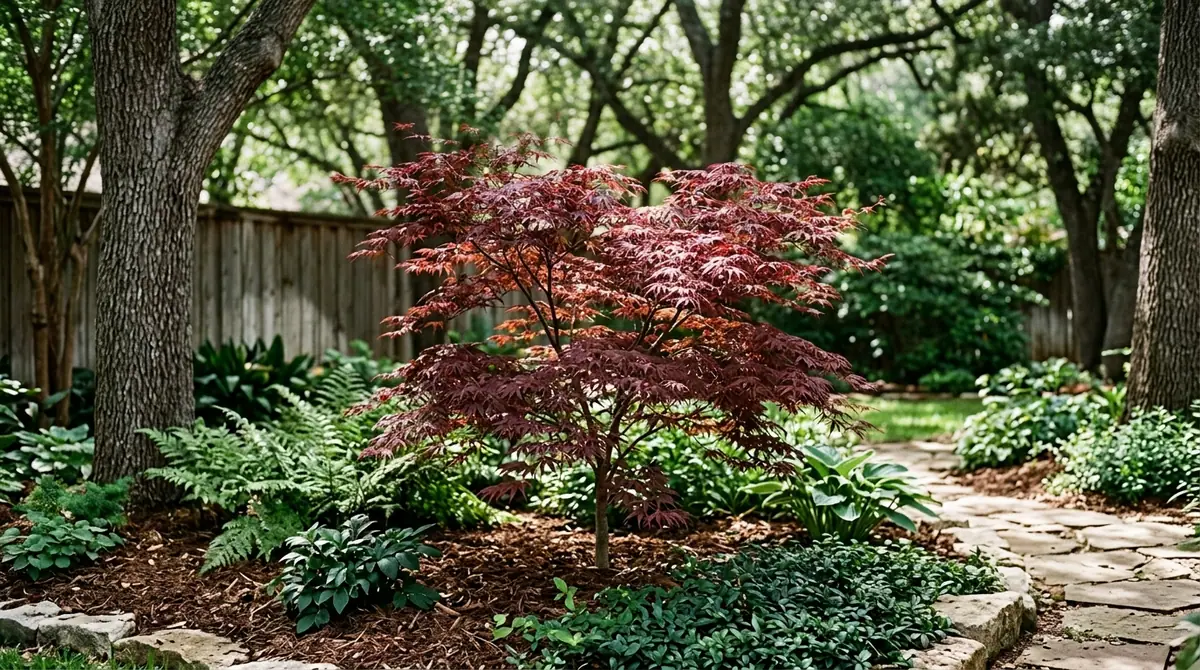
The midday sun in Central Texas was blasting down at 98°F (36.6°C), and my prized Acer palmatum 'Bloodgood' was literally sizzling. I had planted it too close to a south-facing limestone wall, ignoring my own rules, and within four hours, the delicate crimson leaves had turned crispy brown at the edges like overcooked bacon. That heartbreak taught me everything I needed to know about bridging the gap between lush Pacific Northwest woodland plants and the brutal, unforgiving microclimates of the Lone Star State. I’ve spent the last two decades figuring out how to keep these exquisite trees alive through triple-digit summers. Here is your definitive, field-tested guide to growing a stunning Japanese maple in Texas.
1. Botanical Overview & Natural Habitat

Translating this understory adaptation to Texas requires understanding our drastic environmental shifts. In Texas—which spans USDA Hardiness Zones 6a through 9b—these maples face severe challenges. If you are gardening further south, you might wonder What Zone is San Antonio Texas for Plants, where intense heat requires hyper-vigilant site selection.
Botanically, Japanese maples are categorized by their leaf morphology and growth habits. We generally divide them into five groups:
- Dissectum: Finely laciniate, weeping habits that cascade gracefully.
- Linearilobum: Starfish-like leaves with long, ribbon-like lobes.
- Palmatum: The classic, 5-to-7 lobed upright trees.
- Square-stemmed (Matsukazeyama): Distinctive ridged stems.
- Dwarf/Semi-dwarf: Slow-growing cultivars topping out under 6 feet (1.8 meters) at maturity.
To successfully integrate these trees into your property, you should review comprehensive regional design strategies like those found in Texas Landscaping Ideas, ensuring your maple acts as a protected focal point rather than an exposed casualty.
2. Essential Environmental & Care Requirements
Growing a Japanese maple in Texas is an exercise in microclimate management. You must recreate the cool, filtered light and moist soil of an Asian mountain forest right in the middle of a blazing southern landscape.
| Parameter | Optimal Condition | Common Mistake | Why It Matters |
|---|---|---|---|
| Light Exposure | Morning sun (2-4 hours) with strict afternoon shade | Planting in full, all-day southern or western sun | Intense afternoon radiation scorches leaf margins and dehydrates the canopy. |
| Soil pH | 5.5 to 6.5 (Slightly acidic) | Planting directly into alkaline Texas limestone clay (pH 7.8+) | High pH locks out iron, causing severe chlorosis and stunted root growth. |
| Soil Drainage | Loamy, highly organic, drains within 2 hours of heavy rain | Heavy, compacted clay that holds standing water | Roots suffocate and contract Phytophthora root rot in waterlogged conditions. |
| Irrigation | Deep watering 1-2 times weekly (1 inch / 2.5 cm of water) | Frequent, shallow sprinklers that wet only the surface | Deep watering encourages downward root exploration rather than shallow surface roots. |
Temperature tolerance is another critical factor. While Japanese maples can handle winter lows down to -15°F (-26°C), it is our summer highs exceeding 95°F (35°C) combined with low humidity that trigger heat stress. When planning your layout, keep in mind how your local winter conditions align with What Zone is San Antonio Texas in for Planting to protect young trees from sudden temperature swings.
💡 Pro-Tip: If your native yard soil is heavy alkaline clay, do not dig a deep, amended hole—you will create a bathtub effect that drowns the roots. Instead, plant your Japanese maple in a raised berm or mound using a 50/50 mix of native soil and well-aged pine bark compost to keep the root zone aerated and acidic.
3. Step-by-Step Cultivation, Feeding & Propagation
Succeeding with a Japanese maple in Texas requires precision timing. Never plant these trees during the peak of summer. The ideal planting window spans from November through February when the tree is fully dormant, allowing the root system to establish before the scorching spring arrives.
Follow this step-by-step protocol for planting your container-grown Japanese maple:
- Select and Prepare the Site: Choose a location protected from harsh prevailing afternoon winds, ideally beneath the eastern canopy of a large oak or pine tree.
- Dig the Planting Hole: Dig a shallow, wide hole only 8 to 12 inches (20 to 30 cm) deep, but 3 to 4 times wider than the root ball. The root flare must sit 1 to 2 inches (2.5 to 5 cm) above the surrounding grade.
- Inspect and Tease Roots: Gently slide the tree out of its container. Use your fingers to loosen tightly wound outer roots, gently teasing them outward to prevent girdling roots later.
- Position the Tree: Set the tree in the center of the shallow hole. Ensure the top of the root mass is slightly elevated above the native soil line to account for natural settling.
- Backfill and Settle: Fill the hole with a mixture of native soil and organic compost. Tamp the soil down gently with your hands or feet to eliminate large air pockets, but avoid compacting it heavily.
- Water Deeply: Deliver 5 gallons (19 liters) of water slowly to the root zone immediately after backfilling to settle the soil particles around the fine feeder roots.
- Apply Mulch: Spread a 3-inch (7.6 cm) layer of shredded hardwood or pine bark mulch across the entire root zone. Keep the mulch 2 inches (5 cm) away from the trunk bark to prevent collar rot.
For feeding, apply a slow-release, balanced, acid-forming organic fertilizer (such as a 10-10-10 formulation designed for acid-loving plants) just once a year in early spring as buds begin to swell. Never fertilize after June 1st; pushing tender, succulent new growth into the teeth of a Texas July is a recipe for disaster.
When expanding your edible garden spaces nearby, remember that vegetable timelines differ vastly from tree care; for instance, timing your seasonal crops requires knowing When Do You Plant Tomatoes in Texas, When to Plant Watermelons in Texas, and When to Plant Pumpkins in Texas to maximize your overall landscape productivity.
4. Common Problems, Pests & Troubleshooting
Even with meticulous care, growing Japanese maples in a harsh climate presents hurdles. Learning to diagnose visual symptoms early saves trees.
Leaf Scorch (Tip Burn): When leaf margins turn brown and crispy in July or August, your tree is experiencing wind or sun scorch. The roots cannot pull up water fast enough to keep pace with atmospheric transpiration. Solution: Provide temporary shade cloth (30% to 50% density) during heat waves and ensure deep, weekly soil saturation.
Chlorosis (Yellowing Leaves with Green Veins): This is the hallmark of iron deficiency, usually triggered by Texas alkaline soils binding up soil nutrients. Solution: Apply chelated iron directly to the root zone and lower the soil pH by top-dressing annually with elemental sulfur or acidic peat moss. For detailed guidance on managing regional soil chemistry, consult the Texas A&M AgriLife Extension Service.
Verticillium Wilt: A devastating soil-borne fungus that causes sudden wilting and dieback of individual branches. Cut a dying branch transversely; if you see dark, ring-like discoloration in the vascular tissue, Verticillium is present. Solution: Prune out infected branches 12 inches (30 cm) below the visible symptoms, sterilizing your pruning shears in a 10% bleach solution between every single cut. There is no chemical cure for systemic infections; keep the tree stress-free to help it outlast the pathogen.
⚠️ Important Caution: Never use copper-based fungicides or heavy dormant oils when temperatures are projected to exceed 90°F (32°C). In the intense Texas sun, these treatments act as magnifying glasses, instantly frying the remaining foliage and causing severe chemical burns on the tree bark.

5. Frequently Asked Questions
Can Japanese maples survive the full Texas summer heat?
Yes, but only if they are positioned to receive complete shade during the afternoon hours (from 12:00 PM to 6:00 PM) and are provided with consistent, deep soil moisture. Full-sun exposures in regions like Houston, Dallas, or San Antonio will reliably kill or severely disfigure standard cultivars.
Why are my Japanese maple leaves turning white or translucent?
This is typically caused by powdery mildew or sun bleaching. Powdery mildew appears as a white, powdery dust on the leaf surfaces during humid, stagnant weather, whereas sun bleaching strips the pigments entirely from leaves exposed to sudden, intense solar radiation. Treat fungal issues with a bio-fungicide containing Bacillus subtilis.
How often should I water a newly planted Japanese maple in Texas?
During the first establishment year, water your newly planted maple every 5 to 7 days deeply, applying roughly 1 inch (2.5 cm) of water each session. During peak summer months (July and August), you may need to increase irrigation frequency to every 3 to 4 days, depending on your local soil drainage and rainfall amounts.
What are the best Japanese maple cultivars for Texas?
Upright, heat-tolerant cultivars tend to perform best in the southern heat. Look for 'Bloodgood' (classic deep burgundy color), 'Emperor I' (emerges later in spring to avoid late freezes), 'Seiryu' (a hardy green dissectum that tolerates sun better than most laceleafs), and 'Sango Kaku' (coral bark maple, which offers stunning bright winter stems).
Related Guides
- Graft Japanese Maple
- When to Transplant Japanese Maple
- How to Transplant a Japanese Maple Tree
- Cutting Back a Maple Tree
- Sun Valley Maple Tree
- Can Cherries Grow in Texas
- Best Flowering Shrubs for Texas
📋 Table of Contents ▼ Click to expand
Tags:
Keep reading
🌿 Related Plants You Might Like


PlantSavvyWorld
Editorial team
PlantSavvyWorld is an independent botanical education project. Articles are drafted with AI assistance, then edited and checked against university extension services, botanical garden collections and other published horticultural sources.