

Graft Japanese Maple
Written with AI assistance, edited and checked against horticultural sources.
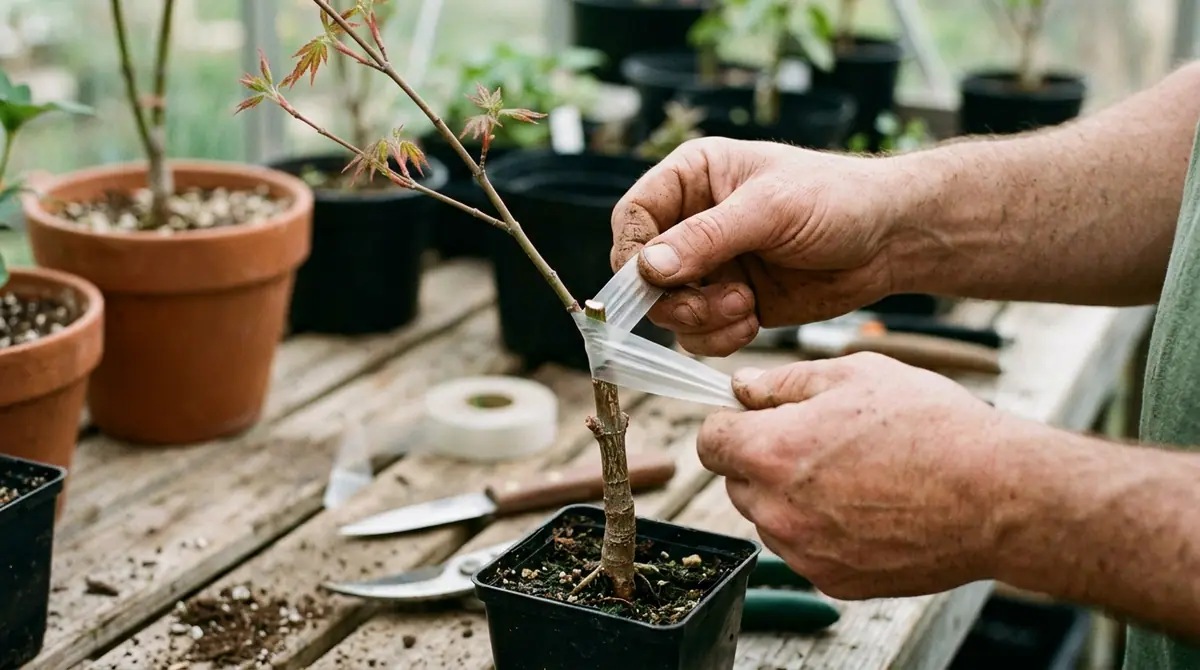
On a damp, 45°F (7.2°C) morning in late winter, the translucent cambium layer of the scion must match the pencil-thick rootstock of Acer palmatum with surgical precision, or months of planning will vanish into rot and callus failure. Over the last twenty years, hundreds of Japanese maples—from cascading 'Dissectum' cultivars to upright, coral-barked specimens—have been successfully grafted using exact botanical mechanics and physical steps required to graft a Japanese maple yourself.
1. Botanical Overview & Natural Habitat

Botanically, Acer palmatum exhibits immense phenotypic plasticity, which is why centuries of Japanese horticulturists—and modern nurseries—have selected hundreds of distinct cultivars. These selections vary wildly in leaf lobe count (from 5 to 9), mature height (ranging from 3 feet/0.9 meters for dwarfs to 25 feet/7.6 meters for standards), and growth habit.
Because many prized cultivars—such as 'Bloodgood', 'Tamukeyama', or 'Orange Dream'—do not grow true from seed or struggle on their own root systems, we rely on asexual propagation. Grafting allows us to unite the desirable canopy characteristics of a cultivar (the scion) with the vigorous, disease-resistant root system of a seedling Acer palmatum (the rootstock). This union relies entirely on the successful fusion of the vascular cambia—the thin layer of actively dividing meristematic cells located just beneath the bark. When the cambial rings of the scion and rootstock are aligned and held under firm pressure, they knit together, establishing a continuous pipeline for water, mineral nutrients, and photosynthetic sugars.
2. Essential Environmental & Care Requirements
To achieve a successful graft union and nurture the resulting Japanese maple, you must tightly control environmental parameters. Fluctuations in temperature, humidity, and light can ruin the delicate cellular bridging process during the first 30 to 45 days post-grafting.
| Parameter | Optimal Condition | Common Mistake | Why It Matters |
|---|---|---|---|
| Grafting Temperature | 55°F to 65°F (12.8°C to 18.3°C) | Exposing fresh grafts to freezing or hot conditions | Extreme cold halts callus formation; excessive heat dries out the exposed cambium before it can knit. |
| Ambient Humidity | 80% to 90% relative humidity | Allowing the scion to dry out in ambient indoor air | Without high humidity, the scion transpires water faster than the un-joined roots and cut tissue can replace it. |
| Light Exposure | Bright, indirect light or filtered shade | Placing fresh grafts in direct, scorching sunlight | Direct sun causes thermal stress and rapid dehydration of the unrooted scion. |
| Soil pH | 5.5 to 6.5 slightly acidic | Planting in heavy, alkaline clay (pH > 7.0) | Alkaline soils cause iron chlorosis, blocking nutrient uptake and stunting the newly established tree. |
💡 Pro-Tip: When selecting your rootstock for side-veneer or whip-and-tongue grafting, always use 1-to-2-year-old seedling Acer palmatum grown in containers. Never dig up wild, stressed rootstock from the landscape, as hidden root pathogens will compromise the graft union.
Watering requirements change drastically from the propagation bench to the landscape. During the healing phase inside a humidity chamber or propagation case, the rooting medium—typically a sterile mix of 50% perlite and 50% peat moss—should be kept evenly moist but never waterlogged. Once planted outdoors in a landscape setting, Japanese maples require approximately 1 inch (2.5 cm) of water per week, delivered deeply to encourage downward root exploration. For a deeper dive into regional climate adaptations and hardiness zones, consult the Royal Horticultural Society guidelines on ornamental tree cultivation.
3. Step-by-Step Cultivation, Feeding & Propagation
Late winter (specifically January through March, depending on your hardiness zone) is the optimal window for grafting Japanese maples. At this time, both the rootstock and the scion wood are fully dormant, meaning sap pressure is low and the tissues will not bleed excessively when cut.
Here is the exact step-by-step protocol for executing a side-veneer graft, the most reliable method for Acer palmatum.
- Select and Prepare Scion Wood: Collect dormant, healthy 1-year-old terminal shoots from your desired cultivar in mid-winter. Scions should be pencil-thick, roughly 4 to 6 inches (10 to 15 cm) long, and feature 3 to 4 plump, viable buds. Wrap them in a damp paper towel, seal them in a plastic bag, and store them in a refrigerator at 34°F to 38°F (1.1°C to 3.3°C) until grafting day.
- Prepare the Rootstock: Bring your potted, dormant 1-year-old seedling rootstock into a clean, well-lit workspace. Wipe the lower stem down with a 10% solution of household bleach or isopropyl alcohol to sterilize the working surface.
- Cut the Rootstock Flap: Using a razor-sharp, sterilized grafting knife, make a downward, shallow cut about 1 to 1.5 inches (2.5 to 3.8 cm) long into the side of the rootstock stem, slicing just through the bark and slightly into the wood. Slice off the sliver of bark at the base of the cut to create a small "seat" for the scion.
- Cut the Scion: Take your scion from cold storage. Make a sloping cut on one side of the lower end matching the length of the rootstock cut (1 to 1.5 inches / 2.5 to 3.8 cm). Make a second, shorter sloping cut on the reverse side to create a wedge shape, exposing the green cambial layer on both sides.
- Align the Cambium Layers: Insert the scion into the rootstock cut. The most critical botanical rule of grafting is this: at least one side of the scion's cambium layer must make direct, unbroken contact with the cambium layer of the rootstock. Align the edges precisely.
- Secure and Seal: Wrap the union tightly with rubber budding strips or specialized grafting tape from bottom to top to maintain firm pressure. Immediately coat all exposed cut surfaces—including the top tip of the scion—with grafting wax or tree-wound sealer to prevent moisture loss.
- Aftercare and Forcing: Place the grafted plant in a humidity-controlled environment, such as a cold frame or unheated greenhouse, maintaining temperatures between 50°F and 60°F (10°C and 15.6°C) for 30 to 45 days. Once callus tissue forms and the scion buds begin to swell, gradually notch and remove the top of the rootstock above the union in stages to force energy entirely into the new scion shoot.
⚠️ Important Caution: Never fertilize a newly grafted Japanese maple with synthetic nitrogen. High salt concentrations in the soil will draw moisture away from the unhealed graft union, causing immediate scion desiccation and failure. Wait until the scion has produced at least two flushes of mature foliage before applying a balanced, slow-release, organic fertilizer in late spring.
4. Common Problems, Pests & Troubleshooting
Even experienced propagators encounter hurdles when working with Japanese maples. Understanding the symptoms of failure allows you to adjust your technique for the next season.
- Symptom: Scion turns brown and shrivels within 14 days.
- Cause: Dehydration due to insufficient humidity or lack of proper sealing with grafting wax.
- Solution: Ensure your humidity chamber maintains 85%+ relative humidity and verify that every millimeter of exposed cut wood is sealed.
- Symptom: Scion stays green for weeks, but buds never swell or push growth.
- Cause: A "blind" graft where cambium contact was missed, or scion wood that was damaged by freezing temperatures while in storage.
- Solution: Check storage temperatures; ensure your refrigerator remains above freezing. Practice your knife cuts on scrap wood to improve cambium alignment accuracy.
- Symptom: White, fluffy fungal growth appears around the graft union.
- Cause: Excessive moisture combined with stagnant air, leading to Botrytis or other fungal pathogens.
- Solution: Increase ventilation in your propagation case immediately, remove infected tissue, and apply a bio-fungicide containing Bacillus subtilis.
- Symptom: Rootstock shoots out vigorous native growth below the graft union.
- Cause: The rootstock is attempting to outcompete the scion for resources.
- Solution: Rub out or prune away all rootstock shoots (often called "suckers") as soon as they appear so the plant directs all its energy into the cultivar canopy.

5. Frequently Asked Questions
Can you graft a Japanese maple onto any type of maple tree?
No. You must graft Japanese maples (Acer palmatum) onto closely related species within the genus Acer, most commonly seedling Acer palmatum or Acer japonicum (Fullmoon maple). Attempting to graft Acer palmatum onto unrelated maples like Acer rubrum (Red maple) or Acer saccharum (Sugar maple) results in biochemical incompatibility, where the vascular tissues fail to unite and the graft dies within weeks.
What is the best month to graft a Japanese maple?
Late winter (January through March) is universally recognized as the best time to graft Japanese maples. During this window, both scion and rootstock are completely dormant, which minimizes sap flow that could otherwise push the scion out of alignment before the callus tissue bridges the gap.
Why did my Japanese maple graft fail even though the cuts looked clean?
Graft failure despite a clean physical cut usually points to one of two hidden variables: poor cambial alignment or desiccation. If the cambium layers of the scion and rootstock do not physically touch, cellular division cannot bridge the gap. Alternatively, if humidity dropped too low or wax coverage was incomplete, the scion dried out from transpiration before vascular connections could form.
Can I use green wood in the summer instead of dormant wood in the winter?
Yes, you can perform summer budding or chip-budding using semi-hardwood material in July or August. However, summer grafting requires specialized misting benches and precise greenhouse climate control to prevent the tender green tissue from wilting, making dormant winter grafting significantly more forgiving for home propagators.
Related Guides
- Japanese Maple in Texas
- When to Transplant Japanese Maple
- How to Transplant a Japanese Maple Tree
- Cutting Back a Maple Tree
- Sun Valley Maple Tree
📋 Table of Contents ▼ Click to expand
Tags:
Keep reading
🌿 Related Plants You Might Like

PlantSavvyWorld
Editorial team
PlantSavvyWorld is an independent botanical education project. Articles are drafted with AI assistance, then edited and checked against university extension services, botanical garden collections and other published horticultural sources.