

When to Transplant Japanese Maple
Written with AI assistance, edited and checked against horticultural sources.
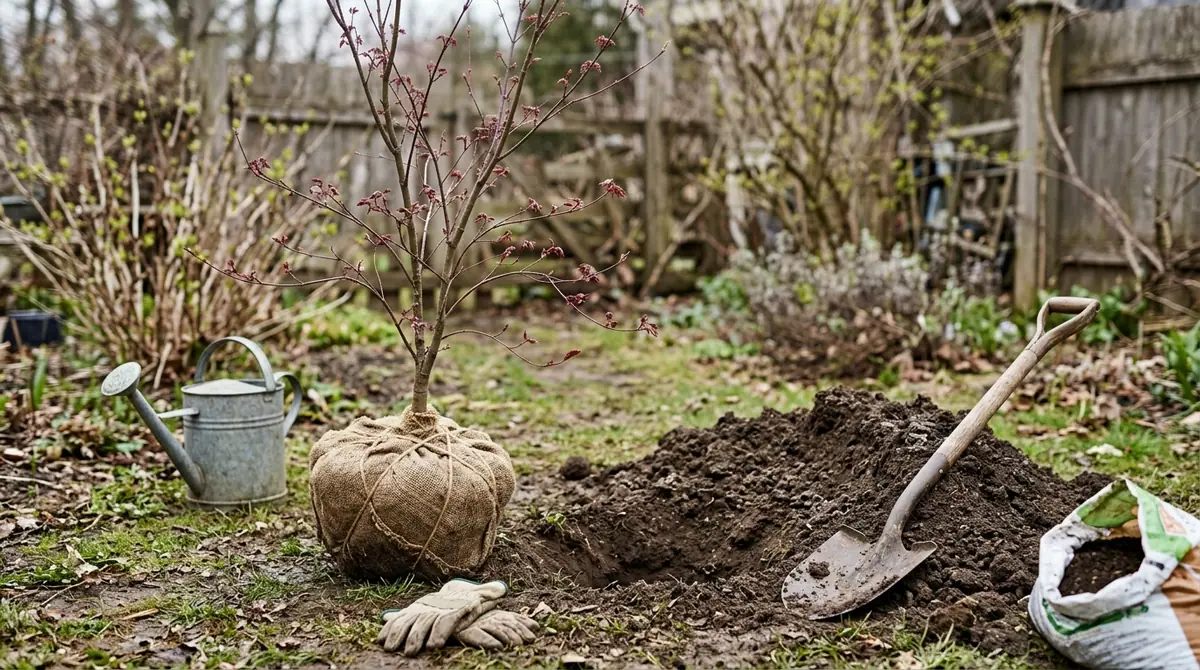
I can still vividly recall standing knee-deep in red Virginia clay in late November, sweating despite the 42°F (5.5°C) chill in the air, frantically root-pruning a magnificent twelve-foot Acer palmatum 'Bloodgood' that had been planted in entirely the wrong microclimate by a previous homeowner. The sun was dipping below the tree line, frost was hardening the topsoil, and my shovel hit a dense mat of fibrous roots that had refused to expand past the compacted clay bowl dug three years prior. That afternoon taught me a fundamental lesson in landscape architecture: a Japanese maple does not care about your schedule; it cares entirely about its dormancy cycle and root physiology. If you move it too early, you bake the canopy; if you move it too late, you rupture active, swelling spring cambium.

1. Botanical Overview & Natural Habitat
The Japanese maple (Acer palmatum) is an understory deciduous tree native to the temperate forests of Japan, Korea, China, eastern Mongolia, and southeast Russia. In its native woodland habitat, it grows protected beneath the high canopy of taller trees like pines and oaks, receiving dappled sunlight and feeding on a rich, highly organic, acidic forest floor rich in leaf mold.
Botanically, Acer palmatum features a shallow, fibrous root system rather than a deep taproot. This physiological adaptation allows the species to scavenge for nutrients and moisture in the uppermost 12 to 18 inches (30 to 45 cm) of forest soil, which is precisely why these trees are uniquely sensitive to drought, soil compaction, and improper transplant depths. Their delicate palmate leaves—often deeply lobed—are prone to marginal scorch when exposed to harsh, drying winds or unrelenting afternoon sunlight, a trait that directly informs where and when you should site them in a landscape design.
For authoritative taxonomic data and regional cultivation insights, you can consult the Royal Horticultural Society.
2. Essential Environmental & Care Requirements
Creating a resilient landscape design means respecting the environmental thresholds of your Acer palmatum. Whether you are moving a specimen across the yard or transitioning it from a nursery container, getting these parameters right dictates survival.
| Parameter | Optimal Condition | Common Mistake | Why It Matters |
|---|---|---|---|
| Soil pH | 5.5 to 6.5 (Acidic to slightly acidic) | Planting in alkaline soil (pH > 7.0) | High pH locks out iron, causing severe interveinal chlorosis and stunted growth. |
| Sunlight | Morning sun with afternoon shade (Dappled light) | Full, unshaded afternoon sun (Zone 7+) | Intense UV rays and heat burn delicate leaf margins, causing irreversible leaf scorch. |
| Drainage | Consistently moist, loamy, well-draining soil | Heavy clay or waterlogged depressions | Poor drainage suffocates the shallow root system, rapidly inviting Phytophthora root rot. |
| Mulch Depth | 2 to 3 inches (5 to 7.5 cm) of organic bark mulch | Volcano mulching (piling against the trunk) | Deep mulch against bark traps moisture, causing trunk decay and inviting rodents. |
💡 Pro-Tip: When planning a landscape overhaul, remember that transplanting woody ornamentals shares physiological timing principles with shifting heavy garden crops. Just as you carefully time when to harvest or shift root vegetables like when to plant carrots in zone 8a or when to plant beets in utah, woody maples demand strict adherence to soil temperatures rather than calendar dates.
3. Step-by-Step Cultivation, Feeding & Propagation
The single most critical factor in transplanting a Japanese maple is timing. You must execute this process during true dormancy—ideally in late autumn (after 100% of the leaves have dropped and soil temperatures hover between 40°F and 50°F / 4.4°C and 10°C) or in very early spring before bud break.
Here is the exact field protocol I use for mature landscape specimens:
- Root Pruning (Optional, 6 Months Prior): If the tree is large or has been in the ground for over five years, trench a circle with a radius equal to 10 inches (25 cm) per inch of trunk diameter in late summer. Sever the outer roots cleanly and backfill with native soil to encourage dense, fibrous root regeneration closer to the root ball.
- Pre-Watering the Root Zone: 48 hours before digging, thoroughly soak the root zone with 10 to 15 gallons (38 to 57 liters) of water to ensure plant tissues are fully turgid and hydrated.
- Digging the New Location First: Prepare the target planting hole before touching the tree. Dig a shallow, saucer-shaped hole 2 to 3 times wider than the estimated root ball, but only 85% as deep. The top of the root flare must sit 1 to 2 inches (2.5 to 5 cm) above the surrounding grade.
- Excavating the Tree: Begin trenching outside your root ball boundary. Using a sharp spade, undercut the root ball at a 45-degree angle to isolate a heavy, solid mass of soil and roots. Slide untreated burlap underneath to secure the root mass.
- Transporting: Lift the root ball by supporting the soil mass, never by lifting the trunk. Place it onto a tarp or wheelbarrow to move it to the new hole to prevent structural stress on the root collar.
- Setting and Backfilling: Position the tree, ensuring proper orientation to the sun. Fill halfway with native unamended soil, tamp gently with your hands to remove large air pockets, and water thoroughly to settle the soil. Fill the remainder, tamp again, and water a second time.
- Staking and Mulching: Stake the tree loosely with soft webbing only if it resides in a high-wind corridor. Apply a 3-inch (7.5 cm) layer of organic hardwood mulch across the root zone, maintaining a 3-inch (7.5 cm) clearance zone completely free of mulch around the trunk flare.
For regional agricultural data and tree care bulletins, reference the USDA Forest Service Plant Database.
4. Common Problems, Pests & Troubleshooting
Transplanting places immense physiological stress on a Japanese maple, often manifesting as localized dieback or vulnerability to secondary pathogens.
- Transplant Shock: Exhibited by sudden leaf drop, twig dieback, or marginal leaf curling during the following growing season. Mitigate this by maintaining consistent soil moisture (never soggy) and erecting a temporary 50% shade cloth windbreak around the tree for its first summer.
- Verticillium Wilt: A devastating soil-borne fungus (Verticillium dahliae) that enters through compromised roots, causing sudden wilting and vascular discoloration (dark rings in cross-sections of branches). There is no chemical cure; prune infected limbs 12 inches (30 cm) below visible symptoms, sterilizing pruners in a 10% bleach solution between cuts.
- Aphids and Scale Insects: Sap-sucking pests that target stressed maples, excreting sticky honeydew that fosters black sooty mold. Blast colonies away with a strong jet of water from a garden hose or apply horticultural dormant oil in late winter before buds swell.
When managing diverse garden ecosystems, balancing perennial tree care with seasonal food production requires careful scheduling. Just as you orchestrate orchard or landscape shifts, keeping track of annual crop calendars like when to plant pumpkins in southern california, when to plant brussel sprouts in zone 7, or when to plant bok choy zone 7 ensures your entire property thrives without overwhelming your maintenance window.
⚠️ Important Caution: Never add high-nitrogen synthetic fertilizers to the backfill soil when transplanting a Japanese maple. Nitrogen forces rapid, weak top-growth before the compromised root system can supply adequate water, which frequently results in total desiccation and plant death.

5. Frequently Asked Questions
Can I transplant a Japanese maple in the middle of summer?
You should strongly avoid summer transplantation. Moving a Japanese maple while it is actively pushing soft spring foliage or enduring high summer heat causes catastrophic transpirational water loss. Because the damaged root system cannot absorb water quickly enough to replace what the leaves transpire, the tree will rapidly defoliate, scorch, and often die. If an emergency move is mandatory, you must construct a temporary shade structure, apply anti-desiccant spray, and provide daily irrigation.
How do I know if my Japanese maple is truly dormant?
True dormancy occurs after 100% of the leaves have naturally turned color, detached, and fallen to the ground, typically between late November and mid-January depending on your hardiness zone. Inspect the buds: they should be firm, tight, and sealed with protective scales. Avoid moving the tree if buds are swelling, green tissue is showing beneath the bark, or leaves remain attached—even if they are brown and withered.
How big should the root ball be when I dig it up?
As a general rule of thumb derived from standard arboricultural practices, you should dig a root ball with a diameter of 10 to 12 inches (25 to 30 cm) for every 1 inch (2.5 cm) of trunk diameter measured 6 inches (15 cm) off the ground. For a tree with a 2-inch (5 cm) trunk, your excavated root ball must be at least 20 to 24 inches (50 to 60 cm) wide and roughly 14 to 18 inches (35 to 45 cm) deep to capture the primary structural root mass.
Should I prune the canopy after transplanting?
You should limit structural pruning at transplant time strictly to removing dead, diseased, or broken branches. While an old gardening myth suggests cutting back the canopy to "balance" root loss, modern arboricultural science proves that leaves produce vital auxin and carbohydrates necessary to stimulate new root growth. Removing healthy canopy reduces the tree's overall energy production capacity and delays successful root establishment.
Related Guides
- How to Transplant a Japanese Maple Tree
- Japanese Maple in Texas
- Graft Japanese Maple
- Cutting Back a Maple Tree
- Sun Valley Maple Tree
📋 Table of Contents ▼ Click to expand
Tags:
Keep reading
🌿 Related Plants You Might Like
PlantSavvyWorld
Editorial team
PlantSavvyWorld is an independent botanical education project. Articles are drafted with AI assistance, then edited and checked against university extension services, botanical garden collections and other published horticultural sources.