

Sun Valley Maple Tree
Written with AI assistance, edited and checked against horticultural sources.
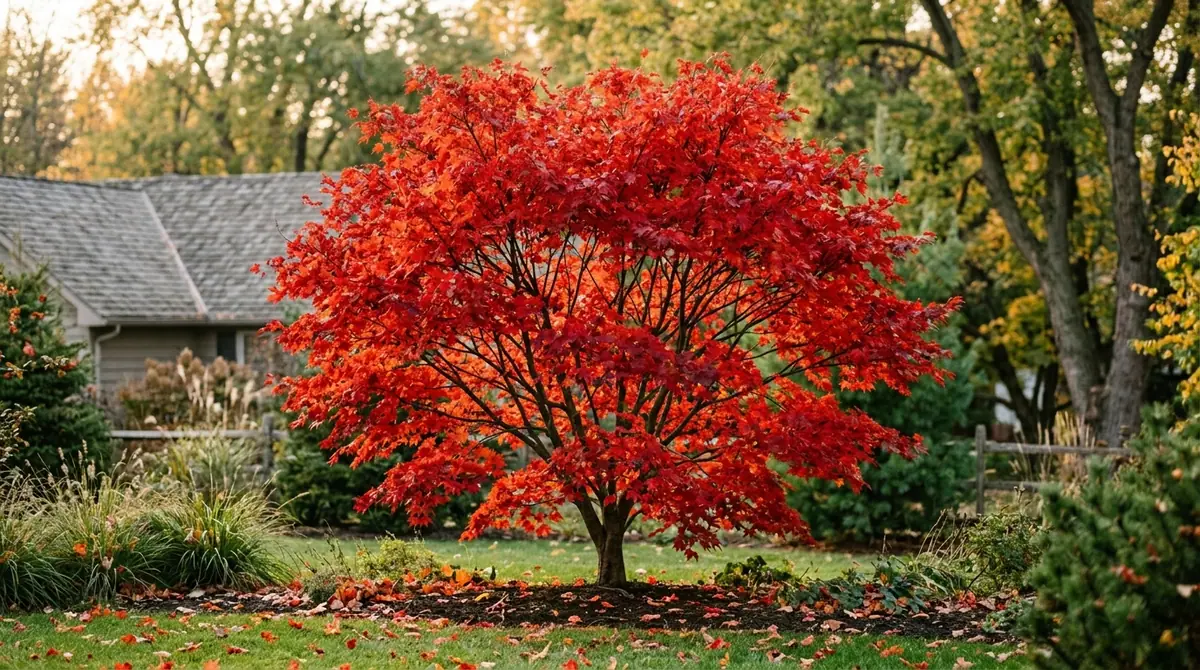
In a waterlogged, clay-heavy suburban backyard in late October, the brilliant scarlet canopy of a newly established "sun valley maple tree" glows against a dreary, overcast gray sky while neighboring red maples drop dull, chlorotic yellow leaves prematurely due to soil compaction. This sterile hybrid stands completely unfazed, its symmetrical oval crown holding fast to its radiant autumn color. That performance defines Acer rubrum 'Sun Valley', a cultivar developed specifically to bring bulletproof performance and breathtaking fiery red color into residential landscapes that usually punish standard maples.

1. Botanical Overview & Natural Habitat
The 'Sun Valley' maple is a controlled hybrid cross between the red maple (Acer rubrum) and the Japanese red maple (Acer saccharinum), originally developed by the U.S. National Arboretum in Washington, D.C., and released to the nursery trade in 1995. As an intellectual triumph of selective breeding, this specific clone combines the intense, reliable red autumn coloration of the red maple with the vigorous growth habit and structural adaptability of its parentage, all while being a strictly male selection that produces zero nuisance seeds.
Botanically classified as a medium-to-large deciduous shade tree, Acer rubrum 'Sun Valley' typically matures to a height of 20 to 30 feet (6 to 9 meters) within its first 10 years, eventually reaching an ultimate height of 35 to 40 feet (10.6 to 12 meters) and a mature spread of 25 to 35 feet (7.6 to 10.6 meters). Its natural growth habit is dense, oval to broadly pyrimidal, featuring clean branching angles that resist splitting under heavy snow loads or high wind events. The leaves are opposite, palmately lobed with 3 to 5 deeply cut segments, emerging a subtle reddish-green in spring, maturing to a lustrous dark green with silvery-white undersides throughout summer, and transforming into a brilliant, luminescent red in mid-to-late autumn.
Because it is a cultivated clone, you will not find 'Sun Valley' growing wild in a native forest habitat; instead, its wild ancestors hail from the saturated bottomlands, swamp edges, and moist upland forests of eastern North America. This ancestral lineage explains why the tree possesses an innate tolerance for periodic soil saturation—a trait rarely found in maples known for scorch-prone foliage. Its root system is moderately deep and spreading, though it can adapt well to urban spaces if given adequate soil volumes. For a broader exploration of how woody perennials interact with their immediate microclimates, you can review resources provided by the Morton Arboretum.
2. Essential Environmental & Care Requirements
Successfully establishing a sun valley maple tree requires matching its environmental preferences as closely as possible to those found in its cultivated pedigree. While adaptable, it performs best when specific soil, light, and moisture parameters are met consistently.
| Parameter | Optimal Condition | Common Mistake | Why It Matters |
|---|---|---|---|
| Soil pH | 4.5 to 6.5 (Acidic to slightly acidic) | Planting in alkaline soils (pH > 7.2) | High alkalinity triggers iron chlorosis, causing yellow leaves and stunted growth. |
| Sunlight | Full sun (6 to 8+ hours of direct light daily) | Planting in dense, heavy shade | Reduces autumn color intensity and leads to an open, leggy structural habit. |
| Moisture | Consistently moist, well-draining loam | Allowing prolonged, extreme drought | Causes leaf scorch (brown tips) and weakens the tree against secondary pest invasions. |
| Hardiness | USDA Zones 4 through 8 | Forcing growth in Zone 9 or warmer | Lacks sufficient winter chill hours to trigger proper dormancy and vibrant color changes. |
Soil preparation is the single most critical factor during establishment. Unlike many fruit trees that demand sharp, gravelly drainage—and which require careful monitoring detailed in guides like How to Identify and Treat Common Fruit Tree Diseases—the sun valley maple actually thrives in moisture-retentive clay loams, provided they do not remain waterlogged like a swamp for months on end. If your site features stubborn alkaline soil, you can successfully amend localized planting pits with elemental sulfur or organic peat moss to lower the pH, though long-term maintenance will require ongoing soil acidification.
💡 Pro-Tip: If your native soil pH tests above 7.0, do not fight the soil chemistry indefinitely. Instead, install your sun valley maple tree within a raised berm composed of acidic compost and pine bark fines. This keeps the root zone comfortably within the 5.5 to 6.5 pH sweet spot without requiring endless chemical treatments.
3. Step-by-Step Cultivation, Feeding & Propagation
Planting a container-grown or balled-and-burlapped (B&B) sun valley maple tree correctly sets the trajectory for its entire lifespan. Follow this precise protocol during the dormant season (early spring or late autumn) for optimal results.
- Site and Soil Preparation: Dig a planting hole that is 2 to 3 times wider than the root ball, but strictly keep the depth equal to the height of the root ball. Sloping the sides of the hole at a 45-degree angle encourages lateral root penetration into the surrounding native soil.
- Root Inspection and Conditioning: Gently slide the tree out of its container or remove all twine, wire baskets, and burlap from the top third of a B&B root ball. If you encounter circling roots, score them vertically with a sharp utility knife in 4 distinct places around the root mass to break the circling pattern.
- Positioning the Tree: Lift the tree by the root ball—never by the trunk—and place it in the center of the hole. Ensure the root flare (where the trunk widens into the main structural roots) sits 1 to 2 inches (2.5 to 5 cm) above the surrounding finished grade to account for natural settling.
- Backfilling: Backfill the hole using unamended native soil, tamping down gently with your hands or feet every 6 inches (15 cm) of depth to eliminate large air pockets without compacting the soil excessively.
- Initial Irrigation: Build a 3-inch-tall (7.6 cm) earthen watering basin around the outer edge of the root ball perimeter. Slowly saturate the root zone with 10 to 15 gallons (38 to 57 liters) of water to settle the soil thoroughly around the roots.
- Mulching: Apply a 3-inch (7.6 cm) layer of shredded hardwood mulch or pine straw over the root zone, extending outward to the drip line. Pull the mulch back 2 to 4 inches (5 to 10 cm) away from direct contact with the trunk to prevent moisture rot and rodent nesting.
- Establishment Watering Schedule: Provide 1 inch (2.5 cm) of water per week via rainfall or deep irrigation for the first 24 months. During scorching summer weeks where temperatures consistently exceed 90°F (32°C), increase deep watering to twice weekly.
Propagation of patented cultivars like 'Sun Valley' is legally protected and restricted to commercial nurseries using specialized vegetative methods such as softwood stem cuttings treated with indole-3-butyric acid (IBA) misted under intermittent propagation benches, or root-stock grafting. Trying to grow this specific clone from seeds collected in your yard will not work, as hybrid seedlings do not come true to type and will revert to unpredictable genetic traits. For official horticultural standards and registration details, consult the Royal Horticultural Society.
4. Common Problems, Pests & Troubleshooting
Even though the sun valley maple tree is exceptionally resilient, environmental stressors and opportunistic pests can occasionally cause issues. Recognizing symptoms early prevents minor setbacks from escalating into structural decline.
- Leaf Scorch: Characterized by dry, brown, crisp margins along the leaves during mid-summer. This occurs when transpiration exceeds the root system's ability to pull up water, usually triggered by drought, wind exposure, or restricted root zones near paved driveways. Remedy this by increasing deep irrigation frequencies and applying a protective organic mulch layer.
- Iron Chlorosis: Manifests as bright yellow leaf blades with starkly contrasting dark green veins, typically appearing on new spring growth. This is a direct physiological reaction to high soil pH locking up available iron. Correct this condition by applying chelated iron liquid drenches to the soil and broadcasting granular sulfur to lower the pH over time.
- Aphids and Scale Insects: Soft-bodied aphids can colonize the undersides of tender spring leaves, excreting sticky honeydew that attracts ants and fosters black sooty mold. Scale insects appear as small, immobile bumps along twigs. Control minor infestations with a strong blast of water from a garden hose or apply horticultural dormant oil sprays in late winter before bud break.
- Verticillium Wilt: A soil-borne fungal pathogen that enters through the roots, causing sudden wilting, branch dieback, and dark green streaking inside the sapwood rings.
⚠️ Important Caution: Verticillium wilt has no chemical cure once it infects a maple. Never plant a sun valley maple tree in a location where a previous susceptible tree (such as an ash, maple, or stone fruit) died from wilt. If your tree shows systematic unilateral branch death and internal vascular discoloration, remove the entire tree and avoid planting another maple in that exact soil for at least five years.

5. Frequently Asked Questions
How fast does a sun valley maple tree grow?
The sun valley maple is considered a moderate grower. Under ideal soil and moisture conditions, you can expect a height increase of 1.5 to 2.5 feet (45 to 75 cm) per year once the root system establishes itself fully after the first two transplant years.
Are the roots of a sun valley maple invasive to foundations or sidewalks?
Its root system is moderately deep and spreading rather than aggressively shallow, making it significantly less destructive to hardscapes than silver maples or Norway maples. However, as a general design rule, plant large canopy trees at least 15 to 20 feet (4.5 to 6 meters) away from permanent structural foundations, septic tanks, and underground utility lines.
Does the sun valley maple produce messy seed helicopters?
No. 'Sun Valley' is a sterile male selection specifically bred and propagated to eliminate seed production entirely. You will not have to rake up thousands of winged samaras (helicopters) in late spring, making it an exceptionally clean choice for patios, poolsides, and formal lawns.
Why are the leaves on my sun valley maple turning yellow in the summer?
Summer yellowing with green veins points directly to iron chlorosis caused by high soil pH or poor root aeration from compacted clay. Test your soil pH immediately; if it reads above 7.0, apply an iron chelate soil drench and acidic organic compost topdressings to restore rich, dark green foliage color.
Related Guides
- How to Transplant a Japanese Maple Tree
- Cutting Back a Maple Tree
- Do Deer Eat Lily of the Valley
- Japanese Maple in Texas
- Graft Japanese Maple
📋 Table of Contents ▼ Click to expand
Tags:
Keep reading
🌿 Related Plants You Might Like






PlantSavvyWorld
Editorial team
PlantSavvyWorld is an independent botanical education project. Articles are drafted with AI assistance, then edited and checked against university extension services, botanical garden collections and other published horticultural sources.