

Can Avocado Trees Grow in Arizona
Written with AI assistance, edited and checked against horticultural sources.
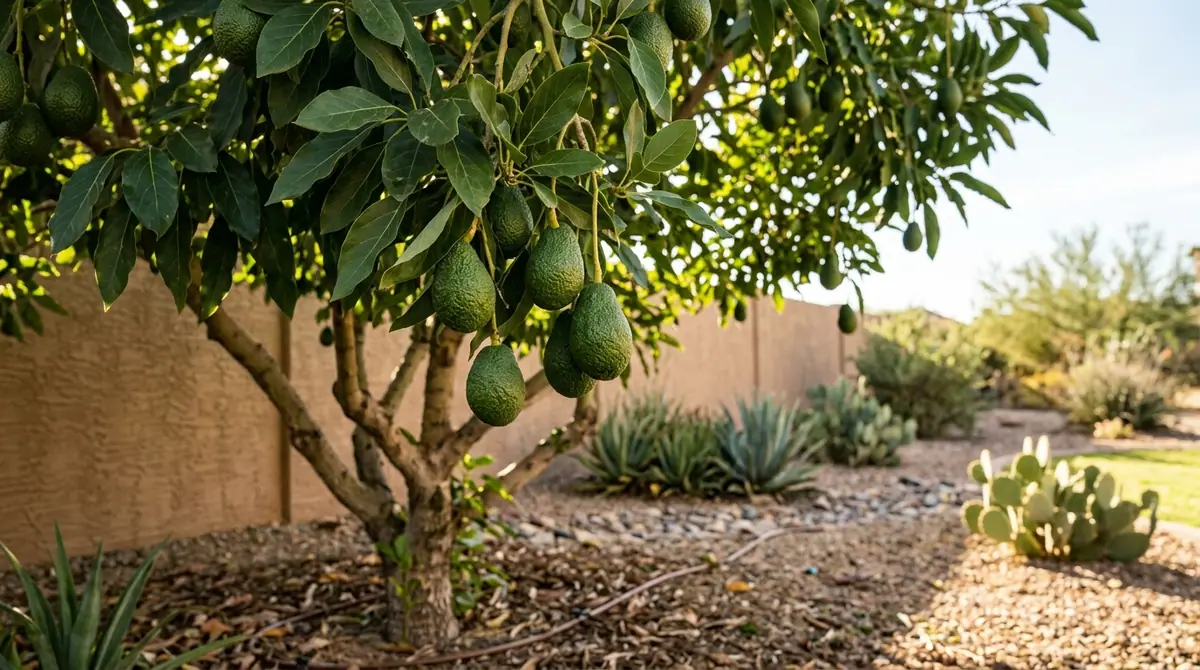
I stood in a mid-July garden in Scottsdale, Arizona, watching the tender, pale-green leaves of a newly planted 'Hass' avocado scorch into crisp brown parchment within forty-eight hours. The ambient air temperature was a brutal 112°F (44°C), and the relative humidity hovered near a desiccating 10 percent. That afternoon failure taught me more than any textbook: growing Persea americana in the Sonoran Desert is not merely about watering a tree; it is an exercise in microclimate engineering. I am often asked whether avocado trees can truly thrive in Arizona. The short answer is yes, but only if you respect their strict botanical limits and master desert arboriculture.
1. Botanical Overview & Natural Habitat
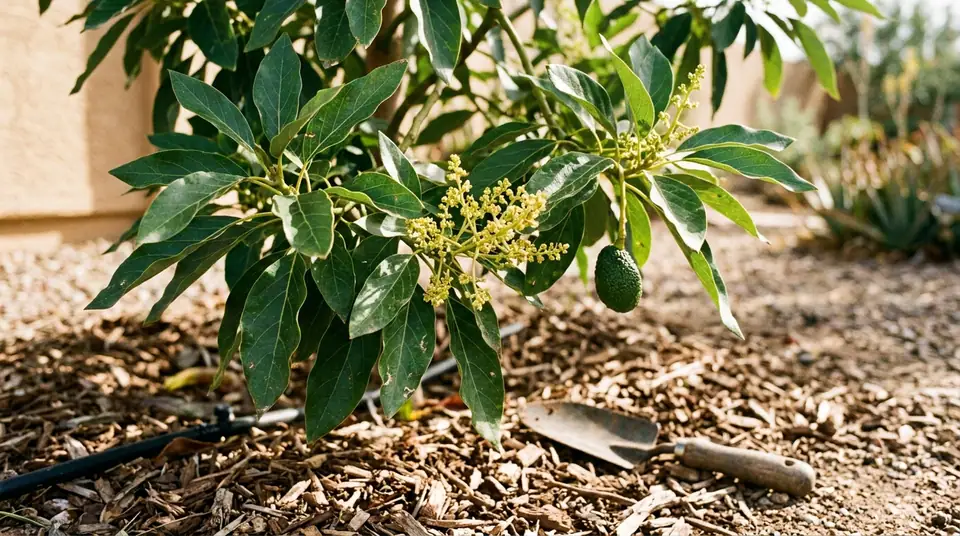
Botanically, avocados belong to the Lauraceae family. They possess shallow, delicate root systems devoid of root hairs, which makes them exceptionally sensitive to both drought and waterlogged conditions. Their leaves are leathery, dark green, and alternate, functioning as solar panels that transpire massive quantities of water to cool the canopy.
When you transplant this tropical denizen into Arizona’s USDA Hardiness Zones 9a through 11b—spanning the low desert valleys of Phoenix and Tucson to the slightly cooler elevations of Yuma—you introduce it to an environment antithetical to its native habitat. Summer temperatures regularly exceed 105°F (40°C), winter frosts can dip below 28°F (-2°C) in desert basin cold sinks, and the intense solar radiation rapidly degrades chlorophyll and burns foliage.
Despite these hurdles, successful cultivation is entirely possible. Much like configuring the diverse layers of a How to Grow a Wild Food Forest Self Sufficiency Garden, integrating an avocado tree requires careful placement beneath a supportive canopy of larger shade trees or structural elements that temper the fierce desert afternoon sun.
2. Essential Environmental & Care Requirements
Creating a hospitable microclimate in the Arizona desert requires rigorous attention to environmental variables. Unlike native desert flora, avocados require specialized management to survive the extremes of the Southwest.
| Parameter | Optimal Condition | Common Mistake | Why It Matters |
|---|---|---|---|
| Temperature | 60°F – 85°F (15°C – 29°C) | Exposing to >105°F (40°C) without shade | Extreme heat causes blossom drop, leaf scorch, and fruit sunburn. |
| Soil Drainage | Silt/Sandy Loam, pH 6.0–6.5 | Heavy, compacted native clay | Poor drainage causes Phytophthora root rot, the #1 killer of avocados. |
| Irrigation | Deep, frequent watering (every 3-5 days in summer) | Shallow, daily sprinkling | Shallow water promotes surface roots that dry out and die in desert heat. |
| Sun Exposure | Morning sun, filtered afternoon shade | Unshielded, glaring western exposure | Intense desert solar radiation strips moisture faster than roots can absorb it. |
Soil composition is particularly critical in Arizona. Our native desert soils are frequently alkaline (pH 7.5 to 8.5) and caliche-heavy, which locks up iron and causes severe chlorosis. Amending planting sites with coarse organic matter and ensuring rapid percolation is non-negotiable. Furthermore, choosing the right cultivar dictates success. Cold-hardy, Mexican-hybrid varieties such as 'Mexicola', 'Bacon', and 'Zutano' tolerate winter dips down to 25°F (-4°C) far better than the commercially ubiquitous 'Hass', which struggles when temperatures drop below 30°F (-1°C) or soar past 100°F (38°C) during the delicate fruit-set phase. For deeper botanical insights on regional climate adaptation, consult the University of Arizona Cooperative Extension.
3. Step-by-Step Cultivation, Feeding & Propagation
Growing avocados in the desert demands precision. Follow this step-by-step protocol to establish a resilient tree:
- Site Selection and Microclimate Design: Choose an eastern or northeastern exposure where the tree receives 4 to 6 hours of gentle morning sun and is completely shielded from harsh western afternoon rays. Position the tree near a block wall or under a deciduous canopy that provides winter sun and summer shade.
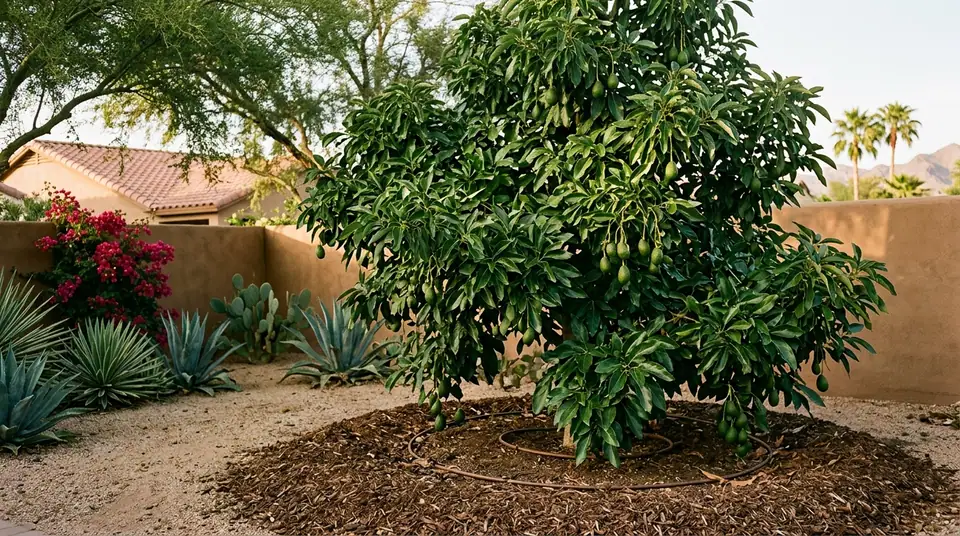
- Soil Preparation and Berming: Excavate a planting hole twice as wide as the nursery container but only equal to the depth of the root ball. Create a raised planting mound or berm 8 to 12 inches (20 to 30 cm) high and 3 feet (90 cm) wide to keep irrigation water away from the trunk flare, preventing collar rot.
- Planting: Gently slide the avocado tree out of its container, teasing apart any circling roots. Place it in the hole ensuring the top of the root ball sits 1 to 2 inches (2.5 to 5 cm) above the surrounding grade. Backfill with native soil mixed with 20 percent coarse compost; do not heavily amend the hole, as this creates a bathtub effect.
- Mulching: Apply a 4-inch (10 cm) layer of coarse wood chip mulch across the entire root zone, maintaining a 6-inch (15 cm) clearance around the trunk. This mulch mimics the forest floor of its native habitat, retaining soil moisture and cooling soil temperatures by up to 15°F (8°C).
- Initial Irrigation: Immediately after planting, deliver 10 to 15 gallons (38 to 57 liters) of water slowly via a drip ring or basin to settle the soil and eliminate air pockets.
- Trunk Protection: Paint the exposed trunk and primary scaffold branches with white, interior latex paint diluted 1:1 with water to prevent devastating sunscald during the blistering summer months.
💡 Pro-Tip: When establishing young fruit trees in arid climates, I always recommend interplanting with dynamic accumulators and nitrogen-fixers, a technique heavily relied upon when establishing a Total Guide to Moringa Why You Should Grow the Miracle Tree or Drumstick Vegetable. The dappled shade cast by fast-growing companion plants protects tender avocado leaves during their critical first two summers.
For those interested in expanding their orchard, learning propagation techniques such as Step By Step Guide to Grafting Fruit Trees for Beginners allows you to fuse cold-hardy Mexican rootstocks with superior fruit-bearing scion wood, dramatically increasing survival rates in harsh desert soils.
4. Common Problems, Pests & Troubleshooting
Desert cultivation tests a grower's diagnostic skills. Recognizing early warning signs prevents minor issues from becoming fatal.
- Leaf Tip Burn and Marginal Necrosis: Caused by high salt accumulation in the soil from municipal irrigation water, combined with low humidity. Solution: Flush the soil deeply every 4 to 6 weeks with low-sodium water, applying twice the normal volume to push salts below the root zone.
- Chlorosis (Yellowing Leaves with Green Veins): Triggered by Arizona's alkaline soils, which bind up available iron and zinc. Solution: Apply chelated iron (Fe-EDDHA) directly to the soil and apply foliar micronutrient sprays during the active flush periods in spring.
- Root Rot (Phytophthora cinnamomi): The most destructive pathogen, thriving in warm, poorly drained soils. Leaves turn pale, wilt, and the tree declines rapidly. Solution: Never allow water to pool around the trunk. If drainage is suspect, install agricultural gypsum to break up compaction and improve soil structure. For official plant pathology guidelines, reference resources provided by the American Phytopathological Society.
- Sunscald: Direct sunlight barks the exposed southern or western sides of branches, causing tissue death and inviting secondary wood-boring insects. Solution: Maintain a thick canopy and renew the white latex trunk paint annually until the tree naturally shades its own scaffold limbs.
Lush avocado tree laden with fruit in an arid desert backyard
5. Frequently Asked Questions
What are the best avocado varieties to grow in Arizona?
Mexican-hybrid cultivars perform best due to their natural tolerance to heat, low humidity, and mild frost. Recommended varieties include 'Mexicola Grande' (exceptionally cold-hardy to 18°F/-8°C), 'Bacon', 'Zutano', and 'Holiday'. Avoid commercial staples like 'Hass' unless you can provide meticulous microclimate protection and frost cloth during extreme weather events.
Do I need to plant two avocado trees for pollination?
Avocados possess a unique biological mechanism called synchronous protogynous dichogamy. Flowers open first as females in the morning, close at midday, and reopen the following afternoon as males. Trees are classified into Type A ('Hass', 'Mexicola') and Type B ('Bacon', 'Zutano'). While a single tree can bear fruit in the desert, planting one Type A and one Type B tree in close proximity significantly increases fruit set and overall harvest yields.
How often should I water an avocado tree in the Phoenix or Tucson summer?
During peak summer months (June through September), mature desert-grown avocados require deep irrigation every 3 to 5 days. Young trees planted within the last 12 months may need watering every 2 to 3 days. Always check soil moisture 4 inches (10 cm) beneath the mulch layer before irrigating; the soil should feel damp like a wrung-out sponge, never soggy or bone-dry.
How do I protect my Arizona avocado tree from sudden winter freezes?
Low desert radiation freezes can occur on clear, calm nights when temperatures drop below 32°F (0°C). Drape a heavy burlap or frost cloth over a sturdy PVC or wooden frame surrounding the tree, ensuring the fabric extends all the way to the ground to trap radiant heat from the soil. Avoid plastic sheeting touching the foliage, as it conducts cold and burns the leaves. For young trees, wrapping the trunk with incandescent outdoor Christmas lights beneath the frost cloth provides reliable emergency heat.
Related Guides
- Grafted Avocado Tree
- When to Plant Watermelon in Arizona
- Arizona Backyard Ideas
- Chilean Mesquite Trees
- Cherry Trees in Texas
- Lions Tailing Trees
📋 Table of Contents ▼ Click to expand
Tags:
Keep reading
🌿 Related Plants You Might Like

PlantSavvyWorld
Editorial team
PlantSavvyWorld is an independent botanical education project. Articles are drafted with AI assistance, then edited and checked against university extension services, botanical garden collections and other published horticultural sources.