

Lions Tailing Trees
Written with AI assistance, edited and checked against horticultural sources.
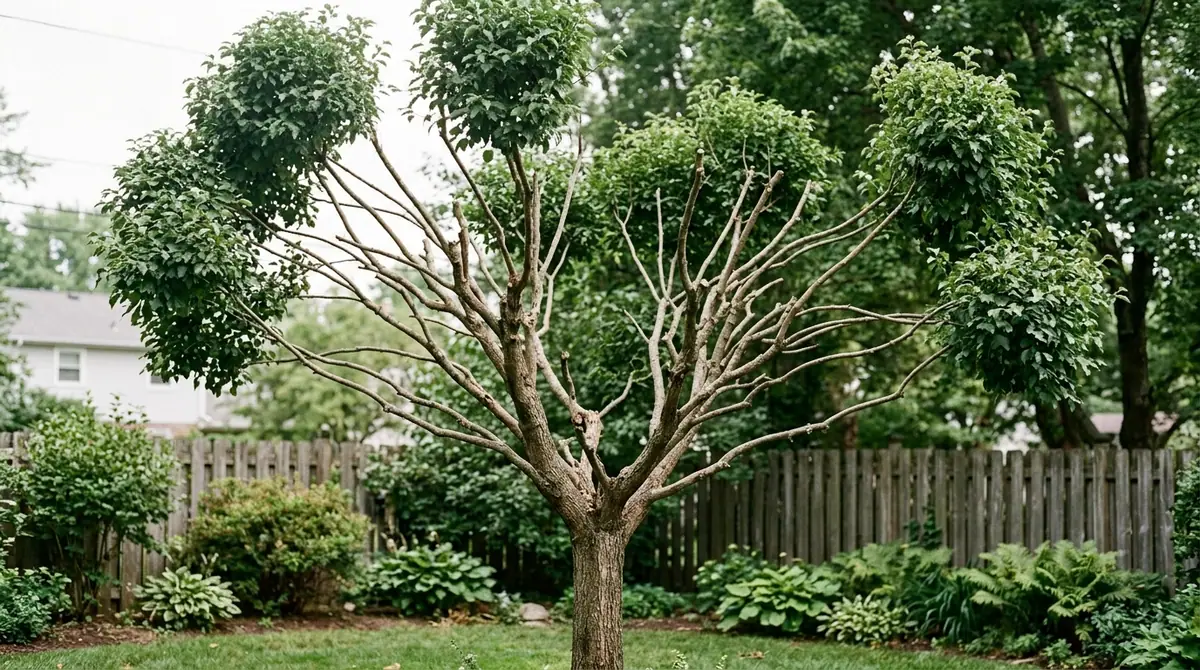
Mature sugar maples can look suspiciously like giant green pom-poms on sticks when a landscape crew strips away every single interior branch, leaving dense tufts of foliage dangling exclusively at the very tips of the limbs. This destructive practice is known in arboriculture as lion's tailing.

1. Botanical Overview & Natural Habitat
To understand why lion's tailing wrecks a tree, we must first look at how trees naturally allocate energy and build structural integrity. In a healthy, unpruned forest or landscape setting, a tree develops a tapered trunk and a complex matrix of interior scaffolding branches. This interior foliage—often mischaracterized as "dead wood" or "clutter"—plays a vital role in the tree's overall physiology.
Trees are hydraulic and photosynthetic powerhouses. Interior leaves and small lateral branches contribute significantly to the overall carbohydrate budget of the tree, feeding the trunk and lower structural limbs. Furthermore, interior branches act as natural shock absorbers. When strong winds whip through a canopy, a well-distributed network of interior branches dampens the kinetic energy, diffusing the load across hundreds of attachment points rather than forcing the stress out to the tips.
When someone applies the lion's tailing technique, they violate the tree's natural evolutionary design. Instead of distributing weight evenly along the scaffold branch, the weight is shifted entirely to the distal (outermost) ends. Think of a fishing rod: if you hang a heavy weight at the very tip of a flexible rod, it bends into a dangerous, stressed arc. That is precisely what happens to a lion-tailed limb.
To prevent this kind of structural failure, arborists must rely on proper thinning cuts rather than wholesale interior stripping, a principle just as important when considering Planting Landscaping Under Pine Trees where soil compaction and root health are already compromised. For authoritative guidance on proper pruning standards and structural integrity, consult the International Society of Arboriculture.
2. Essential Environmental & Care Requirements
Trees recovering from severe structural abuse like lion's tailing require rigorous environmental management to survive the shock. When interior foliage is removed, the bark on the main scaffold limbs—which evolved to be shaded—is suddenly exposed to intense, direct solar radiation. This causes severe bark scald, cambium damage, and opportunistic pest entry.
To help you manage the microclimate and physiological needs of a damaged or over-pruned tree, reference the parameters below:
| Parameter | Optimal Condition | Common Mistake | Why It Matters |
|---|---|---|---|
| Soil Moisture | Consistent deep watering (1 to 2 inches / 2.5 to 5 cm per week) | Frequent, shallow surface watering | Encourages weak surface roots rather than deep, drought-tolerant anchorage |
| Ambient Temperature | Moderate ranges between 60°F to 85°F (15°C to 29°C) for pruning/recovery | Severe pruning during freezing (<32°F / 0°C) or extreme heat (>95°F / 35°C) | Extreme temperatures stress open wounds, inviting fungal pathogens and decay |
| Soil Compaction | Aerated loamy soil with bulk density <1.4 g/cm³ | Heavy compaction from equipment or foot traffic | Restricts oxygen exchange needed for root regeneration and nutrient uptake |
| Canopy Density | 70% to 80% balanced light distribution | Stripping interior to <20% (Lion's Tailing) | Exposes bark to sunscald and shifts wind load dangerously to branch tips |
Managing these environmental variables ensures the tree can produce the epicormic (adventitious) shoots required to eventually rebuild its lost interior canopy. For deeper reading on horticultural science and tree health management, the RHS Gardening Advice portal offers exceptional, peer-reviewed resources.
3. Step-by-Step Cultivation, Feeding & Propagation
If you have inherited a tree that was previously subjected to lion's tailing, you cannot fix it overnight. Remediation requires a multi-year corrective pruning and cultivation strategy to encourage interior regrowth and restore structural taper.
💡 Pro-Tip: Never attempt to remove all the terminal tufts at once to "start over." Doing so will starve the root system of sugars and trigger a massive, uncontrolled flush of weak water sprouts that will take a decade to stabilize.
Follow this step-by-step restoration protocol to rehabilitate a lion-tailed tree:
- Assess Structural Integrity: Inspect the tree during calm weather. Identify limbs with severe end-weight loading (the "pom-pom" effect) that show signs of cracking, splitting, or excessive downward sagging.
- Implement Retrenchment Pruning (Year 1): Instead of removing more wood, reduce the length of the over-elongated terminal ends by 15% to 25%. Cut back to a vigorous lateral branch or a healthy side-bud pointing in the desired growth direction to reduce leverage and wind resistance.
- Apply Balanced Organic Nutrition: Broadcast a slow-release, organic arboricultural fertilizer across the root zone extending out to the drip line (typically reaching depths of 6 to 12 inches / 15 to 30 cm into the soil). Avoid high-nitrogen quick-release synthetic fertilizers, which force weak, rapid flush growth.
- Mulch Correctly: Apply a 3-inch (7.6 cm) layer of shredded hardwood mulch in a ring around the base of the tree. Maintain a 4-inch (10 cm) clearance away from the trunk flare to prevent collar rot and rodent nesting.
- Monitor Epicormic Shoots (Years 2–3): As the bark receives filtered light, epicormic buds will begin to break along the bare scaffold limbs. Select the healthiest, structurally sound shoots spaced 12 to 18 inches (30 to 45 cm) apart, and prune away crossing or rubbing shoots.
- Establish Long-Term Maintenance: Transition to a standard, sustainable canopy management plan, removing no more than 10% to 15% of the live canopy in any single growing season.
If you are expanding your orchard or food forest management alongside shade tree care, you may also find it helpful to review techniques for Step By Step Guide to Grafting Fruit Trees for Beginners to ensure structural longevity from sapling to maturity.
4. Common Problems, Pests & Troubleshooting
Lion's tailing creates a cascading series of pathological and structural failures. Because the tree is thrown into acute physiological shock, its natural defense mechanisms plummet, making it an easy target for environmental stressors and biological invaders.
⚠️ Important Caution: Never apply wound paint, tar, or sealants to pruning cuts on a stressed tree. Modern arboricultural science proves that sealants trap moisture and fungal spores inside the wound, accelerating wood decay rather than preventing it.
- Sunscald and Bark Splitting: With interior foliage removed, harsh afternoon sun barks unprotected limbs. The cambium layer cooks and dies, leading to vertical cracking. Remedy: Protect exposed scaffold limbs with breathable paper tree wrap during peak summer months until new epicormic shoots provide natural shade.
- Borer Infestations: Stressed trees emit ethanol and other chemical distress signals that attract wood-boring insects such as bronze birch borers or flatheaded appletree borers. Remedy: Maintain deep soil moisture during dry spells, and use targeted biological controls rather than broad-spectrum insecticides if populations flare.
- Wind Damage and Limb Failure: The concentrated weight at the tips of lion-tailed branches acts like a lever, snapping limbs cleanly at the main trunk union during severe thunderstorms. Remedy: Immediately cable or brace heavily loaded primary limbs while executing the multi-year reduction pruning protocol outlined in Section 3.
- Fungal Decay (Heart Rot): Large pruning stubs left by improper removal cuts fail to compartmentalize, allowing white rot or brown rot fungi to colonize the heartwood. Remedy: Ensure all future pruning cuts are made just outside the branch collar without leaving stubs or flushing the cut against the trunk.

5. Frequently Asked Questions
What does lion's tailing mean in tree pruning?
Lion's tailing is the harmful pruning practice of removing all interior branches and foliage from a tree limb, leaving leaves and twigs only at the very end of the branch. It destroys the tree's natural weight distribution, stunts root growth, and leaves the tree vulnerable to sunscald, wind damage, and structural failure.
Why is lion's tailing bad for trees?
It removes the foliage responsible for feeding the interior wood and trunk, shifts the center of gravity to the branch tips, and exposes delicate bark to intense solar radiation. Over time, this leads to weakened branch unions, sunscald, increased susceptibility to wood-boring insects, and a drastically shortened lifespan for the tree.
How do you fix a tree that has been lion-tailed?
Fixing a lion-tailed tree requires a multi-year recovery plan. You must avoid stripping any more interior wood, reduce the length of the terminal ends by 15% to 25% to minimize wind leverage, and encourage the growth of new epicormic shoots along the bare branches over successive growing seasons.
Will interior leaves grow back after lion's tailing?
Yes, but slowly. When light hits the newly exposed bark of the scaffold limbs, dormant epicormic buds will often push out new shoots. An arborist must carefully select the healthiest of these new shoots over several years to rebuild a balanced, structurally sound interior canopy.
Related Guides
- Chilean Mesquite Trees
- Can Avocado Trees Grow in Arizona
- Cherry Trees in Texas
- Problems with Olive Trees in Pots
- Fusing Trees Together Bonsai Trunk
📋 Table of Contents ▼ Click to expand
Tags:
Keep reading
🌿 Related Plants You Might Like






PlantSavvyWorld
Editorial team
PlantSavvyWorld is an independent botanical education project. Articles are drafted with AI assistance, then edited and checked against university extension services, botanical garden collections and other published horticultural sources.