Written with AI assistance, edited and checked against horticultural sources.
When a gravel driveway is paved over with smooth, dark asphalt, a network of angry cracks can begin to spiderweb across its surface by the third year, right where a mighty Willow tree stands. That Willow, with its seemingly gentle beauty, can be a root menace in disguise. Choosing the right tree for a driveway is about more than just aesthetics; it is about protecting an investment.
We want our driveways to be a welcoming entrance to our homes, lined with beautiful trees that enhance curb appeal without becoming a costly structural problem. The key lies in understanding tree root systems and selecting species known for their non-invasive, well-behaved nature. This guide will help you navigate those choices, ensuring your driveway remains crack-free for years to come.
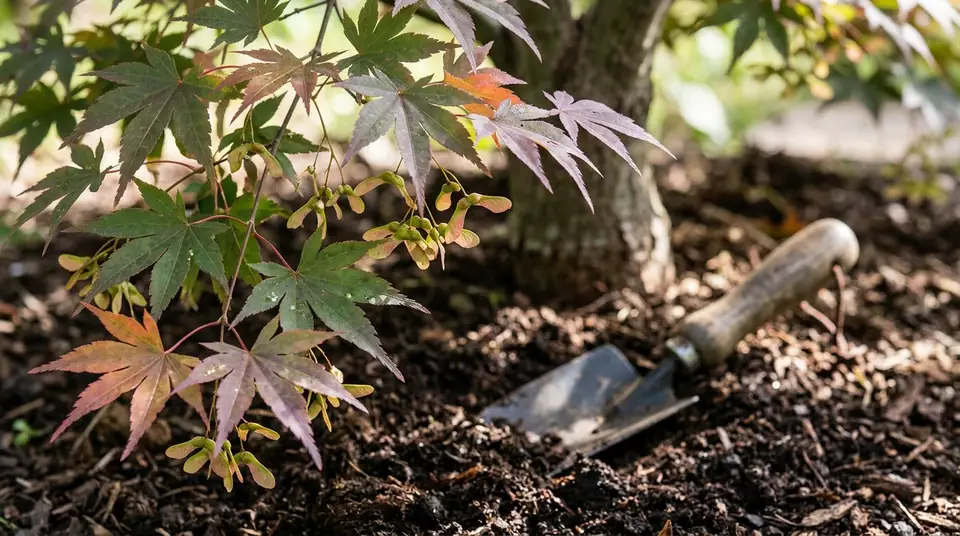
Close-up of a Japanese maple tree trunk with colorful leaves and a trowel in mulch soil
1. Botanical Overview & Natural Habitat
Understanding a tree's natural tendencies is the first step to selecting a driveway-friendly specimen. Many trees that cause driveway damage, like Willows and Poplars, are vigorous growers with shallow, aggressive root systems that seek out water and nutrients readily available in the moist, aerated soil beneath paving. These lateral surface roots can exert significant pressure, lifting and cracking concrete and asphalt. Conversely, trees with deeper taproots or more contained, fibrous root balls are generally much safer bets.
The trees we'll be focusing on are typically ornamental varieties, chosen for their beauty and manageable size. Their natural habitats often include woodland edges, open fields, or well-drained slopes, environments where they don't need to aggressively compete for resources in the same way as their wilder counterparts. This inherent trait often translates to a more docile root system when cultivated in a landscape setting.
Let's look at some of the stars of our driveway-safe lineup:
Crape Myrtle (Lagerstroemia indica): Native to Asia, Crape Myrtles are beloved for their vibrant summer blooms that can last for months, often in shades of pink, red, purple, and white. They are deciduous, offering beautiful exfoliating bark that adds winter interest. They prefer full sun and well-drained soil, thriving in USDA hardiness zones 7-10. Their root system is typically shallow and fibrous, rarely becoming invasive.
Japanese Maple (Acer palmatum): Hailing from Japan, Korea, and China, Japanese Maples are prized for their intricate leaf shapes and stunning seasonal color changes. From deep reds and purples to vibrant greens that turn fiery orange and red in autumn, they offer year-round visual appeal. Most varieties are small to medium-sized trees, preferring partial shade and acidic, well-drained soil, thriving in zones 5-8. Their root systems are generally fine and non-aggressive.
Eastern Redbud (Cercis canadensis): This North American native is a true spring spectacle. Its bare branches erupt with masses of charming, magenta-pink, pea-like flowers before the heart-shaped leaves emerge. It’s a deciduous understory tree, meaning it naturally grows beneath larger trees in its native habitat, indicating a preference for less aggressive competition and a root system that isn't overly dominant. It thrives in full sun to partial shade and prefers well-drained soil, suitable for zones 4-9. Its root system tends to be more taproot-oriented, growing downwards rather than outwards aggressively.
Serviceberry (Amelanchier lamarckii or Amelanchier arborea): Also known as Shadbush or Juneberry, this North American native is a multi-season performer. It offers delicate white flowers in early spring, followed by edible, blueberry-like fruits in early summer, and culminates in brilliant red to orange fall foliage. It's a deciduous small tree or large shrub with a fibrous, non-invasive root system. Serviceberries tolerate a range of conditions, from full sun to partial shade, and prefer moist, well-drained soil, hardy in zones 4-8.
Flowering Dogwood (Cornus florida): A quintessential native of the eastern United States, the Flowering Dogwood is a small, elegant deciduous tree. It's renowned for its showy spring "flowers," which are actually bracts surrounding a cluster of small, true flowers. These bracts are typically white or pink. It also offers attractive red fruits in the fall and good red to purplish fall color. It prefers partial shade and moist, acidic, well-drained soil, thriving in zones 5-9. Its root system is relatively fine and doesn't tend to be a significant problem for nearby hardscaping.
2. Essential Environmental & Care Requirements
While these trees are chosen for their root temperament, they still have specific needs to ensure they thrive and maintain their non-invasive characteristics. Proper siting, soil preparation, and consistent care are crucial.
Sunlight: Most of the trees listed, like Crape Myrtles and Eastern Redbuds, will perform best and produce the most blooms or best fall color in full sun. However, Japanese Maples and Flowering Dogwoods often appreciate some afternoon shade, especially in hotter climates, to prevent leaf scorch. Observe the proposed planting site throughout the day to understand its sun exposure.
Soil Drainage: This is paramount for almost all trees. Waterlogged soil is detrimental to root health and can encourage shallow, spreading root growth as the tree seeks oxygen. Ensure the planting area has good drainage. If your soil is heavy clay, consider amending it with organic matter like compost or incorporating coarse sand to improve aeration and drainage. A soil pH that is slightly acidic is generally preferred by Japanese Maples and Dogwoods.
Watering: Newly planted trees require consistent watering to establish their root systems. This means watering deeply and less frequently, allowing the soil to dry slightly between waterings. Once established, many of these species are relatively drought-tolerant, though they will benefit from supplemental watering during prolonged dry spells. Avoid overwatering, as this can lead to root rot and other issues.
Temperature and Climate: Ensure the tree you choose is suited to your USDA hardiness zone. Planting a zone 9 tree in a zone 5 climate will likely result in winter kill. Conversely, planting a zone 5 tree in a zone 9 climate might mean it doesn't experience the necessary chilling hours for proper dormancy or bloom.
Proximity to Driveway: While these trees are considered root-safe, it's still wise to give them adequate space. A general rule of thumb is to plant them at least 4-8 feet away from the edge of the concrete or asphalt. This provides enough room for root development without direct contact and allows for future growth. For larger species or those with slightly more vigorous growth, err on the side of caution and plant further away.
Here’s a quick reference table to help you visualize optimal conditions versus common pitfalls:
Parameter
Optimal Condition
Common Mistake
Why It Matters
Sunlight
Full sun to partial shade (species dependent)
Too much shade for sun-lovers, too much sun for shade-lovers
Affects bloom, foliage color, and overall health; can influence root growth.
Successfully growing these trees involves careful planting and ongoing care. Propagation is usually done by nurseries, but understanding the basics can be fascinating.
Planting Your Driveway-Safe Tree:
Choose Your Tree: Select a healthy specimen from a reputable nursery. Look for a well-formed canopy, no signs of pests or diseases, and a root ball that isn't tightly "root-bound" in its container.
Select the Location: Consider the mature size of the tree, sunlight requirements, and distance from the driveway (aim for at least 4-8 feet). Dig the hole twice as wide as the root ball and just as deep. The goal is to make the soil around the planting area loose so roots can easily penetrate.
Prepare the Hole: If your soil is compacted or heavy clay, mix in about 25% compost or other organic matter into the excavated soil. Avoid adding excessive fertilizers directly into the planting hole, as this can burn young roots.
Remove the Tree from Container: Gently slide the tree out of its pot. If the roots are circling tightly, gently loosen them with your fingers or make a few vertical slices with a clean knife to encourage outward growth.
Position the Tree: Place the tree in the center of the hole. The top of the root ball should be level with or slightly higher than the surrounding soil surface. You should be able to see the "root flare" – where the trunk widens at the base.
Backfill the Hole: Use the amended soil to fill the hole, gently tamping it down as you go to eliminate large air pockets. Do not pack it too tightly.
Water Thoroughly: Water the newly planted tree deeply to settle the soil and ensure good contact between the roots and the soil.
Mulch: Apply a 2-3 inch layer of organic mulch (like shredded bark or compost) around the base of the tree, keeping it a few inches away from the trunk itself. Mulch helps retain moisture, regulate soil temperature, and suppress weeds.
Feeding Your Tree:
Established trees generally don't require heavy fertilization. Over-fertilizing can lead to rapid, weak growth that can be more susceptible to pests and diseases, and can sometimes encourage more aggressive root development.
New Trees: Focus on providing adequate water and good soil conditions for the first year or two.
Established Trees: If your tree appears healthy and is growing at a reasonable rate, it likely doesn't need supplemental feeding. If growth is sluggish or foliage is pale, a soil test can determine nutrient deficiencies. If needed, a balanced, slow-release fertilizer applied in early spring before new growth begins is usually sufficient. Follow the package instructions carefully.
Propagation:
Most of the trees recommended are commonly propagated by nurseries through methods like:
Grafting: Often used for specific cultivars of Japanese Maples and Crape Myrtles to combine desirable rootstock with superior scion wood.
Cuttings: Softwood or hardwood cuttings can be taken and rooted, particularly for Crape Myrtles and Serviceberries.
Seed: Eastern Redbuds and Serviceberries can be grown from seed, though it may take longer to reach flowering or fruiting stage, and may not produce plants true to the parent if it was a hybrid.
4. Common Problems, Pests & Troubleshooting
Even the best-behaved trees can encounter issues. Being able to identify and address common problems will ensure your tree remains healthy and continues to be a safe addition to your driveway landscape.
Root Rot: Caused by overwatering or poor drainage. Symptoms include yellowing leaves, wilting, and dieback. Solution: Ensure proper drainage, reduce watering frequency, and if severe, consider replanting in better-draining soil after removing rotted roots.
Leaf Spot and Powdery Mildew: These fungal diseases can affect Crape Myrtles and Dogwoods. Powdery mildew is common on Crape Myrtles, appearing as a white, powdery substance on leaves. Leaf spot can cause unsightly blemishes on Dogwood leaves. Solution: Choose disease-resistant varieties whenever possible. Improve air circulation by pruning. In severe cases, fungicides can be applied, typically as a preventative measure before symptoms appear, or at the first sign of infection. Ensure good sanitation by removing fallen infected leaves.
Aphids and Scale Insects: These sap-sucking insects can infest various ornamental trees. Aphids are small, soft-bodied insects that cluster on new growth, while scale insects appear as small bumps on stems and leaves. Solution: A strong blast of water from a hose can dislodge aphids. For more persistent infestations, insecticidal soap or horticultural oil can be effective. Introduce beneficial insects like ladybugs.
Borers: Certain borer insects can attack stressed or weakened trees, tunneling into the bark and cambium layer. This is more common in less healthy trees. Solution: Maintain tree health through proper watering, fertilization (if needed), and mulching. Remove and destroy infested branches. For severe infestations, specific insecticides might be necessary, but prevention is key.
Wilting: Can be a sign of under-watering, over-watering, or root damage. Solution: Check soil moisture levels. If dry, water deeply. If soil is waterlogged, address drainage issues. If it persists, inspect the roots for damage or signs of rot.
Poor Bloom or Fall Color: Often related to insufficient sunlight, improper pruning, or nutrient deficiencies. Solution: Ensure the tree is receiving adequate sunlight for its species. Review pruning practices. If a soil test indicates a deficiency, amend as recommended.
💡 Pro-Tip: When inspecting your tree for problems, don't forget to check the soil. The health of the roots is directly linked to the health of the entire plant. A soil that feels constantly saturated or excessively dry can be the root of many issues, even if you can't see the roots themselves.
⚠️ Important Caution: Avoid planting trees too close to underground utilities like water, sewer, or gas lines. Their root systems can potentially damage these lines over time, leading to very expensive repairs and safety hazards. Always call 811 before you dig to have underground utilities marked.
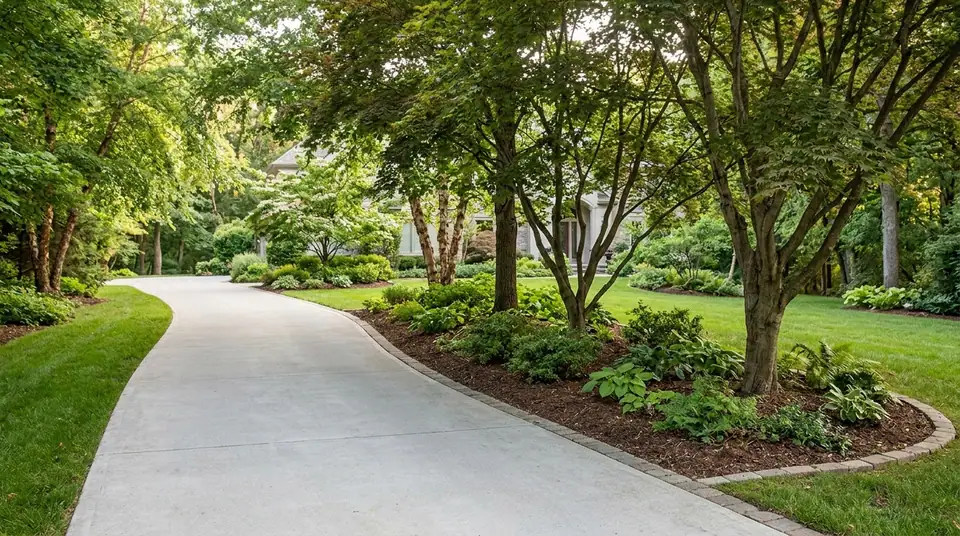
Curving concrete driveway bordered by mature trees and lush garden beds leading to a home
5. Frequently Asked Questions
What's the fastest-growing tree that won't crack my driveway?
While fast growth can sometimes be associated with aggressive root systems, some trees offer a decent growth rate without being problematic. Crape Myrtles can grow 2-5 feet per year in ideal conditions. Eastern Redbuds can also grow at a moderate pace. However, prioritize root structure over speed; a slightly slower-growing tree with a well-behaved root system is infinitely better for your driveway's longevity.
Can I plant a tree right on the edge of my concrete driveway?
It's strongly advised against planting a tree directly on the edge of concrete. Even trees with non-invasive roots will eventually spread. Aim for a minimum of 4 feet, and ideally 6-8 feet or more, especially for larger tree species. This buffer zone allows roots to grow without immediately encountering the hardscape, and it provides space for future growth.
How do I know if a tree's roots are going to be a problem?
Research the specific species and cultivar you are interested in. Look for descriptions that mention "non-invasive roots," "fibrous root system," or "deep taproot." Avoid trees known for aggressive, shallow, surface-rooting habits, such as Willows, Poplars, Silver Maples, and some Oaks. Reputable nurseries and local extension offices are excellent resources for this information. Observing mature trees of the same species in similar conditions can also provide clues.
Will mulch help protect my concrete from tree roots?
Mulch is beneficial for tree health by retaining moisture, regulating soil temperature, and suppressing weeds, but it will not protect your concrete from tree roots. Tree roots are incredibly strong and will grow through or under mulch, soil, and even compacted gravel to find moisture and nutrients, and to expand. The protection comes solely from choosing the right tree species and planting it at an adequate distance.
What about drought-tolerant trees for driveways?
Many of the recommended trees, like Crape Myrtles and Eastern Redbuds, are quite drought-tolerant once established, making them good choices for drier climates or for homeowners who prefer lower-maintenance options. Always check the specific drought tolerance of the cultivar you choose and ensure adequate watering during the establishment phase (the first 1-2 years).
When it comes to selecting trees for your driveway, the long-term vision is key. By choosing wisely, you can enjoy the beauty and benefits of mature trees without the headache and expense of cracked concrete. Happy planting!
PlantSavvyWorld is an independent botanical education project. Articles are drafted with AI assistance, then edited and checked against university extension services, botanical garden collections and other published horticultural sources.