Written with AI assistance, edited and checked against horticultural sources.
Standing on a scorched residential patio in Phoenix back in July of 2014, watching a row of expensive non-native maples crisp into copper-colored potato chips in the 112°F (44°C) afternoon glare, I knew I needed to fundamentally rethink how I approached arid-zone landscaping. That was the afternoon I planted my first Chilean mesquite (Prosopis chilensis). Within three short growing seasons, that single specimen transformed a blinding, reflective concrete dead-zone into an oasis of dappled, filtered shade that dropped ambient patio temperatures by a lifesaving 15°F (8°C). I view Chilean mesquite trees as the ultimate architectural anchor for modern xeriscaping. When matched with proper spacing and thoughtful site design, they offer unmatched resilience, rapid vertical establishment, and sculptural beauty. If you are looking to integrate resilient, heat-loving specimens into your property—perhaps similar to how you would plan planting landscaping under pine trees to manage tricky microclimates—understanding the specific biology of Chilean mesquite is your first step toward long-term success.
1. Botanical Overview & Natural Habitat
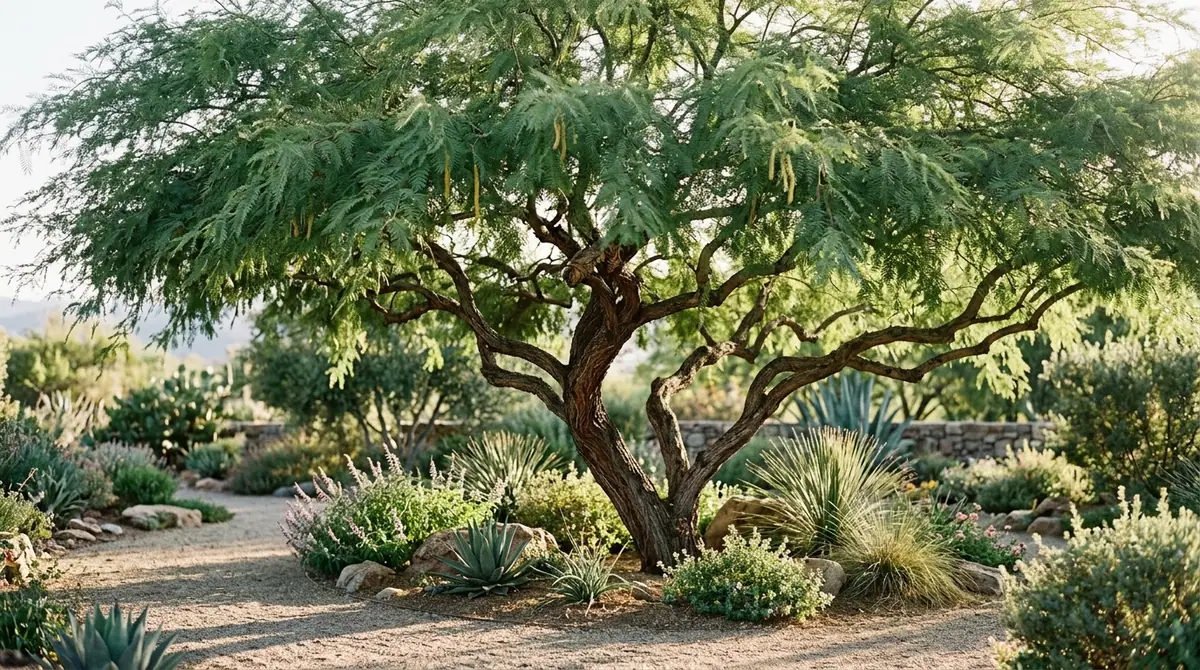
The Chilean mesquite (Prosopis chilensis) belongs to the Fabaceae (legume) family, subfamily Mimosoideae. Native to the arid and semi-arid regions of South America—specifically the Atacama Desert fringes of Chile, Peru, Bolivia, and Argentina—this deciduous to semi-evergreen tree has evolved structural adaptations that allow it to thrive where other landscape plants quickly perish.
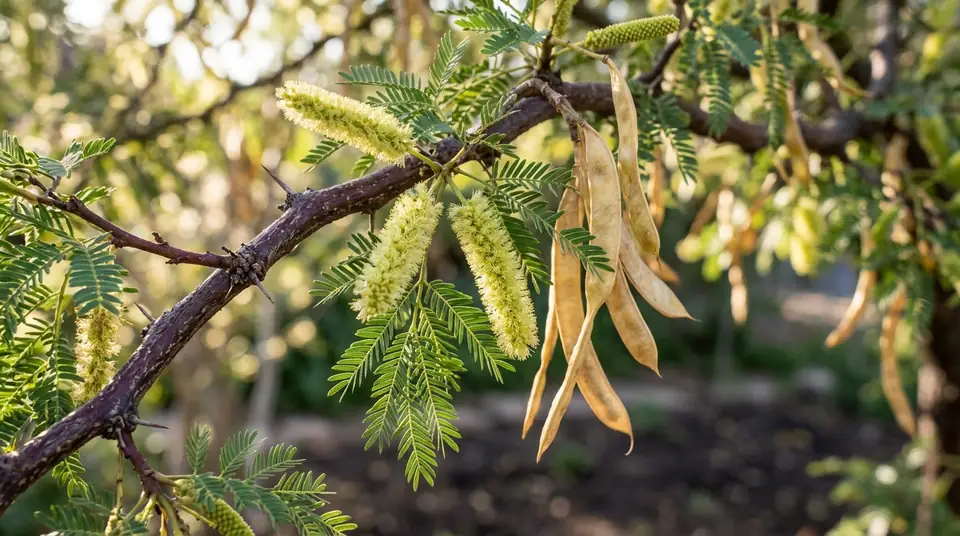
Close-up of Chilean mesquite tree branches with yellow catkin flowers and seed pods
In its native habitat, the Chilean mesquite experiences intense solar radiation, prolonged droughts, and poor, highly alkaline soils. To survive, it employs a dual root system. It deploys a deep taproot that can plunge downward 60 to 100 inches (152 to 254 cm) to tap into subterranean water tables, while simultaneously spreading a vast network of lateral surface roots that capture every drop of ephemeral desert rain.
Mature trees typically reach heights and spreads of 30 to 50 feet (9 to 15 meters), developing a broad, umbrella-shaped canopy characterized by weeping, semi-pendulous branch tips. The bark is dark brown to grayish-black, furrowing deeply with age. The foliage consists of bipinnate leaves divided into fine, bluish-green leaflets, usually 1 to 2 inches (2.5 to 5 cm) long, which reduce transpirational water loss.
Like many legumes, Chilean mesquites feature nitrogen-fixing root nodules populated by symbiotic Rhizobium bacteria. These bacteria convert atmospheric nitrogen into usable nitrates, enriching impoverished desert soils naturally. They also produce narrow, yellowish-brown seed pods—technically legumes—measuring 3 to 6 inches (7.6 to 15 cm) in length, which contain a sweet, starchy pulp historically utilized by indigenous populations.
When designing urban landscapes, many property owners balance these sprawling desert natives with productive home orchards, sometimes utilizing techniques like those found in our guide on best dwarf fruit trees to grow in small backyards to maximize limited space without sacrificing canopy coverage.
2. Essential Environmental & Care Requirements
Establishing a thriving Chilean mesquite requires mimicking its native South American conditions. While remarkably tough, they have specific tolerances that dictate whether they will flourish or decline into structural hazards.
Parameter
Optimal Condition
Common Mistake
Why It Matters
Temperature
80°F to 110°F (27°C to 43°C)
Planting in USDA Zones below 8 (below 10°F / -12°C)
Severe frost damages cambium tissue, causing dieback and structural failure.
Sunlight
Full, unshaded direct sun (8–12 hours daily)
Planting in partial shade or beneath dense canopies
Promotes Phytophthora root rot and suffocates nitrogen-fixing root nodules.
Irrigation
Deep, infrequent soaking every 14–21 days in summer
Frequent, shallow daily sprinkling
Encourages shallow surface rooting, making the tree vulnerable to high winds and toppling.
When selecting a planting site, remember that Chilean mesquites demand unrestricted solar access. They are remarkably drought-tolerant once established, but young trees require consistent moisture during their first 12 months to drive that critical taproot downward.
Growing Chilean mesquite trees successfully from nursery stock or seed requires strict adherence to planting depths and soil preparation protocols. Because these trees grow aggressively when conditions are right, setting them up correctly from day one prevents future structural corrections.
💡 Pro-Tip: When planting container-grown Chilean mesquites, inspect the root ball for circling roots. Score the outer root mass vertically in four places with a sterilized utility knife to encourage outward root extension rather than girdle-forming spirals.
Follow this step-by-step cultivation sequence for planting nursery stock:
Site Selection & Excavation: Locate a spot at least 15 feet (4.5 meters) away from foundations, walkways, and pools. Dig a shallow, saucer-shaped planting hole that is 3 times wider than the nursery container, but exactly the same depth as the root ball—never dig deeper than the root flare.
Soil Preparation: Do not heavily amend the backfill soil. Chilean mesquites prefer native, unamended mineral soils. Mix 10% coarse horticultural sand or decomposed granite into the native backfill if the soil texture leans slightly heavy.
Placement & Unpotting: Gently remove the tree from its container. Place the root ball in the center of the hole, ensuring the root flare sits 1 to 2 inches (2.5 to 5 cm) above the surrounding grade to account for natural settling.
Initial Backfilling & Watering: Backfill halfway with native soil, tamping down gently with your hands or boots to eliminate large air pockets. Fill the hole completely with water to settle the soil, allow it to drain fully for 2 hours, then backfill the remainder of the hole.
Basin Construction: Build a temporary earthen berm 3 feet (0.9 meters) in diameter around the outer edge of the root ball to create a watering basin.
Mulching: Apply a 3-inch (7.6 cm) layer of mineral mulch, such as crushed stone or decomposed granite, across the basin, keeping the mulch 4 inches (10 cm) away from the direct trunk to prevent collar rot.
Establishment Irrigation: Deliver a deep irrigation cycle immediately following planting, then provide deep soaking water every 5 to 7 days for the first month, gradually tapering down to every 14 to 21 days by month six.
When pruning established trees for clearance or structural integrity, always use sterilized bypass loppers. Similar to the hygienic practices required when executing how to prune apple trees for maximum fruit yield, clean cuts prevent the entry of wood-boring insects and opportunistic pathogens.
4. Common Problems, Pests & Troubleshooting
Even the toughest desert trees encounter environmental and biological challenges. Diagnosing issues early prevents permanent structural decline.
Mesquite Psyllids (Heteropsylla texana): These tiny sap-sucking insects feed on new terminal growth, injecting a toxin that causes leaves to curl, yellow, and drop prematurely, accompanied by sticky honeydew secretions. Solution: Blast foliage with a strong stream of water early in the morning, or apply insecticidal soap. Avoid broad-spectrum synthetic insecticides, which kill beneficial predatory lady beetles and lacewings.
Flatheaded Borers (Chrysobothris species): Female beetles lay eggs in bark crevices or sun-scalded trunk sections. Emerging larvae tunnel beneath the bark, disrupting nutrient and water transport and causing sudden branch dieback. Solution: Maintain tree health through proper watering; stressed trees release chemical signals that attract borers. Protect trunks of young trees from direct afternoon sun-scald with breathable paper tree wraps for the first two summers.
Root Rot (Phytophthora and Pythium): Triggered by over-irrigation or standing water lingering within heavy clay soils. Symptoms include sudden wilting, chlorosis, and dark, water-soaked lesions at the base of the trunk. Solution: Immediately cease all irrigation within the drip zone. Improve surface drainage by grading surrounding soil away from the trunk.
Chlorosis: Manifests as interveinal yellowing of younger leaves, typically caused by iron or zinc lockout in highly alkaline soils (pH > 8.2) combined with overwatering that limits root respiration. Solution: Apply chelated iron (Fe-EDDHA) directly to the soil root zone and reduce irrigation frequency to allow soil oxygen levels to recover.
⚠️ Important Caution: Never apply high-nitrogen synthetic fertilizers to Chilean mesquites. Excess nitrogen triggers rapid, structurally weak branch flushes that snap easily during monsoon windstorms and heavily attract sap-sucking psyllids and borers.
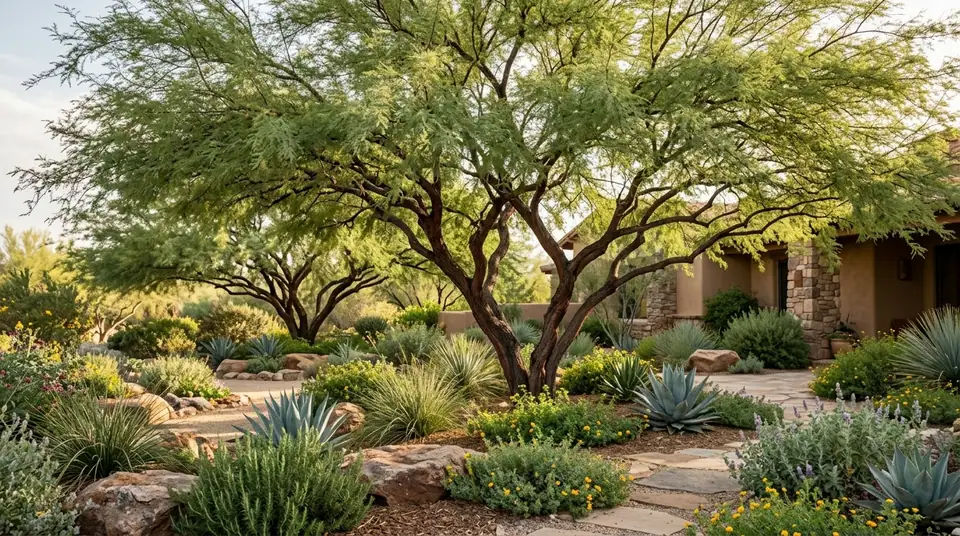
Mature Chilean mesquite tree with sprawling branches in a landscaped desert garden
5. Frequently Asked Questions
How fast do Chilean mesquite trees grow?
Chilean mesquites are exceptionally fast growers, routinely adding 3 to 5 feet (0.9 to 1.5 meters) of vertical and lateral growth per year when supplied with adequate sunlight and deep, infrequent irrigation during their establishment phase. This rapid rate makes them an ideal choice for property owners seeking immediate privacy screening or quick thermal relief from desert heat.
Are Chilean mesquites messy trees?
Yes, they can be considered moderately messy due to their seasonal litter drop. As deciduous or semi-evergreen trees, they drop fine leaflets throughout the year, shed dry seed pods in late summer, and release spent flower catkins in spring. Planting them away from swimming pools, permanent patio seating, and delicate turfgrasses minimizes maintenance headaches.
How do I stop my Chilean mesquite from getting too big?
Management requires structural pruning during late winter before spring bud-break. Never top or pollard a mesquite, as this forces dense, weakly attached water sprouts that ruin the tree's natural architecture. Instead, use thinning cuts to reduce lateral weight, lift lower branches gradually over several years, and remove crossing or rubbing branches to maintain a strong central framework. For broader landscape planning strategies involving woody plants, you can reference resources provided by the Royal Horticultural Society.
Do Chilean mesquites have invasive roots?
While their roots are not notoriously destructive to deep foundations like some water-seeking trees, their lateral roots travel remarkable distances—often twice the width of the canopy—to forage for moisture. Avoid planting them directly adjacent to subterranean utility lines, septic tanks, or delicate patio pavers that could be lifted by heavy surface roots over decades of radial expansion.
PlantSavvyWorld is an independent botanical education project. Articles are drafted with AI assistance, then edited and checked against university extension services, botanical garden collections and other published horticultural sources.