

How to Grow a Wild Food Forest Self Sufficiency Garden
Written with AI assistance, edited and checked against horticultural sources.
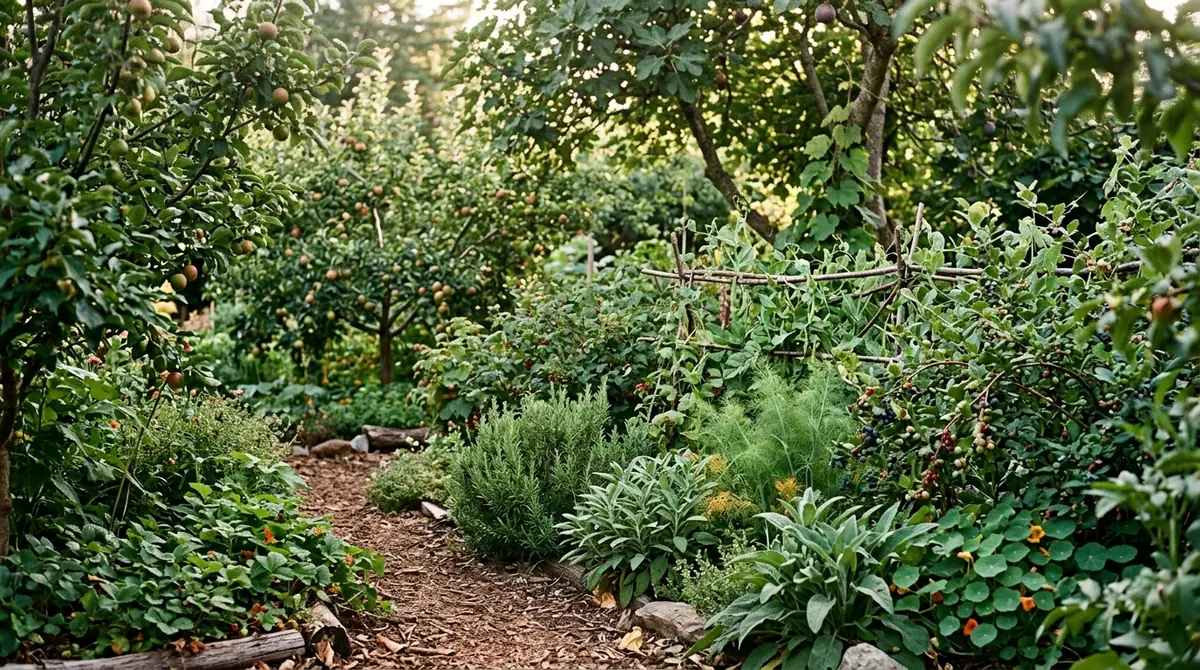
Annual tomatoes can fail under relentless late-May frost waves if they rely on high-maintenance setups requiring synthetic inputs, frost cloth, and endless weeding. In contrast, wild forest edges feature resilient native berries, self-sowing greens, and towering hazelnut shrubs thriving completely unbothered. This contrast shifts landscape design philosophy from struggling with high-maintenance annuals to engineering a self-sustaining wild food forest.

1. Botanical Overview & Natural Habitat
A food forest—or permaculture orchard—is a perennial polyculture modeled after natural woodland ecosystems. Instead of planting isolated crops in bare soil, a food forest mimics the structure of a wild forest, utilizing vertical space to stack yields from the soil line up to the canopy.
To understand how to design one, you must understand its seven distinct vertical layers:
- The Canopy Layer (Emergent): Tall standard fruit and nut trees like sweet chestnut (Castanea sativa) or standard apples (Malus domestica) that reach heights exceeding 30 feet (9.1 meters).
- The Understory Layer (Tree Layer): Smaller dwarf or semi-dwarf fruit trees, such as peaches (Prunus persica) and medlars (Mespilus germanica), sitting comfortably at 10 to 25 feet (3.0 to 7.6 meters).
- The Shrub Layer: Woody perennials producing berries, such as blueberries (Vaccinium corymbosum), black currants (Ribes nigrum), and even nitrogen-fixing shrubs like autumn olive (Elaeagnus umbellata). If you live in warmer subtropical or tropical fringes, you might also consider integrating the remarkable multi-use species detailed in our Total Guide to Moringa Why You Should Grow the Miracle Tree or Drumstick Vegetable.
- The Herbaceous Layer: Non-woody perennials that die back in winter but emerge every spring, including comfrey (Symphytum officinale), artichokes, and self-sowing medicinal and edible weeds. Many gardeners confuse these beneficial volunteers with nuisance plants; understanding the distinctions outlined in Wild Lettuce vs Dandelion Whats the Difference Between Dandelions and Wild Lettuce helps you preserve the right wild greens in your understory.
- The Ground Cover Layer: Low-growing creepers that form a living mulch, suppressing weeds and retaining soil moisture. Examples include strawberries (Fragaria vesca) and creeping thyme (Thymus serpyllum).
- The Rhizosphere (Root Layer): Below-ground edible roots and tubers, such as Jerusalem artichokes (Helianthus tuberosus), horseradish, and garlic.
- The Vertical Layer (Vines and Climbers): Climbing plants that utilize tree trunks for support, such as hardy kiwi varieties (Actinidia arguta) and passionflower (Passiflora incarnata). If your regional climate presents unique winter chill or summer heat limits, reviewing parameters like Will Kiwi Grow in Florida will ensure your vine choices match your hardiness zone.
In a mature wild food forest, these layers work in dynamic synergy. Deep roots mine minerals from deep in the subsoil, dynamic accumulators like comfrey pull up nutrients and deposit them via leaf drop, and dense canopies block sunlight from weed seeds while shielding the soil from destructive wind erosion.
2. Essential Environmental & Care Requirements
Establishing a self-sufficient system requires careful site analysis before your first plant hits the ground. Unlike a standard vegetable patch that demands daily tweaking, a food forest is front-loaded with design choices that dictate its long-term health.
| Parameter | Optimal Condition | Common Mistake | Why It Matters |
|---|---|---|---|
| Sunlight | 6 to 8 hours of direct daily sunlight for upper layers; shade tolerance factored for understory | Planting light-hungry berry shrubs directly beneath dense evergreen canopies | Insufficient light halts photosynthesis, dropping fruit yields to near zero and causing leggy, disease-prone growth. |
| Soil pH | 6.0 to 6.8 for a balanced polyculture; tailored adjustments for acid-loving shrubs | Treating the entire plot with a blanket application of lime or sulfur | Mismatched pH locks out essential micronutrients like iron and phosphorus across diverse root zones. |
| Water Source | Consistent, deep moisture via swales, rainwater catchment, or sustainable irrigation | Relying on frequent, shallow surface watering that encourages weak, surface-level root systems | Deep soaking trains tree and shrub roots to plunge downward, building drought resilience into the ecosystem. |
| Organic Matter | 5% to 8% soil organic carbon maintained via continuous chop-and-drop mulching | Removing fallen autumn leaves and wood chips from the forest floor | Bare soil bakes in the sun, evaporates vital moisture, and starves the subterranean fungal web. |
Water management is the heartbeat of self-sufficiency. If you are depending on subterranean resources during dry spells, assess your supply carefully; resources such as Using Well Water in the Garden a Good Idea provide critical insights into mineral content and pH balance that can impact perennial plant health over decades. Furthermore, before investing in soil amendments to correct structural deficiencies, you should check your baseline acidity levels by learning How to Test Garden Soil Ph Without a Kit to keep your ecosystem cost-effective and natural.
💡 Pro-Tip: Never import massive amounts of outside soil to fix a food forest plot. Instead, use the "sheet mulching" or lasagna gardening technique directly over your native earth. Layer cardboard 3 layers thick, top it with 4 inches (10 cm) of compost, and finish with 6 inches (15 cm) of arborist wood chips. This smothers weeds, feeds the soil food web, and creates an absorbent sponge that slashes your initial irrigation needs by 80%.
3. Step-by-Step Cultivation, Feeding & Propagation
Building a wild food forest is an exercise in ecological succession. You cannot plant a climax forest overnight; you must guide the land through stages of development. Follow this structured protocol to establish your self-sufficiency garden from scratch.
- Site Mapping and Sun Tracking (Days 1–14): Map your land's topography, noting water collection paths, low frost pockets, and sun paths across the summer and winter solstices.
- Sheet Mulch and Inoculate (Days 15–30): Lay down overlapping cardboard across your planting zones to suppress aggressive perennial weeds. Cover the cardboard immediately with organic amendments, finished compost, and a thick layer of wood chips. Introduce mycorrhizal fungi inoculants directly into the root zones of incoming woody plants to jumpstart nutrient exchange.
- Establish the Canopy Layer (Season 1): Plant your primary standard trees first, spacing them at least 15 to 20 feet (4.5 to 6.1 meters) apart to prevent overcrowding at maturity. Dig holes twice as wide as the root ball, but no deeper than the root flare.
- Plant the Understory and Shrub Layers (Season 1–2): Fill the spaces between canopy trees with dwarf fruit trees and berry-producing shrubs. Integrate nitrogen fixers—such as autumn olive, goumi berry (Elaeagnus multiflora), or white clover—every 6 to 8 feet (1.8 to 2.4 meters) to naturally fertilize heavy-feeding fruit trees.
- Incorporate Herbaceous Accumulators and Ground Covers (Season 2): Plant dynamic accumulators like comfrey and yarrow around the drip lines of your trees. Sow creeping ground covers like strawberries and low-growing herbs to blanket every square inch of exposed soil.
- Integrate Vertical Vines and Rhizomes (Season 2–3): Plant hardy kiwi or grapes near the base of fast-growing support trees. Plant perennial root crops like Jerusalem artichokes along the sunlit northern or eastern borders where they won't cast unwanted shade.
- Initiate the Chop-and-Drop Maintenance Cycle (Ongoing): Once plants are established, practice "chop-and-drop." Prune back comfrey leaves 3 to 4 times a year and drop them directly around the bases of your fruit trees to decompose and release vital potassium, nitrogen, and trace minerals.
For academic guidance on perennial polycultures and regional fruit tree selection, consult the resources provided by the Royal Horticultural Society (RHS) and the USDA National Agroforestry Center.
<a id="common-problems, p4. Common Problems, Pests & Troubleshooting
Even the most thoughtfully designed wild food forest will experience growing pains as ecosystems seek equilibrium. Because you are avoiding synthetic pesticides—which kill beneficial predatory insects alongside pests—you must rely on biological controls and structural management.
- Pest Outbreaks (Aphids and Scale): A sudden surge of aphids on your young fruit trees is usually a symptom of a temporary imbalance, often triggered by an excess of quick-release nitrogen or a lack of predatory insects. Do not spray harsh chemicals. Instead, plant insectary strips featuring yarrow, dill, and fennel nearby to attract ladybugs, lacewings, and parasitic wasps.
- Vole and Rodent Girdling: Voles love to chew the bark of young fruit trees right at the soil line during freezing winter months. Protect all juvenile trees by wrapping the lower 18 inches (45.7 cm) of the trunk in hardware cloth or perforated plastic tree guards, sinking the bottom 2 inches (5 cm) directly into the soil.
- Nutritional Deficiencies (Chlorosis): Yellowing leaves with green veins typically indicate iron or magnesium lock-out, often caused by soil compaction or incorrect pH. Relieve the compaction by broadforking around the tree's perimeter and apply an organic foliar spray of liquid kelp or fish emulsion for an immediate micronutrient boost.
⚠️ Important Caution: Never let thick wood chips rest directly against the trunks of your fruit trees or berry shrubs. Piling mulch against the bark traps moisture, inviting collar rot, fungal pathogens, and burrowing rodents that can ring-bark and kill a mature tree within a single season. Maintain a 3-inch (7.6 cm) bare ring around every woody stem.

5. Frequently Asked Questions
How long does it take for a food forest to become self-sufficient?
A food forest typically requires intensive monitoring, targeted watering, and weed management for the first 3 to 5 years. By year 5, the canopy closes, ground covers form an unbroken living mulch, and the system reaches functional ecological maturity, requiring little more than harvesting, occasional pruning, and chop-and-drop maintenance.
Can I grow a food forest in a small suburban backyard?
Yes. You can scale a food forest down to a tiny footprint using "pocket forest" or "urban food forest" design principles. Replace traditional ornamental foundation plants with dwarf fruit trees, berry bushes, and perennial herbs, utilizing vertical walls and fences for climbing vines like hardy kiwi.
Do I need to fertilize a wild food forest annually?
No traditional synthetic fertilization is necessary once the system is established. The design inherently generates its own fertility through nitrogen-fixing shrubs, deep-root mineral mining trees, and the continuous decomposition of dropped leaves, wood chips, and pruned herbaceous biomass.
How do I stop weeds from taking over my food forest in the beginning?
The most effective defense against weeds is eliminating bare soil. Use sheet mulching with cardboard and a thick 6-inch (15 cm) layer of arborist wood chips during establishment. As your planted ground covers and canopy layers expand, they will naturally outcompete and shade out unwanted opportunistic weeds.
Related Guides
- Mittleider Gardening Method More Food from your Garden
- Best Self Watering Planters for Vertical Balcony Gardening
- How Do You Kill Wild Onions Without Killing Grass
- Wild Lettuce vs Dandelion Whats the Difference Between Dandelions and Wild Lettuce
📋 Table of Contents ▼ Click to expand
Tags:
Keep reading
🌿 Related Plants You Might Like




PlantSavvyWorld
Editorial team
PlantSavvyWorld is an independent botanical education project. Articles are drafted with AI assistance, then edited and checked against university extension services, botanical garden collections and other published horticultural sources.