

Best Self Watering Planters for Vertical Balcony Gardening
Written with AI assistance, edited and checked against horticultural sources.
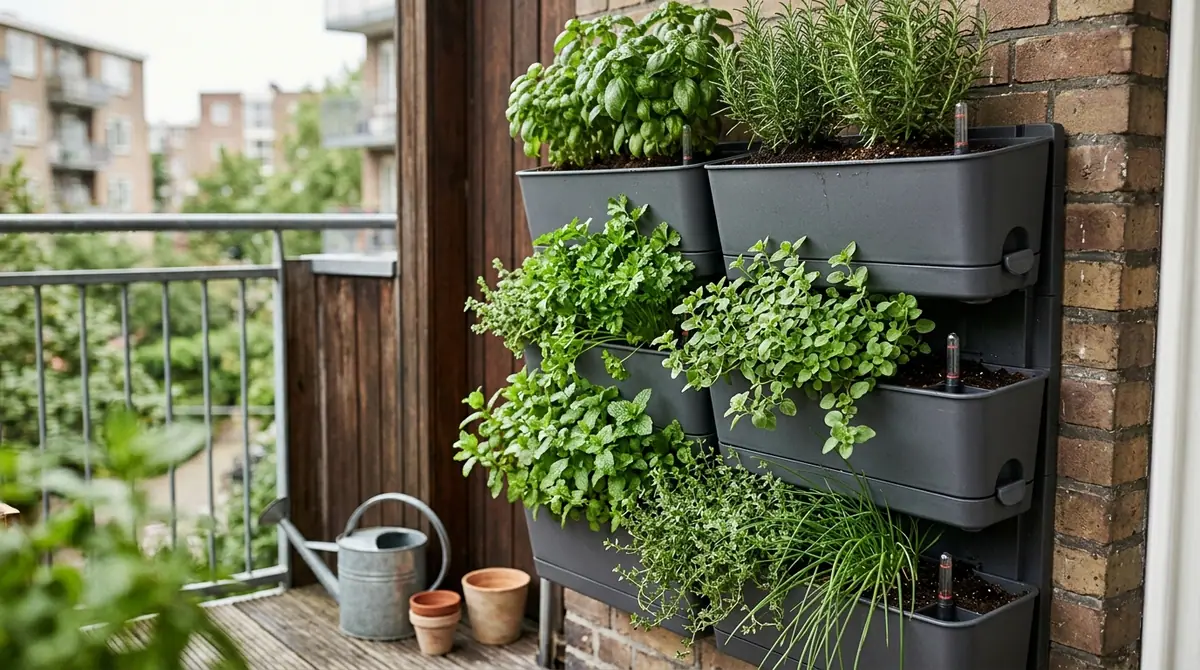
Last July, standing on a wind-scoured eighth-floor balcony in downtown Chicago with the ambient asphalt temperature hovering at 104°F (40°C), I watched two cascading tomato plants go from turgid green to desiccated straw in less than six hours. That afternoon proved what years of field research in container ecosystems already suggested: conventional top-watered balcony setups fail under urban microclimate stress because gravity and wind shear conspire to dry out shallow root zones before capillary action can even begin. When you are restricted to vertical space, where thermal radiation bounces off concrete walls and wind velocity triples compared to ground level, mastering sub-irrigation is the single operational pivot that separates thriving foliage from compost-bin failures.
1. Botanical Overview & Natural Habitat
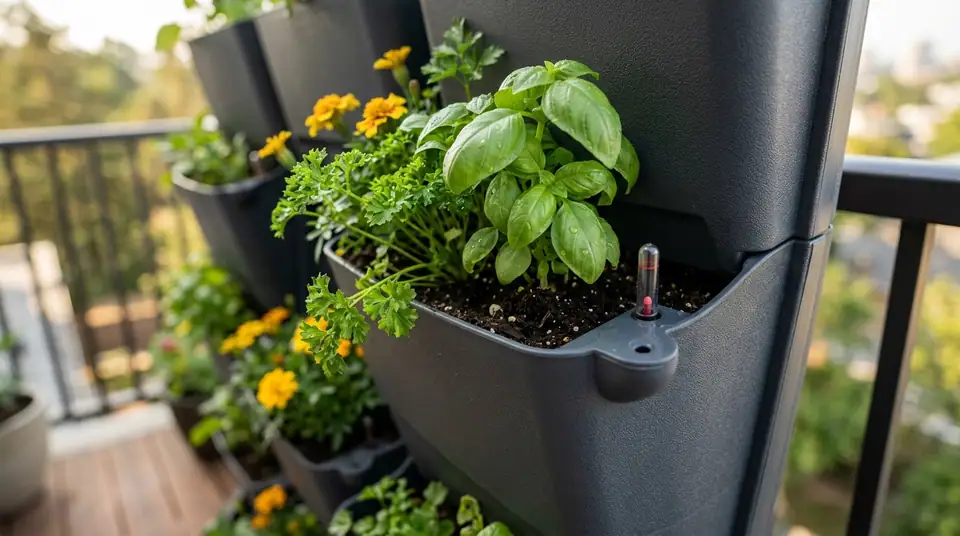
From a botanical standpoint, containerized plants grown vertically lack the thermal buffering and moisture reserves of in-ground earth. In nature, plants like Epipremnum aureum, various Sedum species, and trailing cultivars of Fragaria ananassa (strawberries) survive steep gradients by developing extensive adventitious root systems that intercept ephemeral moisture films. When we translate this to a balcony wall, self-watering planters act as artificial aquifers. They utilize a physical reservoir at the base of the container, drawing water upward via capillary action through a porous substrate medium or specialized wicking matrix.
Understanding this natural habitat translation is vital. In a standard pot, water moves unidirectionally downward, leaching vital nitrates and micronutrients out through the drainage holes. A well-designed vertical self-watering system creates a closed-loop hydraulic gradient. The root zone sits directly above an air gap and a water reservoir, typically holding 0.5 to 2.0 quarts (0.47 to 1.9 liters) of water per planting pocket. This setup encourages roots to grow downward toward the moisture source while maintaining the critical oxygen diffusion rates required for cellular respiration in the meristematic root tips. If you are also managing hardscape planting zones around your outdoor living spaces, balancing moisture retention with structural safety is just as crucial when selecting specimens like those detailed in our guide on 15 Best Trees for Driveways That Won't Crack Concrete.
2. Essential Environmental & Care Requirements
Vertical balcony microclimates are notoriously volatile. Wind tunnels created by high-rise architecture increase the rate of plant transpiration exponentially, often draining leaf tissues faster than standard roots can replace the moisture.
To manage this, your self-watering system must be calibrated to match the Vapor Pressure Deficit (VPD) of your specific outdoor environment. When ambient temperatures exceed 85°F (29°C) with relative humidity dipping below 40%, balcony plants consume up to 300% more water than their ground-level counterparts. The internal reservoir of your vertical planter must be deep enough—ideally maintaining a water column of at least 2.0 to 4.0 inches (5.0 to 10.2 cm)—to buffer against midday solar radiation without boiling the root zone.
| Parameter | Optimal Condition | Common Mistake | Why It Matters |
|---|---|---|---|
| Reservoir Depth | 2.0 – 4.0 inches (5.0 – 10.2 cm) | Selecting purely shallow "saucer-style" reservoirs | Prevents rapid evaporation and ensures consistent capillary draw over 3 to 5 days. |
| Substrate Porosity | 40% air-filled porosity (coir, perlite, vermiculite) | Using dense, unamended garden topsoil | Prevents root asphyxiation and allows oxygen to reach the lower wicking zones. |
| Wind Load Capacity | Anchored to withstand 35+ mph (56+ km/h) gusts | Relying on simple adhesive hooks or lightweight hanging straps | Ensures the entire vertical assembly remains stable during sudden structural wind shears. |
| pH Range | 6.0 – 6.8 for most balcony ornamentals/edibles | Ignoring water alkalinity drift in closed reservoirs | Maintains optimal nutrient solubility, preventing iron and phosphorus lockout. |
💡 Pro-Tip: When filling vertical self-watering pockets, never use standard potting soil straight from the bag. Mix in 20% horticultural-grade expanded clay pebbles (hydroton) or coarse perlite right above the wicking zone. This creates an aerated transition layer that stops roots from sitting in a perpetually saturated state while still drawing up moisture efficiently.
3. Step-by-Step Cultivation, Feeding & Propagation
Setting up a high-performance vertical self-watering balcony garden requires methodical preparation. Follow this precise protocol to ensure optimal hydraulic function and root health.
- Structural Assessment and Mounting: Secure your vertical frame or modular wall brackets directly to masonry studs or heavy-duty balcony railings using stainless steel fasteners. Ensure the entire assembly is level within a 1-degree tolerance; an uneven vertical plane will cause water to pool in one side of modular tier reservoirs while leaving adjacent plants dry.
- Wick and Reservoir Inspection: Install the capillary wicks (typically made of nylon-blend braided cords or compressed felt strips) through the separation grid. Ensure at least 1.5 inches (3.8 cm) of the wick rests submerged in the lower reservoir floor while the upper 2.0 inches (5.0 cm) fans out horizontally into the planting matrix.
- Substrate Layering: Fill the lower third of each pocket with a pre-moistened, peat-free potting mix containing coco coir, compost, and perlite. Press the soil gently around the wicking material to eliminate air pockets that would otherwise break capillary water movement.
- Initial Top-Watering Phase: For the first 7 to 10 days after planting, water your vertical containers gently from the top down. Newly transplanted root systems lack the downward orientation required to pull moisture from the reservoir wick. Top watering establishes root-to-soil contact and jump-starts the natural wicking chain.
- Reservoir Activation and Maintenance Routine: Once new root tips emerge at the base of the root ball (verified by gentle inspection), transition entirely to filling via the dedicated external fill spouts. Maintain a strict feeding schedule by dissolving a balanced, water-soluble organic fertilizer (such as a 4-3-3 N-P-K formulation) directly into the reservoir water every 14 days during the active growing season of May through September. For deeper insights on sustainable plant nutrition and municipal guidelines, consult the Royal Horticultural Society container cultivation standards.
⚠️ Important Caution: Never let self-watering reservoirs run completely dry for extended periods during high summer. When organic potting media dries out entirely, it becomes hydrophobic (water-repelling). If this occurs, the wicks will fail to draw water when the reservoir is refilled, and the root ball will remain bone-dry until manually saturated from the top.
4. Common Problems, Pests & Troubleshooting
Vertical balcony gardens present unique biological challenges due to their confined root runs and elevated positions.
- Root Rot and Anaerobic Odors: If your reservoir smells sulfurous or stagnant, your potting medium is too dense, trapping excess moisture without adequate oxygen exchange. Flush the system immediately with a 3% hydrogen peroxide solution diluted at a ratio of 1 tablespoon per gallon of water to sterilize anaerobic bacteria, then amend your top layer with coarse perlite.
- Fungus Gnats (Sciaridae): The constant moisture at the surface of vertical planters can attract fungus gnats. Introduce beneficial nematodes (Steinernema feltiae) into the top 1.0 inch (2.5 cm) of soil, and top-dress the planting pockets with a 0.5-inch (1.27 cm) layer of horticultural sand or fine gravel to block adult insects from laying eggs in the damp substrate.
- Nutrient Salt Crusts: White, crusty mineral deposits forming on the rims or exterior walls of your vertical planters indicate high electrical conductivity (EC) from tap water salts. Flush the root zones monthly by pouring clean, low-ppm distilled or rainwater through the top of each pocket until it runs clear out of the overflow drain. For scientific data on optimal water quality parameters for containerized horticulture, reference resources provided by the University of California Agriculture and Natural Resources.
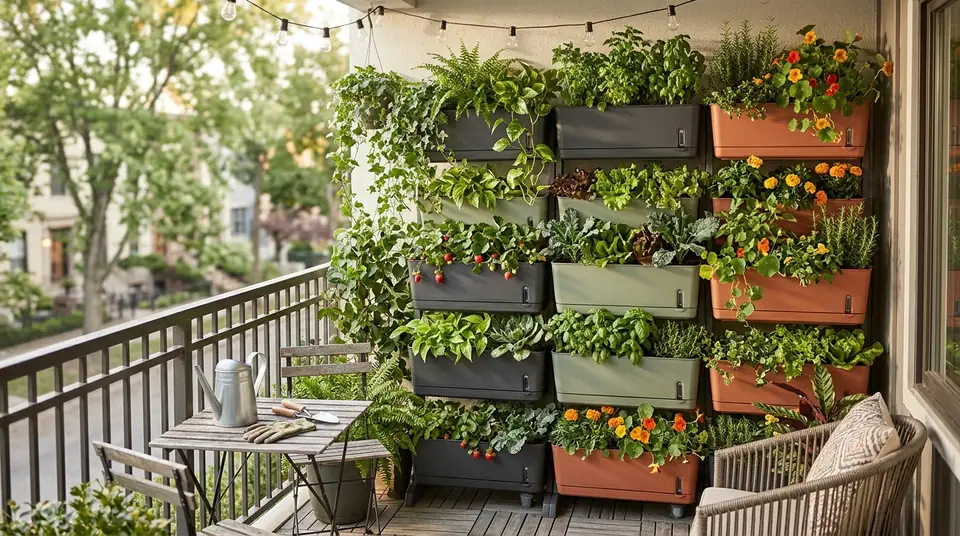
Vertical balcony garden with colorful self-watering planters filled with leafy greens and flowers
5. Frequently Asked Questions
Do self-watering planters attract mosquitoes on a balcony?
No, provided they are designed correctly. High-quality vertical self-watering systems feature enclosed reservoirs with tight-fitting fill caps and overflow drains that prevent adult mosquitoes from accessing standing water to lay eggs. Avoid open-tray saucers entirely.
How often do I need to refill the water reservoir in peak summer?
During peak summer conditions with ambient temperatures averaging 90°F (32°C), most vertical self-watering wall planters require refilling every 3 to 5 days. Smaller modular pockets (holding less than 0.5 quarts of water) may need daily monitoring, whereas larger integrated vertical columns with 1-gallon reservoirs can stretch to 7 days.
Can I grow vegetables in vertical self-watering balcony systems?
Yes, compact and determinate vegetable varieties thrive exceptionally well. Focus on shallow-rooting crops such as leaf lettuce (Lactuca sativa), bush strawberries, culinary herbs (thyme, basil, mint), and dwarf cherry tomato varieties like 'Micro Tom' that do not require deep taproot penetration.
How do I prevent my vertical balcony planters from freezing and cracking in winter?
In regions where temperatures drop below 32°F (0°C), empty all internal water reservoirs completely before the first hard freeze. Water expands by approximately 9% when turning to ice; leaving water in enclosed plastic reservoirs or ceramic modules will cause structural fracture. Bring modular felt-pocket systems indoors or wrap stationary frames in heavy-duty frost blankets.
Related Guides
- How to Grow a Wild Food Forest Self Sufficiency Garden
- Best Shade Loving Plants for Indoor Planters and Dark Rooms
- How to Build Vertical Gardens for Small Urban Balconies
- How to Protect Balcony Plants from Strong Winds and Harsh Sun
- Diy Balcony Herb Garden Ideas for Beginners
📋 Table of Contents ▼ Click to expand
Tags:
Keep reading
🌿 Related Plants You Might Like






PlantSavvyWorld
Editorial team
PlantSavvyWorld is an independent botanical education project. Articles are drafted with AI assistance, then edited and checked against university extension services, botanical garden collections and other published horticultural sources.