
Best Shade Loving Plants for Indoor Planters and Dark Rooms
Written with AI assistance, edited and checked against horticultural sources.
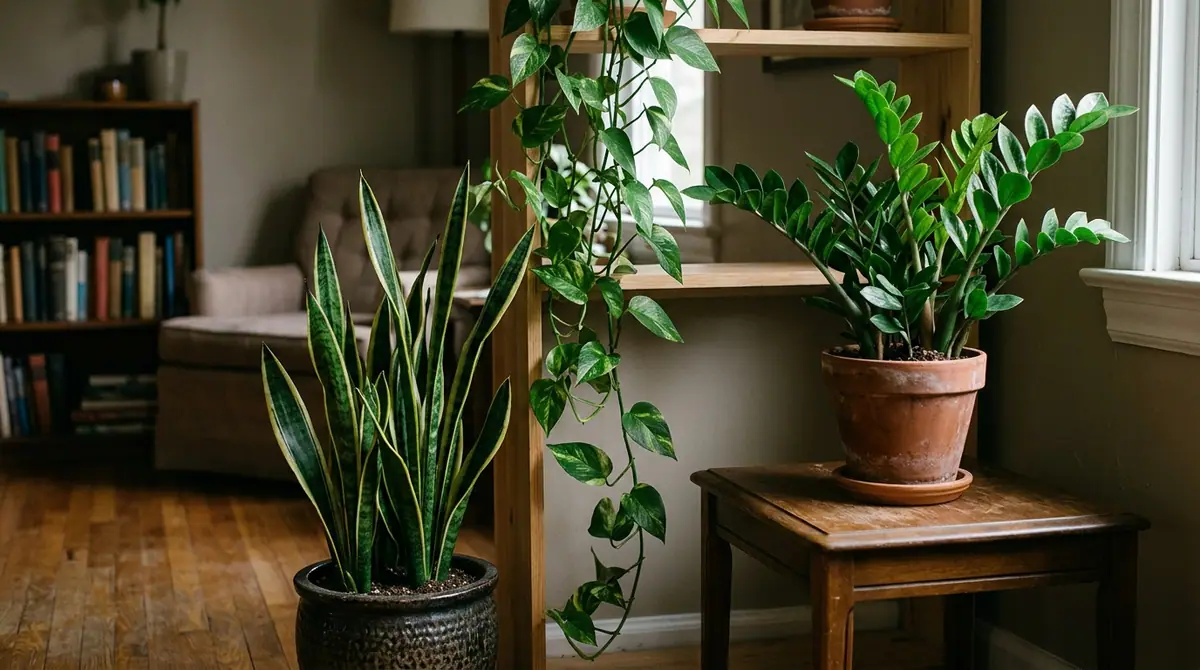
The gardener's east-facing bedroom had a tiny, deeply recessed window that let in barely 50 foot-candles of light at high noon, and I stared at that pitch-black corner for an hour wondering how anything photosynthetic could possibly survive there without wiring up an expensive LED grow light array. That was eight years ago, and after experimenting with dozens of shade-tolerant species, I learned that nature has evolved magnificent understory plants uniquely adapted to survive beneath dense forest canopies where less than 2% of direct sunlight ever penetrates. Here at PlantSavvyWorld, I want to share how you can transform those dim hallways, north-facing apartments, and windowless bathrooms into lush botanical sanctuaries using the absolute best shade loving plants for indoor planters and dark rooms.
1. Botanical Overview & Natural Habitat
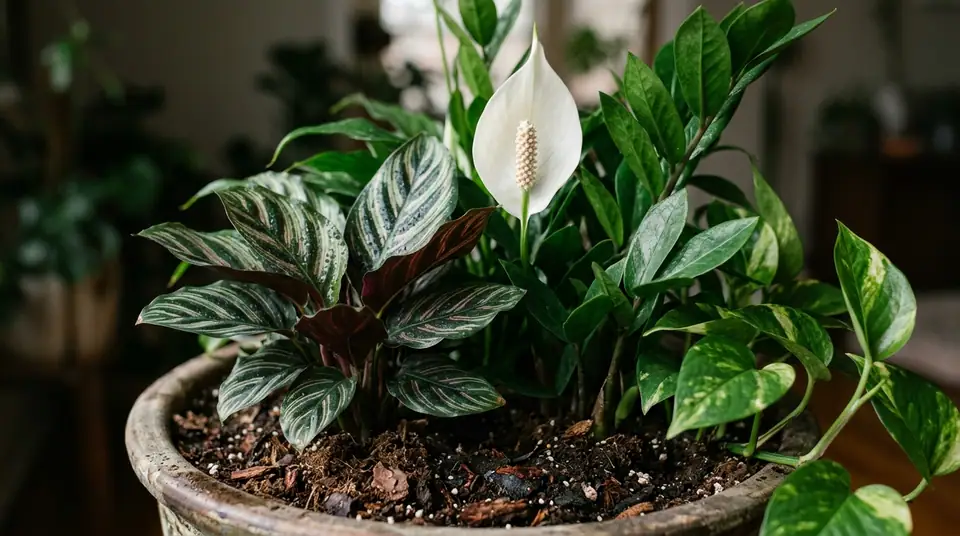
Morphologically, these plants have adapted by developing broad, dark-green leaves packed with high concentrations of chlorophyll a and b to capture every possible photon of light. Some species, like Aglaonema commutatum and Aspidistra elatior, have evolved remarkable physiological resilience, tolerating light levels as low as 25 to 50 foot-candles—levels where standard houseplants would quickly succumb to chlorosis and die.
When you translate this to an indoor environment, it means choosing plants that do not just tolerate dark rooms, but actively thrive in them. Whether you are planting a deep-set floor container in a north-facing living room or styling a hanging planter far away from any window, understanding their forest-floor origins dictates how we water, fertilize, and physically support them. Just as we must carefully manage companion planting layouts in outdoor vegetable patches—similar to how we balance crops in our Sweet Potato Companion Plants: 8 Best Garden Friends & 3 Foes to Avoid guide—indoor shade plants require strict spatial awareness to maximize their limited light capture.
2. Essential Environmental & Care Requirements
Growing plants in dark rooms requires a strict adherence to watering and thermal protocols because low-light conditions inherently slow down transpiration and metabolic rates. If you treat a low-light shade plant the same way you treat a sun-drenched succulent, root rot will follow swiftly.
Temperature consistency is vital. Most interior shade plants prefer ambient room temperatures between 65°F and 80°F (18°C to 27°C). Never expose them to drafts below 55°F (13°C), especially during winter months near poorly sealed windows or drafty entryways.
Humidity is another critical factor. Rainforest understory plants are accustomed to relative humidity levels hovering between 60% and 80%. Indoor environments—particularly during winter heating seasons—frequently drop below 30% relative humidity. Grouping your indoor planters together creates a microclimate that naturally elevates ambient moisture, while regular use of a cool-mist humidifier keeps leaf margins from turning crisp and brown.
| Parameter | Optimal Condition | Common Mistake | Why It Matters |
|---|---|---|---|
| Light | 50–150 foot-candles (Low indirect light) | Placing in direct, harsh southern sunlight | Direct sun scorches broad, delicate understory leaves permanently. |
| Watering | Top 2 inches (5 cm) dry out completely | Keeping soil constantly soggy or bone dry | Overwatering suffocates roots; underwatering causes irreversible cellular collapse. |
| Soil pH | 6.0 to 6.5 slightly acidic | Heavy, unamended clay garden soil | Compacted soil prevents oxygen exchange at the root zone. |
| Temperature | 65°F – 80°F (18°C – 27°C) | Placing near AC vents or freezing glass panes | Extreme thermal shock triggers sudden leaf drop and stem dieback. |
💡 Pro-Tip: When dealing with exceptionally dark rooms, rotate your indoor planters 90 degrees every 14 days. Even shade lovers naturally reach for the slightest directional gradient of ambient light, and regular rotation prevents asymmetric, lopsided growth over time.
For further reading on how professional botanical institutions manage low-light microclimates and resilient structural species, consult the guidelines provided by the Royal Horticultural Society and the Missouri Botanical Garden Plant Finder.
3. Step-by-Step Cultivation, Feeding & Propagation
Planting and maintaining shade lovers in indoor containers requires precision. Because evaporation rates are naturally lower in dark rooms, your potting mix must provide exceptional aeration to compensate for reduced airflow.
Here is the exact step-by-step protocol I use in my own design studio for potting and propagating prime shade-tolerant specimens like Cast Iron Plants (Aspidistra elatior), Snake Plants (Dracaena trifasciata), and ZZ Plants (Zamioculcas zamiifolia):
- Select the Container: Choose a sturdy ceramic or terracotta indoor planter that features at least one drainage hole measuring a minimum of 0.5 inches (1.3 cm) in diameter. Avoid pots without drainage in low-light rooms, as trapped water has virtually no solar energy to evaporate it.
- Mix the Substrate: Combine 50% high-quality organic potting soil, 25% coarse horticultural perlite, and 25% orchid bark. This creates a fast-draining, chunky medium that mimics the loose, organic-rich forest floor.
- Establish the Planting Depth: Gently unpot your shade plant, tease apart any tightly bound root balls, and position it in the container so the crown sits exactly 1 inch (2.5 cm) below the container rim. Planting too deeply invites stem rot.
- Initial Watering & Settling: Water the potting mix thoroughly until it runs freely from the drainage hole. Allow the container to drain completely for 30 minutes in a sink before placing it in its permanent dark room location.
- Establish a Feeding Schedule: Feed your plants strictly during the active growing season (spring through summer) every 30 to 45 days using a balanced, water-soluble houseplant fertilizer diluted to half-strength. Never fertilize during the dark, dormant winter months.
- Propagate via Division: In early spring, remove the plant from its container, gently slice through the rhizomes or tuberous roots with a sterile blade ensuring each division has at least 3 healthy stems, and repot them individually into smaller nursery pots.
⚠️ Important Caution: Never use heavy garden soil straight from your yard for indoor containers. Yard soil contains compacted clay, weed seeds, and latent pathogens that thrive in stagnant, dark indoor conditions, virtually guaranteeing root failure.
If you enjoy managing diverse indoor and outdoor microclimates, you might also appreciate learning how to manage robust garden systems and structural elements. For instance, when designing structural landscapes outdoors, selecting the right species is just as critical as choosing indoor shade plants; take a look at our expert recommendations for 15 Best Trees for Driveways That Won't Crack Concrete to see how deep-root behavior dictates placement. Additionally, if you enjoy experimenting with indoor edible setups or seasonal forcing techniques, check out our detailed Holiday Plants Care Guide: How to Force Poinsettias to Rebloom & Holiday Cacti ID.
4. Common Problems, Pests & Troubleshooting
Even the toughest shade-loving plants can experience issues when placed in challenging indoor environments. Because dark rooms lack robust airflow and intense sunlight, minor issues can quickly escalate if you do not catch them early.
- Yellowing Lower Leaves: This is the classic symptom of overwatering combined with low light. When the soil stays wet for more than 14 days, roots suffocate and stop taking up nitrogen. Solution: Let the soil dry out to a depth of 3 inches (7.6 cm) before watering again, and reduce your watering frequency by half during autumn and winter.
- Brown, Crispy Leaf Tips: Usually caused by dry indoor air or accumulated mineral salts from tap water. Solution: Switch to distilled or filtered water, and mist the surrounding air or run a humidifier to keep relative humidity above 50%.
- Mealybugs and Spider Mites: Surprisingly, even in dark rooms, sap-sucking pests can hitchhike indoors on new plants or thrive in dry, stagnant corners. Check the undersides of leaves and leaf axils monthly. Solution: Wipe down foliage with a cloth soaked in a 1% solution of horticultural insecticidal soap.
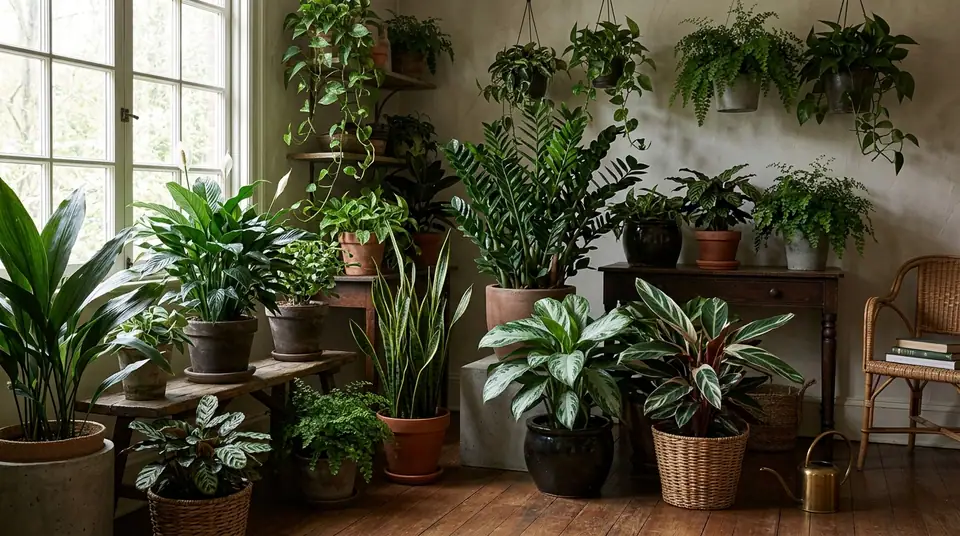
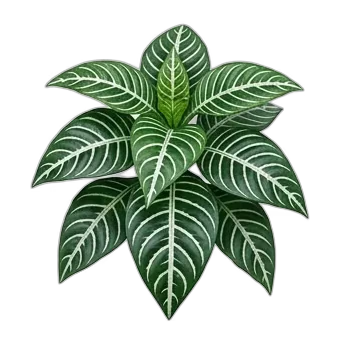
Collection of diverse shade loving houseplants arranged in pots on the floor, shelves and hanging near a window
5. Frequently Asked Questions
What are the absolute best plants for a room with zero windows?
While no plant can survive in absolute pitch blackness 24 hours a day, species like the ZZ Plant (Zamioculcas zamiifolia), Snake Plant (Dracaena trifasciata), and Cast Iron Plant (Aspidistra elatior) can easily survive in rooms that rely entirely on ambient overhead interior lighting or a few hours of indirect hallway light each day.
How often should I water shade plants in dark rooms?
Because low-light conditions slow down photosynthesis and reduce soil evaporation, you should check your indoor planters every 7 to 10 days by inserting your index finger 2 inches (5 cm) deep into the soil. If the soil feels completely dry at that depth, water thoroughly; if it still feels damp, wait another 5 to 7 days.
Do shade-loving indoor plants need fertilizer?
Yes, but much less frequently than sun-loving plants. Feed them once every 4 to 6 weeks only during spring and summer using a balanced liquid fertilizer diluted to 50% strength. Completely withhold fertilizer from October through February when natural daylight hours plummet.
Can I use regular potting soil for indoor shade plants?
No. Standard potting soil retains too much moisture and packs down tightly in indoor pots, choking off oxygen to the roots. Always amend standard potting mixes with at least 25% perlite or pumice and 25% orchid bark to ensure proper drainage and aeration.
Related Guides
- Best Self Watering Planters for Vertical Balcony Gardening
- Indoor Plant Leaves Curling Inward
- How to Care for Indoor Orchids to Make Them Bloom Again
- Why Do People Use Shade Sails
- Hydrangeas for Part Shade
📋 Table of Contents ▼ Click to expand
Tags:
Keep reading
🌿 Related Plants You Might Like

PlantSavvyWorld
Editorial team
PlantSavvyWorld is an independent botanical education project. Articles are drafted with AI assistance, then edited and checked against university extension services, botanical garden collections and other published horticultural sources.