

Hydrangeas for Part Shade
Written with AI assistance, edited and checked against horticultural sources.

1. Botanical Overview & Natural Habitat
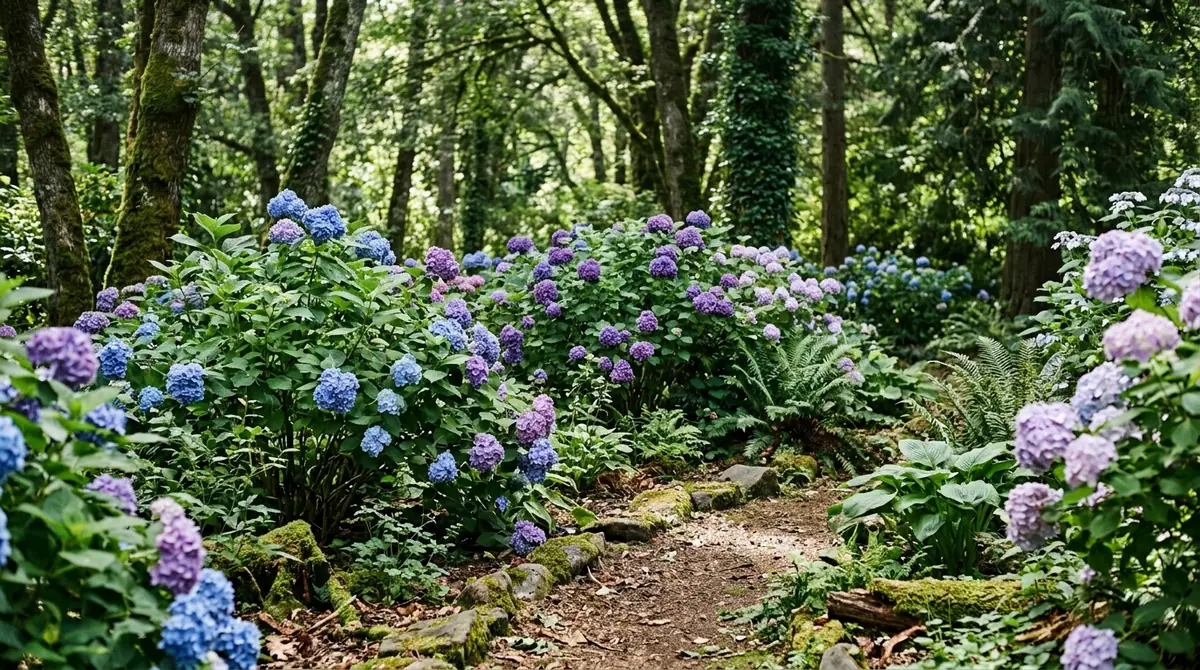
The genus Hydrangea comprises over 70 species of deciduous and evergreen shrubs, small trees, and lianas native primarily to eastern and southern Asia (China, Japan, and Korea) as well as North and South America. In their native understory habitats, these plants do not bake in open fields. Instead, they thrive along forest margins, woodland edges, and stream banks where the soil remains damp and cool, protected from the scorching afternoon rays by a high canopy of taller deciduous trees.
Understanding this evolutionary background is the single most important key to landscape design success. When we look closely at how they grow in nature, we see why part shade is their absolute sweet spot. Morning sunlight provides the energy needed for robust photosynthesis and vibrant bloom development, while afternoon shade protects their broad, delicate foliage and massive inflorescences from excessive transpirational water loss.
When designing a landscape, incorporating hydrangeas into part shade zones creates a lush, layered aesthetic. Their generous foliage texture and luminous blooms contrast brilliantly against finer-textured woodland companions. For those looking to expand their shade gardening portfolio beyond shrubs, you can explore textural pairings detailed in my guide on Best Shade Loving Plants for Indoor Planters and Dark Rooms, which offers exceptional inspiration for bridging indoor and outdoor transitional spaces.
Among the wealth of species, four stand out as absolute champions for part shade garden designs:
- Hydrangea macrophylla (Bigleaf Hydrangea): Renowned for massive mophead or lacecap flowers. They thrive in USDA Zones 5–9, reaching heights of 3 to 6 feet (90 to 180 cm) with an equal spread. Flower color on these plants is famously tied to soil pH, shifting from pink in alkaline soils to striking blue in acidic soils.
- Hydrangea paniculata (Panicle Hydrangea): While exceptionally hardy (Zones 3–8) and capable of handling more sun than other species, panicled hydrangeas perform exceptionally well in part shade, producing massive, cone-shaped white flower panicles that age to dusky pink and antique bronze by autumn. They can be pruned into multi-stemmed shrubs or elegant small trees reaching 8 to 15 feet (2.4 to 4.5 m).
- Hydrangea arborescens (Smooth Hydrangea): Native to eastern North American woodlands (Zones 3–9), this species is remarkably resilient in partial shade. Cultivars like 'Annabelle' produce breathtaking, snowball-like white blooms up to 12 inches (30 cm) across on plants standing 4 to 5 feet (120 to 150 cm) tall.
- Hydrangea quercifolia (Oakleaf Hydrangea): Featuring deeply lobed, oak-like leaves that turn brilliant burgundy and purple in autumn, this native southern beauty (Zones 5–9) thrives beautifully in woodland edges and part shade. It produces upright white panicles that fade to pink, complemented by exfoliating, cinnamon-colored bark on mature stems.
For additional scientific depth on regional variations and performance trials, consult the comprehensive resources provided by the Royal Horticultural Society and the University of Florida IFAS Extension.
2. Essential Environmental & Care Requirements
Creating an optimal environment for your part shade hydrangeas requires balancing light, soil moisture, and nutrient availability. Let’s break down the exact parameters needed for long-term health and vigorous blooming.
| Parameter | Optimal Condition | Common Mistake | Why It Matters |
|---|---|---|---|
| Sunlight | 3–6 hours of gentle morning sun, protected from harsh 12 PM–4 PM rays | Planting in deep, dark shade under dense evergreens | Insufficient light halts flower bud initiation, leading to lush green foliage with zero blooms. |
| Soil Moisture | Consistently moist, evenly damp, rich loamy-clay | Allowing soil to dry out completely between waterings | Rapid wilting causes leaf scorch, bud blast, and irreversible root tip dieback in delicate surface roots. |
| Soil pH | 5.2 to 5.5 for blue flowers; 6.0 to 6.5 for pink flowers | Guessing soil pH without testing | Soil chemistry directly dictates aluminum uptake, which determines bloom pigmentation in H. Macrophylla. |
| Mulching | 3 to 4 inches (7.5 to 10 cm) of shredded hardwood or leaf mold | Piling mulch directly against the woody stems | Deep mulch insulates shallow roots against extreme temperature swings, but touching stems induces rot. |
💡 Pro-Tip: When planning a part shade bed, pay close attention to root competition from nearby trees like maples or oaks. Install a physical root barrier 18 inches (45 cm) deep around your hydrangea planting zone to prevent aggressive tree roots from stealing precious moisture and nutrients from your shrubs.
3. Step-by-Step Cultivation, Feeding & Propagation
Getting your hydrangeas established correctly in a part shade setting guarantees years of low-maintenance beauty. Follow this precise protocol for planting and propagation.
- Site Selection & Soil Preparation: Select a location receiving morning sun and afternoon shade. Dig a hole 2 times wider than the root ball and exactly as deep as the container. Incorporate 2 inches (5 cm) of well-rotted compost into the excavated native soil to improve structure and water retention.
- Planting & Root Teasing: Gently tease out any circling roots on the container-grown plant to prevent girdling. Set the shrub in the hole, ensuring the top of the root ball sits 0.5 inches (1.2 cm) above the surrounding soil grade to account for settling. Backfill halfway, tamp down gently to remove air pockets, and water thoroughly to settle the soil before filling the remainder of the hole.
- Applying Moisture Retentive Mulch: Apply a 3-inch (7.5-cm) layer of organic shredded bark or leaf mulch across the entire root zone, maintaining a 2-inch (5-cm) clearance ring around the main stems to prevent collar rot.
- Initial Watering Regimen: Provide 1 inch (2.5 cm) of water weekly through rainfall or irrigation for the first 90 days. During heatwaves where temperatures exceed 85°F (29°C), increase watering frequency to every 48 hours.
- Fertilization Schedule: Apply a balanced, slow-release, controlled-release fertilizer (such as a 10-10-10 formulation) once in early spring as new shoots emerge. Avoid high-nitrogen fertilizers after July 1st, as late succulent growth will be severely damaged by the first autumn frost.
- Propagation via Softwood Cuttings: In mid-summer (typically late June to mid-July), take 5-inch (12.5-cm) cuttings from non-flowering lateral shoots. Strip the lower leaves, dip the base in rooting hormone powder, and insert them into a 50/50 perlite and peat propagation tray. Keep the medium moist under high humidity for 21 to 28 days until roots measure 1 inch (2.5 cm) long.
⚠️ Important Caution: Never prune Hydrangea macrophylla or Hydrangea quercifolia in late summer, autumn, or winter. These species set their flower buds for the following year on old wood during late summer. Pruning them outside of the tight window immediately after flowering (usually mid-summer) will result in zero blooms the following spring.
4. Common Problems, Pests & Troubleshooting
Even in ideal part shade conditions, hydrangeas can encounter minor hiccups. Here is how to diagnose and solve them before they threaten your plants.
- Foliage Wilting in the Afternoon: If your hydrangeas droop dramatically at 2 PM but recover by evening, this is often a normal physiological response to high transpirational demand, even when soil moisture is adequate. However, if they do not recover overnight, check soil moisture immediately. Deeply soak the root zone and consider erecting temporary shade cloth if afternoon exposure is too intense.
- Powdery Mildew (Erysiphe species): Appearing as a white, powdery dusting on leaves during humid late-summer days, this fungal issue thrives in stagnant, shaded air. Solution: Improve air circulation by selectively thinning interior branches, avoid overhead irrigation in the evening, and spray preventive treatments of potassium bicarbonate or copper fungicide at the first sign of symptoms.
- Chlorosis (Interveinal Yellowing): Bright yellow leaves with dark green veins indicate iron chlorosis, frequently caused by soil that is too alkaline, preventing iron uptake. Solution: Test soil pH. If pH is above 6.5, apply elemental sulfur or chelated iron to lower pH and restore deep green foliage color.
- Cercospora Leaf Spot: Small, circular purple spots that develop gray centers on lower leaves are caused by the fungus Cercospora hydrangeana. Solution: Clean up and destroy all fallen infected leaves in autumn. Water at the base of the plant using drip irrigation to prevent water splashing spores from soil to foliage.

5. Frequently Asked Questions
Can hydrangeas grow in part shade without any direct sunlight?
Hydrangeas tolerate bright, indirect light or dappled shade under tall tree canopies, but absolute zero direct sunlight typically results in sparse, weak stems and zero flower production. Aim for a minimum of 2 hours of gentle morning sun to stimulate reliable blooming.
How do I change my hydrangea flowers from pink to blue in a part shade garden?
To achieve blue flowers on Hydrangea macrophylla, your soil pH must be acidic (between 5.2 and 5.5) and contain accessible aluminum ions. Apply aluminum sulfate in early spring and autumn according to package directions. If your soil is naturally alkaline, growing them in raised beds enriched with peat moss and pine bark makes pH management much easier.
Why are my part shade hydrangea leaves turning brown on the edges?
Brown leaf margins usually point to inconsistent soil moisture or fertilizer burn. If the plant dries out completely between waterings, the delicate leaf edges scorch. Ensure your 3-inch (7.5-cm) mulch layer is intact and maintain a deep, regular watering schedule providing 1 inch (2.5 cm) of water every week.
When is the correct time to prune smooth hydrangeas (Hydrangea arborescens)?
Smooth hydrangeas bloom on new wood, meaning they produce flower buds on the current season's growth. Prune them hard in late winter or early spring (February to March) before new shoots emerge. You can shear them down to 12 to 18 inches (30 to 45 cm) from the ground to encourage exceptionally large flower heads. If you are also interested in expanding your productive garden beds with perennial food crops, check out my companion guide on Best Plants to Grow in your Survival Garden Part 2 16 Must Grow Perennial Edibles for wonderful additions that thrive right alongside your ornamental shade shrubs.
Related Guides
- Best Plants to Grow in your Survival Garden Part 2 16 Must Grow Perennial Edibles
- Why Do People Use Shade Sails
- Does Clematis Grow in the Shade
- Best Shade Loving Plants for Indoor Planters and Dark Rooms
- How Do I Keep Cut Hydrangeas Fresh
📋 Table of Contents ▼ Click to expand
Tags:
Keep reading
🌿 Related Plants You Might Like


PlantSavvyWorld
Editorial team
PlantSavvyWorld is an independent botanical education project. Articles are drafted with AI assistance, then edited and checked against university extension services, botanical garden collections and other published horticultural sources.