

How to Protect Balcony Plants from Strong Winds and Harsh Sun
Written with AI assistance, edited and checked against horticultural sources.
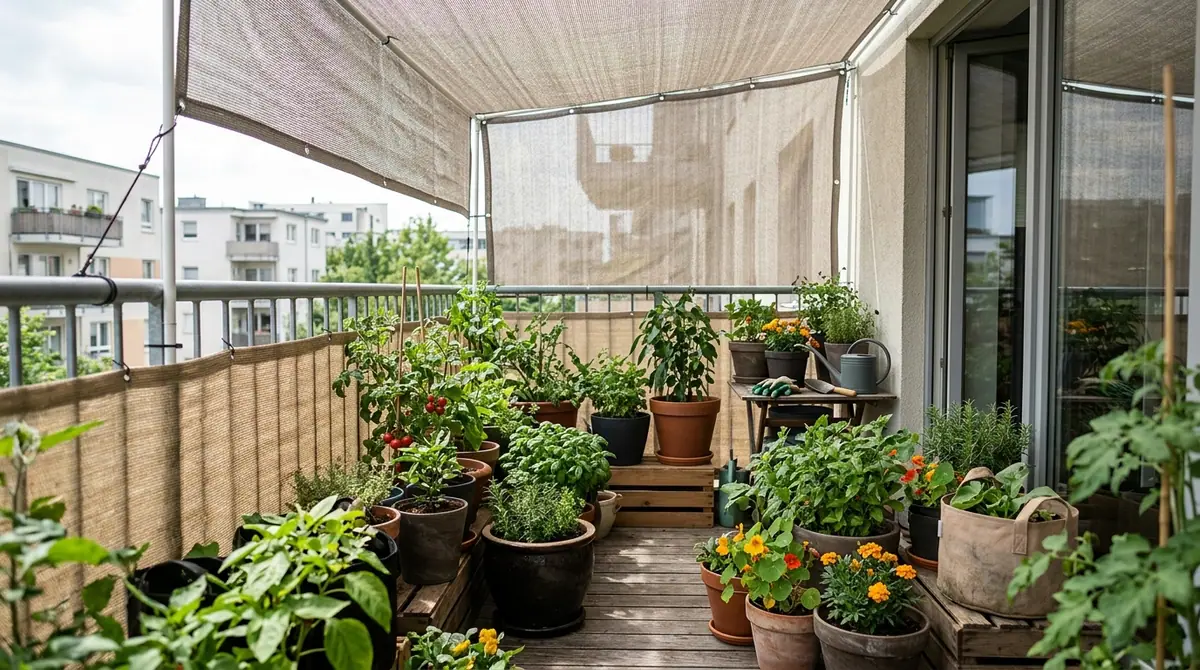
A sudden thermal microburst can send heritage tomato containers airborne and instantly shred the delicate, papery leaves of Japanese maples, while ambient temperatures swing wildly from 92°F (33°C) down to a wind-whipped chill. Urban balconies are not sheltered gardens; they are miniature wind tunnels and solar ovens combined.

1. Botanical Overview & Natural Habitat
To protect balcony plants, you must first understand how wild plants survive extreme elements. In nature, plants growing on exposed cliffs, arid dunes, or windy alpine ridges do not fight strong winds and scorching sun; they adapt to them.
Alpine and cliffside species develop stunted, woody stems, thick cuticles, and specialized trichomes (tiny hair-like structures) that reflect harsh UV rays and trap a boundary layer of humid air against the leaf surface. When we place potted plants on a concrete balcony, we strip them of these natural support systems. The elevated altitude, lack of surrounding vegetation, and heat-radiating concrete walls create an artificial desert.
Solar radiation on an elevated balcony is significantly more intense than at ground level because there is less atmospheric filtration, and nearby glass or concrete surfaces reflect additional light onto your foliage. Simultaneously, the Bernoulli principle accelerates wind speed as it hits the vertical face of a building, funneling high-velocity air streams directly across your patio rails.
Understanding this botanical reality helps us design a micro-habitat that mimics a sheltered forest understory or a rocky crag, keeping our green spaces thriving even during extreme weather advisories. For further reading on urban horticultural stressors, you can reference the Royal Horticultural Society guidelines on container gardening.
2. Essential Environmental & Care Requirements
Balcony cultivation demands strict attention to physical parameters. If your soil volume is too small, wind shear will topple the container; if your moisture management fails, intense solar radiation will cook the root ball within hours.
| Parameter | Optimal Condition | Common Mistake | Why It Matters |
|---|---|---|---|
| Container Weight | Min. 25 lbs (11.3 kg) total | Using lightweight plastic pots without ballast | Prevents tipping and root damage during high wind events |
| Soil Moisture | Consistent dampness at 2 inches (5 cm) deep | Allowing complete dry-down cycles in high heat | Protects root hairs from thermal shock and desiccation |
| Wind Mitigation | Porous windbreaks reducing velocity by 50% | Using solid glass or acrylic barriers that create back-eddies | Slows airflow without causing destructive air turbulence |
| Solar Shading | 30% to 50% shade cloth during peak hours (12 PM–4 PM) | Leaving sensitive foliage exposed to direct afternoon sun | Prevents leaf scorching, cell collapse, and rapid transpiration |
💡 Pro-Tip: When selecting pots for high winds, choose wider, squat containers with a low center of gravity. A pot with a base diameter equal to or greater than its height will withstand double the wind shear of a tall, tapered urn.
3. Step-by-Step Cultivation, Feeding & Propagation
Securing a balcony against the elements requires a systematic approach to hardware, soil physics, and plant placement. Follow this exact sequence to winterize or storm-proof your terrace setup.
- Audit Your Structural Anchors: Inspect all railing brackets and plant hangers. Ensure every heavy container is secured with heavy-duty UV-resistant zip ties or stainless steel earthquake straps designed to withstand wind gusts up to 50 mph (80 km/h).
- Install a Permeable Windbreak: Mount a bamboo reed screen or a woven mesh windscreen along the outer railing. Ensure it has a porosity of roughly 40% to 50%, which filters and slows the wind rather than deflecting it violently over the top.
- Upgrade Your Soil Matrix: Amend your potting mix with 20% horticultural perlite or pumice and 10% organic worm castings. This heavy, well-draining matrix adds crucial ballast weight while holding vital moisture during scorching 95°F (35°C) summer afternoons.
- Group Plants for Mutual Protection: Arrange your flora in dense clusters. Place taller, sturdier shrubs like dwarf conifers on the windward side to act as a living shield for delicate trailing annuals, much like the companion dynamics explored in How to Grow Strawberries Indoors: From Fruit Seeds to Sweet Berries.
- Apply a Protective Mulch Layer: Top-dress every container with a 1.5-inch (3.8 cm) layer of slate chips or coarse pine bark. This blocks direct sun from evaporating soil moisture and prevents wind from scouring the topsoil away.
- Deploy Retractable Shade Cloth: Install a sliding 40% shade cloth overhead or on the sun-facing side of your balcony. Pull it across your plants daily between the crucial hours of 11:00 AM and 4:00 PM when solar radiation peaks.
⚠️ Important Caution: Never use solid plastic sheets or solid canvas tarps as windbreaks on high-rise balconies. They act as sails, catching the wind and generating massive torque that can snap wrought-iron railings or tear mounting brackets straight out of masonry walls.
4. Common Problems, Pests & Troubleshooting
Balcony microclimates prone to wind and sun stress frequently present unique physiological disorders and pest pressures.
- Wind Burn (Desiccation): Leaves turn brown and crispy at the margins, while stems feel dry and brittle. This happens when wind strips moisture from foliage faster than the roots can supply it. Solution: Move plants further inward, apply an anti-transpirant spray to coat the leaves, and ensure your watering schedule is dialed in.
- Solar Leaf Scorch: Bleached white or brown patches appear on the sides of leaves facing the sun or reflecting off nearby glass windows. Solution: Immediately deploy temporary shade cloth and prune away dead, non-functional tissue after a 14-day recovery period.
- Root Ball Thermal Stress: Plants wilt despite having damp soil because high container temperatures cook the delicate root tips. Solution: Wrap your containers in burlap or light-colored insulating bubble wrap to reflect solar heat, keeping soil temperatures below 85°F (29°C).
- Spider Mite Infestations: Hot, dry, wind-swept balconies are breeding grounds for microscopic spider mites. They spin fine webs across leaf nodes and suck plant sap. Solution: Blast foliage weekly with a strong stream of cold water from a spray bottle, followed by an application of horticultural insecticidal soap applied at dusk over a 7-day treatment cycle.

5. Frequently Asked Questions
How do I stop my balcony pots from blowing over in high winds?
Anchor your pots by placing heavy bricks or stones at the bottom of the container before adding soil, or use heavy terracotta instead of thin plastic. Additionally, link multiple pots together using secure wire frames or strap them directly to sturdy architectural railing posts to distribute the wind load evenly.
What are the best wind-resistant plants for apartment balconies?
Opt for plants with flexible, narrow, or needle-like foliage that bends rather than snaps. Excellent choices include ornamental grasses like feather reed grass, dwarf conifers, rosemary, lavender, and tough succulents such as Agave or Sempervivum species.
How can I lower the temperature on a blazing hot concrete balcony?
Concrete acts as a giant heat sink, absorbing sunlight all day and radiating it back out. Cool the area down by installing wooden deck tiles over the concrete, placing large saucers of water to boost local humidity via evaporation, and setting up vertical green walls with climbing vines to shade the hard surfaces.
Should I water my balcony plants more often when it is windy?
Yes, absolutely. Wind strips ambient humidity away from leaves and dramatically increases the rate of transpiration. Check your soil daily by inserting your finger down to the 2-inch (5 cm) mark; if it feels dry, water thoroughly until it drains freely from the bottom of the pot.
Related Guides
- How to Protect Backyard Fruit Orchard from Winter Frost
- How to Make a Wooden Decoy Bird to Protect your Garden
- Diy Balcony Herb Garden Ideas for Beginners
- Best Vegetables to Grow in Apartment Balcony Gardens
- Best Self Watering Planters for Vertical Balcony Gardening
📋 Table of Contents ▼ Click to expand
Tags:
Keep reading
🌿 Related Plants You Might Like





PlantSavvyWorld
Editorial team
PlantSavvyWorld is an independent botanical education project. Articles are drafted with AI assistance, then edited and checked against university extension services, botanical garden collections and other published horticultural sources.