Written with AI assistance, edited and checked against horticultural sources.
Under a punishing 92°F (33°C) afternoon sun, a heavy truss of 'Campari' cluster tomatoes can snap under its own weight right at the stem joint if left unclipped to its supporting stake, resulting in the loss of nearly two pounds of perfectly uniform, deeply aromatic globes to structural failure. Cultivating cluster tomatoes—often sold commercially as vine-ripe or truss tomatoes—requires careful support to prevent this.
Growing these multi-fruit wonders requires a specialized approach that differs slightly from slicing or paste varieties. Because the fruit develops and ripens along a shared rachis, your management of nutrients, water, and structural support must account for the collective heavy load these plants bear. Whether you are timing your season using a When to Start Tomatoes Indoors Zone 6 schedule or evaluating your options based on When is Too Late to Plant Tomatoes, understanding the precise mechanics of cluster tomato growth is the secret to getting greenhouse-quality yield in a home garden.
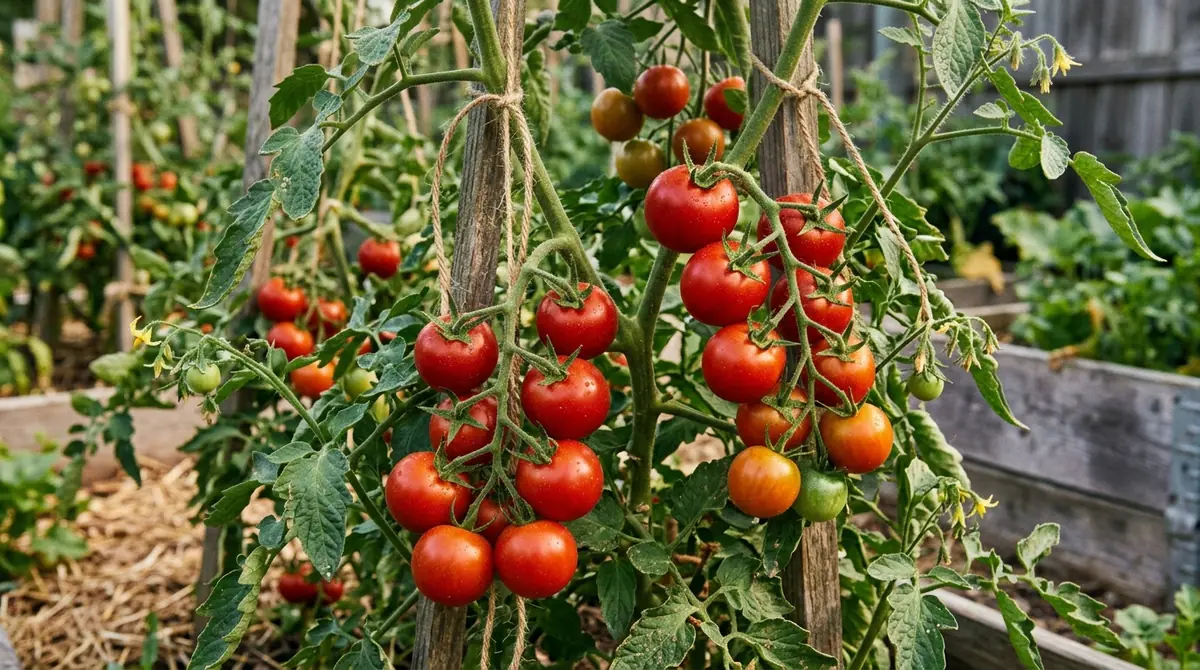
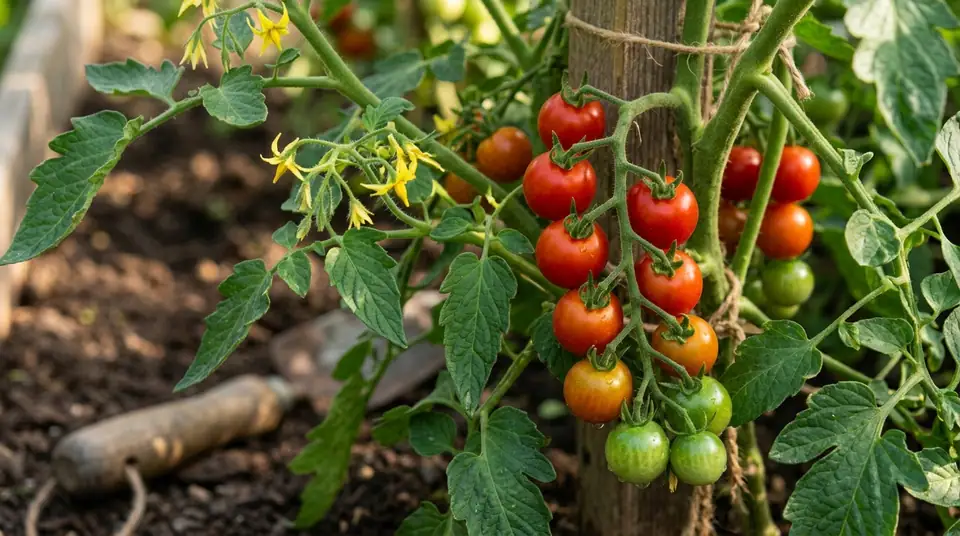
Red and green cluster tomatoes growing on vines in a garden bed
1. Botanical Overview & Natural Habitat
Cluster tomatoes belong to the Solanum lycopersicum species within the nightshade family (Solanaceae). Botanically, they are distinguished by their indeterminate growth habit and their specific inflorescence structure: a branched raceme, known as a cyme, that produces multiple flowers opening in sequential order over several weeks.
In their wild ancestral habitats spanning the western coast of South America up through Central America, ancestral tomato relatives grew as perennial, vining plants climbing over arid scrub and rocky soils. Modern cluster cultivars—such as 'Cocktail', 'Campari', and standard truss types—have been selected to maintain this uniform, multi-fruited inflorescence. Each fruit on the cluster develops simultaneously or in tight succession, relying on an unbroken rachis (the main stem of the flower cluster) to channel photosynthates, water, and minerals directly from the vine.
Unlike determinate varieties that set fruit all at once and terminate their terminal buds, cluster tomatoes continue to vine upward, frequently reaching heights of 6 to 12 feet (1.8 to 3.6 meters) under proper trellising. The leaves are alternate, deeply lobed, and covered in glandular trichomes that secrete the distinct, pungent volatile oils characteristic of the plant. Because the fruit is harvested as an intact vine rather than as individual spheres, the physiological stress on the supporting stem is immense, requiring strong vascular tissue and a robust root system capable of exploring significant soil volumes.
2. Essential Environmental & Care Requirements
To produce sweet, brix-rich cluster tomatoes, you must tightly control their environmental parameters. Fluctuations in moisture or temperature quickly manifest as blossom end rot or split skins along the rachis.
Parameter
Optimal Condition
Common Mistake
Why It Matters
Temperature
70°F–85°F (21°C–29°C) day; 60°F–68°F (15°C–20°C) night
Letting night temperatures drop below 55°F (13°C)
Cool nights disrupt pollen viability, leading to dropped blossoms and incomplete cluster set.
Soil pH
6.2 to 6.8
Allowing soil to become highly acidic (< 5.5) or alkaline (> 7.5)
Extreme pH locks out calcium and magnesium, directly inducing blossom end rot on heavy fruit sets.
Watering
1 to 2 inches (2.5 to 5 cm) per week, evenly spaced
Erratic watering (heavy soaking followed by drought)
Rapid moisture shifts cause fruit to expand faster than the skin can handle, resulting in severe splitting.
Sunlight
Minimum 6 to 8 hours of direct, unfiltered sun
Planting in partial shade or dense canopy shadow
Insufficient light lowers sugar accumulation (Brix levels) in the fruit, yielding bland flavors.
💡 Pro-Tip: When planning your garden layout, remember that cluster tomatoes demand high light penetration across the entire vine to ripen whole trusses evenly. Space your plants a minimum of 24 to 30 inches (60 to 76 cm) apart in rows spaced 36 to 48 inches (90 to 120 cm) apart. Proper airflow prevents foliar diseases that can travel up the shared rachis and ruin an entire harvest before it colors up.
Growing high-yielding cluster tomatoes requires a disciplined routine from propagation to harvest. Follow this step-by-step protocol to maximize your vine health and fruit quality.
Seed Germination and Indoor Sowing: Sow seeds 0.25 inches (0.6 cm) deep in a sterile, peat-based seed-starting mix. Maintain a soil temperature of 75°F to 80°F (24°C to 27°C) using a heating mat. Germination typically occurs within 7 to 14 days. Provide 16 hours of daily light immediately upon emergence to prevent leggy stems.
Hardening Off and Transplanting: Begin hardening off seedlings outdoors 7 to 10 days before your final frost date. When timing this step in cooler regions, reference guidelines like When to Plant Tomatoes Zone 7b. Dig a trench or deep hole and bury the seedling up to its top two sets of true leaves, planting at a depth of 6 to 8 inches (15 to 20 cm) to encourage adventitious root formation along the buried stem.
Trellising and Pruning (The Single-Leader System): Because most cluster tomatoes are indeterminate, prune them to a single dominant stem by pinching out all lateral suckers that emerge in the leaf axils. Tie the main stem to a heavy-duty stake or string trellis every 12 inches (30 cm) using soft horticultural twine.
Truss Support and Flower Thinning: Once a fruit cluster forms and sets 6 to 8 uniform fruit, use specialized plastic truss supports or soft clips to attach the stem of the cluster to the main vertical stake. If a single truss sets more than 10 small fruit, gently snip away the smallest terminal fruits to direct energy into uniform sizing and ripening.
Fertilization Management: Feed plants weekly with a balanced organic tomato fertilizer high in potassium and calcium during the vegetative phase. Transition to a lower-nitrogen, high-potassium formula once fruit set begins to promote sugar development. For regional planting schedules, consult resources like When Do You Plant Tomatoes in Texas.
Harvesting the Cluster: Monitor the cluster daily. Harvest the entire truss when all fruits have reached an even, deep red or orange hue, clipping the main stem just above the fruit cluster junction with clean, sanitized pruning shears.
Cluster tomatoes present unique diagnostic challenges due to the dense grouping of fruit and foliage.
Green Back and Uneven Ripening: If the shoulders of your cluster tomatoes remain green, hard, and yellowish-white while the bottom of the fruit is red, you are likely dealing with high ambient temperatures exceeding 95°F (35°C) or potassium deficiency. High heat inhibits the synthesis of lycopene. Shade cloth providing 30% solar reduction during peak afternoon hours can correct this.
Rachis Necrosis and Blossom End Rot: Sunken, black leathery patches on the bottom of the fruit, often accompanied by browning of the stem cluster, indicate calcium translocation failure. This is rarely caused by a true lack of calcium in the soil; rather, it stems from irregular watering. Keep soil moisture consistently damp to ensure steady calcium uptake.
Tomato Hornworms (Manduca quinquemaculata): These massive green caterpillars can strip a cluster tomato vine of its leaves and scar ripening fruit overnight. Hand-picking at dusk using a blacklight (which causes them to glow a distinct fluorescent green) is highly effective. For severe infestations, apply Bacillus thuringiensis (Bt) while larvae are small.
Botrytis Fruit Rot (Grey Mold): High humidity trapped within dense leaf canopies and heavy fruit clusters encourages fungal spores to germinate. Prune lower leaves to enhance airflow, water only at the base of the plant in the early morning, and never overhead irrigate.
⚠️ Important Caution: Never pull or twist a tomato cluster off the vine by hand. The woody stem of the rachis is tough, and tearing it manually can strip the main vine bark, creating a gaping wound that invites bacterial canker and fungal pathogens like Botrytis cinerea into the vascular system of the plant. Always use sterile, sharp bypass pruners.
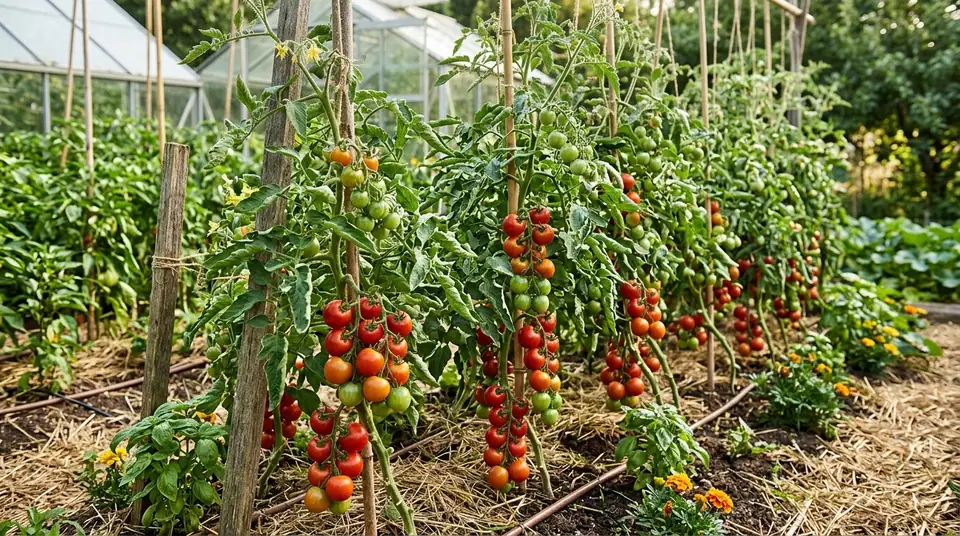
Cluster tomatoes growing on stakes in a garden with greenhouses behind
5. Frequently Asked Questions
Can I grow cluster tomatoes in containers on a balcony?
Yes, provided you select a container with a minimum capacity of 10 to 15 gallons (38 to 57 liters) per indeterminate plant. Because cluster varieties are vigorous growers, container-grown plants require daily watering and frequent liquid feeding because nutrients leach out of potting mixes rapidly during heavy fruit development.
Why are my cluster tomatoes splitting open on the vine?
Fruit splitting is almost always caused by a sudden, drastic influx of water—such as heavy rain or deep irrigation—after a dry spell. The internal flesh of the tomato expands faster than the outer cuticle can stretch. Maintain even soil moisture and harvest clusters as soon as they reach full color to minimize weather-related splitting.
How do I know when a tomato cluster is ready to harvest?
Unlike slicing tomatoes that can be picked at the breaker stage and ripened indoors, cluster tomatoes develop their best flavor profile when allowed to vine-ripen. Harvest the entire cluster when every individual fruit on the rachis has turned uniform color and yields slightly to gentle palm pressure.
How long does it take for cluster tomatoes to go from flower to harvest?
Under optimal conditions with temperatures averaging 75°F (24°C), it takes approximately 55 to 70 days from fruit set to a fully ripe harvest cluster. Tracking your progress is straightforward when you understand How Long Does It Take for Tomatoes to Grow Tomato Growing and Harvesting Guide. Maintain consistent feeding during this window to ensure every fruit on the truss crosses the finish line together.
PlantSavvyWorld is an independent botanical education project. Articles are drafted with AI assistance, then edited and checked against university extension services, botanical garden collections and other published horticultural sources.