

Epsom Salt for Peppers and Tomatoes
Written with AI assistance, edited and checked against horticultural sources.
Vigorous 'Brandywine' tomatoes showing distinct interveinal chlorosis—yellowing leaves with sharply defined green veins—often indicate a severe magnesium deficiency brought on by heavy spring rains that leach vital nutrients from the root zone. A quick foliar application of magnesium sulfate, universally known as Epsom salt, can transform that yellowing foliage back to a rich, photosynthesizing green within fourteen days. However, while Epsom salt is an incredible tool for nightshades, it is routinely misused by gardeners who treat it as a universal plant cure-all. Separating horticultural science from garden folklore is essential when looking at how to properly use Epsom salt for peppers and tomatoes.
1. Botanical Overview & Natural Habitat
Magnesium ($Mg^{2+}$) plays a non-negotiable role in their physiology. It sits directly at the center of the chlorophyll molecule, acting as the structural atom that captures light energy during photosynthesis. Without sufficient magnesium, chlorophyll synthesis halts, stunting overall growth and reducing fruit yield. Furthermore, magnesium acts as an enzymatic activator, facilitating phosphorus uptake—a vital nutrient for heavy fruit set.
While gardeners often obsess over nitrogen, phosphorus, and potassium (NPK), secondary macronutrients like magnesium and sulfur (both components of Epsom salt, which is chemically magnesium sulfate heptahydrate, $MgSO_4 \cdot 7H_2O$) dictate how efficiently a plant can metabolize those primary elements. Understanding this relationship helps you time your amendments correctly, much like knowing When to Start Tomatoes Indoors Zone 6 ensures your seedlings have the robust foundation they need before hitting the garden beds.
2. Essential Environmental & Care Requirements
Nightshades demand specific environmental parameters to thrive. Both tomatoes and peppers require full sun—at least 6 to 8 hours of direct sunlight daily—and temperatures ranging consistently between 70°F and 85°F (21°C to 29°C) for optimal metabolic function. Soil pH should remain slightly acidic to neutral, ideally between 6.0 and 6.8, which maximizes nutrient solubility and uptake.
| Parameter | Optimal Condition | Common Mistake | Why It Matters |
|---|---|---|---|
| Soil pH | 6.0 – 6.8 | Allowing soil to drop below 5.5 | Locks out magnesium and phosphorus, causing nutrient deficiencies despite rich soil. |
| Soil Temperature | 70°F – 85°F (21°C – 29°C) | Planting when soil is below 60°F (15°C) | Slows root metabolism, inhibiting water and mineral absorption. |
| Watering | 1 to 2 inches (2.5 to 5 cm) per week | Shallow, frequent sprinkles | Encourages shallow root systems vulnerable to drought and heat stress. |
| Magnesium Level | Adequate native $Mg^{2+}$ or balanced amendment | Over-applying Epsom salt blindly | Induces calcium lockout, triggering blossom end rot in developing fruits. |
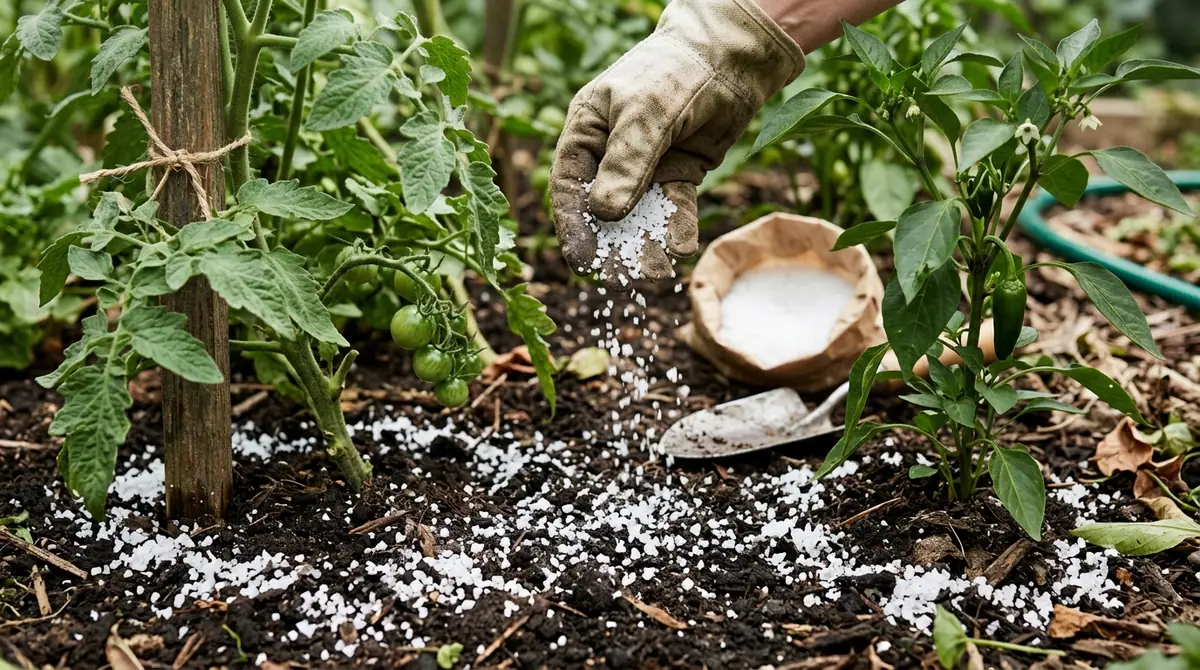
⚠️ Important Caution: Never apply Epsom salt blindly. Excess magnesium in the soil competes directly with calcium ions for uptake by plant roots. A calcium deficiency in fruiting nightshades directly causes blossom end rot—the sunken, black leathery patches on the bottom of your tomatoes and peppers. Always base your magnesium applications on a soil test or clear visual deficiency symptoms.
3. Step-by-Step Cultivation, Feeding & Propagation
When deploying Epsom salt for peppers and tomatoes, precision is everything. Whether you are transitioning your starts outdoors following guides like When to Transplant Tomatoes or managing established plants, follow this systematic protocol to maximize magnesium uptake without disrupting your soil chemistry.
- Conduct a Soil Test: Before adding any mineral amendment, use a reliable testing kit to verify that magnesium is genuinely deficient and that your soil pH sits within the optimal 6.0 to 6.8 range.
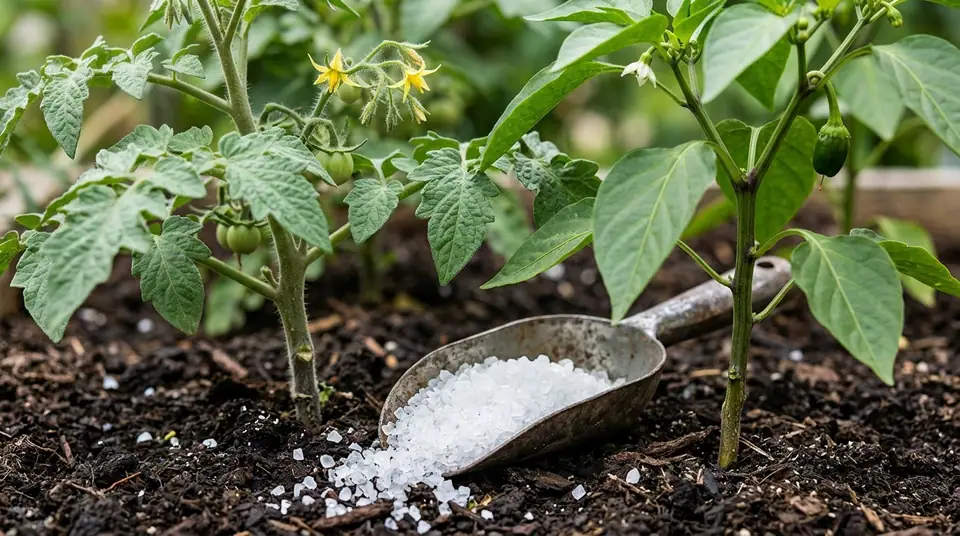
- Prepare the Planting Hole: For newly transplanted tomatoes and peppers, amend the planting hole with organic compost. If your soil test confirms low magnesium, mix 1 tablespoon (15 ml) of Epsom salt directly into the soil at the base of the planting hole, covering it with a thin layer of plain soil to prevent direct root burn.
- Establish a Drench Schedule: For actively growing plants entering the flowering and fruit-set stage, dissolve 1 tablespoon of Epsom salt per gallon (3.8 liters) of water in a watering can. Drench the soil around the base of each plant once every 4 weeks.
- Deploy Foliar Sprays for Rapid Correction: If you observe interveinal chlorosis on older lower leaves, mix 2 tablespoons of Epsom salt per gallon of water and apply it as a foliar spray using a pump sprayer. Spray early in the morning so the stomata are open and foliage dries quickly, minimizing fungal disease risks.
- Monitor Fruit Development and Yield: Track your harvest timelines using resources such as How Long Does It Take for Tomatoes to Grow Tomato Growing and Harvesting Guide to evaluate whether your magnesium supplementation successfully improved fruit size, flavor profile, and overall yield.
💡 Pro-Tip: Pair your Epsom salt soil drenches with a reliable calcium source like bone meal or agricultural gypsum if your local tap water is soft. This delicate balancing act ensures that boosting magnesium does not inadvertently starve your plants of the calcium they need for cellular wall integrity.
4. Common Problems, Pests & Troubleshooting
Even with meticulous care, nightshades encounter stressors. Recognizing the visual cues of nutritional imbalances versus pest damage saves crops from premature decline.
- Interveinal Chlorosis: Yellowing leaves where the tissue between the veins turns pale while the veins remain deep green. This is the hallmark signature of magnesium deficiency. Remedy this with a targeted foliar spray of Epsom salt solution (2 tablespoons per gallon of water).
- Blossom End Rot: Water-soaked spots on the distal end of fruit that turn dark and leathery. While often blamed on watering inconsistencies, excessive soil magnesium applied via heavy-handed Epsom salt use frequently triggers this by blocking calcium uptake. Flush the soil with pure water and apply a calcium-rich amendment.
- Aphids and Whiteflies: Soft-bodied sap-suckers that congregate on the undersides of nutrient-stressed leaves. Plants deficient in secondary macronutrients are particularly vulnerable. Treat outbreaks using insecticidal soaps or neem oil, ensuring you address the root nutritional stressor simultaneously.
- Stunted Growth and Poor Flowering: If your plants look dark green but refuse to set flowers or fruit, you may have over-corrected with magnesium, locking out potassium and phosphorus. Review your fertilization logs and irrigate thoroughly to leach excess salts from the root zone.
5. Frequently Asked Questions
Can you put too much Epsom salt on tomato plants?
Yes. Over-application of magnesium sulfate increases soil salinity and creates a chemical imbalance that blocks calcium and potassium uptake. This antagonism directly leads to blossom end rot in tomatoes and peppers, as well as general root burn. Always adhere to recommended dosage rates of 1 tablespoon per gallon of water or per planting hole.
Should I put Epsom salt in the hole when planting tomatoes?
You can place 1 tablespoon of Epsom salt directly into the planting hole, provided you cover it with a 1-to-2-inch layer of garden soil before setting the root ball down. This prevents the concentrated salt crystals from making direct contact with tender roots, which causes osmotic shock and root desiccation.
How often should I spray Epsom salt on pepper plants?
Foliar sprays of Epsom salt should be used sparingly—typically no more than once every 3 to 4 weeks, and only if visual symptoms of magnesium deficiency (such as interveinal yellowing on older leaves) are present. For ongoing maintenance, a monthly soil drench is safer and more effective than frequent foliar spraying.
Does Epsom salt actually increase tomato yield?
Epsom salt increases yield only if the soil is genuinely deficient in magnesium. According to agricultural research publications like those from the Royal Horticultural Society, adding nutrients to soils that already possess adequate levels provides no physiological benefit and can negatively impact plant health. If your soil test shows sufficient magnesium, Epsom salt will not boost your harvest.
Can I mix Epsom salt with other fertilizers?
Yes, Epsom salt can be dissolved alongside water-soluble general-purpose fertilizers, but you must check compatibility. Avoid mixing it with concentrated calcium nitrate in a liquid concentrate tank, as they can precipitate out of solution as calcium sulfate (gypsum), rendering both nutrients temporarily unavailable to the plant roots.
Related Guides
- Epsom Salt for Peppers
- Epsom Salt for Pepper Plants
- When to Start Peppers Indoors Zone 6
- Cluster Tomatoes
- When to Transplant Tomatoes
- When to Plant Tomatoes in Mn
- When to Plant Tomatoes in Mississippi
- When to Plant Tomatoes in Minnesota
📋 Table of Contents ▼ Click to expand
Tags:
Keep reading
🌿 Related Plants You Might Like






PlantSavvyWorld
Editorial team
PlantSavvyWorld is an independent botanical education project. Articles are drafted with AI assistance, then edited and checked against university extension services, botanical garden collections and other published horticultural sources.