
When to Start Basil
Written with AI assistance, edited and checked against horticultural sources.

1. Botanical Overview & Natural Habitat
Basil (Ocimum basilicum) belongs to the Lamiaceae family, sharing ancestry with mint, sage, and oregano. Botanically, it is a tender perennial native to the tropical and subtropical regions of Central Africa and Southeast Asia. Because its evolutionary origin is rooted in hot, humid, sun-drenched climates, it possesses zero frost tolerance and reacts poorly to persistent damp, cold soil.
Understanding its native habitat dictates our cultivation strategy. In nature, Ocimum basilicum germinates only when the rainy season transitions into intense tropical heat. When we ask "when to start basil," we are essentially trying to replicate that precise thermal trigger in our northern or temperate growing zones. If you start seeds too early indoors without supplemental warmth and high-intensity light, the seedlings exhaust their cotyledons trying to find sunlight that simply isn't there yet.
Different cultivars also exhibit distinct growth habits and timelines. Common sweet basil (Ocimum basilicum) reaches heights of 18 to 24 inches (45 to 60 cm) with large, tender leaves, whereas dwarf varieties like 'Greek' form tight, mounded spheres peaking at 8 inches (20 cm). Thai basil (Ocimum basilicum var. thyrsiflora) features narrow, purple-stemmed leaves with a distinct anise flavor, demanding an even longer, warmer maturation period than standard sweet Italian varieties.
2. Essential Environmental & Care Requirements
To successfully start and grow basil, you must master four environmental pillars: temperature, light, moisture, and soil composition.
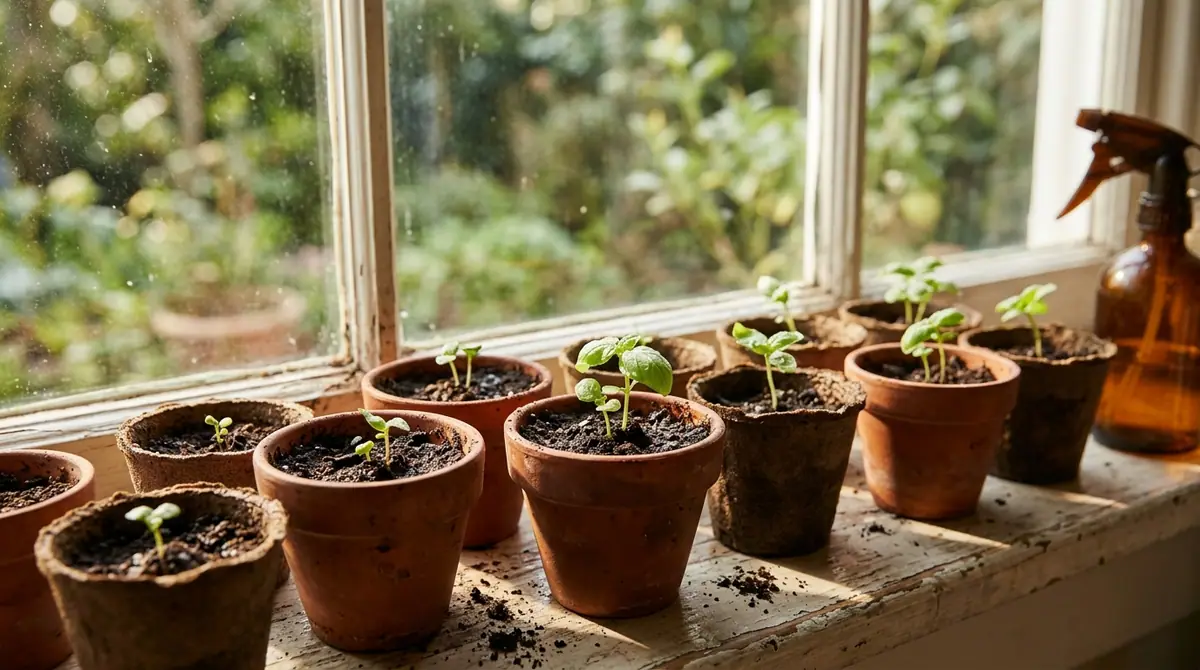
Basil seeds require a soil temperature between 70°F and 85°F (21°C to 29°C) for rapid germination, which typically occurs within 5 to 10 days. Once sprouted, seedlings thrive in ambient daytime temperatures of 70°F to 80°F (21°C to 27°C) and nighttime temperatures no lower than 50°F (10°C). Exposing young plants to sustained temperatures below 50°F stunts root metabolism and triggers physiological shock, turning the foliage an unappetizing purple-bronze.
Light intensity is equally critical. Indoor seedlings require 14 to 16 hours of bright light daily, positioned just 2 to 3 inches (5 to 7 cm) beneath full-spectrum LED grow lights. Outdoors, select a site receiving a minimum of 6 to 8 hours of direct, unfiltered sunlight daily.
Soil must be exceptionally well-draining, rich in organic matter, and maintained at a pH between 6.0 and 7.5. Heavy clay holds too much water, suffocating the delicate root systems and inviting fungal pathogens like Fusarium oxysporum. For deeper insight into early seed dynamics, consult this guide on Does Basil Need Light to Germinate? Soil Depth & Sprouting Science.
| Parameter | Optimal Condition | Common Mistake | Why It Matters |
|---|---|---|---|
| Soil Temperature | 70°F–85°F (21°C–29°C) | Sowing in cold soil below 60°F (15°C) | Triggers seed rot and fungal decay before germination |
| Indoor Light | 14–16 hours daily under LEDs | Placing trays on north-facing windowsills | Causes etiolation (leggy, weak, collapsing stems) |
| Soil Moisture | Consistently moist, never soggy | Over-watering or letting mix dry completely | Suffocates roots and invites damping-off disease |
| Transplant Timing | 2–3 weeks after last spring frost | Planting out while night air drops below 50°F | Stunts growth, reddens leaves, and delays harvest |
💡 Pro-Tip: When sowing indoor seeds, use a heating mat beneath your seed trays for the first 7 days. Raising the soil temperature to a steady 75°F (24°C) cuts your germination timeline almost in half and dramatically increases uniform sprouting rates.
3. Step-by-Step Cultivation, Feeding & Propagation
Getting the timing right is only half the battle. Whether you are timing your indoor starts or preparing for spring transplants, follow this precise protocol to ensure robust plants. For those managing complex seasonal calendars across different regions, you can cross-reference regional timing models with this When to Plant Strawberries in Kansas: Zone 6a/6b Seasonal Calendar.
- Calculate Your Target Date: Count backward 6 weeks from your region's average last spring frost date to determine when to start your basil seeds indoors. If your last frost is May 15th, your indoor sowing window opens around April 3rd.
- Prepare the Germination Medium: Fill sterile, multi-cell seed flats with a fine, pre-moistened seed-starting mix composed of peat moss and perlite. Avoid heavy garden soil, which packs down and retains excessive moisture.
- Sow at the Correct Depth: Press basil seeds into the surface of the medium at a depth of 0.25 inches (0.6 cm). Basil seeds need very light coverage to sprout efficiently; pressing them down gently ensures good seed-to-soil contact without burying them in darkness.
- Provide Bottom Heat and Moisture: Mist the surface lightly with a spray bottle and cover the tray with a clear humidity dome. Place the tray on a seedling heating mat set to 75°F (24°C). Check daily and mist if the surface appears dry.
- Transition to Light: The moment you see green loops breaking the soil surface, remove the humidity dome immediately and position your seedlings under grow lights. Keep the lights 2 inches (5 cm) above the foliage, raising them as the plants grow.
- Harden Off Your Seedlings: 7 to 10 days before your final outdoor planting date, begin hardening off your plants. Expose them to outdoor conditions incrementally: start with 1 hour of filtered shade on day one, slowly increasing direct sunlight exposure over a full week to prevent transplant shock—a process similarly critical for other tender crops, as detailed in When to Transplant Cucumber Seedlings: Stop Root Shock & Boost Growth.
- Plant Out in the Garden: Transplant your hardened-off seedlings into well-amended garden soil or containers once nighttime lows reliably exceed 55°F (13°C). Space individual plants 10 to 12 inches (25 to 30 cm) apart to guarantee adequate air circulation.
⚠️ Important Caution: Never fertilize newly sprouted basil seedlings until they have developed their second set of true leaves. Forcing synthetic nitrogen onto fragile, immature roots will burn them and invite sudden collapse.
4. Common Problems, Pests & Troubleshooting
Even with perfect timing, growers frequently encounter biological hurdles. Recognizing symptoms early lets you intervene before the crop is lost.
- Damping-Off Disease: Caused by soil-borne fungi (Pythium or Rhizoctonia), seedlings pinch at the soil line and topple over. This is almost always triggered by stagnant air, over-watering, and cool temperatures. To prevent this, run a small oscillating fan across your indoor seedling shelves and water only from the bottom via capillary action.
- Yellow Lower Leaves: If the oldest leaves at the base of your basil turn pale yellow, your plants are likely experiencing nitrogen deficiency or root compaction. Feed established plants every three weeks with a balanced, organic liquid fish emulsion diluted to half strength. For broader regional companion planting insights, review strategies outlined in guides like When to Plant Onions in Southern California (Zone 9 & 10 Planting Calendar).
- Japanese Beetles and Slugs: Outdoors, adult Japanese beetles adore devouring tender interveinal tissue, while slugs chew ragged holes in lower leaves overnight. Hand-pick beetles into soapy water at dawn when they are sluggish, and install copper tape or organic iron phosphate bait around container rims to deter slugs.
- Fusarium Wilt: A devastating fungal pathogen that causes sudden wilting, stem twisting, and brown streaks inside the vascular tissue. Once infected, basil cannot be cured. Pull and discard the entire plant in the trash (do not compost), and choose resistant varieties like 'Nufar' for your next planting cycle.

5. Frequently Asked Questions
Can I start basil seeds directly outdoors?
Yes, but only after all danger of frost has passed and your soil temperature consistently registers above 70°F (21°C). Direct-sowing too early in cold spring soil results in seed rot. In cooler northern climates, starting seeds indoors 6 weeks before your last frost is strongly recommended to secure a full harvest window.
Why are my indoor basil seedlings so tall and spindly?
Leggy seedlings are almost always reaching for insufficient light. If your trays are resting on a windowsill, the light intensity is far too low for vigorous vegetative growth. Move your seedlings directly beneath a full-spectrum LED grow light system, keeping the bulbs no more than 3 inches (7 cm) above the top leaves for 14 to 16 hours a day.
Should I pinch the top off my young basil plants?
Absolutely. Once your basil plant develops three sets of true leaves, pinch out the central growing tip right above the second set of nodes. This encourages lateral branching from the leaf axils, transforming a single-stemmed, sparse plant into a bushy, high-yielding culinary powerhouse.
How do I know when my basil is ready to harvest?
You can begin harvesting leaves once your basil plant reaches 6 to 8 inches (15 to 20 cm) in height. Always harvest by cutting the stems just above a pair of lower leaf nodes rather than picking individual leaves; this stimulates two new shoots to emerge, extending the productive life of the plant through the entire summer.
Related Guides
- Can Bunnies Have Basil
- Can Rabbits Eat Fresh Basil
- Can Rabbits Eat Sweet Basil
- Can Bunnies Eat Basil
- Can Rabbits Have Basil
📋 Table of Contents ▼ Click to expand
Tags:
Keep reading
🌿 Related Plants You Might Like
PlantSavvyWorld
Editorial team
PlantSavvyWorld is an independent botanical education project. Articles are drafted with AI assistance, then edited and checked against university extension services, botanical garden collections and other published horticultural sources.