

Does Basil Need Light to Germinate? Soil Depth & Sprouting Science
Written with AI assistance, edited and checked against horticultural sources.
1. Botanical Overview & Natural Habitat
Basil seed germination does not actually require light, and the seeds should be covered lightly with soil.
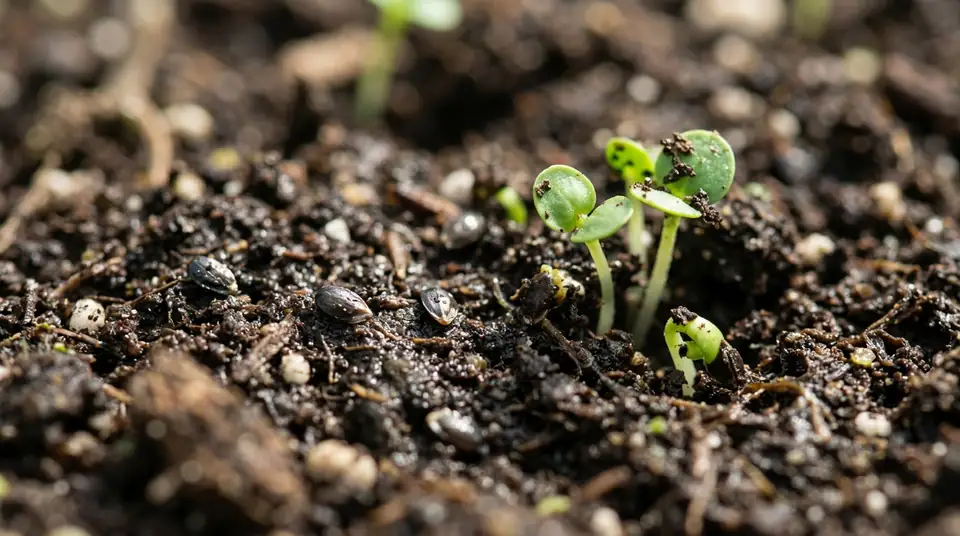
To understand why, we must examine the evolutionary physiology of Ocimum basilicum (Sweet Basil), a tender perennial member of the mint family (Lamiaceae). Native to tropical regions stretching from Central Africa to Southeast Asia, basil evolved in warm, high-light environments where seed dispersal occurs onto soil surfaces during monsoon transitions.
 PHYTOCHROMES & GERMINATION

 [ Seed Hydrated ] ───> [ Myxospermy (Mucilage Gel Coat Formed) ]
 │
 ▼
 [ Dark / Buried Deep ] <────────────── [ Red Light (660nm) ]
 │ │
 ▼ ▼
 Inactive Pr Form Remains Pr Converted to Active Pfr
 (ABA High / GA Low) (GA High / ABA Low)
 │ │
 ▼ ▼
 [ Dormancy / Seed Rots ] [ Radicle & Cotyledons Erupt ]
Basil seeds exhibit positive photoblastism, a physiological condition where seed germination is strictly triggered or significantly enhanced by light exposure. This mechanism is governed by plant photoreceptors called phytochromes.
Within the tiny basil seed, phytochrome exists primarily in an inactive form known as $P_r$ (phytochrome red). When light—specifically red spectrum wavelengths around 660 nanometers—strikes the seed, $P_r$ converts into the biological active form, $P_{fr}$ (phytochrome far-red). This molecular transformation triggers a cascade of enzymatic activities:
- Gibberellic Acid (GA) Synthesis: Stimulates endosperm breakdown and cell elongation.
- Abscisic Acid (ABA) Suppression: Downregulates the hormone responsible for maintaining seed dormancy.
Furthermore, basil seeds exhibit myxospermy. Upon contact with moisture, the outer seed coat produces a clear, jelly-like mucilage halo composed of complex polysaccharides. This gel layer performs two vital survival functions: it anchors the seed to the soil surface against wind or heavy rain, and it creates a localized micro-reservoir of water while allowing ambient light to pass directly into the embryo.
If you bury a basil seed deep under soil, you starve the $P_r$ photoreceptors of red light. The seed remains dormant under high soil moisture conditions, quickly succumbing to fungal rot before it ever sees the sun. To achieve a 95%+ germination rate, basil seeds must be surface-sown or dusted with no more than a microscopic layer ($1/16$ inch or $<2\text{ mm}$) of light-transmissive medium like horticultural vermiculite.
2. Essential Environmental & Care Requirements
Achieving rapid, uniform sprouting requires precise alignment of abiotic factors. Light triggers the cellular signal, but temperature, moisture, and soil physical structure dictate the speed and vigor of radicle emergence.
| Parameter | Optimal Condition | Common Mistake | Biological Effect |
|---|---|---|---|
| Light | 12–16 hours daily; ambient ambient light or LED/Fluorescent (2,000–3,000 Lux / 40–60 $\mu\text{mol/m}^2/\text{s}$ PAR) | Burying seeds under $>1/4\text{ inch}$ of heavy soil matrix | Inhibits $P_r \rightarrow P_{fr}$ phytochrome conversion; seeds remain dormant and decay |
| Watering | Bottom-watering or light atomized misting; high internal seed hydration without displacement | Overhead watering with heavy stream | Washes micro-seeds away, buries them in mud, or disrupts the delicate mucilage halo |
| Humidity | 85%–95% ambient relative humidity during sprouting phase | Leaving seed trays exposed to low room humidity ($<40%$) | Dries out the myxospermic mucilage layer, halting embryonic cell expansion mid-sprout |
| Soil / Substrate | Sterile, fine-textured peat/coco coir seed-starting mix (pH 6.0–6.8); highly oxygenated | Dense, unsterilized garden soil or heavy clay compost | Compaction starves oxygen-hungry roots; pathogens cause damping-off disease |
| Temperature | Substrate bottom heat maintained at 75°F–85°F (24°C–29°C) | Germinating on cold windowsills ($<65\text{°F / }18\text{°C}$) | Metabolic slowdown; germination delays from 4–6 days to over 18–21 days |
3. Step-by-Step Cultivation, Feeding & Propagation Protocol
Follow this scientific, step-by-step masterclass protocol to sprout and rear robust, disease-resistant basil plants from seed.
Step 1: Substrate Preparation
Select a fine, sterile seed-starting mix composed of 60% sphagnum peat moss or coconut coir, 20% horticultural grade perlite, and 20% vermiculite. Moisten the substrate with distilled or reverse-osmosis water until it reaches the consistency of a wrung-out sponge (field capacity). Gently press the mix into seed trays or pots, firming it lightly to eliminate large air pockets while keeping the bulk density low.
Step 2: Surface Sowing & Mucilage Activation
Sow 2 to 3 basil seeds per cell or space seeds 1 inch apart in open flats. Do not dig holes or press seeds down into the soil. Instead, press them very lightly onto the surface so they maintain firm contact with the damp substrate.
💡 Pro-Tip: If you are germinating seeds in a high-airflow indoor setup where surface drying is an issue, do not use topsoil to cover them. Instead, dust a paper-thin layer of fine horticultural vermiculite over the seeds—just enough to hold moisture while letting over 80% of ambient light pass through to the phytochrome receptors.
Step 3: Moisture Preservation & Dome Installation
Mist the top surface gently with an atomizing spray bottle filled with room-temperature water. Within 15–30 minutes, you will observe a light blueish-gray gelatinous ring forming around each seed—this is myxospermy in action! Cover the tray with a clear plastic humidity dome or clean plastic wrap to lock in 90%+ relative humidity.
Step 4: Thermal & Light Activation
Place the covered seed tray on a thermostatically controlled seedling heat mat set to 78°F (25.5°C). Position full-spectrum LED or T5 fluorescent grow lights 4 to 6 inches directly above the clear dome. Program the timer for 14 to 16 hours of continuous light daily.
⚠️ Important Caution: Never place humidity-domed seed trays in direct, unfiltered intense sunlight on a south-facing windowsill. The dome will act as a solar oven, rapidly elevating internal air temperatures above 100°F (38°C), which thermal-cooks delicate embryonic plant cells and destroys viability within hours.
Step 5: Post-Sprouting Care & Ventilation
Sprouting typically occurs within 4 to 7 days. As soon as you spot the green pair of embryonic seed leaves (cotyledons) emerging:
- Prop open the humidity dome slightly for 24 hours to transition ambient air, then remove it entirely.
- Turn off the bottom heat mat if ambient room temperatures remain above 70°F (21°C).
- Adjust grow lights to remain 2 to 4 inches above the tops of the growing seedlings to prevent leggy etiolation.
Germination Substrate (Moist, Fine Mix)
 │
 ├── Lightly Sown Seeds on Surface
 │ │
 │ ├── Thin Dusting of Vermiculite (< 1/16")
 │ │
 │ └── Direct Light Exposure (14–16 hrs/day)
 │
 └── Bottom-Watering Reservoir (Keeps surface stable)
Step 6: Step-Up Feeding & Thinning
When seedlings develop their first set of true leaves (the second pair of leaves displaying characteristic notched margins and aromatic oil glands), thin them to one strong plant per cell using sharp micro-snips. Begin feeding with a balanced, organic liquid fertilizer (such as fish hydrolysate and kelp meal) diluted to quarter-strength (approx. 250 PPM N) once weekly using a bottom-watering method.
4. Common Plant Issues, Pests & Troubleshooting
Even with meticulous attention to detail, early basil propagation can run into environmental bumps. Here is how to diagnose and resolve issues immediately:
Damping-Off Disease (Pythium, Rhizoctonia, or Fusarium species)
- Symptom: Young seedlings suddenly collapse at the soil line; stem bases look water-soaked, thin, and brownish-black.
- Cause: Overwatering, cold substrate, poor air circulation, or non-sterile growing media allowing soil-borne fungi to thrive.
- Solution: Instantly discard infected seedlings and media. Sanitize trays with a 10% bleach solution. Ensure a small oscillating fan provides gentle air movement over healthy trays, and switch exclusively to bottom-watering.
Etiolation (Leggy, Pale, Weak Stems)
- Symptom: Seedlings develop long, spindly, pale-green or white stems that flop over under their own weight.
- Cause: Insufficient light intensity post-germination. Although the seed sprouted, it is starving for photon density to drive photosynthesis.
- Solution: Lower grow lights closer to the canopy (2–4 inches for fluorescent/low-wattage LEDs) or increase photoperiod to 16 hours daily. If using natural window light, supplement with an artificial grow bulb.
Sticky Seed Coat Retention ("Helmet Head")
- Symptom: Cotyledons emerge above ground but remain trapped inside the hard black seed coat, preventing leaf expansion.
- Cause: Relative humidity dropped too low during the emergence phase, causing the outer mucilage and hull to harden like concrete around the leaves.
- Solution: Do not rip the seed coat off manually—you will tear the cotyledons! Place a drop of warm water or wet paper towel directly onto the trapped seed coat. Wait 10 minutes for the hull to soften, then gently ease it off using sterile tweezers.
Fungus Gnats (Bradysia species)
- Symptom: Tiny black flies hovering over the soil surface; slow seedling growth due to microscopic larvae feeding on tender root hairs.
- Cause: Consistently oversaturated soil surface high in decomposing organic matter.
- Solution: Allow the top $1/4\text{ inch}$ of mix to dry slightly between waterings. Apply Bacillus thuringiensis israelensis (BTI) mosquito bits/dunks dissolved in your watering solution to eliminate soil larvae biological targets safely.
5. Frequently Asked Questions (FAQ)
Does basil seed really need light to germinate, or can I cover it with soil?
Yes, basil seeds are positively photoblastism-driven and require light exposure to initiate germination. Red light spectrums activate internal phytochromes ($P_r \rightarrow P_{fr}$), which trigger the hormonal shift needed to break dormancy. If you cover basil seeds under more than $1/8\text{ inch}$ of soil, light cannot penetrate, causing the seed to remain dormant, rot, or die beneath the surface. For highest success, sow seeds directly on the surface or cover them only with a micro-layer of light-transmissive horticultural vermiculite.
Why do my basil seeds develop a blue-gray gelatinous coating when wet?
That gelatinous coating is a completely natural biological process called myxospermy. When basil seeds contact water, specialized epidermal cells in the seed coat absorb moisture rapidly and swell into a mucilaginous polysaccharide gel. This evolutionary trait serves three key purposes: it locks essential moisture directly against the seed coat in dry climates, anchors the light seed to the soil surface so it isn't blown away, and creates a clear, transparent window that lets light hit the phytochrome receptors inside.
How long does basil take to sprout under grow lights versus sunlight?
Under full-spectrum LED grow lights paired with a bottom heat mat set to 78°F–82°F (25°C–28°C), basil seeds typically sprout within 3 to 5 days. When relying solely on natural sunlight on a windowsill, germination usually takes 7 to 14 days (or longer) due to fluctuating indoor temperatures, shorter daylight hours, and variable photon flux density. Consistent warmth combined with 14–16 hours of dedicated grow light produces the fastest, most uniform germination rates.
Related Guides
- How Deep Do Pepper Plant Roots Go? Pot Size & Substrate Depth Guide
- Can Bunnies Have Basil
- Can Rabbits Eat Fresh Basil
- Can Rabbits Eat Sweet Basil
- Can Bunnies Eat Basil
Further Reading
📋 Table of Contents ▼ Click to expand
Tags:
Keep reading
🌿 Related Plants You Might Like






PlantSavvyWorld
Editorial team
PlantSavvyWorld is an independent botanical education project. Articles are drafted with AI assistance, then edited and checked against university extension services, botanical garden collections and other published horticultural sources.