

When to Plant Tomato Plants in California
Written with AI assistance, edited and checked against horticultural sources.
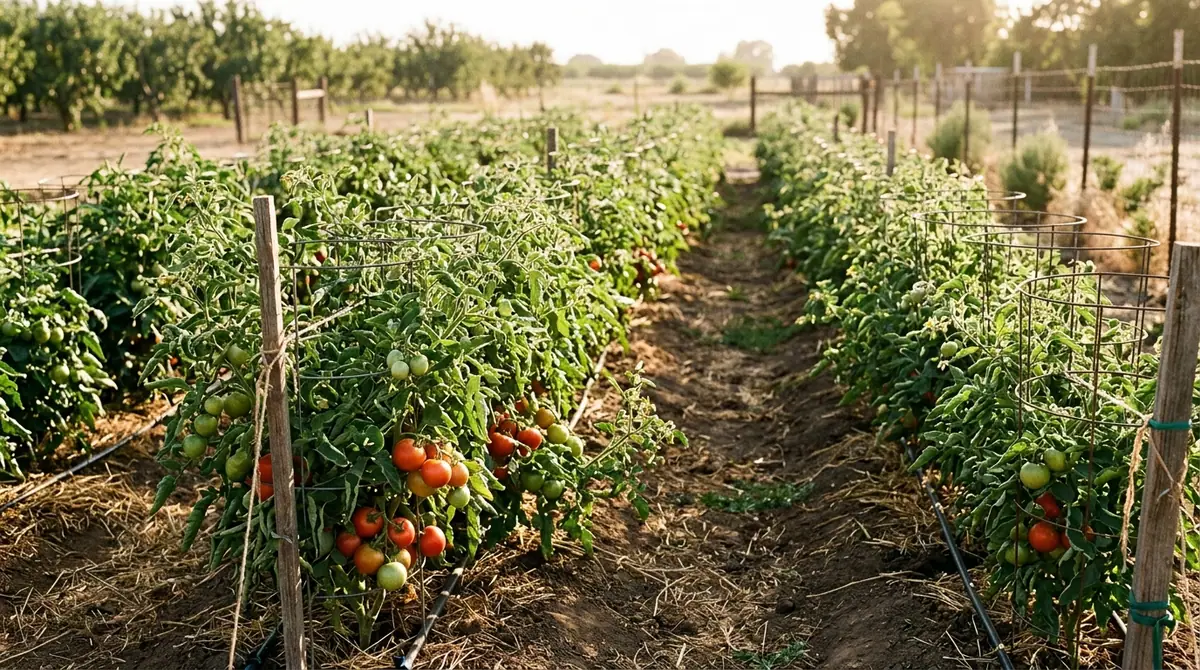
I stood in my Topanga Canyon hillside garden last April, holding a flat of leggy Early Girl tomato transplants, watching a cold Pacific marine layer stubbornly blanket the valley floor at 10:00 AM. The air smelled of damp chaparral and wet clay, and my soil thermometer read a dismal 52°F (11°C). Planting them right then would have meant weeks of stunted, purple-veined leaves and root rot. In California, planting tomatoes is never a single statewide date on a calendar; it is a localized dance dictated by microclimates, coastal fog corridors, interior valley heat islands, and soil temperatures that refuse to lie.
1. Botanical Overview & Natural Habitat

Understanding this ancestral home explains why modern cultivars behave the way they do in California gardens. In the Andes, wild tomatoes grew as scrambling, perennial woody vines sustained by deep root systems that could chase moisture far down into gravelly, mineral-rich substrates. They are fundamentally tender warm-season crops. They possess a C3 photosynthetic pathway, meaning their cellular machinery operates best under moderate daytime temperatures accompanied by high light intensities, followed by cool nighttime respites.
When you introduce Solanum lycopersicum to California’s diverse topography—ranging from USDA Zone 5 in the Sierra Nevada mountains to USDA Zone 11 in the Coachella Valley—you are essentially trying to mimic Andean conditions. Along the fog-belt coast of Northern and Central California, cool summer highs rarely break 65°F (18°C), stalling fruit set because pollen viability drops sharply when ambient temperatures remain below 55°F (13°C) at night or fail to reach 70°F (21°C) during the day. Conversely, in the Central Valley (zones 9b through 10a), summer temperatures frequently rocket past 100°F (38°C), causing blossom drop as flower styles elongate past the anther cone and pollen becomes sterile.
For a deeper dive into maximizing your harvest once your timing is locked in, consult our guide on How to Grow Huge Tomato Plants: Pruning, Trenching & Heavy Yields.
2. Essential Environmental & Care Requirements
Tomatoes are exceptionally demanding when it comes to balancing soil physics, hydration, and radiant energy. To achieve optimal yields, you must calibrate your management to match their physiological limits.
Soil Temperature and Structure
Soil temperature is the ultimate trigger for planting. Never rely on the calendar; rely on a digital soil thermometer pushed 4 inches (10 cm) deep into the bed at 9:00 AM. When readings sustain 60°F (15°C) to 65°F (18°C) for five consecutive days, the root system can actively pump phosphorus and water. Below 55°F (13°C), root elongation halts entirely, and phosphorus deficiency sets in, manifesting as dark purple anthocyanin pigmentation on the undersides of leaves. Soil must also possess superior drainage, maintaining a bulk density of roughly 1.2 to 1.4 g/cm³, rich in organic matter with a target pH between 6.0 and 6.8.
Sunlight and Photoperiod
As obligate sun-lovers, tomatoes require a minimum of 8 to 10 hours of direct, uninhibited sunlight daily. In California’s interior, afternoon shade during July and August can actually protect fruit from sunscald, but coastal gardens need every drop of solar radiation possible, making south-facing walls or reflective white gravel mulches vital design elements.
Water Relations
Irrigation must be deep and consistent. Fluctuations between drought and sudden heavy watering cause fruit cells to expand at uneven rates, resulting in the dreaded concentric and radial fruit cracking, as well as blossom-end rot (a physiological disorder caused by localized calcium deficiency during rapid fruit swell).
| Parameter | Optimal Condition | Common Mistake | Why It Matters |
|---|---|---|---|
| Soil Temperature | 60°F – 70°F (15°C – 21°C) | Planting when air feels warm while soil is cold | Cold soil stunts root growth, stops nutrient uptake, and invites fungal pathogens. |
| Soil pH | 6.0 – 6.8 slightly acidic | Ignoring soil tests in alkaline California soils | Extreme pH locks out micronutrients like iron, manganese, and calcium. |
| Direct Sunlight | 8 – 10 hours daily | Planting in shaded urban microclimates | Insufficient light reduces sugar synthesis, yielding watery, flavorless fruit. |
| Irrigation Depth | 12 inches (30 cm) per watering | Frequent shallow sprinkling | Shallow water creates surface roots vulnerable to drought and thermal shock. |
💡 Pro-Tip: If your coastal California garden features stubborn clay soil that stays cold and wet deep into spring, construct raised beds at least 10 inches (25 cm) high filled with a custom mix of 50% native sandy loam, 30% aged compost, and 20% horticultural perlite. Raised beds absorb solar radiation from the sides, warming your planting zone up to two weeks earlier than in-ground beds.
3. Step-by-Step Cultivation, Feeding & Propagation
Successful tomato cultivation in California requires matching your region's specific frost-free window to your planting strategy. For instance, Southern California coastal gardeners (Zone 10a/10b) can often plant their first round of tomatoes in mid-to-late March, whereas interior desert growers in Imperial County plant as early as February for a spring crop, or delay until August for a fall crop to bypass the blistering June-July heat.
Here is the precise field protocol for establishing your tomato crops:
- Harden Off Your Transplants: Begin the 7-to-10-day hardening-off process when outdoor nighttime temperatures reliably stay above 50°F (10°C). Place seedlings in a protected, dappled-shade spot for 2 hours on day one, gradually increasing direct sun exposure and wind exposure daily until they can withstand a full 24 hours outside without wilting.
- Amend and Pre-Irrigate: Two days prior to planting, thoroughly water your bed. Incorporate a balanced organic granular fertilizer (such as a 4-3-4 blend) along with 1 cup of bone meal per planting hole to supply slow-release phosphorus and calcium for root development.
- Trench or Deep Plant: Strip the lower two-thirds of leaves off your tomato transplant. Dig a trench 4 to 6 inches (10 to 15 cm) deep horizontally (or a vertical hole 8 inches deep if the plant is exceptionally stocky), and lay the root ball and bare stem horizontally into the soil. Adventitious roots will rapidly emerge along the buried stem, building a massive root architecture that anchors the plant and scavenges deep moisture.
- Install Support Structures: Drive heavy-gauge steel stakes or install sturdy concrete-reinforcing wire cages immediately after planting while the root zone is clear. Trying to cage a sprawling, 6-foot (1.8-meter) indeterminate tomato plant two months later inevitably damages lateral roots.
- Apply Mulch: Apply a 3-inch (7.5-cm) layer of clean wheat straw, untreated arborist wood chips, or shredded leaves across the soil surface, leaving a 2-inch (5-cm) breathing gap around the main stem. This suppresses weed germination, moderates soil temperature swings, and prevents soil-borne fungal spores from splashing onto lower foliage during irrigation.
- Water in with Mycorrhizae: Irrigate the newly planted bed deeply with a water-soluble mycorrhizal inoculant solution to colonize the root hairs and maximize nutrient exchange capacity.
For advanced training strategies on managing these vigorous plants once they take off, review the University of California Agriculture and Natural Resources (ANR) Vegetable Gardening Handbook.
⚠️ Important Caution: Never handle tomato plants when the foliage is wet from morning dew or overhead irrigation. Handling damp plants readily spreads Tobacco Mosaic Virus (TMV), bacterial speck, and early blight from plant to plant via clothing and hands. Always sanitize your pruning shears with a 70% isopropyl alcohol solution between individual plants.
4. Common Problems, Pests & Troubleshooting
Even with careful timing, California growers face distinct regional challenges that test plant resilience.
Tomato Hornworms (Manduca quinquemaculata)
These massive green caterpillars can strip a mature plant of its foliage and fruit overnight. Look for dark green frass (droppings) on lower leaves. If you notice white, rice-like cocoons on a hornworm’s back, leave it alone—those are the pupae of the beneficial braconid wasp, which will hatch and parasitize other pests in your garden. Hand-picking at dusk using a UV blacklight is remarkably effective, as hornworms fluoresce a bright neon color under ultraviolet light.
Blossom-End Rot
Appearing as a sunken, leathery black patch on the distal end of the fruit, this disorder is caused by irregular soil moisture. When soil dries out, calcium cannot travel up the transpiration stream to the developing fruit tissue. Maintain consistent soil moisture using drip irrigation and avoid high-nitrogen fertilizers that force vegetative growth faster than calcium can be absorbed.
Powdery Mildew and Fungal Blights
Coastal California’s heavy marine layer creates high relative humidity that favors fungal pathogens. Space indeterminate varieties at least 3 feet (1 meter) apart, prune lower leaves up to 18 inches (45 cm) off the ground once the plant is established to promote air circulation, and apply preventive bio-fungicides like Bacillus subtilis when nighttime temperatures remain above 60°F (15°C) with high humidity.

5. Frequently Asked Questions
When is the exact best month to plant tomatoes in Southern California?
In coastal Southern California (Zones 10a and 10b), the ideal planting window opens in late March and runs through April. For inland valleys (Zone 9b, such as parts of Riverside or San Bernardino), aim for early April once the soil consistently hits 60°F (15°C). Planting earlier exposes young plants to chilling stress that they rarely outgrow.
Can I plant tomatoes in Northern California in March?
Generally, no. Northern California soils remain too cold in March, hovering between 45°F (7°C) and 52°F (11°C). Gardeners in the San Francisco Bay Area and Sacramento Valley should wait until late April or early May, unless utilizing greenhouse protection, cloches, or heavy black plastic mulch to pre-warm the soil bed.
How do I know if my soil is warm enough for tomatoes?
Do not guess—measure. Purchase a digital soil stem thermometer, insert it 4 inches (10 cm) deep into your garden bed at 9:00 AM, and record the temperature for five consecutive days. If the reading stays at or above 60°F (15°C) every morning, your soil is biologically active enough to sustain a newly transplanted tomato.
What should I do if a late frost hits my newly planted California tomatoes?
If a surprise late-spring frost threatens your plants (temperatures dropping below 32°F / 0°C), cover them immediately before sunset with breathable frost cloth, burlap, or overturned 5-gallon buckets weighted with stones. Ensure the cover reaches all the way to the soil to trap ground heat, and remove the covers by 10:00 AM the following morning to prevent solar overheating. For broader climate research and regional frost date maps, reference the USDA Plant Hardiness Zone Map resource page.
Related Guides
- When to Plant Pumpkins in Southern California
- When to Plant Tomatoes Southern California
- When to Plant Tomatoes in Southern California
- When to Plant Tomatoes in California
- When to Plant Tomatoes California
📋 Table of Contents ▼ Click to expand
Tags:
Keep reading
🌿 Related Plants You Might Like



PlantSavvyWorld
Editorial team
PlantSavvyWorld is an independent botanical education project. Articles are drafted with AI assistance, then edited and checked against university extension services, botanical garden collections and other published horticultural sources.