

When to Plant Tomatoes Southern California
Written with AI assistance, edited and checked against horticultural sources.
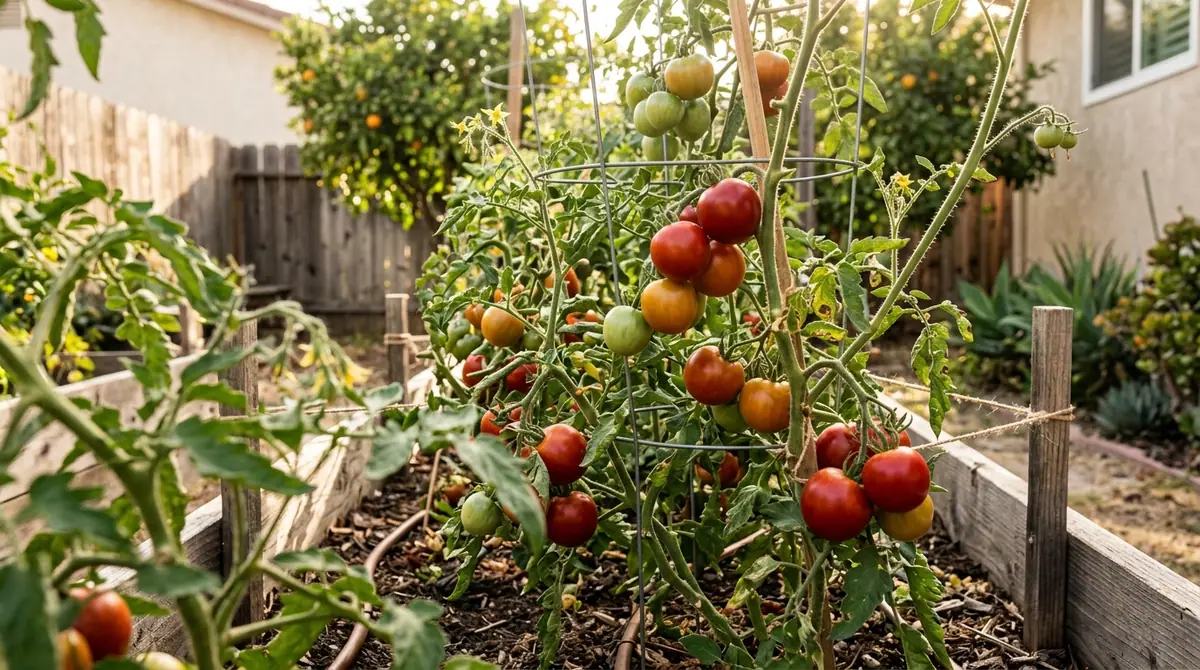

1. Botanical Overview & Natural Habitat
Tomatoes (Solanum lycopersicum, formerly classified in the genus Lycopersicon) belong to the nightshade family, Solanaceae, sharing a taxonomic lineage with peppers, eggplants, and potatoes. Native to the western Andean region of South America—spanning parts of Ecuador, Peru, Bolivia, and Chile—wild tomatoes evolved growing in high-altitude, sun-drenched, well-draining soils where they experienced warm days, cooler nights, and moderate, consistent moisture.
Understanding this natural habitat is crucial for Southern California growers. Unlike tropical plants that require continuous high humidity, wild tomatoes are adapted to drier air and intense solar radiation. In their native range, they sprawl as perennial vines over rocky, nutrient-rich earth. When we cultivate them in the Mediterranean microclimates of Southern California (USDA Zones 9a through 11b, encompassing Sunset Zones 18 through 24), we are essentially giving them a vacation home that mirrors their ancestral Andean environment—provided we manage the transition between our cool coastal marine layers and scorching interior heatwaves.
Botanically, the tomato is a woody-stemmed herbaceous annual (or short-lived perennial in frost-free microclimates) possessing a remarkable evolutionary trait: adventitious roots. Every hair along a tomato stem is a potential root node waiting to happen. This anatomical quirk allows us to bury leggy transplants deep into the ground, triggering a massive root system that anchors the plant and maximizes nutrient uptake.
Growth habits broadly split into two categories:
- Determinate (Bush): These varieties grow to a predetermined height—usually 3 to 4 feet (0.9 to 1.2 meters)—set their entire fruit crop over a concentrated 2- to 3-week window, and then naturally decline. They are exceptional for container gardening and small Southern California patios.
- Indeterminate (Vining): These possess a genetic instruction to grow continuously, climbing anywhere from 6 to 12+ feet (1.8 to 3.6+ meters) until frost or disease stops them. They produce fruit continuously throughout the spring, summer, and autumn months, requiring substantial staking, caging, or trellis systems.
For regional advice on structuring your garden beds and understanding soil dynamics for other warm-season crops, you can reference this How Deep Do Pepper Plant Roots Go? Pot Size & Substrate Depth Guide.
2. Essential Environmental & Care Requirements
To coax maximum yields out of your tomato plants in Southern California, you must dial in four non-negotiable environmental parameters: temperature, light, water, and soil composition.
Tomatoes are exceptionally sensitive to thermal shifts. Air temperatures must consistently hover between 70°F and 85°F (21°C to 29°C) for optimal vegetative growth, while nighttime lows should remain above 55°F (13°C). More importantly, soil temperature—measured 4 inches (10 cm) deep—must reach a stable 60°F (15°C) before you even think about transplanting. If you plant into 50°F (10°C) soil, phosphorus uptake grinds to a halt, turning leaves purple and freezing plant metabolism.
| Parameter | Optimal Condition | Common Mistake | Why It Matters |
|---|---|---|---|
| Soil Temperature | 65°F–75°F (18°C–24°C) | Planting when air warms up but soil is still cold (<55°F / 13°C) | Cold soil causes phosphorus lockout, root stunting, and transplant shock. |
| Sunlight | 8+ hours of direct sun daily | Shading plants behind walls or planting under deep eaves | Insufficient light reduces photosynthesis, causing leggy growth and zero fruit set. |
| Soil pH | 6.2 to 6.8 (slightly acidic) | Ignoring soil chemistry in alkaline Southern California clay | Extreme pH locks out micronutrients like calcium and iron, causing blossom end rot. |
| Watering Depth | 8 to 12 inches (20 to 30 cm) per deep soaking | Frequent, shallow surface sprinkling | Shallow water breeds weak surface roots; deep watering forces roots downward to chase moisture. |
Light intensity in Southern California is fierce. While tomatoes demand full sun—defined as a minimum of 8 hours of direct, unfiltered solar radiation daily—interior valley growers often face sunburned fruit and blossom drop when temperatures spike above 95°F (35°C). Conversely, coastal gardeners battling the "June Gloom" marine layer must select early-maturing, cool-tolerant varieties like 'Stupice' or 'Oregon Spring' because coastal fog delays morning warmth.
Soil preparation is your secret weapon. Much of Southern California features dense, alkaline clay that compacts easily and drains poorly, or sandy coastal soils that leach nutrients instantly. Amending your native earth with 3 to 4 inches (7.5 to 10 cm) of fully composted organic matter breaks up clay, improves aeration, and buffers soil pH toward the ideal 6.2–6.8 sweet spot.
If you are transitioning your garden space from cool-season root crops, check out our guide on When to Plant Onions in Southern California (Zone 9 & 10 Planting Calendar) to manage crop rotations seamlessly.
3. Step-by-Step Cultivation, Feeding & Propagation
Getting the timing right is the first hurdle; executing the planting protocol flawlessly is the second. In Southern California, our planting calendar splits into two distinct windows:
- Inland Valleys & Low Deserts (Riverside, San Bernardino, Coachella): Plant your spring crop from March 1 to April 15 once soil temperatures stabilize. A secondary fall planting window opens from July 15 to August 15 to beat the worst of the summer heat and harvest through November.
- Coastal Zones (Santa Monica, San Diego, Long Beach): Plant from April 1 to May 15. Because the marine layer moderates extreme heat, coastal tomatoes can produce all the way through October without a strict need for a fall replant.
Follow this meticulous 7-step cultivation sequence to establish your tomato plants:
- Harden Off Your Transplants: Take your nursery or seed-grown starts outside 10 days before planting. Expose them to morning sun and outdoor wind for 1 hour on day one, increasing exposure by 1 hour daily until they live outside full-time.
- Prepare the Planting Hole: Dig a hole twice as wide as the root ball and roughly 12 to 18 inches (30 to 45 cm) deep. Mix a handful of organic bone meal and aged earthworm castings into the bottom of the excavation to fuel early root development.
- Strip the Lower Foliage: Carefully pinch off the lower two-thirds of leaves from your tomato seedling, leaving only a small tuft of green foliage at the very top of the stem.
- Plant Deeply or Trench: Place the stripped stem deep into the soil—either vertically up to the top leaves or horizontally in a shallow trench if the plant is exceptionally leggy. Burying the stem encourages adventitious roots to erupt along the entire buried length, creating an anchor-like root architecture.
- Install Support Structures Immediately: Drive your tomato cages, stakes, or Florida weave posts into the ground right now, while the soil is loose and before the root system expands. Trying to install cages mid-season inevitably drives stakes through vital root systems.
- Apply Initial Deep Irrigation: Saturate the root zone thoroughly with 1 to 2 gallons (3.8 to 7.6 liters) of water per plant to settle the soil and eliminate air pockets around the roots.
- Mulch Heavily: Apply a 3-inch (7.5 cm) layer of clean straw, shredded bark, or untreated grass clippings across the entire bed, keeping the mulch 2 inches (5 cm) away from the main stem to prevent fungal stem rot. Mulch is mandatory in Southern California to preserve soil moisture against dry Santa Ana winds.
💡 Pro-Tip: When planting indeterminate vining tomatoes, orient your rows running North-to-South. This maximizes solar interception across the plant canopy throughout the day, preventing lower leaves from shading each other out during low-angle morning and afternoon light.
For those propagating from seed indoors, ensure you manage humidity and light levels carefully, mirroring the delicate care required when handling tender tropical cuttings such as those detailed in our Lipstick Plant (Aeschynanthus Radicans) Complete Care & Bloom Guide.
4. Common Problems, Pests & Troubleshooting
Even with perfect timing, Southern California's unique climate introduces specific pathological challenges. Anticipating these issues will save your harvest.
Blossom End Rot (BER)
Appearing as a sunken, leathery, black patch on the blossom end of the fruit, BER is not a fungal infection. It is a physiological disorder caused by fluctuating soil moisture that prevents the plant from taking up sufficient calcium.
- The Fix: Maintain consistent soil moisture using drip irrigation. Avoid letting your soil swing from bone-dry to waterlogged. Incorporate agricultural gypsum into your soil prior to planting if your native earth is calcium-deficient.
Tomato Hornworms (Manduca quinquemaculata and Manduca sexta)
These massive, pale-green caterpillars can strip an entire tomato vine of its leaves and green fruit in a matter of 48 hours. They blend in so well with foliage that you often spot their dark green frass (droppings) on the mulch before you spot the pest.
- The Fix: Hand-pick them at dusk using a blacklight flashlight (they glow a fluorescent neon green under UV light). If you spot white, rice-like cocoons on a hornworm’s back, leave it alone—those are parasitic braconid wasp larvae that will hatch and decimate the hornworm population naturally.
Powdery Mildew and Fusarium Wilt
Coastal humidity and inland temperature swings create prime conditions for fungal spores. Powdery mildew coats leaves in a white, talcum-powder-like film, choking photosynthesis.
- The Fix: Prune lower branches up to 18 inches (45 cm) off the ground to improve air circulation from the soil up. Water strictly at the base using drip lines or Soaker hoses—never overhead sprinkle. For severe outbreaks, apply organic potassium bicarbonate or copper fungicide early in the morning.
⚠️ Important Caution: Never compost tomato plants or fruit infected with viral pathogens (like Tomato Spotted Wilt Virus) or persistent soil-borne fungi (like Verticillium or Fusarium wilt). The resting spores can survive standard backyard compost temperatures and reinfect your garden beds for years to come. Municipal green waste collection or bagging and trashing diseased plant matter is much safer.

5. Frequently Asked Questions
What happens if I plant my tomatoes too early in Southern California?
If you plant your tomatoes before soil temperatures hit 60°F (15°C)—such as in mid-winter or early February—the plants experience severe root stunting. The root system stops growing, nutrient uptake (especially phosphorus and nitrogen) halts, and the plant becomes highly susceptible to fungal pathogens and root rot. Instead of accelerating your harvest, early planting usually results in stunted plants that are ultimately outperformed by seeds started weeks later.
Can I grow tomatoes year-round in Los Angeles or San Diego?
While Southern California's coastal zones (Sunset Zones 23 and 24) experience very mild winters, true tomatoes are warm-season annuals that require high light intensity and warmth to set fruit. While a plant might survive a frost-free coastal winter as a woody, semi-dormant vine, its growth will stall, and fruit production will drop to zero between November and March. For true year-round productivity, transition your garden beds to cool-season brassicas and root crops during the winter months.
How often should I water established tomato plants in Southern California clay soil?
During peak summer heat (July through September), established tomatoes in heavy clay soil generally need deep irrigation every 3 to 5 days, rather than light daily sprinklings. Clay holds water tightly; a thorough, deep soaking allows moisture to percolate 12 inches (30 cm) deep, encouraging roots to dive down where the soil stays cooler and more stable. Always check soil moisture 3 inches (7.5 cm) down with your finger before turning on the valves.
Do I need to prune the suckers off my tomato plants?
It depends entirely on whether your variety is determinate or indeterminate. Never prune determinate (bush) varieties, as removing their side shoots reduces your total fruit yield. For indeterminate (vining) varieties grown in standard cages or stakes, pruning the "suckers"—the small shoots that emerge in the "V" joint between the main stem and a branch—keeps the plant manageable, improves airflow, and channels energy into larger, higher-quality fruit rather than excessive foliage.
Where can I find official, localized agricultural data for my specific Southern California county?
For hyper-local climate data, pest alerts, and master gardener resources tailored to your exact zip code, consult the UC Agriculture and Natural Resources (UC ANR) Master Gardener Program. Their county-specific offices provide incredible, research-backed toolkits for regional vegetable growers. Additionally, you can cross-reference plant performance and seasonal microclimates by checking the extensive collections and educational resources at the Huntington Library, Art Museum, and Botanical Gardens in San Marino.
Related Guides
- When to Plant Tomatoes in Southern California
- When to Plant Pumpkins in Southern California
- When to Plant Strawberries in Southern California
- When to Plant Onions in Southern California (Zone 9 & 10 Planting Calendar)
- When to Plant Tomatoes in California
- When to Plant Tomatoes California
- When to Plant Pumpkins California
📋 Table of Contents ▼ Click to expand
Tags:
Keep reading
🌿 Related Plants You Might Like






PlantSavvyWorld
Editorial team
PlantSavvyWorld is an independent botanical education project. Articles are drafted with AI assistance, then edited and checked against university extension services, botanical garden collections and other published horticultural sources.