

When to Plant Tomatoes in California
Written with AI assistance, edited and checked against horticultural sources.
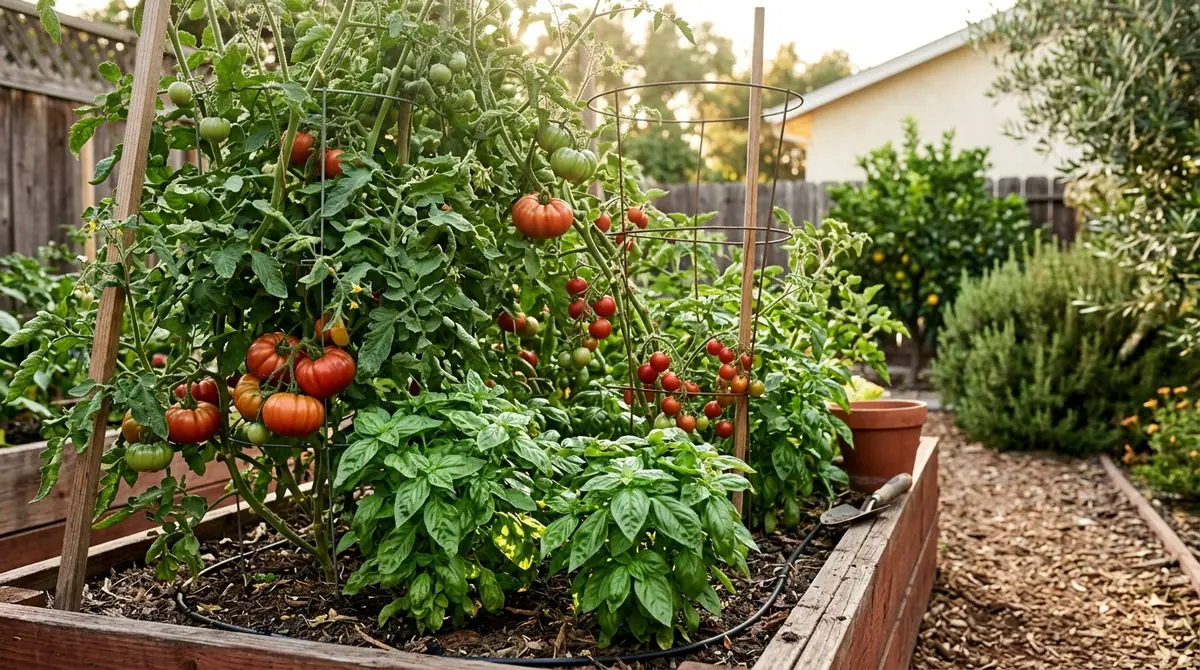
I stood in trial gardens in Davis last March, shivering slightly in a damp, pre-dawn fog, holding a tray of leggy 'Early Girl' transplants that were begging for warm soil. My fingers brushed the dirt in one of the 4-inch pots, reading a chilly 52°F (11°C). My instinct—born of years of landscape design impatience—screamed to bury them and get the season moving. But my botanical training held me back. Planting tomatoes in California is never about the calendar on your kitchen wall; it is a delicate, region-specific dance with soil temperature, microclimates, and the retreating threat of frost. Plant them too early in the Central Valley, and they sit sullenly in cold mud, their roots locking up against phosphorus uptake. Plant them too late in the interior deserts, and their blossoms drop like stones the moment June temperatures scorch past 95°F (35°C). Whether you are managing coastal marine layers in San Francisco or baking clay in Riverside, timing your tomato planting with precision is the single most important variable separating a bumper harvest from botanical heartache.
1. Botanical Overview & Natural Habitat

Understanding this ancestral habitat explains why modern cultivars behave the way they do in California gardens. They are tender perennial vines treated as annuals in agricultural and residential settings. They possess a remarkable physiological trait: adventitious root systems. Along every millimeter of a tomato stem lie dormant root primordia. When you bury a leggy transplant deep into the earth—a practice we will cover shortly—those tiny bumps rapidly transform into active roots, radically expanding the plant's structural and nutritional anchor.
In California's diverse Mediterranean climate, tomatoes thrive because the dry summer air keeps fungal pressure lower than in the humid American Southeast. However, this climate also presents distinct architectural challenges. Indeterminate varieties (vining types that continue growing and setting fruit until frost) can easily reach lengths of 10 to 15 feet (3 to 4.5 meters) in coastal valleys, requiring heavy-duty stakes or cages. Determinate varieties (bush types that grow to a genetically predetermined height of 3 to 4 feet, or 0.9 to 1.2 meters, and fruit all at once) are exceptional for container gardening and small Southern California patios, much like how you might carefully select a compact container when figuring out How Deep Do Pepper Plant Roots Go? Pot Size & Substrate Depth Guide.
2. Essential Environmental & Care Requirements
Tomatoes are unapologetic sun worshippers and heat lovers. To unlock their full genetic potential, you must dial in four core environmental pillars: soil temperature, ambient warmth, solar exposure, and soil drainage.
First, soil temperature is far more important than air temperature when timing your planting. Never put a tomato in the ground until the morning soil temperature—measured 4 inches (10 cm) deep at 8:00 AM—consistently reads 60°F (15.5°C) or higher for three consecutive days. If soil hovers at 50°F (10°C), phosphorus absorption shuts down, turning lower foliage purple and severely stunting root establishment.
Second, ambient air temperatures should ideally range between 70°F and 85°F (21°C to 29°C) during the day, with night temperatures staying above 55°F (13°C). When nighttime lows drop below 50°F (10°C) or daytime highs surge past 90°F (32°C), pollen becomes sterile, flowers fail to pollinate, and blossoms simply drop off the vine.
Third, site selection dictates your yield. Tomatoes require a minimum of 6 to 8 hours of direct, unfiltered sunlight daily. In California's hotter inland valleys (such as USDA Zones 9b and 10a), afternoon shade during peak July heatwaves can actually prevent sunscald on ripening fruit.
Finally, soil structure must be loamy, rich in organic matter, and structurally open. Heavy California adobe clay will drown roots and invite root rot (Phytophthora spp.) if drainage isn't amended with compost.
| Parameter | Optimal Condition | Common Mistake | Why It Matters |
|---|---|---|---|
| Soil Temperature | 60°F – 70°F (15.5°C – 21°C) | Planting when air feels warm but soil is still cold | Cold soil halts phosphorus uptake and stunts root growth permanently. |
| Sunlight | 8+ hours of direct sun daily | Placing in partial shade under eaves or trees | Insufficient light reduces photosynthesis, lowers sugar content in fruit, and increases disease susceptibility. |
| Soil pH | 6.2 – 6.8 | Ignoring pH or planting in alkaline California caliche soils | Extreme pH locks up micronutrients like iron and calcium, leading to blossom end rot. |
| Watering Depth | 8 – 12 inches (20 – 30 cm) per deep soak | Frequent, shallow surface watering | Shallow moisture encourages surface roots, making plants vulnerable to drought and heat stress. |
For deep-dive horticultural data on regional frost dates and microclimate mapping, consult the UC Master Gardener Program resources.
3. Step-by-Step Cultivation, Feeding & Propagation
Timing your planting in California depends entirely on your geographic zone:
- Southern California Coastal (Zones 10-11): Plant mid-March through April.
- Southern California Inland & Descents (Zones 9-10): Plant late February through March (for an early summer crop) or July for a fall harvest.
- Central Valley (Zone 9): Plant late March through April once frost danger passes.
- Northern California Coastal (Zones 9-10): Plant mid-April through May.
- Mountain & High Desert Regions (Zones 7-8): Wait until late May or early June.
When your window opens, follow this rigorous, professional planting protocol:
- Harden off your transplants: Take indoor-grown or nursery seedlings outside 10 days before planting. Expose them to morning sun and wind for 1 hour on day one, gradually increasing exposure over 10 days to prevent sunscald and wind-snap.
- Prep the planting trench or hole: Dig a hole twice as wide as the root ball and roughly 12 inches (30 cm) deep. If your soil is heavy clay, amend the native soil 50/50 with aged compost. Avoid adding excessive high-nitrogen fertilizers at this stage, or you will grow a massive, beautiful green bush with zero fruit.
- Strip the lower leaves: Gently pluck off the lower two-thirds of the leaves along the tomato stem, leaving only a small tuft of foliage at the very top.
- Plant deep or trench-lay: Place the stripped stem deep into the earth—either vertically down to the top leaves or lying horizontally in a trench angled upward. Burying the stem triggers the plant to root along its entire length, creating a massive, drought-resistant root network. If you are also transitioning other tender food crops, you can use similar careful spacing strategies as detailed in When to Transplant Cucumber Seedlings: Stop Root Shock & Boost Growth.
- Install structural support immediately: Drive your tomato stakes, cages, or Florida weave posts into the ground at the time of planting. Waiting until the plant is established will inevitably damage the newly expanded root system.
- Water in deeply: Apply a thorough, deep soaking of 1 to 2 inches (2.5 to 5 cm) of water to settle soil air pockets around the roots. Follow up with a 3-inch (7.5 cm) layer of organic mulch (such as straw or shredded bark) to retain moisture and suppress weeds.
💡 Pro-Tip: When planting your tomatoes in California's arid soils, drop a crushed calcium tablet or a handful of powdered bone meal directly at the bottom of the planting hole, underneath the root ball. As the deep roots expand downward, they will immediately access this concentrated calcium source, preventing the dreaded blossom end rot that plagues early-season fruit during sudden heatwaves.
4. Common Problems, Pests & Troubleshooting
Even with perfect timing, California's unique environment introduces specific stressors and pests that every grower must navigate.
Blossom End Rot: Appearing as a sunken, leathery black patch on the bottom of ripening fruit, this is not a pathogen. It is a physiological calcium deficiency caused by erratic soil moisture. When soils swing wildly from bone-dry to soaked, the plant cannot transpire enough calcium to the distal end of the growing fruit. Solution: Maintain consistent soil moisture using drip irrigation and avoid high-nitrogen fertilizers that force rapid, unmanageable vegetative growth.
Tomato Hornworms (Manduca quinquemaculata): These massive, camouflage-green caterpillars can strip a mature tomato vine of its leaves and green fruit overnight. Look for their dark green droppings on lower leaves. Solution: Hand-pick them at dusk using a blacklight (they glow a fluorescent neon color under UV light). If you spot white, rice-like cocoons on a hornworm's back, leave it alone—those are parasitic braconid wasp larvae that will hatch and destroy the pest population naturally.
Curly Top Virus: Transmitted by the beet leafhopper, this virus causes leaves to roll upward, turn yellow with purple veins, and stiffen. It is particularly prevalent in California's Central Valley when native weeds dry up in the foothills. Solution: Use reflective silver mulch to disorient leafhoppers, and immediately pull and destroy infected plants to prevent vector transmission.
⚠️ Important Caution: Never overhead water your tomatoes with a sprinkler system, particularly in regions subject to coastal fog. Splashing soil pathogens like Alternaria solani (Early Blight) up onto the lower leaves is the primary trigger for fungal defoliation. Always use soaker hoses or drip emitters at the base of the plant.

5. Frequently Asked Questions
What happens if I plant my tomatoes too early in California?
If you plant your tomatoes before soil temperatures reach 60°F (15.5°C), the root systems enter stasis. They cannot absorb water or vital nutrients, particularly phosphorus. The plants will sit paralyzed, turn a dull purple-green color, and become highly susceptible to soil-borne fungal pathogens like Fusarium and Verticillium wilt. A patient gardener who waits two extra weeks will always outperform an impatient grower whose early plants are permanently stunted.
Can I grow tomatoes year-round in Southern California?
In true microclimates within USDA Zones 10b and 11 (such as coastal San Diego or protected pockets of Los Angeles), you can technically keep determinate tomato plants alive through mild winters, but active fruit production halts between November and February due to insufficient daylight hours and cool ambient temperatures. Most California gardeners treat tomatoes as warm-season annuals, pulling spent vines in November and starting fresh in spring.
How do I protect my tomato blossoms from dropping when California experiences a sudden heatwave?
When ambient temperatures spike above 95°F (35°C), tomato pollen dehydrates and becomes sterile, causing open flowers to drop off without setting fruit. To mitigate this, erect 30% to 50% shade cloth over your plants during peak afternoon hours (12:00 PM to 4:00 PM), and ensure your drip irrigation delivers consistent moisture to keep the ambient root zone cooled through transpiration.
Do I need to prune the suckers off my tomato plants?
Pruning depends entirely on your variety selection. Indeterminate (vining) varieties benefit greatly from pruning side shoots (suckers) that emerge in the "V" joint between the main stem and a branch. Removing these focuses the plant's energy upward into a manageable 1 or 2-stem cordon supported by stakes. Determinate (bush) varieties should never be pruned; removing their suckers drastically reduces your overall harvest, as their fruit sets simultaneously on those side branches.
Related Guides
- When to Plant Tomatoes Southern California
- When to Plant Tomatoes in Southern California
- When to Plant Tomatoes California
- When to Plant Pumpkins in Southern California
- When to Plant Tomato Plants in California
📋 Table of Contents ▼ Click to expand
Tags:
Keep reading
🌿 Related Plants You Might Like


PlantSavvyWorld
Editorial team
PlantSavvyWorld is an independent botanical education project. Articles are drafted with AI assistance, then edited and checked against university extension services, botanical garden collections and other published horticultural sources.