

When to Plant Strawberries in Southern California
Written with AI assistance, edited and checked against horticultural sources.
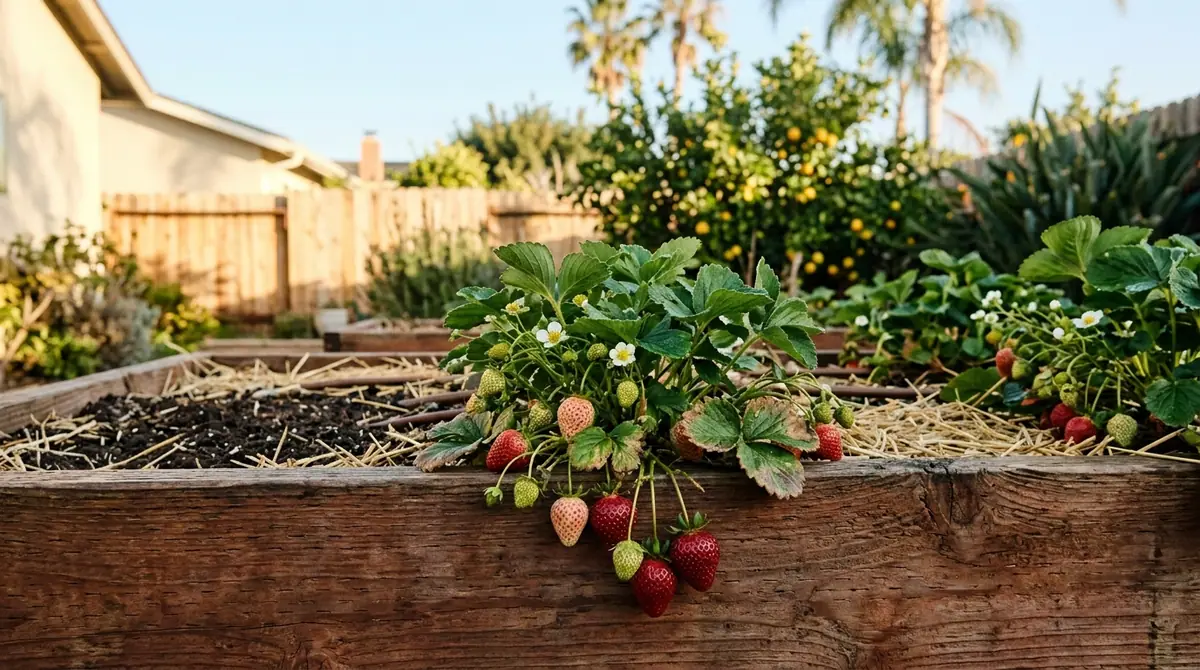
In Southern California (USDA Zones 9 and 10), bare-root 'Chandler' strawberry plants must be timed carefully to avoid the desert Santa Ana winds frying them, the June gloom shrivelling the harvest, or July heatwaves baking the fruit. Respecting the narrow autumn-to-winter planting window prevents crop failure and ensures a continuous harvest of sweet, ruby-red fruit all season long.
1. Botanical Overview & Natural Habitat

Understanding their natural habitat explains why they behave the way they do in Southern California. Native to cool, temperate, coastal understories and moist woodland margins, wild strawberries thrive in damp, fertile soils with moderate temperatures and reliable moisture. They are perennial herbaceous plants featuring a modified stem structure called a crown, from which leaves, runners (stolons), and flower stalks emerge. The crown must remain strictly at or just above the soil surface; burying it induces crown rot, while exposing it too high desiccates the feeder roots.
In Southern California, your choice of cultivar dictates your success entirely. We primarily grow three types:
- Short-Day (June-Bearing) Cultivars: These initiate flower buds when day lengths drop below 14 hours—typically in our autumn and winter. They produce one massive, intensely sweet harvest wave in spring (April through June). Outstanding performers for SoCal include 'Chandler' and 'Sequoia'.
- Day-Neutral Cultivars: These do not rely on day length for flower bud initiation. Instead, they flower and fruit continuously as long as temperatures remain between 50°F (10°C) and 85°F (29°C). Varieties like 'Albion', 'Seascape', and 'Portola' will produce fruit from spring right through autumn, making them the absolute workhorses of Southern California backyard gardens.
- Everbearing Cultivars: Despite the name, these actually prefer long days and produce two distinct flushes—one in late spring and another in late summer or early autumn. They generally underperform compared to day-neutrals in our Mediterranean climate.
Because day-neutrals and short-days handle our winters so gracefully, timing your planting around our unique seasonal shifts is crucial. For regional guidance on agricultural timing and pest management, the UC Statewide Integrated Pest Management Program (UC IPM) offers invaluable resources tailored specifically to our microclimates. Additionally, you can cross-reference our seasonal planting schedules with related regional guides, such as When to Plant Onions in Southern California (Zone 9 & 10 Planting Calendar), to coordinate your winter vegetable garden beds effectively.
2. Essential Environmental & Care Requirements
Strawberry plants are notoriously finicky if their environmental parameters stray outside strict boundaries. To achieve optimal sugar accumulation in the fruit and vigorous vegetative growth, you must manage light, temperature, soil composition, and hydration with absolute precision.
Light and Temperature Dynamics
Strawberries require a minimum of 6 to 8 hours of direct, unfiltered sunlight daily. In inland Southern California valleys (like the San Fernando, San Gabriel, or Inland Empire), afternoon shade during peak July heat can prevent leaf scorch, but coastal regions (Santa Monica, San Diego) require full sun exposure all day. Ideal ambient temperatures range between 60°F (15°C) and 80°F (26°C). Once sustained ambient temperatures exceed 90°F (32°C), flower development stalls, pollen sterility occurs, and fruit production drops off sharply.
Soil Composition and pH
Soil preparation is the single most important factor determining whether your plants thrive or wither. Strawberries demand loose, loamy, well-draining soil rich in organic matter. Heavy clay soils, common throughout Los Angeles and Orange County, trap water and suffocate roots. Amend clay heavily with aged compost, forest humus, or well-rotted manure to a depth of 12 inches (30 cm). The ideal soil pH sits between 5.5 and 6.5. If your native tap water or soil is alkaline (pH > 7.0), plants will exhibit iron chlorosis—manifesting as yellow leaves with stark green veins.
Irrigation and Hydration
Because their root systems are relatively shallow—typically occupying the top 6 to 8 inches (15 to 20 cm) of soil—strawberries cannot tolerate prolonged drought. Conversely, sitting in waterlogged soil invites Phytophthora and Verticillium wilt. Utilize drip irrigation or soaker hoses to keep the foliage dry and reduce fungal spore germination. Deliver approximately 1 to 1.5 inches (2.5 to 3.8 cm) of water weekly, increasing frequency during Santa Ana wind events when relative humidity drops below 20%.
| Parameter | Optimal Condition | Common Mistake | Why It Matters |
|---|---|---|---|
| Soil pH | 5.5 – 6.5 | Planting in unamended SoCal alkaline soil (>7.0) | High pH locks out essential micronutrients like iron, causing severe chlorosis and stunted growth. |
| Sunlight | 6–8 hours of direct sun daily | Placing in deep shade or unprotected blazing inland sun | Insufficient light halts photosynthesis and fruit sweetness; unshaded extreme heat drops blossoms. |
| Planting Depth | Crown level exactly at soil surface | Burying the crown or leaving roots exposed | Deeply buried crowns rot and die; exposed roots dry out, leading to transplant shock. |
| Watering | Evenly moist, 1–1.5 inches per week | Frequent shallow sprinkling or waterlogging | Shallow watering builds weak roots; soggy soil breeds root-rot pathogens (Phytophthora). |
3. Step-by-Step Cultivation, Feeding & Propagation
When should you actually put strawberries in the ground in Southern California? Unlike colder USDA zones where you wait for spring thaw, Southern California gardeners have a distinct advantage: October through January is the prime window for planting bare-root and fresh-dig strawberry plants. Planting during this cooler autumn and winter window allows plants to establish extensive root systems before the spring vegetative push. If you miss winter, container-grown starts can be planted in early spring (March), though they will produce smaller initial yields.
Here is the exact step-by-step protocol for establishing a high-yielding strawberry bed in Southern California:
- Site Selection and Soil Preparation: Choose a sunny location with unobstructed southern or eastern exposure. Clear all weeds and perennial roots. Turn the soil to a depth of 12 inches (30 cm), incorporating a 3-inch (7.5 cm) layer of organic compost and a balanced organic slow-release fertilizer (such as a 5-10-10 blend) at a rate of 2 pounds per 100 square feet.
- Bed Shaping and Spacing: Create raised mounds or rows spaced 30 to 36 inches (75 to 90 cm) apart. Raised beds improve drainage significantly in heavy soils. Space individual plants 12 to 14 inches (30 to 35 cm) apart within the row in a staggered double-row configuration to maximize airflow and sunlight penetration.
- Soaking Bare-Root Plants: If using bare-root stock, soak the root systems in a bucket of tepid water for 30 to 45 minutes immediately before planting to rehydrate the tissues. Trim any damaged or overly long roots back to about 4 inches (10 cm).
- Precision Planting: Dig a hole wide enough to spread the roots out naturally without curling upward. Position the plant so the midpoint of the crown sits precisely at the soil line.
⚠️ Important Caution: Never bury the crown (the central growing node) beneath the soil, and do not leave the upper roots exposed. Incorrect planting depth is the #1 cause of failure in newly installed strawberry beds.
- Initial Watering and Mulching: Press the soil firmly around the roots to eliminate air pockets. Water deeply immediately after planting to settle the soil. Apply a 2-inch (5 cm) layer of clean wheat straw, pine needles, or black agricultural plastic mulch around the plants. Mulch suppresses weeds, retains soil moisture, and keeps developing fruit clean and away from soil-borne pathogens.
- Fertilizing and Maintenance: Once new leaves emerge in late winter, side-dress plants with a low-nitrogen, high-potassium organic fertilizer to encourage robust flowering rather than excess leafy growth. Pinch off the first round of flower blossoms on newly planted June-bearing varieties for the first 4 to 6 weeks to redirect plant energy entirely into root and canopy establishment.
💡 Pro-Tip: For continuous harvests in Southern California's frost-free coastal and valley zones, plant a mix of 70% day-neutral varieties ('Albion') and 30% short-day varieties ('Chandler'). This guarantees heavy spring production alongside a steady trickle of fruit right through November.
If you are expanding your edible landscape or experimenting with indoor propagation during our scorching summer months, you can reference resources like How to Grow Strawberries Indoors: From Fruit Seeds to Sweet Berries. For structural spacing comparisons with other heavy-yielding crops in your garden, take a look at our How Deep Do Pepper Plant Roots Go? Pot Size & Substrate Depth Guide.
4. Common Problems, Pests & Troubleshooting
Even with pristine timing, Southern California's unique climate creates specific challenges for strawberry growers. Anticipating these issues will save your harvest.
Fungal Pathogens: Powdery Mildew and Gray Mold
Our characteristic morning coastal marine layer ("June gloom" or "May grey") provides high relative humidity that encourages fungal outbreaks. Powdery mildew (Podosphaera macularis) appears as a white, powdery dusting on the undersides of leaves, causing them to curl upward and turn purplish-red. Gray mold (Botrytis cinerea) attacks ripening fruit during damp periods, enveloping berries in a fuzzy gray coating.
- Solution: Prune older, lower leaves to maximize air circulation. Avoid overhead irrigation by utilizing drip lines. Apply organic copper fungicide or wettable sulfur preventatively at the first sign of humid conditions, maintaining a strict 7- to 10-day spray interval during outbreak windows.
Insect Pests: Spider Mites and Strawberry Aphids
Hot, dusty inland conditions—especially during Santa Ana wind events—are a breeding ground for twospotted spider mites (Tetranychus urticae). They pierce plant cells on the leaf underside, creating a stippled, yellow-bronze appearance accompanied by fine webbing. Strawberry aphids vector destructive plant viruses and cluster on tender new shoots.
- Solution: Blast undersides of leaves with a sharp jet of water early in the day to physically disrupt mite colonies. Introduce beneficial predatory insects such as Phytoseiulus persimilis (a predatory mite) or lady beetles (Hippodamia convergens). For severe infestations, apply insecticidal soaps or horticultural oils, ensuring complete coverage of leaf undersides.
Vertebrate Pests: Birds, Rats, and Snails
Sweet, ripe strawberries are a universal delicacy in the animal kingdom. Mockingbirds, roof rats, and garden snails will frequently harvest your crop before you do.
- Solution: Drape lightweight bird-netting over hoops once fruits begin to blush red. Set physical barriers or organic iron phosphate bait around the base of raised beds to deter snails and slugs.

5. Frequently Asked Questions
Can I plant strawberries in the spring in Southern California?
Yes, you can plant container-grown strawberry starts in early spring (March through April), but it is far from ideal. Spring-planted strawberries miss the crucial cool-weather chilling window required for optimum root establishment. Consequently, they will produce a sparse harvest during their first season compared to plants established in autumn or winter.
Do strawberries die back in the winter in Southern California?
Most of Southern California experiences mild winters (USDA Zones 9b and 10a/10b), meaning strawberry plants do not truly go dormant. Instead, vegetative growth slows down significantly between November and January. Short-day varieties use this cooler period to initiate flower buds, while day-neutral varieties may continue producing sporadic, smaller fruits straight through winter if temperatures stay above 45°F (7°C) at night.
How many years do strawberry plants live in Southern California gardens?
While strawberries are technically perennial, commercial growers and experienced horticulturists replace their plantings every 2 to 3 years. After three years, plants naturally lose vigor, crown size diminishes, viral load increases, and yields drop off precipitously. Establish a rotation schedule by propagating new runners or buying fresh bare-root stock every autumn to keep your beds at peak productivity.
Should I cut back my strawberry plants after harvesting?
For June-bearing (short-day) varieties, yes. Once their heavy spring harvest concludes in late June, you can perform what is known as "renovation." Mow or prune the foliage back to about 1 inch (2.5 cm) above the crown, taking care not to nick the central growing point. Fertilize lightly and apply fresh water and mulch; this encourages a flush of clean, disease-free foliage and vigorous runner development for the following year's crop. Never hard-prune day-neutral varieties, as they fruit continuously on living vegetative mass.
For further reading on maintaining productive edible perennial systems in arid and Mediterranean regions, consult the California Garden Web maintained by UC Agriculture and Natural Resources (ANR), which offers exceptional science-based gardening strategies tailored to our climate.
Related Guides
- When to Plant Pumpkins in Southern California
- When to Plant Tomatoes Southern California
- When to Plant Tomatoes in Southern California
- When to Plant Onions in Southern California (Zone 9 & 10 Planting Calendar)
- What Zone is Southern Indiana
📋 Table of Contents ▼ Click to expand
Tags:
Keep reading
🌿 Related Plants You Might Like




PlantSavvyWorld
Editorial team
PlantSavvyWorld is an independent botanical education project. Articles are drafted with AI assistance, then edited and checked against university extension services, botanical garden collections and other published horticultural sources.