

Peonies from Seed
Written with AI assistance, edited and checked against horticultural sources.
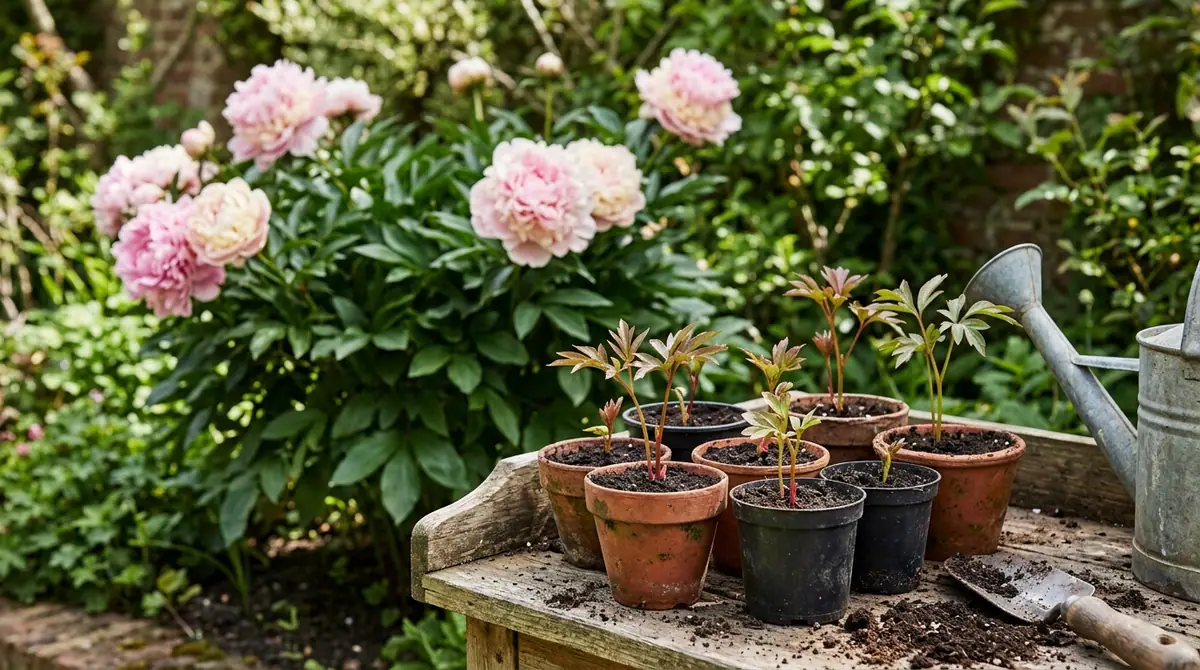
1. Botanical Overview & Natural Habitat
In their native habitats—ranging from the rocky limestone screes of the Caucasus mountains to the dappled woodland edges of central China—peonies drop their large, leathery follicles in late summer. These seeds possess a unique survival mechanism known as epicotyl dormancy combined with a double dormancy.
When a peony seed drops to the ground in August, it does not immediately sprout a green shoot. Instead, the seed first undergoes root germination (radicle emergence) during the warm autumn soil phases. Only after the radicle establishes does the seed require a prolonged period of cold stratification to break the dormancy of the epicotyl (the embryonic shoot). If you plant peony seeds outdoors, nature handles this dual-stage process over two distinct seasonal cycles. Understanding this native woodland rhythm is essential; if you try to force a peony seed to act like a common bean or a tomato, you will fail. The seed coat is remarkably tough, protecting the inner endosperm and embryo from premature moisture intake and frost damage until the precise biochemical signals trigger growth.
2. Essential Environmental & Care Requirements
To coax a stubborn peony seed into germination and sustained growth, you must mimic its native environment down to the degree and the milliliter. Peonies are notoriously intolerant of wet feet and heavy, asphyxiating clay soils during their juvenile phase.
| Parameter | Optimal Condition | Common Mistake | Why It Matters |
|---|---|---|---|
| Soil pH | 6.5 to 7.0 (Slightly acidic to neutral) | Planting in acidic soils below 6.0 | Extreme acidity locks up calcium and magnesium, stunting root formation. |
| Soil Drainage | Highly porous, sandy-loam with organic grit | Heavy, waterlogged clay holding moisture | Standing water rots the nascent radicle within 48 hours. |
| Warm Stratification | 70°F to 85°F (21°C to 29°C) for 60-90 days | Skipping warm phase or keeping seeds cold immediately | Warm temperatures are chemically required for the root radicle to emerge. |
| Cold Stratification | 35°F to 41°F (2°C to 5°C) for 90-120 days | Inadequate cold duration or freezing solid | Cold is mandatory to break the epicotyl dormancy of the future shoot. |
| Sun Exposure | Full sun (6+ hours) to dappled morning light | Deep shade under heavy tree canopies | Low light reduces photosynthetic capacity needed for tuber enlargement. |
Nutritional requirements during the seedling phase must be managed delicately. Just as you might structure intensive feeding schedules like the Mittleider Gardening Method More Food from your Garden for heavy feeders, young peony seedlings require measured, low-dose fertility rather than heavy raw compost applications that can invite fungal pathogens like Botrytis.
💡 Pro-Tip: Never let your stratification medium dry out completely. If the peat or vermiculite loses all moisture during the warm phase, the seed's internal moisture content drops below the threshold required to trigger metabolic awakening, resetting your timeline to zero.
3. Step-by-Step Cultivation, Feeding & Propagation
Growing peonies from seed is a marathon, not a sprint. Expect flowers to appear anywhere from 3 to 5 years after sowing. Follow this sequential protocol to maximize your germination rates.
- Harvest or Acquire Fresh Seed: Gather seeds in late August when the pods (follicles) begin to split open naturally, revealing black or bright red/purple seeds. Do not let seeds dry out; plant them immediately while the seed coat is permeable. If using dried commercial seeds, soak them in warm water for 24 hours to rehydrate the hard seed coat.
- Perform the Warm Stratification Phase: Place your seeds in a sealed plastic baggie filled with a 50/50 mix of damp peat moss and perlite. Maintain a steady room temperature of 70°F to 85°F (21°C to 29°C) for 60 to 90 days. Check the bag weekly for moisture and mold. During this phase, you will notice white root radicles (often 1 to 3 inches / 2.5 to 7.5 cm long) pushing out of the seed coats.
- Transition to Cold Stratification: Once the root radicle appears, move the baggie directly into your refrigerator, maintaining a chilling temperature between 35°F and 41°F (2°C to 5°C). Keep them here for 90 to 120 days. This step stimulates the dormant epicotyl inside the seed.
- Pot Up into Containers: In late winter or early spring, remove the germinated seeds with established roots. Plant each seed individually into deep, 4-inch (10 cm) nursery pots filled with a sterile, well-draining potting mix containing coarse sand and perlite. Plant the seed roughly 1 inch (2.5 cm) deep.
- Provide First-Year Care: Place the containers under bright, indirect light or grow lights for 14 hours a day. Keep the soil evenly moist but never soggy. When managing young container plants outdoors later in the season, remember that wind stress can desiccate fragile foliage; utilize physical barriers similar to strategies used when you How to Protect Balcony Plants from Strong Winds and Harsh Sun.
- Transplanting Out to the Garden: In autumn of their first growing year, transplant the young peonies into a permanent, well-drained garden bed with full sun exposure. Ensure the crown of the young plant sits no deeper than 1 to 2 inches (2.5 to 5 cm) below the soil surface. Protect the young, shallow root systems from severe winter heaving by applying a loose mulch layer, keeping practices comparable to how you How to Protect Backyard Fruit Orchard from Winter Frost.
⚠️ Important Caution: Never plant your peony seeds or young container-grown seedlings too deep. If the crown is buried deeper than 2 inches (5 cm), the plant will survive and produce green foliage, but it may stubbornly refuse to flower for a decade or more.
For additional scientific background on the complex physiological mechanisms of seed dormancy, consult the Royal Botanic Gardens Kew Seed Information Database.
4. Common Problems, Pests & Troubleshooting
Even with meticulous stratification, growing peonies from seed presents distinct hurdles.
Root Rot (Pythium and Phytophthora): This is the single greatest killer of indoor-stratified peony seeds. If your stratification bag smells sour or the emerging radicles turn brown and mushy, your medium is too wet. Discard infected seeds immediately, sterilize the remaining seeds in a weak hydrogen peroxide solution (1 part 3% H2O2 to 10 parts water), and switch to a fresher, barely damp perlite medium.
Foliar Blight (Botrytis paeoniae): Once your seedlings emerge above the soil line in spring, high humidity and stagnant air can cause young stems to turn black at the base and collapse. Ensure strong horizontal airflow using small circulating fans, water only at the base in the morning, and avoid heavy nitrogen fertilizers that push soft, succulent growth vulnerable to fungal attack. For a comprehensive overview of fungal pathogen management in ornamental perennials, reference the University of Minnesota Extension Yard and Garden guides.

5. Frequently Asked Questions
Can you grow peonies from store-bought seeds?
Yes, but with caveats. Commercial peony seeds sold online or in packets have often dried out completely during storage. Because a dry peony seed enters deep secondary dormancy, you must soak them in warm water for 24 to 48 hours before starting the warm stratification phase. Be prepared for lower germination rates and longer wait times compared to freshly harvested seeds.
How long does it take for peony seeds to sprout?
Because of their double dormancy (warm requirement followed by cold requirement), it typically takes between 4 to 6 months from the initial sowing date for the first true leaves to emerge above the soil line. The root radicle emerges during the warm phase (months 1–3), while the shoot emerges after the cold stratification phase (months 4–6).
Do peony seeds come true to the parent plant?
No. Peonies grown from seed are genetic hybrids and will almost never look identical to the parent plant. If you harvest seeds from a prized double pink cultivar, the offspring may produce single red, white, or semi-double flowers with entirely unique characteristics. If you need an exact genetic clone of a specific plant, you must propagate via root division instead.
Why are my peony seedlings dying after sprouting?
The most common cause of seedling collapse is overwatering leading to fungal damping-off. Peony seedlings require excellent drainage and air circulation. If the stems turn water-soaked and pinch off at the soil line, reduce watering immediately, remove infected plants, and treat the surrounding soil with a bio-fungicide containing Bacillus subtilis.
Related Guides
- Mulch for Peonies
- Do Peonies Grow in Texas
- Growing Peonies in Containers
- Do You Cut Back Peonies in the Fall
📋 Table of Contents ▼ Click to expand
Tags:
Keep reading
🌿 Related Plants You Might Like



PlantSavvyWorld
Editorial team
PlantSavvyWorld is an independent botanical education project. Articles are drafted with AI assistance, then edited and checked against university extension services, botanical garden collections and other published horticultural sources.