

Is My Bonsai Tree Dying
Written with AI assistance, edited and checked against horticultural sources.
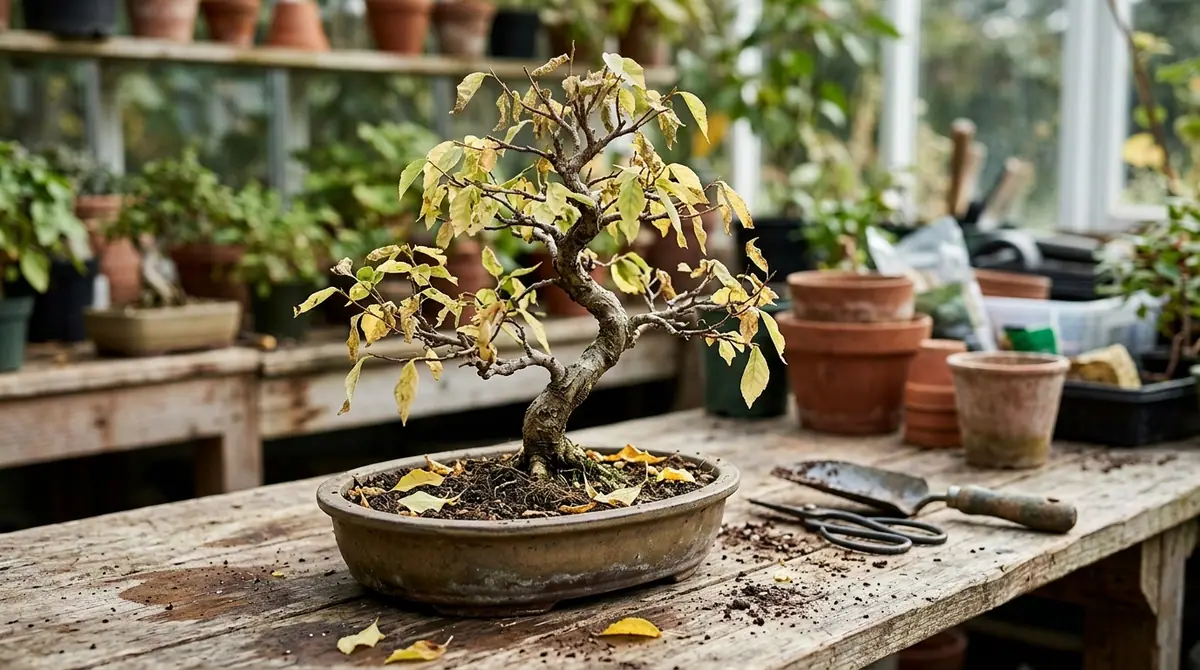
It was a humid Tuesday morning in July when I found myself kneeling on a greenhouse floor, frantically scraping away the topsoil of a ten-year-old Japanese Juniper (Juniperus procumbens) that had begun dropping its needle scales. The interior of the root ball was bone dry, yet the surface moss looked verdant and damp. The nursery owner who gifted it to me had warned that bonsai trees do not tolerate neglect, but seeing a miniaturized titan slowly suffocate from a fundamental watering miscalculation is a humbling experience for any botanist. That crisis taught me a lesson I carry into every landscape design project today: a declining bonsai is rarely suffering from a sudden disease; it is almost always sending an urgent distress signal about a chronic environmental mismatch.

1. Botanical Overview & Natural Habitat
To understand a dying bonsai, you must first unlearn the illusion that a bonsai is a houseplant. A bonsai is not a genetically dwarfed species; it is a full-sized tree—often an oak, maple, juniper, or ficus—kept miniature through meticulous root pruning, branch wiring, and restricted soil volume. In their natural habitats, these woody perennials span acres of earth, sending taproots down 3 to 6 feet (90 to 180 cm) to anchor themselves and tap into stable sub-surface water tables.
When we confine these majestic organisms into ceramic containers typically measuring just 6 to 12 inches (15 to 30 cm) wide and 2 to 3 inches (5 to 7.5 cm) deep, we drastically alter their biological reality. The root system loses its thermal and hydraulic buffers. In nature, a sudden 20°F (-6°C) drop in temperature is absorbed by the surrounding earth; in a shallow bonsai pot, that same drop chills the root tips to a dangerous degree within 30 minutes.
Understanding whether your tree is truly dying starts with recognizing its native climate archetype. Indoor tropicals, such as the Ficus retusa or Carmona microphylla, hail from zones where ambient temperatures rarely dip below 60°F (15°C) and relative humidity hovers above 70%. Conversely, temperate outdoor varieties like the trident maple (Acer buergerianum) or Scots pine (Pinus sylvestris) require distinct seasonal dormancy, experiencing chilling hours between 32°F and 45°F (0°C to 7°C) for 60 to 90 days annually. If you keep a temperate outdoor bonsai inside a climate-controlled living room kept at a constant 72°F (22°C), the tree fails to enter dormancy, exhausts its carbohydrate reserves over a single winter, and exhibits dieback that mimics a fatal disease. For a broader perspective on how trees react to root displacement and environmental stress, you can explore our guide on creative landscaping ideas around tree roots.
2. Essential Environmental & Care Requirements
More than 80 percent of declining bonsai trees suffer from improper watering technique or substandard soil composition. Because traditional potting soil compacts and suffocates roots within months, professional bonsai soil must consist of hard, porous aggregates like Akadama, pumice, and lava rock. This mixture allows oxygen to reach the fine root hairs while draining away excess moisture instantly.
| Parameter | Optimal Condition | Common Mistake | Why It Matters |
|---|---|---|---|
| Watering Frequency | When top 0.5 inches (1.3 cm) of soil is dry | Watering on a rigid schedule (e.g., every Tuesday) | Overwatering rots roots by cutting off oxygen; underwatering dehydrates cambium layers. |
| Light Exposure | 6–8 hours of direct sun (outdoor) or 2000+ lumens (indoor) | Placing light-loving outdoor trees on interior windowsills | Insufficient light halts photosynthesis, starving the tree of energy to fight pathogens. |
| Ambient Humidity | 50%–70% relative humidity | Placing tropicals directly over active heating vents | Low humidity causes leaf tip necrosis and invites spider mites. |
| Temperature Range | 60°F–85°F (15°C–29°C) for tropicals; natural seasonal drops for outdoor species | Subjecting indoor trees to sudden drafts below 55°F (13°C) | Sudden thermal shock causes instant leaf drop and weakens cellular walls. |
When managing outdoor trees during unseasonable weather swings, you may find valuable contextual care parallels in our detailed manual on how to identify and treat common fruit tree diseases, as woody perennials share many common fungal vulnerabilities.
💡 Pro-Tip: Never water your bonsai by spraying the leaves with a mist bottle daily. While it feels nurturing, surface moisture breeds fungal spores like powdery mildew without hydrating the actual root zone where survival happens. Instead, submerge the entire pot in a basin of water up to the rim for 5 minutes until air bubbles cease rising.
3. Step-by-Step Cultivation, Feeding & Propagation
Reviving a struggling bonsai requires a systematic triage protocol. If your tree is shedding leaves, showing brittle branches, or failing to push new spring growth, execute this recovery sequence immediately:
- Perform the Scratch Test: Gently scrape away a 0.25-inch (0.6 cm) patch of bark on a lower branch using your fingernail or a grafting knife. If the tissue underneath is bright green or moist white, the branch is alive. If it is brown, brittle, and dry, move inward toward the trunk until you find green tissue, then prune off the dead wood at a 45-degree angle.
- Inspect and Correct the Root Zone: Carefully extract the tree from its pot. If the root mass is a solid, impenetrable felted mat of circling roots, the tree is root-bound. Use a root hook to gently comb out the outer 15 to 20 percent of the root ball, pruning away black, mushy, or rotting roots with sterilized shears.
- Repot into Porous Substrate: Discard old, compacted organic soil. Re-pot the tree using a professional inorganic mix (such as a 2:1:1 ratio of Akadama, pumice, and volcanic ash) to ensure maximum aeration. Secure the root ball into the pot using copper or aluminum anchor wires threaded through the drainage holes.
- Calibrate Watering and Placement: Move the tree to a recovery microclimate—shaded from harsh midday sun (filtering light to roughly 50%) and protected from drying winds. Water thoroughly only when the surface aggregate dries to a depth of 0.75 inches (1.9 cm).
- Withhold Fertilizer Completely: Never feed a stressed or dying bonsai. Synthetic fertilizers contain mineral salts that burn compromised root hairs. Wait until you observe vigorous new stem and leaf growth—typically after 30 to 45 days—before applying a weak, half-strength organic liquid fertilizer once a month during the active growing season.
If you enjoy propagating woody plants from cuttings as an extension of your bonsai practice, you will appreciate the methodologies outlined in our total guide to moringa why you should grow the miracle tree or drumstick vegetable.
⚠️ Important Caution: Do not use heavy garden soil or pure potting compost from a hardware store bag for your bonsai. Fine garden soils pack down tightly in shallow containers, retaining water like a sponge and suffocating the microscopic root hairs within 14 days.
4. Common Problems, Pests & Troubleshooting
Diagnosing bonsai ailments is an exercise in reading botanical body language. Here is how to resolve the most frequent crises:
- Sudden Green Leaf Drop: If your ficus or elm drops green leaves overnight, the culprit is almost always environmental shock—a sudden drop in temperature, a draft from an air conditioner, or a drastic shift from outdoor sun to indoor shade. Stabilize the ambient temperature between 68°F and 75°F (20°C–24°C) and provide auxiliary LED grow light coverage for 12 hours daily. For authoritative reference on physiological plant responses, consult the Royal Horticultural Society.
- Sticky Residue and Fine Webbing: If you notice fine webbing across the branch crotches or sticky honeydew on the leaves, your tree is infested with spider mites or aphids. Rinse the foliage thoroughly with a high-pressure stream of water, then spray every 7 days for three cycles with insecticidal soap or horticultural neem oil diluted to a 1% concentration.
- Mushy, Black Roots with Sour Odor: This is root rot (Phytophthora or Pythium fungi), triggered by stagnant water and anaerobic soil conditions. Unpot the tree immediately, wash away the foul soil, trim away all infected black roots until only firm, light-colored tissue remains, and repot in fresh, fast-draining inorganic substrate. For broader horticultural pathology research, visit the University of California Agriculture and Natural Resources extension repository.
- Brittle, Shriveled Conifer Needles: Pines and junipers can remain green for weeks after their roots have died. If the foliage turns a dull grayish-green and feels crisp like paper, the root system has suffered terminal drought or freeze damage and cannot be revived.

5. Frequently Asked Questions
How can I tell if my bonsai tree is dormant or actually dead?
Perform the scratch test on the lower trunk or primary branches. Live tissue beneath the bark will be green or moist pale white. Furthermore, dormant deciduous trees will have plump, firm buds ready for spring, whereas dead trees feature shriveled, hollow buds and completely brittle, dry twigs that snap cleanly without bending.
Can I bring an outdoor bonsai tree inside for the winter?
Most temperate outdoor bonsai (such as maples, junipers, and pines) cannot survive indoors long-term. They require a mandatory winter dormancy period featuring freezing or near-freezing temperatures to reset their hormonal clocks. Bringing them into a heated home tricks them into continuous growth, exhausting their energy reserves until they die within 60 to 90 days. Protect them outdoors instead by placing the pot directly in the ground or insulating the container with mulch.
Why are the leaves on my indoor bonsai turning yellow and falling off?
Yellowing leaves are most frequently caused by overwatering or poor soil drainage, which starves the root system of oxygen. Check the soil moisture 1 inch (2.5 cm) deep; if it feels wet or soggy days after watering, your soil has compacted. Allow the soil to dry out slightly between waterings, ensure drainage holes are completely clear, and consider emergency repotting into a coarser aggregate mix.
How often should I water my bonsai tree?
There is no universal calendar schedule for watering a bonsai. You must check your tree daily by touching the top 0.5 inches (1.3 cm) of soil. If the surface is dry and lighter in color, water thoroughly until it runs freely from the bottom drainage holes. Depending on ambient wind, humidity, and pot size, this may mean watering twice a day during scorching July afternoons or once every five days in December.
Related Guides
- Fusing Trees Together Bonsai Trunk
- Dying Cactus
- How to Know When a Verruca is Dying
- What Does a Verruca Look Like When It is Dying
- Will a Lemon Tree Survive Winter
- Colvilles Glory Tree Colvillea Racemosa Growing Guide
- Can You Replant a Christmas Tree
📋 Table of Contents ▼ Click to expand
Tags:
Keep reading
🌿 Related Plants You Might Like






PlantSavvyWorld
Editorial team
PlantSavvyWorld is an independent botanical education project. Articles are drafted with AI assistance, then edited and checked against university extension services, botanical garden collections and other published horticultural sources.