Written with AI assistance, edited and checked against horticultural sources.
I stood in growers’ driveway last January, staring at a six-foot Nordmann Fir that had spent fourteen days indoors bathed in string lights, dry heat, and forced air. The soil in the burlap-wrapped root ball was bone dry, yet the tips of the lower branches were weeping amber resin. Growers looked at me with hopeful eyes, asking the question I hear every single winter: "Can you replant a Christmas tree?" I had to gently explain that while the biological answer is yes, the physiological hurdles we had just created inside their living room made survival a gamble.
I have evaluated hundreds of post-holiday conifers. Success depends entirely on understanding tree physiology, respecting the transition from dormancy to active growth, and executing planting protocols with absolute precision. Let us dive into the science of whether that holiday centerpiece can become a permanent fixture in your landscape.
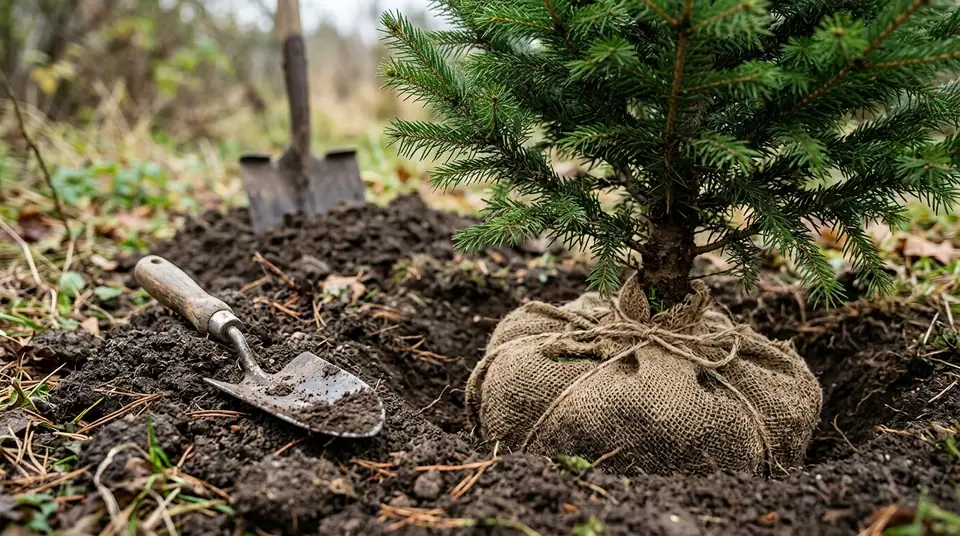
Christmas tree with root ball in burlap ready for planting with garden trowel and shovel
1. Botanical Overview & Natural Habitat
Most potted or balled-and-burlapped Christmas trees belong to the Pinaceae family, primarily encompassing genera such as Abies (firs), Picea (spruces), and occasionally Pseudotsuga (douglas-firs). In their natural montane and boreal habitats, these evergreens experience distinct seasonal shifts. Winter brings sub-freezing temperatures—often dropping below 14°F (-10°C)—which triggers deep physiological dormancy. During this phase, metabolic processes slow dramatically, water movement within the vascular cambium reduces, and the tree hardens off its soft new growth to protect cellular walls from ice crystal formation.
When you bring a living tree indoors into a 68°F to 72°F (20°C to 22°C) living room, you trick its biological clock. The sudden influx of heat and artificial light signals that spring has arrived. The tree breaks dormancy prematurely, mobilizing stored carbohydrates and resuming transpiration through its needles. Roots that were adapted to cool, damp forest soils are suddenly subjected to dry indoor air and warm, erratic watering schedules.
Understanding this natural habitat is crucial for landscape success. Conifers thrive in well-aerated soils with an acidic pH ranging from 5.5 to 6.5. They require mycorrhizal fungi associations in the rhizosphere to facilitate nutrient and water uptake. When you disrupt these systems by moving a tree between extreme environments, you induce severe transplant shock. To explore more about how regional conifer species adapt to urban and domestic landscapes, consult the Royal Horticultural Society guidance on conifer cultivation.
2. Essential Environmental & Care Requirements
If your Christmas tree is going to survive the transition from indoor holiday display to outdoor landscape specimen, you must meticulously manage its environmental parameters. The single biggest mistake people make is keeping the tree indoors for too long. A living Christmas tree should never spend more than 10 consecutive days inside your home. Ideally, limit this to 7 days.
Parameter
Optimal Condition
Common Mistake
Why It Matters
Indoor Temperature
55°F to 62°F (13°C to 17°C)
Placing next to a heating vent or fireplace (75°F / 24°C+)
Extreme heat accelerates respiration, depleting stored energy reserves and causing needle drop.
Indoor Humidity
40% to 50% relative humidity
Leaving in dry indoor air (below 25% humidity)
Low humidity causes rapid moisture loss through stomata, leading to irreversible desiccation.
Soil Moisture
Consistently damp, never waterlogged
Allowing root ball to dry out completely for 48 hours
Fine root hairs die rapidly when dry, destroying the tree's ability to take up water.
Acclimation Period
7 to 14 days in a protected garage or porch
Moving straight from a 70°F living room to a 20°F garden
Rapid thermal shock ruptures plant cells and kills the cambium layer.
💡 Pro-Tip: Never let the root ball of a living Christmas tree sit in standing water inside its decorative saucer. Conifer roots require oxygen; sitting in stagnant water for even 24 hours induces root rot (Phytophthora species) and suffocates the beneficial mycorrhizae.
Replanting a Christmas tree requires a disciplined, multi-stage protocol. You cannot simply dig a hole on New Year's Day and shove the root ball into frozen ground.
Pre-Digging the Outdoor Hole: Do this in late autumn before the ground freezes solid. Dig a hole 2 to 3 times wider than the root ball, but at the exact same depth as the container or root ball. Store the excavated soil in your garage so it does not freeze.
Minimizing Indoor Exposure: Keep the tree in the coolest part of your home—such as a brightly lit foyer or unheated sunroom—and strictly limit indoor display time to 7 days maximum. Check the soil moisture daily by inserting your finger 2 inches (5 cm) deep.
The Transitional Hardening Phase: Move the tree outdoors to a protected, unheated space like a garage, shed, or covered patio for 10 to 14 days. This step allows the tree to re-enter dormancy safely. Temperatures here should ideally hover between 32°F and 40°F (0°C to 4°C).
Root Inspection and Pruning: Remove the container or carefully cut away wire baskets and burlap from the top two-thirds of the root ball. Inspect for girdling roots; gently tease apart any roots circling the exterior of the root mass using your fingers or a hori hori knife.
Setting the Tree: Place the tree into the pre-dug hole, ensuring the root flare (where the trunk widens into the root system) sits 1 inch (2.5 cm) above the surrounding soil grade. Settling will occur naturally.
Backfilling and Watering: Backfill with the native soil you set aside earlier, tamping down gently every 6 inches (15 cm) to eliminate air pockets. Do not add fertilizer to the planting hole, as chemical salts will burn tender, recovering roots. Apply a deep initial watering of 5 gallons (19 liters) to settle the soil.
Mulching for Thermal Protection: Apply a 3-inch (7.5 cm) layer of shredded bark mulch across the root zone to insulate against winter temperature swings. Maintain a 2-inch (5 cm) clearance between the mulch and the actual tree trunk to prevent fungal decay.
4. Common Problems, Pests & Troubleshooting
Even with careful handling, transplanted Christmas trees face physiological stress. Identifying symptoms early allows you to intervene before damage becomes terminal.
Needle Browning and Drop: If needles turn brittle and drop en masse within weeks of planting, the tree suffered from severe desiccation while indoors. Check the cambium layer by scratching a small patch of bark on a minor branch with your fingernail; if it is green and moist, the tree may recover with consistent watering. If it is brown and dry, the branch is dead.
Tip Dieback: If the uppermost tips of the branches turn brown or black in late winter, the tree experienced frost damage because it broke dormancy too early indoors. Prune back dead tips in early spring just below the damage point into healthy green tissue.
Spider Mites (Tetranychidae): Indoor heat often triggers outbreaks of microscopic spider mites. You may notice fine webbing between needles and a stippled, yellowed appearance. Blast the foliage thoroughly with a strong stream of cold water outdoors, or apply horticultural soap spray if infestations persist during milder weather.
Root Rot (Phytophthora): If the tree wilts despite moist soil, or if the lower trunk feels spongy and smells sour, root rot is likely present. Unfortunately, established root rot in conifers is rarely curable. Ensure future planting sites feature optimal drainage—percolating at least 1 inch (2.5 cm) of water per hour.
⚠️ Important Caution: Never apply high-nitrogen synthetic fertilizers to a newly replanted Christmas tree in winter or early spring. Forcing new flush growth before the root system has fully re-established structural integrity will exhaust the tree's remaining carbohydrate reserves and can cause fatal cellular collapse during a late-season freeze.
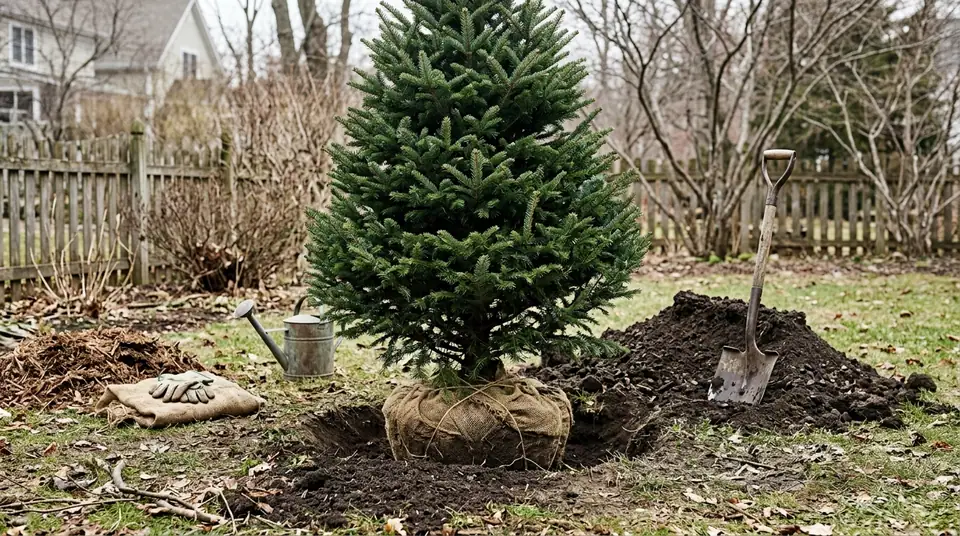
A ball-and-burlap Christmas tree ready to plant beside a hole, shovel, and pile of dirt in a backyard
5. Frequently Asked Questions
Can I plant a cut Christmas tree that doesn't have roots?
No. A cut Christmas tree has been harvested by severing its main trunk at the base. Without a functional root system and root ball, the vascular tissue cannot absorb water or nutrients from the soil, making regrowth biologically impossible. Only trees sold specifically as "living," "potted," or "balled-and-burlapped" with intact root systems can be replanted.
How long can a living Christmas tree stay inside the house?
A living Christmas tree should remain inside your heated home for no longer than 7 to 10 days. Staying indoors longer tricks the tree into breaking winter dormancy prematurely, making it highly susceptible to fatal thermal shock when moved back outside into freezing winter temperatures.
What is the best way to water an indoor living Christmas tree?
Check the soil moisture daily by pushing your finger 2 inches (5 cm) deep into the root ball. Water thoroughly whenever the top 2 inches feel dry, ensuring excess water drains freely through the pot's bottom drainage holes. Avoid letting the root ball sit in standing water, and never rely solely on ice cubes placed on top of the soil, as this delivers inadequate moisture to the lower root zone.
Can I keep my Christmas tree in a pot on my patio instead of planting it in the ground?
Yes, but container culture requires specific management. Choose a frost-proof container at least twice the diameter of the current root ball, use a well-draining acidic potting mix, and keep in mind that potted evergreens are more vulnerable to root freeze during harsh winters. You will also need to repot the tree every 2 to 3 years and provide regular structural pruning to match the root volume to the container size.
PlantSavvyWorld is an independent botanical education project. Articles are drafted with AI assistance, then edited and checked against university extension services, botanical garden collections and other published horticultural sources.