Written with AI assistance, edited and checked against horticultural sources.
Frost-sensitive dwarf Alberta spruce (Picea glauca 'Conica') will perish if trapped inside a sealed glass terrarium with wet soil and warm indoor heating, causing needles to brown within fourteen days and drop. A Christmas fairy garden is a living, breathing assemblage of miniature ecosystems forced to coexist indoors during the harshest season of the year.
I approach holiday miniatures through the lens of strict plant physiology. When you combine tropical houseplants, alpine evergreens, and dormant mosses into a single decorative container, you are engineering a complex microclimate. Here is your definitive, science-backed guide to designing, planting, and maintaining a thriving Christmas fairy garden that outlasts the holiday season.
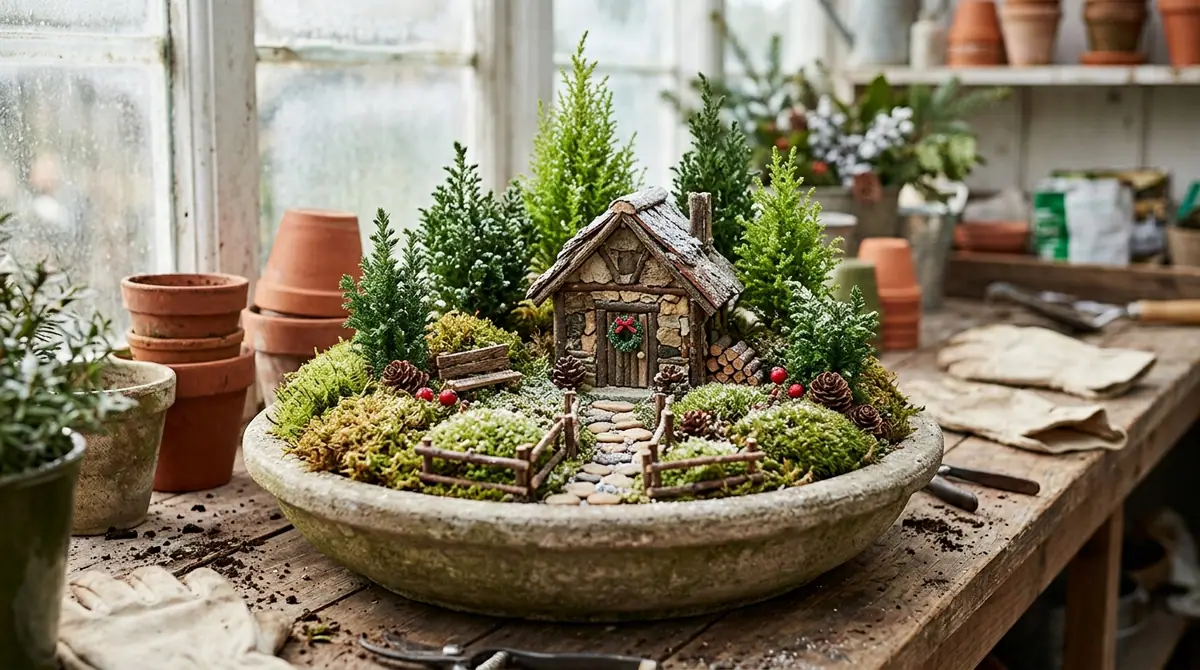
Miniature Christmas fairy garden in a terracotta pot with a tiny wooden cabin and pine sprigs
1. Botanical Overview & Natural Habitat
A successful Christmas fairy garden requires careful plant selection because you are blending species from radically different natural habitats. Most standard holiday fairy garden displays rely on miniature conifers, creeping ground covers, and humidity-loving tropicals. Understanding their native environments is the key to keeping them alive indoors between 65°F and 72°F (18°C to 22°C).
The structural backbone of any winter scene is typically a dwarf conifer, such as Picea glauca 'Conica' or Chamaecyparis obtusa 'Nana Gracilis'. In the wild, these dwarf conifers grow in cold, high-altitude zones (USDA Hardiness Zones 3 through 8), enduring freezing winters and heavy snowpacks. They require absolute winter dormancy and cool ambient temperatures. When forced indoors for the holidays, they experience severe environmental shock if placed near heating vents.
To create the snowy ground cover or forest floor, we turn to low-growing perennials and mosses. Irish Moss (Sagina subulata), which is actually a member of the Caryophyllaceae (pink) family rather than a true moss, thrives in damp, acidic soils native to Western Europe. True cushion mosses (Leucobryum glaucum) originate in shaded temperate woodlands, where they absorb moisture directly through their leaves rather than roots.
For festive color and textural contrast, designers often incorporate small-leafed tropicals like Ficus pumila (creeping fig) from the rainforests of East Asia, or Soleirolia soleirolii (baby's tears) from the western Mediterranean. Creeping fig clings to vertical surfaces using aerial rootlets, making it ideal for scaling miniature stone walls or rustic winter cabins, while baby's tears forms dense, emerald green mats that mimic lush forest floors.
Parameter
Optimal Condition
Common Mistake
Why It Matters
Ambient Temperature
60°F–68°F (15°C–20°C)
Placing near 80°F (26°C) radiator vents
Rapidly desiccates conifers and triggers early dormancy break.
Soil pH
5.5 to 6.5 (slightly acidic)
Using heavy, alkaline garden soil
Locks out essential iron and micronutrients, causing chlorosis.
Container Drainage
Holes at least 0.5 inches (1.2 cm) wide
Using un-drained glass bowls or zinc buckets
Causes root rot (Pythium species) within 7 to 10 days of overwatering.
Light Intensity
1,000 to 2,500 foot-candles (bright indirect)
Tucking deep into dark, windowless corners
Stunts photosynthesis, causing lower foliage drop in evergreens.
2. Essential Environmental & Care Requirements
Balancing the environmental needs of your Christmas fairy garden plants is a delicate exercise in compromise. Because you are grouping plants with varying tolerances into a shared container, your management of light, water, and humidity dictates the longevity of the display.
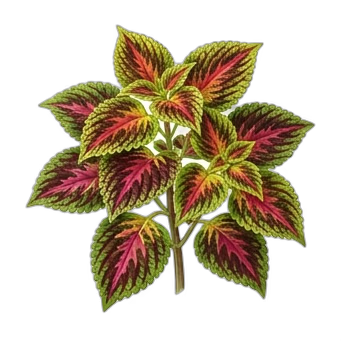
Conifers demand intense, direct light—ideally 4 to 6 hours of sunlight daily by a south- or west-facing window. Conversely, tropical ground covers like baby's tears and polka dot plants (Hypoestes phyllostachya) scorch under harsh direct sunlight, preferring bright, indirect eastern exposure. To resolve this tension in indoor winter settings, position your fairy garden directly in front of a bright window, or supplement with a full-spectrum LED grow light suspended 12 inches (30 cm) above the canopy for 10 hours daily.
Watering requires targeted precision. Never water a fairy garden on a rigid calendar schedule. Instead, measure soil moisture at a depth of 1.0 inch (2.5 cm) using your index finger. If the substrate feels dry at that depth, water thoroughly until it runs freely through the drainage holes.
💡 Pro-Tip: Conifers hidden inside holiday displays often die not from underwatering, but from dry indoor air. Mist your entire display every 48 hours with distilled water, or place the container atop a pebble tray filled with water to maintain a localized relative humidity of 50% to 60%.
Soil aeration is equally critical. The root zones of miniature plants are exceptionally compact—often restricted to containers just 4.0 to 6.0 inches (10 to 15 cm) deep. Use a bespoke soil blend consisting of 50% high-grade organic potting mix, 30% horticultural perlite or pumice for drainage, and 20% sphagnum peat moss to retain necessary moisture without compacting. Avoid garden soil entirely, as it introduces soil-borne pathogens and packs down too tightly around delicate root systems.
Building a structural, long-lasting Christmas fairy garden requires a systematic approach to root management, hardscape placement, and layering. Follow this exact protocol to establish a thriving miniature landscape.
Select and Prepare the Container: Choose a wide, shallow container—such as a terra cotta bowl or wooden half-barrel—at least 12 inches (30 cm) in diameter and 6 inches (15 cm) deep, ensuring it features at least one functional drainage hole.
Layer the Drainage Base: Lay down a 1.0-inch (2.5 cm) layer of expanded clay pebbles or horticultural gravel at the base of the container to prevent perched water tables from drowning lower roots.
Add the Substrate: Fill the container to 2.0 inches (5 cm) below the rim using your pre-mixed soil blend of 50% potting mix, 30% perlite, and 20% peat moss. Tamp the soil lightly to eliminate large air pockets.
Position Structural Hardscape and Conifers: Plant your focal-point dwarf conifer first. Gently tease out the root ball to loosen circling roots, plant it at the exact same depth it was in its nursery pot, and anchor any stone walls, miniature pathways, or fairy houses around it.
Infill with Ground Covers: Plant creeping ground covers like Sagina subulata or Soleirolia soleirolii around the base of the conifer and along your pathways, spacing them 2.0 inches (5 cm) apart to allow for lateral spread.
Apply Holiday Accents and Top-Dressing: Cover exposed soil surfaces with a 0.5-inch (1.2 cm) layer of sheet moss or fine white quartz sand (to mimic fresh winter snow). Insert miniature fairy garden accessories, twinkle lights, and holiday ornaments carefully, ensuring wires do not constrict plant stems.
Initial Watering: Water the completed display thoroughly with a dilute seaweed extract solution until moisture runs from the drainage holes. This minimizes transplant shock within the first 24 hours.
Feeding should be managed conservatively. Because miniature plants in fairy gardens are intentionally kept small and compact, heavy fertilization causes rapid, leggy growth that ruins the scale of the design. Apply a balanced, water-soluble houseplant fertilizer diluted to one-quarter strength just once every 6 weeks during the active winter maintenance window. For deeper horticultural insights, consult the Royal Horticultural Society container gardening guidelines.
Propagation of your fairy garden plants can begin right as you dismantle the display after the holidays. Take 3.0-inch (7.5 cm) stem cuttings from your Ficus pumila or Hypoestes phyllostachya, dip the lower nodes in rooting hormone powder, and insert them into a 50/50 perlite and peat propagation tray at 70°F (21°C). They will successfully strike roots within 14 to 21 days.
4. Common Problems, Pests & Troubleshooting
Indoor holiday environments create ideal conditions for specific plant pests and physiological disorders. Identifying symptoms early saves your miniature landscape from total collapse.
Needle Browning and Drop on Conifers: If your dwarf spruce or cypress drops brown needles from the interior outward, the plant is experiencing heat stress and low humidity. Move the container away from heating registers, mist daily, and check that ambient temperatures do not exceed 68°F (20°C).
Fungus Gnats (Bradysia species): Swarming tiny black gnats indicate that your soil is remaining too wet for too long. Allow the top 1.5 inches (3.8 cm) of soil to dry out completely between waterings, and apply beneficial nematodes or mosquito dunks soaked in your watering can to eradicate larvae in the root zone.
Powdery Mildew (Erysiphe species): A white, powdery dusting on the leaves of your ground covers occurs when humidity is high and air circulation is stagnant. Prune back overcrowded foliage, improve air movement with a small oscillating fan, and spray affected leaves with a copper-based fungicide or a mixture of 1 teaspoon baking soda per quart of water.
Root Rot (Phytophthora or Pythium): If your tropical ground covers suddenly collapse at the soil line with mushy, blackened stems, you have severe root rot driven by poor drainage.
⚠️ Important Caution: Never use chemical aerosol bug sprays or heavy systemic pesticides indoors near holiday decorations, pets, or food prep areas. Instead, treat minor pest outbreaks manually using cotton swabs dipped in 70% isopropyl alcohol, or spray thoroughly with insecticidal soap formulated for indoor plants.
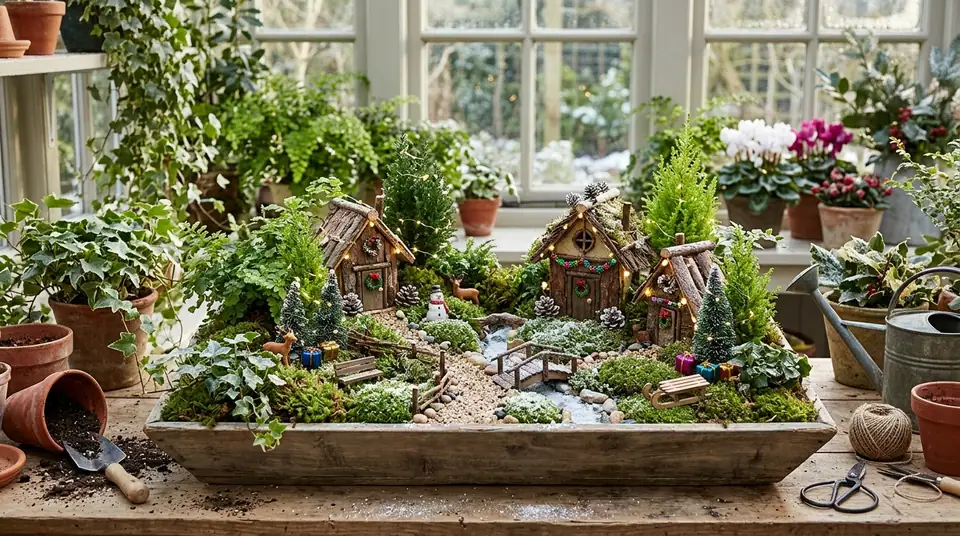
Miniature Christmas fairy garden in a wooden trough with tiny houses, moss, and evergreen plants
5. Frequently Asked Questions
Can a Christmas fairy garden survive outdoors after the holidays?
Yes, provided you choose hardy perennial plants like dwarf conifers and creeping mosses. Once danger of severe sub-zero temperature drops passes in early spring, transition the container outdoors gradually over 7 days to harden off the plants. For more detailed climate-specific survival strategies, refer to the University of Illinois Extension container gardening resources.
How do I keep holiday string lights from burning the plant leaves?
Always use low-voltage, battery-operated LED fairy lights rather than incandescent bulbs. LEDs emit negligible thermal radiation, ensuring delicate conifer needles and tropical leaves will not scorch or dehydrate even when wrapped directly around plant stems.
What are the best plants to use that won't outgrow the miniature scale?
Stick to slow-growing dwarf cultivars such as Picea glauca 'Conica' (dwarf Alberta spruce), Chamaecyparis pisifera 'Filifera Nana' (thread-branch cypress), Ficus pumila 'Quercifolia' (oakleaf creeping fig), and Soleirolia soleirolii (baby's tears). These species naturally maintain compact profiles when grown in restricted container volumes.
How often should I water a winter indoor fairy garden?
Check soil moisture every 3 to 5 days by inserting your finger 1.0 inch (2.5 cm) deep into the substrate. Water thoroughly only when the soil feels dry at that depth, typically resulting in a watering frequency of once every 7 to 10 days indoors, depending on your home's ambient heating levels.
PlantSavvyWorld is an independent botanical education project. Articles are drafted with AI assistance, then edited and checked against university extension services, botanical garden collections and other published horticultural sources.