

Easy Succulent Garden Ideas for Beginners Indoors
Written with AI assistance, edited and checked against horticultural sources.
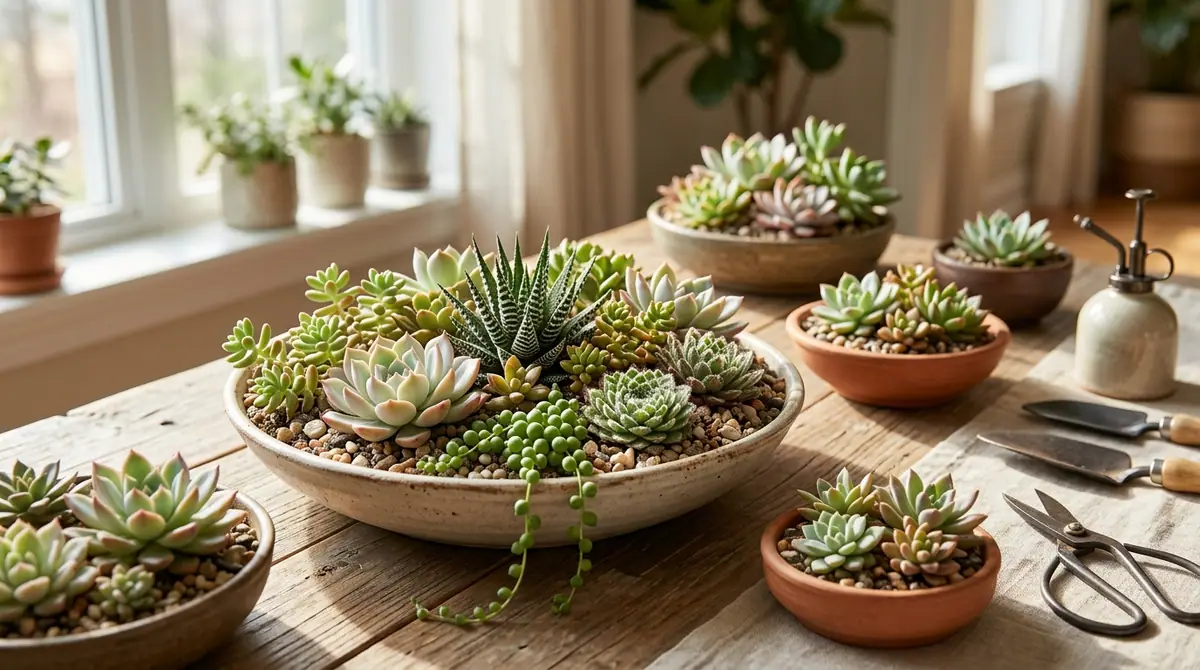
Seventeen years ago, I stood in my first apartment with a north-facing window, a dead fiddle-leaf fig in the corner, and a dying echeveria resting on a saucer of stagnant water. I had treated that succulent like a tropical fern—watering it every three days because the topsoil looked dry. It rotted from the stem down in less than two weeks. That expensive mistake forced me to study how these remarkable plants actually survive in hyper-arid, nutrient-poor native ecosystems. Today, I want to share how you can bypass those early heartaches and create a thriving, resilient indoor succulent oasis, even if your indoor space lacks direct sunlight. Whether you are transitioning from growing edibles like How to Grow Strawberries Indoors: From Fruit Seeds to Sweet Berries or starting your botanical journey from scratch, creating an indoor succulent garden is an achievable, deeply rewarding endeavor.
1. Botanical Overview & Natural Habitat
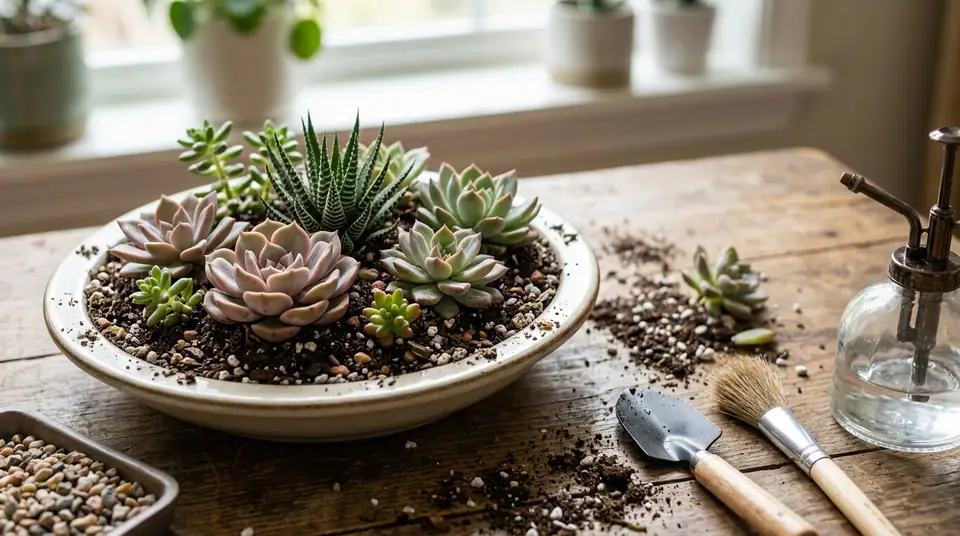
When designing an indoor garden, grouping plants with similar taxonomic traits ensures long-term harmony. For beginners, I always recommend sticking to genera that share resilient adaptation mechanisms:
- Echeveria and Sempervivum: Rosette-forming succulents that store water in thick, overlapping leaves. They require high light intensity to prevent stretching (etiolation).
- Haworthia and Gasteria: Native to the shaded rocky crevices of South Africa, these tolerate lower light levels naturally, making them exceptionally forgiving indoor companions.
- Crassula and Sedum: Versatile structural plants with woody or semi-woody stems that develop attractive bonsai-like characteristics over time.
In their natural habitats, these plants experience intense daytime solar radiation followed by drastic nighttime drops in temperature. They utilize a specialized photosynthetic pathway known as Crassulacean Acid Metabolism (CAM). While typical plants open their stomata during the day to take in carbon dioxide—losing precious moisture in the process—CAM succulents keep their stomata tightly sealed during blazing daylight. They open them only at night to fix carbon dioxide into malic acid, locking away hydration for survival during prolonged droughts. When you bring them indoors, replicating these conditions as closely as possible dictates your success.
2. Essential Environmental & Care Requirements
Creating a reliable indoor environment for your beginner succulent garden requires balancing light, temperature, watering frequency, and substrate composition. Let us examine the exact metrics required for optimal plant health.
| Parameter | Optimal Condition | Common Mistake | Why It Matters |
|---|---|---|---|
| Light Intensity | 6 to 8 hours of bright, indirect-to-direct light (or 2,000 to 3,000 foot-candles via LEDs) | Placing plants in deep interior rooms or dark corners | Insufficient light triggers etiolation, causing weak, pale, stretched stems that cannot support the plant's weight. |
| Substrate Drainage | Rapid drainage; 50% inorganic grit (perlite, pumice, coarse sand) to 50% organic matter | Using heavy, dense standard potting soil or garden dirt | Compacted soil retains moisture around fine roots, suffocating them and encouraging anaerobic fungal pathogens like Pythium. |
| Watering Protocol | Soak-and-dry method: water thoroughly until it runs out the drainage hole, then let dry 100% | Giving small sips of water every few days on a rigid calendar schedule | Shallow watering encourages weak surface roots instead of deep, robust anchorage systems. |
| Temperature Range | 65°F to 80°F (18°C to 27°C) days; drops to 50°F to 60°F (10°C to 15°C) nights | Exposing plants to drafts below 40°F (4°C) or blasting HVAC vents | Extreme thermal shock damages cellular walls, leading to translucent, mushy leaves. |
Light Management Indoors
Even the brightest domestic windowsills filter out a significant percentage of the ultraviolet spectrum. South-facing windows provide the ideal exposure in the Northern Hemisphere, offering unobstructed sunlight for 6 to 8 hours daily. If your home only features east- or west-facing windows, supplement your arrangement with a full-spectrum LED grow light positioned 8 to 12 inches (20 to 30 cm) above the foliage, running on a 12-hour timer.
Soil and Container Dynamics
Your choice of container is just as critical as the soil mix. Always select planters featuring at least one unobstructed drainage hole measuring a minimum of 0.5 inches (1.3 cm) in diameter. For an authoritative breakdown of container gardening science and soil physics, consult the University of Illinois Extension Container Gardening Guide. Avoid glazed ceramic pots without drainage or glass terrariums; while visually appealing, terrariums lack air circulation and trap humidity, creating a lethal greenhouse effect for desert plants.
💡 Pro-Tip: When mixing your own soil, avoid fine builder's sand or beach sand, as they pack down into a concrete-like consistency. Instead, source horticultural pumice or coarse perlite sized between 0.1 and 0.25 inches (2 to 6 mm) to guarantee permanent, microscopic air pockets in the root zone.
3. Step-by-Step Cultivation, Feeding & Propagation
Designing and planting your indoor succulent garden is an artistic exercise rooted in strict botanical principles. Follow this step-by-step sequence to establish a flawless arrangement.
- Select and Prepare the Vessel: Choose a shallow, wide-mouthed container—such as a terracotta bowl measuring 8 to 12 inches (20 to 30 cm) in diameter and 4 to 6 inches (10 to 15 cm) in depth. Terracotta is porous, allowing excess moisture to evaporate through the walls.
- Mix the Custom Substrate: Combine equal parts commercial cactus/succulent potting mix and inorganic grit (pumice or coarse perlite). Sift out any microscopic dust particles that could clog pore spaces.
- Establish the Drainage Layer: Place a thin layer of dry mesh or a single coffee filter over the bottom drainage hole to prevent soil from washing out while maintaining maximum water evacuation.
- Layer the Soil Medium: Fill the container up to 1.5 inches (3.8 cm) below the rim with your custom succulent soil mix, pressing it down gently to eliminate large air pockets.
- Arrange Your Plant Palette: Unpot your selected starter plants, gently massaging the root balls to remove dense nursery peat. Position the tallest focal plant slightly off-center, then arrange cascading and rosette-forming species around it, leaving at least 1 inch (2.5 cm) of breathing room between each specimen.
- Backfill and Anchor: Fill remaining gaps with soil mix, tapping the sides of the container to settle the substrate around the roots. Ensure the crown (where the stem meets the root system) sits level with or slightly above the soil line; burying stems too deep invites rot.
- Apply Top-Dressing: Spread a 0.5-inch (1.3 cm) layer of decorative top-dressing—such as crushed granite, decomposed lava rock, or akadama—across the surface. This keeps lower leaves dry, prevents soil displacement during watering, and completes the professional landscape design look.
- Initiate the Dry Period: Do not water immediately. Keep the newly planted arrangement completely dry for 7 to 10 days to allow any bruised or torn roots to callous over, preventing pathogen entry.
Feeding and Propagation
Succulents are light feeders compared to heavy-blooming ornamentals. Fertilize your indoor garden only twice a year—once in early spring and once in mid-summer—using a balanced, water-soluble fertilizer diluted to one-quarter strength (e.g., a 10-10-10 formula mixed at 1/4 teaspoon per gallon of water).
Propagation is one of the most rewarding aspects of succulent cultivation. Many varieties, particularly Echeveria and Graptopetalum, propagate easily via leaf cuttings. Gently twist a healthy, mature leaf from the base of the stem, ensuring the abscission zone remains intact. Place the leaf flat on top of dry succulent soil in bright, indirect light. Within 14 to 21 days, tiny pink roots will emerge from the leaf base, followed closely by a miniature rosette. Once the mother leaf shrivels and dies off naturally, pot your new baby succulent into its own individual container. For advanced botanical insights on plant propagation physiology, refer to the Royal Horticultural Society Plant Propagation Guide.
⚠️ Important Caution: Never mist indoor succulents. Misting raises ambient humidity and leaves microscopic water droplets sitting in the tight centers of rosettes, inviting catastrophic stem rot and fungal leaf spot diseases.
4. Common Problems, Pests & Troubleshooting
Even experienced growers encounter occasional setbacks. Recognizing the early warning signs of stress allows you to correct environmental parameters before permanent damage occurs.
Overwatering and Root Rot
- Symptoms: Lower leaves turn translucent, mushy, yellow, or pale green, eventually dropping off at the slightest touch. The stem base may turn brown or black.
- Correction: Unpot the plant immediately. Inspect the root system; trim away any dark, mushy, or foul-smelling roots using sterilized shears sanitized in isopropyl alcohol. Dust the remaining healthy roots with horticultural sulfur powder and allow the plant to bare-root in a dry, shaded room for 48 to 72 hours before replanting in fresh, dry substrate. Withhold water for 3 weeks.
Underwatering
- Symptoms: Leaves appear shriveled, wrinkled, paper-thin, or puckered. Growth halts entirely.
- Correction: Submerge the entire container in a basin of water up to the rim for 30 minutes, allowing the root ball to rehydrate fully. Drain thoroughly. The leaves should plump back up within 48 to 72 days.
Etiolation (Light Starvation)
- Symptoms: Stems stretch rapidly, leaves space far apart vertically, and coloration fades from vibrant reds or blues to a pale, sickly lime green.
- Correction: Gradually move the plant to a brighter location over the course of 7 days to prevent sunburn, or install an LED grow light. Note that stretched stems will not revert to compact rosettes; you must behead the top rosette, let the stem callous for 7 days, and re-root it.
Pests: Mealybugs and Scale
- Symptoms: Cottony, white, web-like masses tucked into leaf axils (mealybugs) or hard, brown, immobile bumps stuck along stems (scale). These sap-sucking insects weaken the plant and secrete sticky honeydew, which attracts black sooty mold.
- Correction: Isolate the infected plant immediately. Dip a cotton swab in 70% isopropyl alcohol and dab it directly onto every visible pest to dissolve their protective waxy coatings. Follow up by spraying the entire plant with potassium salts of fatty acids (insecticidal soap) every 7 days for 3 weeks to eliminate microscopic crawlers.
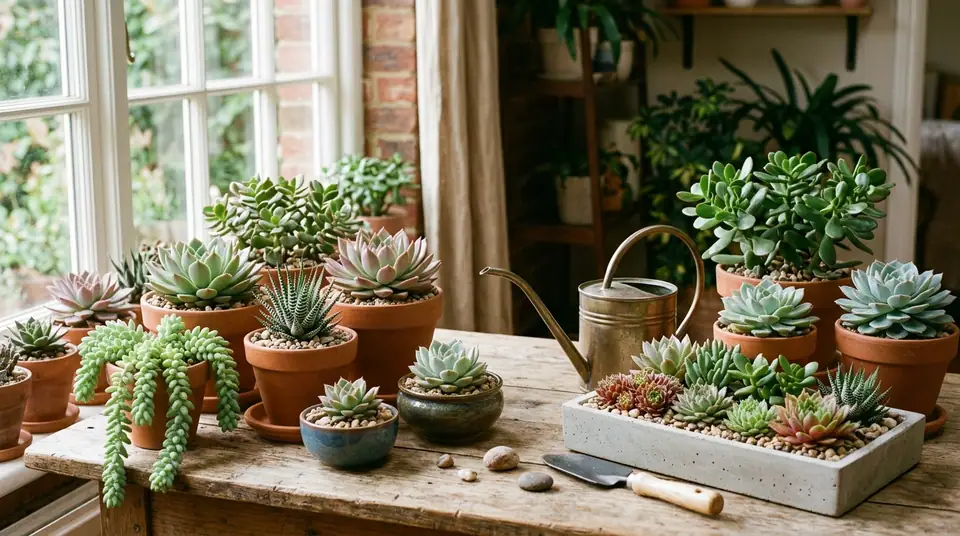
Various indoor succulents in pots arranged on a wooden table near a window
5. Frequently Asked Questions
How often should I water my indoor succulent garden?
There is no fixed calendar schedule for watering indoor succulents, as ambient humidity, temperature, and pot material dictate drying rates. Instead, rely on the soil dryness test: insert a clean wooden chopstick or your finger 2 inches (5 cm) deep into the substrate. If any soil particles cling to it or if it feels cool and damp, do not water. In warm summer months, this usually translates to watering every 10 to 14 days; in winter dormancy, watering may drop to once every 30 to 45 days.
Why are the bottom leaves of my indoor succulent turning yellow and falling off?
Natural leaf senescence occurs when older, lower leaves reach the end of their lifecycle. These leaves turn completely yellow, dry up into crisp paper, and fall off naturally. This is entirely normal. However, if multiple leaves turn yellow, mushy, and translucent simultaneously—or if leaves higher up on the stem show this damage—it indicates overwatering and root asphyxiation.
Can succulents survive indoors without direct sunlight?
Succulents cannot survive indefinitely in rooms lacking direct natural light or high-output artificial grow lights. While shade-tolerant genera like Haworthia and Gasteria can tolerate lower light levels longer than desert species, true low-light survival is a myth. Without adequate photon energy, all succulents eventually etiolate, weaken, and succumb to secondary pathogens. If your home lacks bright windows, invest in a dedicated LED grow light fixture.
What is the absolute best soil mix for indoor potted succulents?
The ideal soil mix balances water retention with exceptional aeration. Combine 50% commercial cactus and succulent potting soil (which contains peat or compost for minimal nutrient retention) with 50% inorganic aggregate, such as horticultural pumice, perlite, or crushed chicken grit. This coarse ratio ensures that water flushes through the pot instantly, preventing the stagnant moisture conditions that trigger root rot.
Related Guides
- Diy Balcony Herb Garden Ideas for Beginners
- Do Succulent Plants Need Drainage
- Worm Farming and Composting in a 5 Gallon Bucket Its Easy
- Step By Step Guide to Grafting Fruit Trees for Beginners
- Complete Guide to Winter Vegetable Harvesting for Beginners
📋 Table of Contents ▼ Click to expand
Tags:
Keep reading
🌿 Related Plants You Might Like






PlantSavvyWorld
Editorial team
PlantSavvyWorld is an independent botanical education project. Articles are drafted with AI assistance, then edited and checked against university extension services, botanical garden collections and other published horticultural sources.