
Do Succulent Plants Need Drainage
Written with AI assistance, edited and checked against horticultural sources.
1. Botanical Overview & Natural Habitat
To understand why drainage is non-negotiable for succulents, we must first examine where these remarkable plants evolved. The term "succulent" is morphological rather than taxonomic, describing plants that have adapted to arid environments by storing water in specialized fleshy leaves, stems, or roots.
Genera such as Aloe, Haworthia, Crassula, and Sedum hail predominantly from hyper-arid or semi-arid regions. In their native habitats—ranging from the rocky outcroppings of the Karoo in South Africa to the dry arroyos of the Sonoran Desert in North America—these plants experience extreme environmental shifts. Temperatures can easily soar above 100°F (38°C) during the day, followed by rapid cooling to 45°F (7°C) at night.
Rainfall in these regions is rarely gentle or continuous. Instead, native succulents rely on infrequent, high-intensity flash downpours. Crucially, their natural soils are coarse, rocky, and mineral-heavy, allowing massive volumes of water to rush past the root zone instantly without ever pooling. When you confine a succulent to a vessel without a drainage hole, you are trapping water in an artificial bowl, forcing roots to exist in a waterlogged anaerobic swamp that mimics nothing found in nature.
2. Essential Environmental & Care Requirements
Recreating arid conditions indoors or in containers requires careful balancing of light, temperature, soil composition, and container mechanics. Succulents are masters of drought survival, but they are exceptionally vulnerable to overwatering when drainage is compromised.
| Parameter | Optimal Condition | Common Mistake | Why It Matters |
|---|---|---|---|
| Soil Drainage | Gritty mix with 50% inorganic grit (pumice, perlite) | Using heavy, organic potting soil or garden dirt | Compact soil retains water too long, suffocating roots and inviting pathogens. |
| Container Design | Pots with unobstructed drainage holes (min. 0.5 inches / 1.3 cm wide) | Planting in sealed glass terrariums or decorative cachepots | Without an escape route, excess water pools at the bottom, rotting the root crown. |
| Watering Frequency | Deep soak only when soil is 100% dry down to 3 inches (7.6 cm) | Frequent, shallow sips or watering on a strict calendar schedule | Shallow watering encourages weak root growth; watering wet soil triggers rot. |
| Light Exposure | 6 hours of bright, direct sunlight daily (or 2,500–5,000 foot-candles) | Placing in dim interior corners | Low light slows transpiration, meaning roots stay wet longer even with minimal water. |
To dive deeper into regional climate adaptations and hardiness zones, you can cross-reference local growing guidelines with resources like the Clemson University Home & Garden Information Center for southern humidity challenges, or check What Zone is South Carolina for Plants to see how regional precipitation impacts container placement.
💡 Pro-Tip: Never place a layer of gravel or broken pottery shards at the bottom of a drainless pot under the assumption that it creates artificial drainage. Due to physical properties called perched water tables, water actually hangs suspended in finer soil right above coarse layers, bringing the saturated zone even closer to the plant's crown.
3. Step-by-Step Cultivation, Feeding & Propagation
When setting up your succulent displays, every step from pot selection to propagation must prioritize unimpeded water movement. Follow this systematic protocol to ensure long-term plant health:
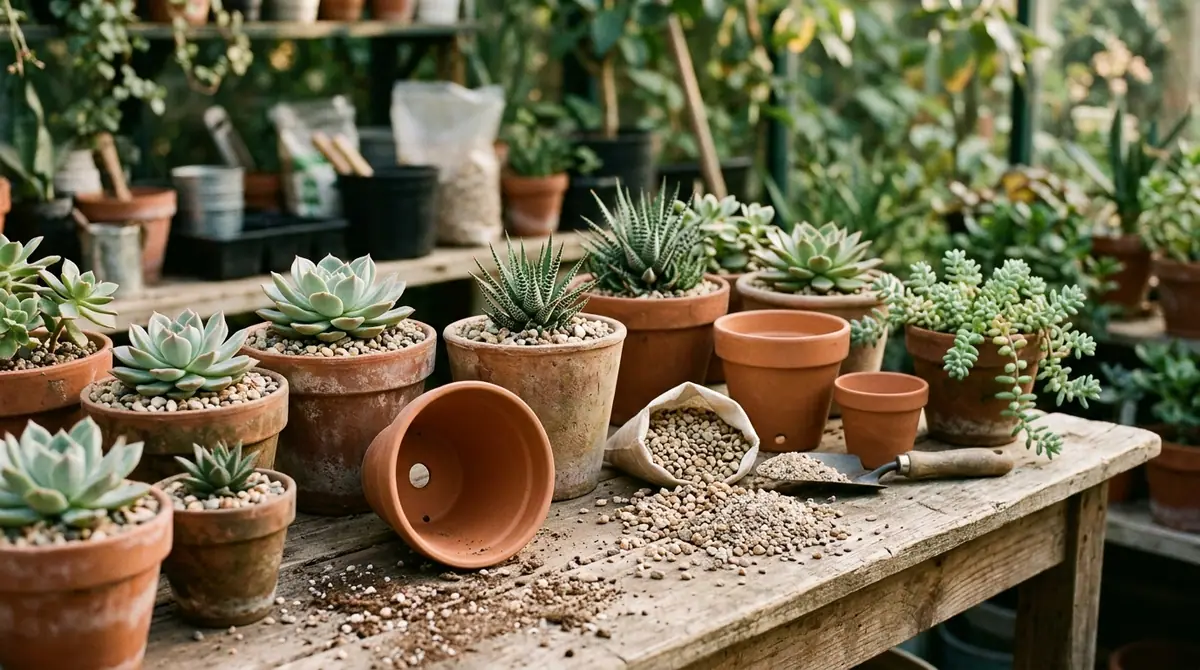
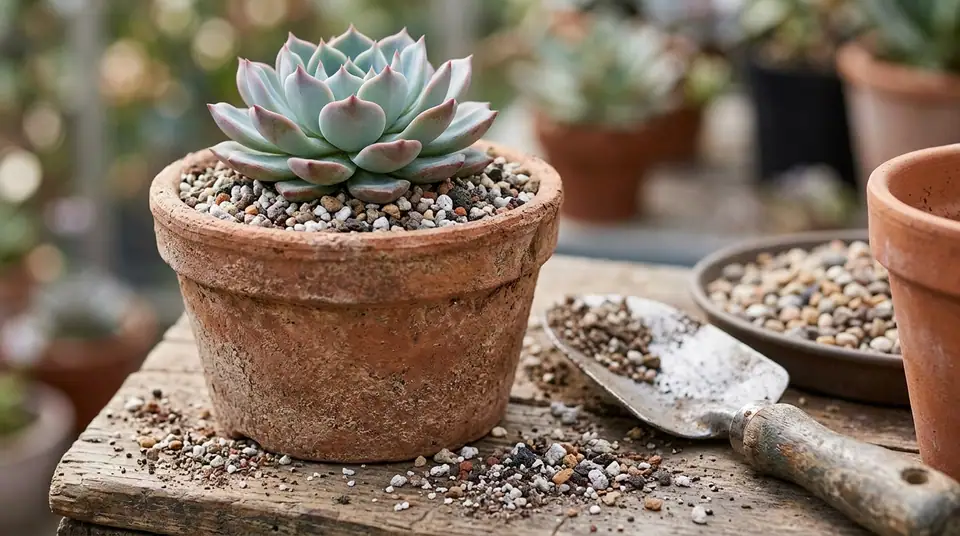
- Select the Right Vessel: Choose a container featuring at least one drainage hole measuring a minimum of 0.5 inches (1.3 cm) in diameter. Terracotta and unglazed ceramic are ideal because their porous walls allow moisture to evaporate from the sides.
- Mix the Substrate: Blend 50% commercial cactus and succulent potting mix with 50% inorganic drainage amendments, such as horticultural pumice, expanded shale, or coarse perlite graded to 0.125–0.25 inches (3–6 mm).
- Pot the Specimen: Place a small mesh screen over the drainage hole to prevent soil loss, fill the pot halfway with your gritty mix, position the succulent root ball, and backfill until the soil line sits 0.5 inches (1.3 cm) below the rim.
- Initial Watering & Settling: Water thoroughly until it streams freely from the bottom drainage hole. Allow the pot to drip completely dry for 30 minutes before returning it to its saucer. Wait 7 to 10 days before exposing the plant to intense direct sun to let any damaged roots heal.
- Establish Maintenance Cycles: Check soil moisture depth weekly using a wooden chopstick inserted to the bottom of the pot. Only water when the stick emerges completely dry and clean. During the active growing season (spring through summer), feed once every 30 days with a balanced, low-nitrogen liquid fertilizer diluted to half-strength.
⚠️ Important Caution: If you live in a region with high relative humidity—similar to the conditions tracked when evaluating What Zone is Virginia for Plants—you must reduce your watering frequency by half during the autumn and winter months. High ambient moisture drastically slows the rate at which container soil dries out.
4. Common Problems, Pests & Troubleshooting
Drainage issues manifest rapidly in succulents, often presenting visible symptoms before the plant perishes entirely.
- Stem and Root Rot (Phytophthora and Pythium): Caused by persistent moisture around the root zone. Symptoms include translucent, yellowing lower leaves that feel squishy, accompanied by a blackened, mushy stem base. To salvage the plant, use a sterilized razor blade to cut away all infected tissue well above the rot line, dust the wound with sulfur powder, and let it callus in dry air for 5 to 7 days before replanting in fresh, dry, well-drained soil.
- Edema: Manifests as hard, corky, blister-like spots on leaves. This occurs when roots take up water faster than the plant can transpire it, causing individual plant cells to burst due to water-logged conditions. Improve air circulation around the plant and ensure your potting medium has adequate drainage.
- Fungus Gnats (Sciaridae): Tiny black flies hovering near your containers. Their larvae thrive exclusively in perpetually damp, organic-rich soil. If your pots lack drainage, the topsoil stays wet long enough to complete the gnat life cycle. Let the top 2 inches (5 cm) of soil dry out entirely, or treat the surface with beneficial nematodes or Bacillus thuringiensis israelensis (BTI).
5. Frequently Asked Questions
Can I grow succulents in pots without drainage holes if I water them less?
No. Even if you drastically reduce the volume of water you give a drainless pot, moisture inevitably pools at the lowest point of the container through gravity and capillary action. Without an exit hole, salts from tap water and fertilizers also accumulate in the soil over time, creating a toxic chemical environment that burns the root tips.
What should I do if my favorite decorative pot has no drainage hole?
You have two primary options. The safest method is to use the decorative pot as a cachepot: plant your succulent in a plain plastic nursery pot that features drainage holes, and place that inner pot inside your decorative container. Just remember to empty any runoff water from the outer pot within 10 minutes of watering. Alternatively, use a masonry drill bit and a rotary hammer drill to carefully bore a 0.5-inch (1.3 cm) hole through the bottom of ceramic, terra cotta, or concrete vessels.
How do I know if my succulent is suffering from overwatering or underwatering?
An underwatered succulent will show flat, wrinkled, or puckered lower leaves as it metabolizes its internal water reserves; the stem remains firm, and the soil is bone dry. An overwatered succulent with compromised drainage will display plump, translucent, yellow, or bursting leaves that easily detach from the stem at the slightest touch, while the soil remains damp beneath the surface crust.
What is the absolute best soil mix for potted succulents?
The ideal medium is highly porous and drains within seconds. A proven professional recipe consists of 40% organic matter (peat-free potting compost or coco coir) blended with 60% inorganic grit, split evenly between coarse perlite, horticultural pumice, and poultry grit or decomposed granite.
Related Guides
- Easy Succulent Garden Ideas for Beginners Indoors
- How to Make a Drainage Ditch Look Good
- Downspout Drainage Ideas
📋 Table of Contents ▼ Click to expand
Tags:
Keep reading
🌿 Related Plants You Might Like
PlantSavvyWorld
Editorial team
PlantSavvyWorld is an independent botanical education project. Articles are drafted with AI assistance, then edited and checked against university extension services, botanical garden collections and other published horticultural sources.