

How to Make a Drainage Ditch Look Good
Written with AI assistance, edited and checked against horticultural sources.
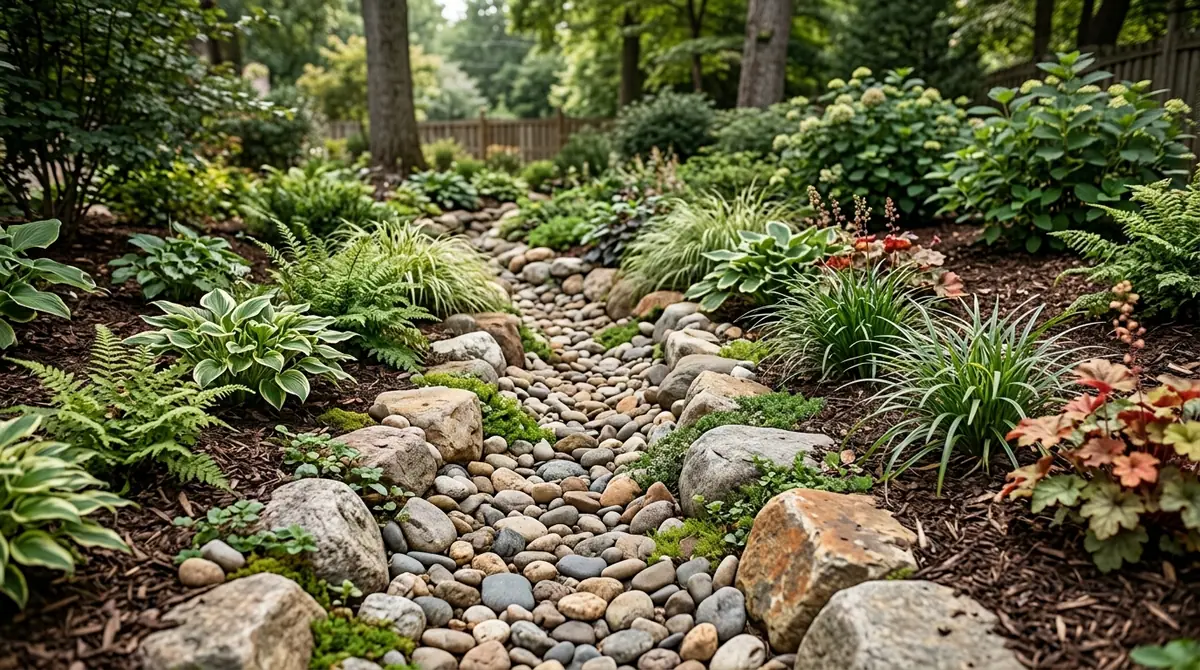
The heavy clay in my residential landscape trials always told on me after a two-inch cloudburst, pooling water in an unsightly gully right beside my southern exposure foundation. For three seasons, I treated that natural swale as an engineering failure to be hidden beneath heavy landscape fabric and mismatched river rock, until a visiting ecologist asked why I was fighting a localized wetland instead of planting it. That afternoon, I ripped out the plastic, reshaped the earthen banks to a gentle 3:1 slope, and began treating the ditch not as an irrigation liability, but as a deliberate rain garden ecosystem.

1. Botanical Overview & Natural Habitat
Drainage ditches mimic the ecology of natural riparian zones, seasonal stream banks, and vernal pools. In the wild, plants occupying these moisture-gradient environments survive by developing specialized adaptations, such as aerenchyma tissue in their roots to transport oxygen through waterlogged substrate, and deep taproots that anchor soil against high-velocity runoff while reaching stable moisture tables during droughts.
When designing a planted ditch, we divide the cross-section into three distinct horticultural zones:
- The Bottom (Invert): The lowest point of the ditch, which experiences total saturation or standing water for 24 to 72 hours after a storm event. Plants here must tolerate anaerobic soil conditions temporarily.
- The Side Slopes (Banks): The transition zone that experiences rapid drainage and moderate moisture levels. This is where root reinforcement is critical to prevent slope slumping and surface erosion.
- The Crest (Lip): The upper boundary where soil dries out quickly. Drought-tolerant perennials transition the ditch seamlessly into the surrounding traditional landscape beds.
Selecting species with fibrous root mats, such as Carex stricta (Tussock Sedge) or Iris pseudacorus, creates a living lattice that locks soil particles in place, resisting shear stress from flowing water running at velocities up to 3 feet per second (0.9 meters per second).
2. Essential Environmental & Care Requirements
Managing a planted drainage ditch requires understanding that your microclimate fluctuates wildly based on precipitation. Soil temperatures in the invert can drop significantly during spring saturation events, while the upper crests can bake in summer sun exceeding 90°F (32°C).
| Parameter | Optimal Condition | Common Mistake | Why It Matters |
|---|---|---|---|
| Soil Infiltration Rate | 0.5 to 2.0 inches per hour (1.2 to 5.0 cm/hr) | Compacting clay during installation | Prevents standing water from breeding mosquitoes for longer than 72 hours |
| Slope Gradient | 3:1 (3 feet horizontal to 1 foot vertical / 3:1 cm) | Steeper than 2:1 | Leads to severe bank erosion and plant root exposure during heavy flows |
| Organic Matter (Topsoil) | 5% to 8% incorporated compost | Using pure heavy topsoil without grit | Ensures adequate microbial activity while maintaining structural macro-pores |
| Sunlight Exposure | Full sun to partial shade (6+ hours direct light) | Planting light-loving marginals in deep shade | Causes leggy growth, weak stem integrity, and poor flowering performance |
💡 Pro-Tip: Never rely solely on topsoil in a drainage ditch. Incorporate coarse, washed angular gravel (1.5 inches / 3.8 cm in diameter) into the bottom invert layer to create sub-surface void space that slows water velocity without clogging.
3. Step-by-Step Cultivation, Feeding & Propagation
Transforming an eroded ditch into a botanical asset requires precise site preparation and strategic installation timing. Spring (soil temperatures consistently above 55°F / 13°C) or early autumn allows root systems to establish before extreme seasonal weather hits.
- Clear and Shape: Excavate the ditch to ensure a broad, U-shaped or trapezoidal profile rather than a sharp V-shape. Broad profiles slow water velocity and maximize surface area for infiltration. Ensure the longitudinal slope drops at least 1% (1 inch drop per 100 inches / 2.5 cm per 2.5 m) to prevent stagnant pooling.
- Amend and Stabilize: Work 3 inches (7.6 cm) of compost and sharp horticultural sand into the top 6 inches (15 cm) of the side slopes. For slopes steeper than 3:1, install a biodegradable jute or coir erosion control mesh directly over the soil surface, pinning it down with 6-inch (15 cm) metal sod staples spaced 12 inches (30 cm) apart.
- Zone Planting: Install your plug plants or container-grown perennials directly through slits cut into the erosion mesh. Place moisture-loving species like Asclepias incarnata (Swamp Milkweed) and Eupatorium fistulosum (Joe Pye Weed) in the lower third of the slope and invert. Position drought-tolerant ornamental grasses like Panicum virgatum (Switchgrass) on the upper crest.
- Initial Irrigation: Provide 1 inch (2.5 cm) of water weekly for the first 30 days if natural rainfall does not occur, ensuring the root zones knit securely into the native soil beneath the jute netting.
- Mulch with Stone, Not Wood: Apply a 2-inch (5 cm) layer of washed river rock (2 to 4 inches / 5 to 10 cm in size) around the base of the plants in the invert. Avoid standard shredded wood mulch in the bottom of the ditch, as buoyant organic matter will wash downstream during heavy storms.
⚠️ Important Caution: Always check with your local municipal utility locator service (e.g., calling 811 in the United States) before digging or reshaping any drainage swale to avoid striking buried electrical, gas, or communication lines.
For deeper insights into sustainable urban water management and native plantings, consult the guidelines provided by the Lady Bird Johnson Wildflower Center.
4. Common Problems, Pests & Troubleshooting
Even well-designed drainage ditches face environmental stress. Here is how to diagnose and correct common issues:
- Symptom: Severe bank washing and soil scouring during heavy rain.
- Cause: Water velocity is too high, often due to a narrow channel or lack of check dams.
- Solution: Install low-profile stone check dams every 10 feet (3 meters) along the invert. These miniature rock walls slow water momentum, trap sediment, and encourage infiltration.
- Symptom: Persistent standing water lasting longer than 96 hours, accompanied by sulfur odors.
- Cause: Subsurface soil compaction creating an impermeable hardpan layer.
- Solution: Drive a garden fork 10 inches (25 cm) deep into the soil around the plants to fracture the hardpan, or construct a French drain trench filled with coarse gravel beneath the invert.
- Symptom: Plant crown rot and fungal leaf spots on marginal species.
- Cause: Continuous submersion combined with poor air circulation due to overcrowding.
- Solution: Thin out overly dense plant clumps in late winter, and ensure the upper edges of the root crowns sit slightly above the surrounding soil grade.

5. Frequently Asked Questions
What are the best plants for a drainage ditch that stays wet?
Species that naturally thrive in saturated soils and seasonal wetlands perform best in the bottom invert. Excellent choices include Iris versicolor (Blue Flag Iris), Acorus calamus (Sweet Flag), Lobelia cardinalis (Cardinal Flower), and Juncus effusus (Soft Rush). These plants tolerate low-oxygen root environments while providing strong structural architecture.
Will planting a drainage ditch block the flow of water?
No, provided you select herbaceous perennials and ornamental grasses rather than woody shrubs or trees. Herbaceous plants bend with the current during high-flow events and spring back upright afterward. Avoid large trees like willows inside narrow ditches, as their aggressive root systems can damage buried pipes and alter the engineered water flow path.
How do I stop mulch from floating away in my rain ditch?
Replace traditional shredded hardwood bark mulch with heavy, rounded river stones measuring 2 to 4 inches (5 to 10 cm) in diameter. The individual weight of these stones keeps them anchored during high-velocity water surges, while the spaces between the rocks allow water to filter smoothly into the soil below.
Do planted drainage ditches attract mosquitoes?
A properly functioning planted ditch will actually reduce mosquito populations compared to an unplanted, muddy puddle. Plants support beneficial predatory insects like dragonflies and damselflies, whose larvae consume mosquito wigglers. Furthermore, by improving soil infiltration rates so water drains entirely within 24 to 48 hours, you eliminate the standing water cycle required for mosquito reproduction.
Related Guides
- Do Succulent Plants Need Drainage
- Downspout Drainage Ideas
- What Does a Verruca Look Like When It is Dying
- What Does a Peony Seed Look Like
📋 Table of Contents ▼ Click to expand
Tags:
Keep reading
🌿 Related Plants You Might Like






PlantSavvyWorld
Editorial team
PlantSavvyWorld is an independent botanical education project. Articles are drafted with AI assistance, then edited and checked against university extension services, botanical garden collections and other published horticultural sources.