

Zucchini Companion Plants Good Bad
Written with AI assistance, edited and checked against horticultural sources.
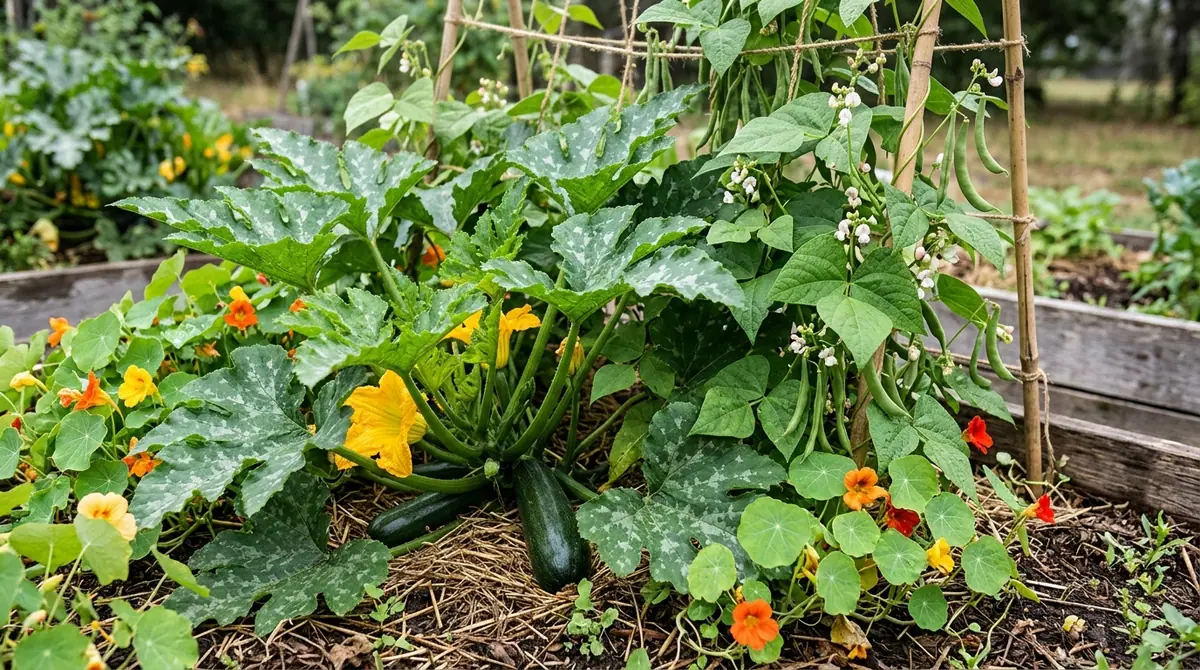
Powdery-mildew-choked zucchini mounds can engulf neighboring plants unless properly spaced, whereas companion-planted blocks of marigolds and bush beans stand vibrant, unbothered, and pump out kilograms of fruit. Mastering the art of companion planting serves as an absolute goldmine for sorting out a garden layout so summer squash thrives without trampling everything else in the beds.
1. Botanical Overview & Natural Habitat

Morphologically, Cucurbita pepo is a vigorous herbaceous annual. Unlike its vining cousins, standard zucchini cultivars grow in a dense, upright, semi-shrub habit, though modern breeding has produced both open-bush and slightly sprawling varieties. The leaves are palmate, deeply lobed, often speckled with silvery-white variegation (which gardeners frequently mistake for powdery mildew), and covered in trichomes—tiny, stiff hairs that act as a physical deterrent against pests.
Zucchinis are monoecious, meaning separate male and female flowers appear on the same plant. The large, bright yellow blossoms rely heavily on insect pollination, primarily native bees and honeybees, to transfer pollen from the staminate (male) flowers to the pistillate (female) flowers, which feature a miniature, unfertilized fruit at the base.
Because of their native habitat of open, fertile floodplains and forest edges, zucchinis demand rich soils, high nitrogen, and uncompromising sunlight. When you practice companion planting, you are essentially mimicking a polyculture forest edge: stacking plants to shade the soil, confuse pests, and maximize spatial efficiency. For a broader look at how different crop families interact beneath the surface and above ground, you can reference the layout strategies in our Sweet Potato Companion Plants: 8 Related Garden Friends & 3 Foes to Avoid guide.
2. Essential Environmental & Care Requirements
To successfully pair zucchinis with other crops, you must first understand their baseline demands. If your companion plants require conditions that clash with these parameters, one species will inevitably fail.
| Parameter | Optimal Condition | Common Mistake | Why It Matters |
|---|---|---|---|
| Soil pH | 6.0 to 6.8 | Planting in highly acidic soil (< 5.5) | Locks out essential micronutrients, stunting vine development. |
| Soil Temperature | 70°F to 95°F (21°C to 35°C) | Direct sowing into cold soil (< 60°F / 15°C) | Seeds rot before germination; young roots stall out. |
| Sunlight | Full sun, minimum 6 to 8 hours daily | Shading out with tall crops too close | Drastically reduces photosynthesis and fruit set. |
| Watering | 1 to 2 inches (2.5 to 5 cm) weekly | Overhead sprinkling late in the day | Wet foliage in cool evening air invites fungal pathogens. |
| Spacing | 36 to 48 inches (90 to 120 cm) apart | Crowding plants closer than 24 inches | Restricts airflow, triggering powdery mildew outbreaks. |
Zucchinis are heavy water hogs. Their massive leaves transpire moisture rapidly, meaning they will easily outcompete shallow-rooted companions if planted too tightly. When designing polyculture beds, ensure your companions either share these moisture and sun preferences or occupy a different root zone entirely.
💡 Pro-Tip: When planning your layout, avoid pairing zucchinis with heavy feeders like How to Grow Huge Tomato Plants: Pruning, Trenching & Heavy Yields without amending your soil doubly. Both crops demand immense amounts of nitrogen and phosphorus; placing them too close together triggers a nutrient turf war that leaves both yields stunted.
3. Step-by-Step Cultivation, Feeding & Propagation
Getting zucchini and its companions off to a flying start requires meticulous bed preparation. Follow this tested protocol to establish a high-yielding, balanced polyculture system.
- Site Selection and Soil Testing: Choose a garden bed receiving at least 8 hours of direct sunlight daily. Test your soil pH to ensure it sits comfortably between 6.0 and 6.8.
- Bed Amending: Work a 3-inch (7.5 cm) layer of aged compost and balanced organic fertilizer into the top 8 to 12 inches (20 to 30 cm) of soil to provide the heavy nutrition Cucurbita pepo demands.
- Sow or Transplant: Direct sow seeds 1 inch (2.5 cm) deep once soil temperatures consistently exceed 65°F (18°C), or set out hardened-off transplants 2 weeks after your last expected spring frost date.
- Establish the Companion Buffer: Plant protective companions—such as French marigolds (Tagetes patula) or nasturtiums (Tropaeolum majus)—in a protective ring 12 to 18 inches (30 to 45 cm) away from the central zucchini stem to deter nematodes and aphids.
- Mulch Deeply: Apply a 3-inch (7.5 cm) layer of clean straw or shredded hardwood bark around the base of the zucchini and its companions to retain soil moisture and suppress weeds.
- Irrigate at the Base: Install drip irrigation or soaker hoses beneath the mulch, delivering 1.5 inches (3.8 cm) of water weekly directly to the root zone.
- Prune for Airflow: As the central stem grows and lower leaves yellow or touch the soil, prune them cleanly away to enhance air circulation and prevent fungal spores from splashing up from the earth.
For further reading on maintaining soil ecology and beneficial insect habitats in intensive garden designs, consult the Royal Horticultural Society Companion Planting Guidelines.
4. Common Problems, Pests & Troubleshooting
Even with meticulous planning, growing zucchinis alongside companions presents unique hurdles. Here is how to diagnose and correct them before they decimate your harvest.
Powdery mildew (Podosphaera xanthii) is the single most common ailment. It appears as white, talcum-powder-like spots on the upper leaf surfaces. This typically strikes mid-summer when humidity spikes and night temperatures drop. Combat this by spacing plants properly, pruning crowded leaves, and spraying a preventative mixture of 1 tablespoon of baking soda, 1 teaspoon of liquid dish soap, and 1 gallon (3.8 liters) of water.
Pests like the squash vine borer (Melittia cucurbitae) and cucumber beetles can lay waste to an entire patch overnight. If you notice sudden wilting of a single vine coupled with small holes at the base of the stem featuring frass (sawdust-like excrement), you have a borer. Use floating row covers early in the season until female flowers appear, then remove them to allow pollination.
⚠️ Important Caution: Never apply synthetic insecticides or broad-spectrum neonicotinoids to zucchini blossoms or nearby flowering companions. Because zucchinis rely entirely on insect pollination, killing off visiting bees will result in deformed, unpollinated fruit that shrivels and drops off the vine before maturity—a physiological disorder often mistaken for blossom end rot.

5. Frequently Asked Questions
What are the absolute best companion plants for zucchini?
The top companions include radishes (which deter cucumber beetles), nasturtiums (which trap aphids and repel squash bugs), borage (which attracts beneficial pollinators and improves soil minerality), and bush beans (which fix atmospheric nitrogen into the soil).
Can I plant tomatoes next to zucchini?
It is generally discouraged. Both tomatoes and zucchinis are heavy feeders, require massive amounts of space, and are susceptible to overlapping fungal blights. If space forces you to plant them together, keep them at least 4 feet (1.2 meters) apart and commit to aggressive pruning and heavy fertilization.
Why are my zucchini flowers falling off without producing fruit?
The first flowers produced by zucchini plants are almost always exclusively male. They bloom, drop off naturally, and do not set fruit. If female flowers (which have a tiny baby zucchini at the base) are dropping, it is usually due to a lack of pollination or extreme heat stress exceeding 95°F (35°C).
What plants should I never plant near zucchini?
Avoid planting potatoes, fennel, and large vining winter squash near zucchini. Potatoes compete for the exact same subterranean root space and invite blight, fennel inhibits the growth of almost all garden vegetables through allelopathic chemical secretions, and winter squash will tangle with zucchini, creating an unmanageable, disease-prone thicket.
To deepen your research on vegetable garden ecosystems and regional climate adaptations, review the USDA National Agricultural Library Plant Hardiness Resources.
Related Guides
- Best Companion Plants for Organic Vegetable Gardens
- Sweet Potato Companion Plants: 8 Best Garden Friends & 3 Foes to Avoid
- When to Plant Zucchini in Washington State
📋 Table of Contents ▼ Click to expand
Tags:
Keep reading
🌿 Related Plants You Might Like






PlantSavvyWorld
Editorial team
PlantSavvyWorld is an independent botanical education project. Articles are drafted with AI assistance, then edited and checked against university extension services, botanical garden collections and other published horticultural sources.