Written with AI assistance, edited and checked against horticultural sources.
A postage-stamp-sized front yard in downtown Portland with compacted clay soil that bakes in the afternoon sun and turns to muck during relentless winter rains can achieve high curb appeal with zero weekend maintenance and zero grass. Small front yards are not constraints; they are canvas miniatures that demand precision, not sweat. When designing for a compact footprint, every square inch counts, and low maintenance cannot mean low impact.
Welcome to my definitive guide on the 10 best low maintenance front yard landscaping ideas for small spaces. Whether you are working with a narrow strip between the sidewalk and your foundation, or a sun-baked entryway that drains your energy every weekend, these strategies, plant pairings, and architectural frameworks will transform your entry into a resilient, self-sustaining ecosystem.
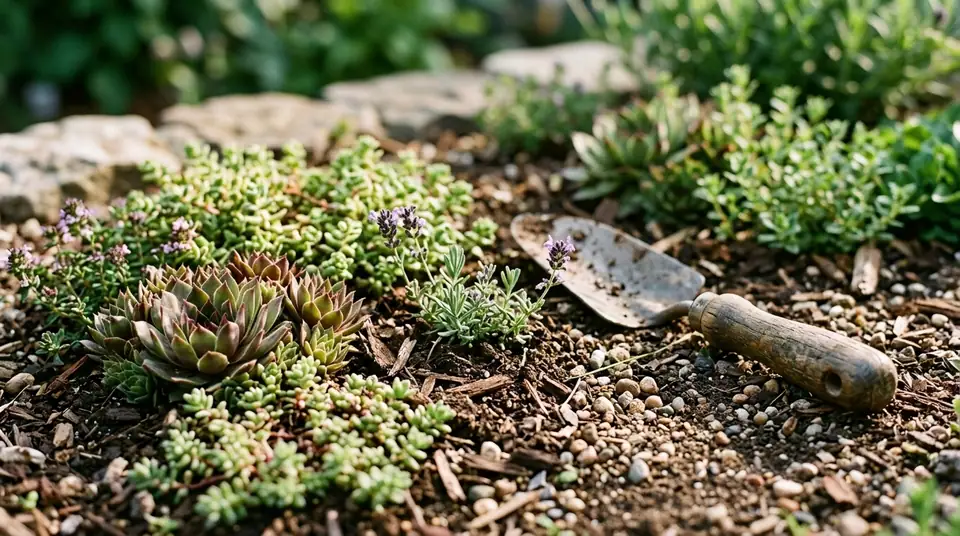
Garden trowel lying in soil next to succulents and low maintenance plants
1. Botanical Overview & Natural Habitat
To design a low-maintenance landscape for a small space, we must first look to how plants survive in the wild. The most successful urban front yard designs mimic natural arid, alpine, or woodland edge habitats where plants receive minimal supplemental care.
In a small footprint, your plant palette must earn its keep through multi-season interest and strict vertical or compact growth habits. We rely heavily on structural, drought-tolerant species. For instance, Yucca filamentosa (Adam's Needle) and Sempervivum tectorum (Hens and Chicks) originate from rocky outcroppings and alpine slopes, respectively. They thrive in poor soils and dry conditions because their natural ecosystems feature baking sun and razor-sharp drainage.
When adapting these plants to small front yards, we group them into ten distinct landscaping strategies that require minimal pruning, watering, and soil amendments:
The Modern Gravel and Succulent Xeriscape: Replacing thirsty turf with 2 inches (5 cm) of decorative pea gravel topped with architectural succulents like Agave parryi and Sedum album. This completely eliminates mowing while retaining ultra-sharp soil drainage.
The Multi-Tiered Corten Steel Planter Box: Raising planting beds by 18 to 24 inches (45 to 60 cm) using weathered steel. This elevates plants to eye level, improves ergonomics, completely bypasses native clay compaction, and stops weeds at the source.
Vertical Evergreen Espalier: Training dwarf fruit trees or broadleaf evergreens flat against a front-facing blank wall. This keeps the ground plane entirely open for ornamental grasses or stone pathways. If you enjoy edible vertical gardening, you can apply similar space-saving physics to your backyard by reviewing my guide on How to Grow Butternut Squash in Small Spaces: Vertical Trellising Secrets.
The Perennial Feather-Grass Buffer: Using compact ornamental grasses like Festuca glauca (Blue Fescue) or Muhlenbergia capillaris (Pink Muhly Grass) en masse. They move in the wind, require zero deadheading, and suppress weed germination through dense root competition.
Architectural Boulder and Dwarf Conifer Groupings: Pairing rounded granite boulders with slow-growing conifers like Picea pungens 'Glauca Globosa' (Globe Blue Spruce). These maintain their tight, geometric shapes for decades without shearing.
Low-Profile Groundcover Carpets: Swapping mulch for creeping thyme (Thymus serpyllum) or golden creeping Jenny (Lysimachia nummularia). These walkable green carpets crowd out weeds and release aromatic oils when brushed against by foot traffic.
The Hardscaped Dry Creek Bed: Constructing a meandering channel of river rock (ranging from 2 to 6 inches / 5 to 15 cm in diameter) that doubles as a functional French drain for roof runoff while anchoring drought-hardy marginal plants.
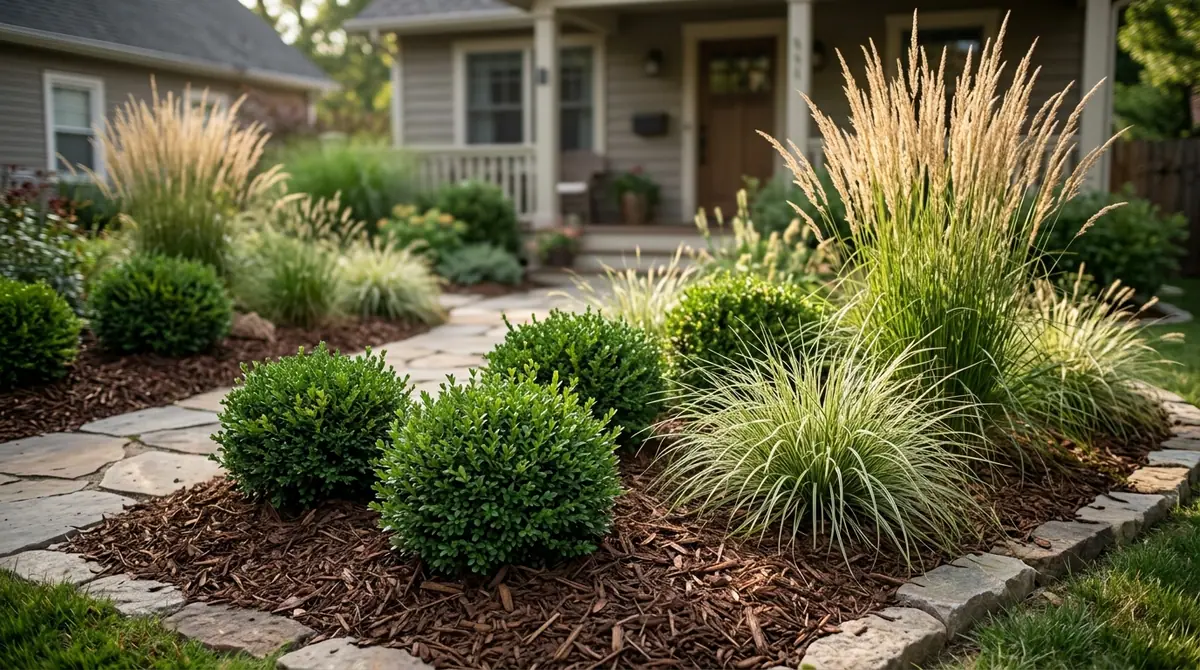
Monoculture Boxwood Parterres: Planting a clean, geometric border of dwarf English boxwood (Buxus sempervirens 'Compacta') around a central bed of low-water perennials. A single professional shear in late spring keeps them crisp all year.
The Shade-Loving Woodland Pocket: Transforming north-facing urban entryways with shade champions like Hosta cultivars and Heuchera (Coral Bells). Their colorful foliage provides months of brightness without a single flower petal to clean up.
The Vertical Green Columnar Accent: Installing narrow, fastigiate trees or shrubs—such as Ilex crenata 'Sky Pencil'—that shoot straight up without widening. This provides dramatic height alongside a front door without blocking windows or encroaching on walkways. For property boundaries, you might also consider structural elements discussed in my guide on 15 Best Trees for Driveways That Won't Crack Concrete.
2. Essential Environmental & Care Requirements
Even the lowest-maintenance front yard requires attention to environmental fundamentals during establishment. Getting these baselines right in the first 30 to 60 days ensures your landscape thrives on autopilot for years to come.
Light exposure is your primary constraint. Most low-maintenance xeriscapes and architectural plants demand at least 6 hours of direct sunlight daily. If your small front yard is shaded by a mature street canopy, pivot your plant selection away from agaves and fescues toward shade-tolerant ferns and hellebores.
Soil composition dictates water retention. Urban front yards are notorious for construction-compacted subsoils with zero organic matter. Before planting, loosen the soil depth to at least 8 to 12 inches (20 to 30 cm) and incorporate coarse horticultural sand or well-rotted compost to balance aeration and moisture.
Parameter
Optimal Condition
Common Mistake
Why It Matters
Soil Drainage
Rapid percolation (water drains 2 inches / 5 cm per hour)
Planting in heavy clay without amendments
Prevents root rot in drought-tolerant species during heavy seasonal rains.
Sunlight
6+ hours of direct light for xeriscapes; dappled shade for woodland pockets
Assuming all small-space plants are shade-tolerant
Insufficient light causes leggy, weak growth and eliminates flowering.
Mulch Depth
2 to 3 inches (5 to 7.5 cm) of organic bark or mineral gravel
Piling mulch directly against plant stems (volcano mulching)
Regulates soil temperature and blocks weed seeds while preventing crown rot.
Irrigation Frequency
Deep soaking every 10–14 days once established
Frequent, shallow surface watering
Encourages shallow root systems that dry out quickly during heat waves.
💡 Pro-Tip: When calculating gravel or mulch quantities for small spaces, measure your square footage, multiply by your desired depth in inches, and divide by 324 to get the exact cubic yards needed. Always add a 10% overage buffer for settling.
Transforming a tired, weed-choked front yard into a pristine, low-maintenance showpiece requires a deliberate sequence of operations. Follow this protocol for flawless installation.
Site Clearing and Weed Eradication: Strip all existing turf and perennial weeds down to the bare mineral soil. Spray stubborn persistent weeds with an organic horticultural vinegar solution (20% acetic acid) on a sunny day when temperatures exceed 70°F (21°C).
Soil Conditioning and Grading: Till or broadfork the soil to a depth of 10 inches (25 cm). Incorporate 2 inches (5 cm) of compost or coarse grit depending on your plant selections. Rake the soil grade so it slopes gently away from your home’s foundation at a minimum grade of 0.25 inches per foot (2 cm per meter).
Hardscape and Edging Installation: Install rigid metal or stone landscape edging 4 to 6 inches (10 to 15 cm) deep. This forms a physical barrier that keeps turfgrass from creeping into your new low-maintenance beds.
Plant Placement (The Dry-Fit Phase): Arrange your plants in their containers across the beds before digging a single hole. Group plants with identical watering needs together (hydrozoning) and allow adequate spacing for mature widths—typically 18 to 36 inches (45 to 90 cm) apart depending on the species.
Digging and Planting: Dig planting holes twice as wide as the nursery pot, but exactly the same depth. Gently tease root-bound container roots outward. Set the root ball 0.5 inches (1.2 cm) above the surrounding soil grade to account for natural settling.
Initial Irrigation and Settling: Water each newly installed plant thoroughly at the base until the soil is saturated to a depth of 8 inches (20 cm). This settles soil pockets around the root system.
Mineral Mulching: Apply a 2-inch (5 cm) layer of crushed stone, decomposed granite, or coarse bark across the entire planting bed. Keep the mulch at least 2 inches (5 cm) away from the actual stems and trunks to prevent fungal decay. For further reading on municipal green standards, consult the Royal Horticultural Society (RHS) planting guidelines.
Feeding requirements for low-maintenance plants are remarkably low. Over-fertilizing causes weak, rapid growth that attracts aphids and requires frequent pruning. Apply a slow-release, low-nitrogen, organic granular fertilizer (such as a 5-10-10 blend) once annually in early spring just as new growth emerges.
4. Common Problems, Pests & Troubleshooting
Even low-maintenance front yards encounter environmental stress. Here is how to diagnose and correct the most frequent issues in compact urban spaces.
Root Rot and Stem Mushiness: If your succulents or ornamental grasses develop soft, water-soaked bases, your soil is retaining too much moisture.
Solution: Stop watering immediately. Dig up the affected plant, trim away black, decaying roots with sterilized shears, and replant in a mix containing 50% coarse perlite or pumice to maximize drainage.
Foliage Chlorosis (Yellowing Leaves): In small front yards bordered by concrete foundations, lime leaching from concrete can dramatically spike soil pH, locking out iron availability.
Solution: Test your soil pH. If it exceeds 7.5, apply agricultural sulfur or chelated iron liquid drench to acidify the root zone and restore deep green foliage color.
Weed Infiltration in Gravel Beds: Wind-blown weed seeds inevitably land in decorative stone mulch, germinating in the thin layer of dust that accumulates on top.
Solution: Apply a pre-emergent organic corn gluten meal in early spring before weed seeds germinate, or use a thermal weed torch on a low flame to instantly vaporize young weed seedlings between decorative stones. For comprehensive university-backed weed management strategies, refer to the University of California Agriculture and Natural Resources (UC ANR) publication database.
⚠️ Important Caution: Never use systemic residual herbicides in small, enclosed front yard spaces where runoff can wash chemicals directly into municipal storm drains or onto neighboring properties. Always rely on mechanical pulling, thermal weeding, or targeted organic bio-herbicides.
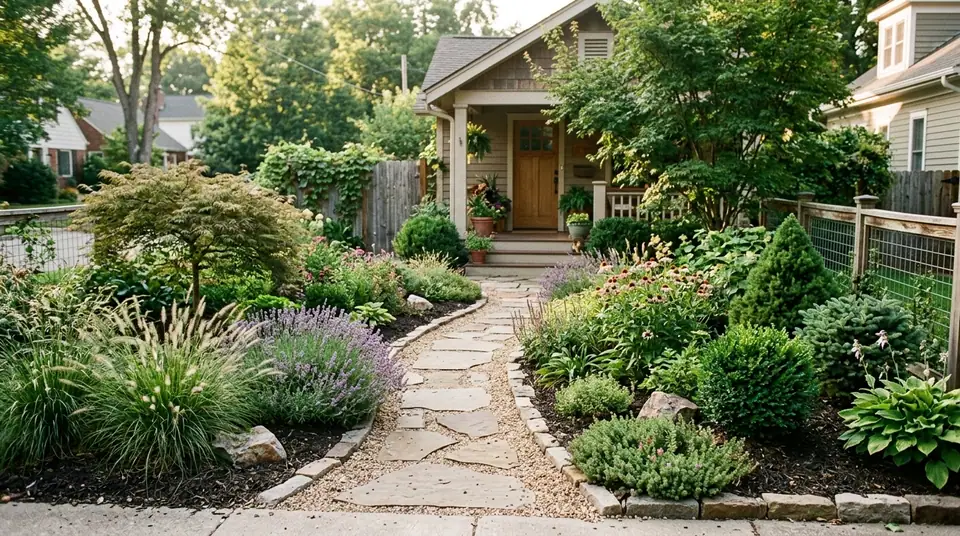
Stone walkway framed by lush perennials, grasses, and shrubs leading to a small house
5. Frequently Asked Questions
What are the absolute best drought-tolerant plants for a narrow urban hellstrip?
The best plants for narrow hellstrips (the strip between sidewalk and street) must tolerate foot traffic, reflected heat from asphalt, and road salt. Excellent choices include Sedum kamtschaticum (Russian Stonecrop), Achillea millefolium (Yarrow), and Lavandula angustifolia (English Lavender). These species feature deep root systems or thick succulent leaves that shrug off intense urban stress without supplemental irrigation once established.
How do I stop neighborhood cats from using my front yard gravel mulch as a litter box?
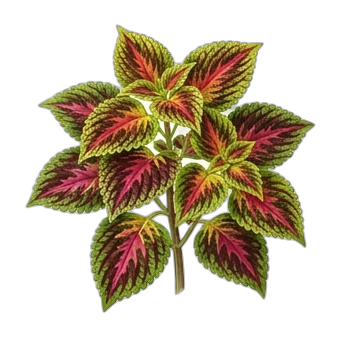
Cats dislike walking on uneven, sharp, or heavily scented surfaces. Mix dried citrus peels, crushed pinecones, or rosemary sprigs directly into the top layer of your mulch. Alternatively, install motion-activated sprinkler deterrents or plant dense groupings of Coleus caninus (commonly known as the Scaredy Cat plant), which releases an odor unpleasant to felines and canines alike.
How often do I actually need to water a low-maintenance front yard?
During the first growing season (months 1 through 3), water deeply once every 5 to 7 days to encourage deep root establishment. Once established (after month 6), most xeriscapic and native low-maintenance plantings only require a deep soaking every 14 to 21 days during peak summer heat, and zero supplemental water during fall and winter months depending on your regional rainfall.
Can I create a low-maintenance front yard without removing my existing concrete walkway?
Absolutely. Instead of jackhammering concrete, use it as an architectural feature. Build raised corten steel or timber planters directly over unappealing concrete pads, or cover cracked concrete with exterior-grade interlocking stone tiles. You can also soften the edges of concrete walkways by planting spilling groundcovers like Phlox subulata (Creeping Phlox) that naturally cascade over hard edges, softening the landscape geometry.
PlantSavvyWorld is an independent botanical education project. Articles are drafted with AI assistance, then edited and checked against university extension services, botanical garden collections and other published horticultural sources.