Written with AI assistance, edited and checked against horticultural sources.
I stood knee-deep in red clay out in Blanco County, sweating through my linen shirt while holding a limp, waterlogged lavender plant that was rotting from the crown down. The owner looked at me and asked the question I hear at least a dozen times every spring: "the PlantSavvyWorld editorial team, does lavender actually grow in Texas, or am I fighting a losing battle?" The truth is, lavender thrives in the Lone Star State, but only if you stop treating it like a thirsty perennial and start treating it like the desert native it essentially is.
When designing landscapes across the state—from the limestone hills of Austin to the humid expanses of East Texas—getting lavender to survive requires working with our brutal climate rather than fighting it. If you are also mapping out your warm-season edible crops, keep in mind that the soil prep required for Mediterranean herbs shares similarities with knowing when do you plant tomatoes in texas, especially regarding drainage. Let us dive into the science, soil specs, and exact cultivars you need for success.
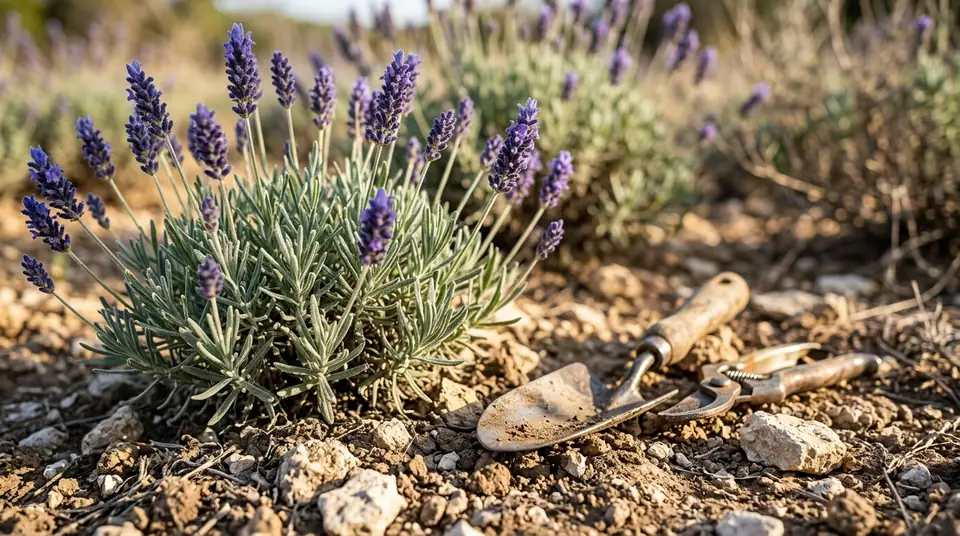
Lavender plant growing in rocky soil next to a trowel and pruners
1. Botanical Overview & Natural Habitat
Lavender (Lavandula spp.) belongs to the Lamiaceae (mint) family, which explains its square stems and highly aromatic, essential-oil-packed foliage. Native to the rocky, sun-drenched, calcareous slopes of the Mediterranean basin, lavender evolved to endure searing heat, prolonged drought, and lean, rocky soils.
When we try to grow it in Texas, we are attempting to replicate these native conditions. The state spans USDA Hardiness Zones 6a through 9b, encompassing microclimates that can either bake lavender to perfection or drown it in heavy humidity.
The primary species and cultivars suited for Texas include:
Spanish Lavender (Lavandula stoechas): Highly tolerant of coastal humidity and sandy soils, thriving in Zones 8 through 9. It features distinctive "rabbit ear" bracts atop purple blooms.
English Lavender (Lavandula angustifolia): Prefers drier air and cooler nights. It performs well in the Texas Hill Country (Zone 7-8) if drainage is immaculate, but struggles with the stifling humidity of the Gulf Coast. Look for heat-tolerant cultivars like 'Hidcote' or 'Munstead'.
Lavandin (Lavandula x intermedia): A sterile hybrid between L. Angustifolia and L. Latifolia. Varieties like 'Grosso' and 'Phenomenal' are the absolute workhorses for Texas. They produce massive, fragrant flower spikes, resist root rot better than English types, and handle the transition from spring rains to 100°F (37.8°C) summers with grace.
As you plan your broader property layout—perhaps integrating perennial herbs into a larger self-sustaining homestead layout—referencing a how to grow a wild food forest self sufficiency garden guide can help you zone your irrigation so your drought-tolerant lavender never gets accidentally soaked by nearby high-water fruit trees.
2. Essential Environmental & Care Requirements
To keep lavender alive in Texas, you must master four environmental pillars: sun, soil, air circulation, and watering frequency.
Sunlight
Lavender requires a minimum of 6 to 8 hours of direct, uninhibited sunlight daily. Planting it in the shade of a live oak or behind a dense fence will result in leggy, weak growth and invite fungal diseases.
Soil Composition and pH
This is where most Texas gardeners fail. Lavender despises heavy clay soils that retain moisture. It demands a neutral to slightly alkaline pH between 6.5 and 7.5. If you garden in the blackland prairies or the acidic sands of East Texas, you must amend your beds. Incorporate coarse horticultural sand, decomposed granite, and expanded shale into the top 12 inches (30.4 cm) of soil to drastically improve percolation.
Watering
Establishment requires regular moisture for the first 14 to 21 days after planting. Once established, pivot to a deep, infrequent watering schedule. Allow the soil to dry out completely down to a depth of 3 inches (7.6 cm) before applying water directly to the base of the plant. Never use overhead sprinklers; wet foliage combined with Texas humidity is an invitation for Phytophthora root rot.
For comprehensive regional data on horticultural practices and soil amendments tailored to our state, consult the Texas A&M AgriLife Extension Service, which provides invaluable research for local growers.
Parameter
Optimal Condition
Common Mistake
Why It Matters
Soil pH
6.5 – 7.5
Planting in acidic soils (< 6.0)
Acidic conditions cause nutrient lockout and root degradation.
Drainage
Rapid percolation (gravelly/loamy)
Heavy unamended clay
Water retention suffocates roots and triggers fungal rot.
Sunlight
Full sun (8+ hours daily)
Partial shade
Low light reduces essential oil production and causes leggy stems.
Watering
Deep, infrequent (dry out between drinks)
Frequent shallow sprinkling
Constant surface moisture invites crown rot and weak root systems.
Growing lavender successfully in Texas requires strict adherence to planting timelines. Planting in the scorching heat of July is a recipe for disaster; instead, target the fall (October through November) or early spring (February through March) when daytime temperatures hover comfortably between 60°F and 75°F (15.5°C to 23.9°C).
💡 Pro-Tip: Build a raised berm or mound at least 6 to 8 inches (15 to 20 cm) high for your lavender beds. This gravity-assisted drainage trick has saved countless Texas lavender crops from drowning during our torrential spring flash floods.
Follow this step-by-step protocol to establish your plants:
Site Selection & Soil Prep: Choose a south- or west-facing slope or flat area with full sun. Clear all weeds and work in a 3-inch (7.6 cm) layer of coarse sand, expanded shale, and compost to a depth of 12 inches (30.4 cm) to guarantee porosity.
Hole Digging: Dig a hole twice as wide as the nursery pot, but no deeper than the root ball itself. The top of the root mass must sit slightly above the surrounding soil line.
Planting: Gently loosen the outer root ball to prevent girdling. Set the plant in the hole, backfill with the native-amended soil mix, and firm it down gently with your hands—do not compact it heavily with your boots.
Initial Irrigation: Water the newly planted lavender thoroughly to settle the soil around the roots. Apply a 2-inch (5 cm) layer of pea gravel or decomposed granite around the base of the plant instead of organic mulch; organic mulches trap humidity against the woody crown.
Pruning & Maintenance: Prune back one-third of the plant's green growth immediately after its primary summer bloom cycle to encourage branching and prevent woody, sparse centers.
For additional timing strategies on warm-weather crops and soil management across different regions of the state, review guidelines on when to plant watermelons in texas to coordinate your garden layout transitions.
4. Common Problems, Pests & Troubleshooting
Even with meticulous care, Texas weather can throw curveballs that challenge your lavender plants. Recognizing symptoms early gives you the best chance of remediation.
Root Rot (Phytophthora and Pythium)
If your lavender suddenly wilts, turns greyish-green, and dies back from the base within a few days, you are dealing with root rot. This occurs when soil stays wet for too long following heavy rains.
Fix: Dig up the affected plant immediately. If the roots are brown, mushy, and foul-smelling, discard it. Improve the surrounding soil drainage with expanded shale before attempting to replant in that spot.
Leaf Spot and Fungal Blight
High humidity combined with stagnant air can cause gray mold (Botrytis cinerea) or fungal leaf spots, manifesting as grey, fuzzy patches or brown spots on leaves and stems.
Fix: Prune out infected stems immediately using sterilized pruners. Thin out surrounding vegetation to maximize airflow through the canopy.
Spider Mites and Aphids
During prolonged drought and searing heat waves exceeding 95°F (35°C), spider mites can colonize the undersides of lavender leaves, causing stippling and fine webbing. Aphids occasionally target tender new spring growth.
Fix: Blast the foliage with a sharp stream of water from the hose early in the morning, or apply organic insecticidal soap directly to the affected areas. Avoid broad-spectrum synthetic insecticides, which destroy beneficial ladybugs and predatory wasps.
For a broader scientific perspective on Mediterranean plant pathology and climate adaptation, consult the Royal Horticultural Society (RHS) database, which offers exhaustive diagnostic criteria for stress-related plant disorders.
⚠️ Important Caution: Never fertilize lavender with high-nitrogen fertilizers or fresh manure. Lavender evolved in poor, nutrient-deficient soils; excess nitrogen produces a flush of soft, rapid leaf growth that is highly susceptible to pests, frost damage, and stem breakage.
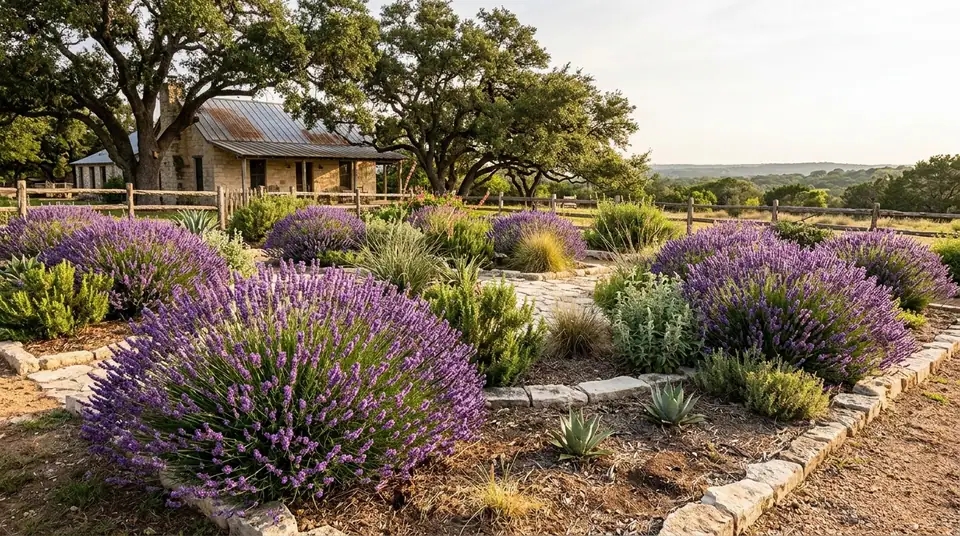
Lush purple lavender bushes blooming in a sunny garden bed before a rustic stone house
5. Frequently Asked Questions
Can lavender survive a hard Texas freeze?
Yes, most established lavender varieties easily tolerate freezing winter temperatures, dipping down into USDA Zone 6 or 7 (-10°F to 0°F / -23.3°C to -17.8°C). The primary danger in a Texas winter is not the cold itself, but the combination of freezing rain and poorly draining soil that causes the roots to freeze and rot simultaneously.
Why is the middle of my lavender plant turning woody and dying out?
This is a natural aging process known as "woody center syndrome," accelerated in Texas by a lack of annual pruning. Lavender will not reliably regenerate new growth from old, bare wood if you cut back past the green foliage. Prevent this by shearing back one-third of the green plant structure every year right after flowering.
How often should I water established lavender in Texas?
Once established—typically after 6 to 12 months in the ground—mature lavender plants only require deep watering every 10 to 14 days during peak summer heat, and practically no supplemental water during winter months unless there is an extended drought. Always let the soil dry out completely between waterings.
Can I grow lavender in containers in Texas?
Container growing is often the safest method for gardeners living in regions of Texas with heavy, clay-heavy soils or oppressive coastal humidity. Use a wide, unglazed terracotta pot (at least 14 inches / 35.5 cm in diameter) filled with a specialized cactus and succulent potting mix blended with extra perlite or pumice to ensure instant drainage.
PlantSavvyWorld is an independent botanical education project. Articles are drafted with AI assistance, then edited and checked against university extension services, botanical garden collections and other published horticultural sources.