

Why Are My Peace Lily Flowers Green
Written with AI assistance, edited and checked against horticultural sources.
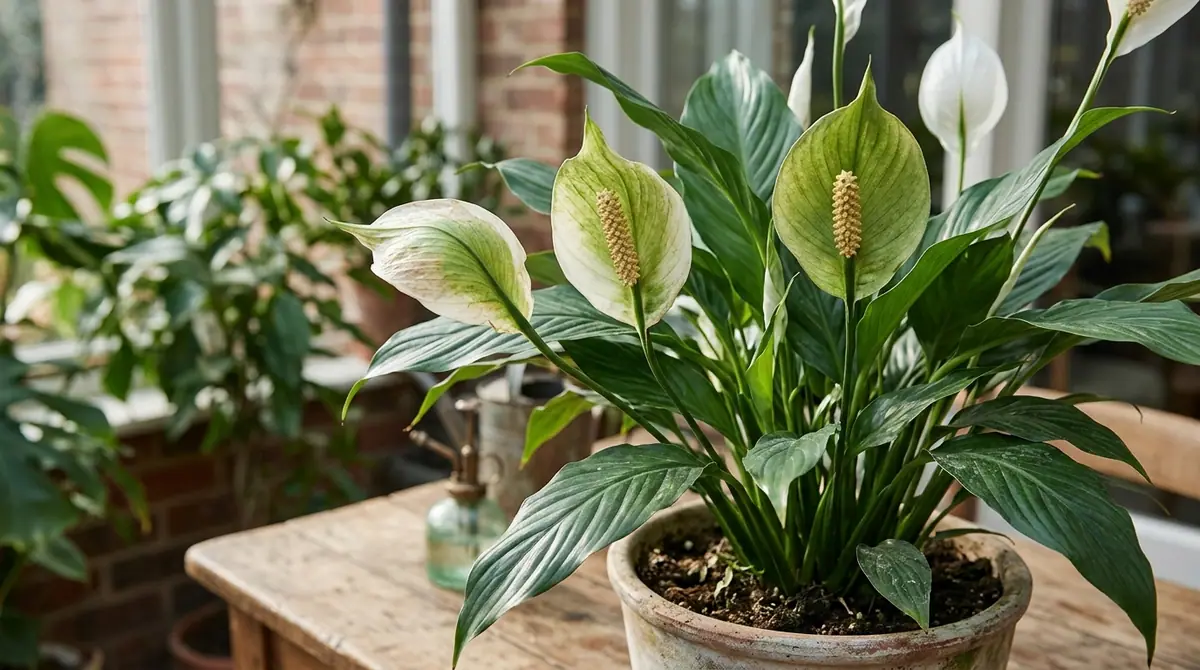
I stood in my conservatory last Tuesday, holding a pruning shear inches away from a striking, pale-emerald spathe on my Spathiphyllum wallisii. A gardener had called me that morning in a panic, convinced her prized indoor specimen was mutating or dying because its pristine white blooms had turned an unmistakable shade of chartreuse. I smiled, feeling that familiar wave of relief that every botanist feels when a plant emergency turns out to be entirely natural. If you came to this guide because your own peace lily flowers are shifting from snow-white to green, take a deep breath. You are witnessing a normal botanical milestone, not a catastrophe.

1. Botanical Overview & Natural Habitat
To understand why your peace lily flowers are green, we have to clear up a common botanical misconception. What most people call the "flower" of a peace lily is actually a modified leaf called a spathe. The true, microscopic flowers are clustered densely along a central, finger-like spike called the spadix.
In their native understory habitats of Central and South American tropical rainforests, Spathiphyllum species grow beneath dense multi-layered tree canopies. These environments filter natural sunlight down to a fraction of full ambient daylight. As an evolutionary adaptation, the white spathes act as biological beacons. Their brilliant reflectance helps attract nocturnal or dim-light pollinators, such as specific beetles and small insects, in the shadowy gloom of the forest floor.
Once pollination occurs, or simply as the natural life cycle of the spathe progresses past its prime, the plant undergoes a profound physiological shift. The white pigment—primarily reflecting light without absorbing it—is no longer necessary for reproduction. The plant triggers the production of chloroplasts within the spathe tissue. Chlorophyll floods the cells, turning the brilliant white bract into a lush green photosynthetic organ. This clever evolutionary recycling mechanism allows the plant to harvest energy from ambient light using the aging spathe until it eventually senesces, yellows, and dries out.
Sometimes, this color shift isn't just aging; it is directly tied to the specific cultivar you purchased. Modern commercial breeding programs have introduced varieties like Spathiphyllum 'Mauna Loa Supreme' or Spathiphyllum 'Domino'. Some specific hybrids, such as 'Sensation', produce massive leaves and spathes that can emerge with a greenish hue or transition into green much faster than older heritage species.
2. Essential Environmental & Care Requirements
If your peace lilies are turning green prematurely—meaning before the flower has matured and aged—your environmental parameters are likely forcing the plant into a survivalist photosynthetic response. Let us examine the specific thresholds your indoor space needs to maintain healthy, long-lasting white blooms.
| Parameter | Optimal Condition | Common Mistake | Why It Matters |
|---|---|---|---|
| Light | Bright, indirect light (1500–2500 foot-candles) | Direct afternoon sun or deep, dark corners | Extreme light drives rapid chlorophyll production in spathes, turning them green, while darkness prevents flowering entirely. |
| Temperature | 68°F to 85°F (20°C to 29°C) | Placing near drafty AC vents or heaters below 55°F (13°C) | Sudden thermal shock disrupts cellular transport, stalling bloom development and causing erratic pigment synthesis. |
| Watering | Water thoroughly when the top 2.0 inches (5.0 cm) are dry | Keeping soil waterlogged or letting the plant droop severely | Chronic root stress alters hormone distribution, causing flowers to green up or drop prematurely. |
| Humidity | 50% to 60% relative humidity | Dry indoor air during winter heating seasons below 30% | Low humidity scorches spathe margins and accelerates premature aging and color change. |
Maintaining these ranges prevents unnecessary stress. If you are experimenting with outdoor plantings or trying to understand regional microclimates for other flora, you can reference What Zone is Ohio for Planting Flowers to see how latitude and hardiness zones dictate plant performance.
💡 Pro-Tip: If you want to maximize the lifespan of your white spathes, keep your peace lily at a stable temperature of 72°F (22°C) with constant air circulation. Stagnant air coupled with fluctuating temperatures accelerates the senescence phase, forcing that unwanted green transition weeks ahead of schedule.
3. Step-by-Step Cultivation, Feeding & Propagation
When your peace lily needs a reset—whether it is producing permanently green flowers due to over-fertilization or simply needs a soil refresh—following a precise horticultural protocol ensures recovery. Here is my tested step-by-step procedure for repotting, feeding, and encouraging true white blooms.
- Assess the root mass: Gently slide the peace lily out of its container. Inspect the root ball for brown, mushy, or circling roots. Prune away dead tissue using sterilized shears cleaned with isopropyl alcohol.
- Select the correct potting medium: Mix a custom substrate consisting of 40% high-grade organic peat moss, 30% coarse perlite or pumice for drainage, and 30% composted bark. The ideal pH range sits between 5.6 and 6.5.
- Repot to the correct depth: Place the plant into a pot that is only 1.0 to 2.0 inches (2.5 to 5.0 cm) wider than the previous root mass. Bury the root crown level with the soil surface—never submerge the crown deeper than 0.5 inches (1.3 cm), as this invites stem rot.
- Implement a balanced feeding schedule: During the active growing season spanning spring through summer (roughly 120 to 150 days), apply a balanced, water-soluble fertilizer with an N-P-K ratio of 10-10-10 or 20-20-20, diluted to half-strength, every 30 days. Avoid high-nitrogen formulas; excess nitrogen triggers aggressive leaf and green pigment production at the expense of crisp white spathes.
- Manage post-propagation recovery: If you are dividing a large clump, ensure each division possesses at least 3 distinct vegetative shoots and an intact root system. Water the newly potted division thoroughly until liquid drains from the base, then withhold fertilizer for 45 days to prevent chemical burn on fresh roots.
For those interested in branching out into edible crops or specialized stimulant plants, understanding soil biology and pruning techniques can be explored further in guides like How to Grow Tea Green Black.
4. Common Problems, Pests & Troubleshooting
Green flowers are rarely an isolated symptom. They often accompany other environmental imbalances. Let us diagnose what else might be happening in your pot.
⚠️ Important Caution: Never use commercial leaf shine products or milk solutions to wipe down peace lily leaves or green spathes. These oily residues clog the stomata—the microscopic pores on the leaf and spathe surface—suffocating the plant tissue and causing rapid chlorosis and tissue death.
Over-Fertilization and Nutrient Lockout
If you have been heavy-handed with liquid plant food, salts build up in the root zone. This osmotic pressure prevents the plant from absorbing iron and magnesium, leading to erratic pigmentation where new leaves emerge pale yellow-green and flowers turn a sickly, blotchy green. Flush the soil thoroughly by running plain, tepid water through the pot for 5 solid minutes to leach out excess mineral salts.
Pest Infestations
Stressed peace lilies attract fungus gnats, mealybugs, and spider mites. Mealybugs look like tiny cotton balls tucked into leaf axils. Treat mild outbreaks by dabbing pests with a cotton swab soaked in 70% isopropyl alcohol. For persistent spider mites—signified by fine webbing and stippling on foliage—wash the plant down in a shower and apply horticultural insecticidal soap, ensuring complete coverage of both upper and lower leaf surfaces.

5. Frequently Asked Questions
Why did my white peace lily flowers turn green overnight?
Flowers do not turn green literally overnight, but the color transition can become suddenly noticeable as chlorophyll concentration peaks. If a white spathe has been open for 4 to 8 weeks, this color change is entirely natural. The plant is ending its reproductive cycle and converting the bract into a photosynthetic organ to harvest extra energy.
Can I cut off the green flowers to force white ones to grow back?
Yes. Using clean pruning shears, cut the flower stem down near the base of the plant, being careful not to damage surrounding foliage. Removing spent or green spathes redirects the plant's metabolic energy back into root development and new leaf and bud production, paving the way for fresh white blooms in the next cycle.
Do green peace lily flowers mean the plant is getting too much light?
Frequently, yes. If your peace lily is placed too close to a bright, sunlit window—receiving direct rays that exceed 3000 foot-candles—the plant reacts by rushing chloroplast production into the spathes to protect sensitive tissues from photo-oxidation. Move the plant back 3.0 to 5.0 feet (0.9 to 1.5 meters) from the light source to restore balance.
Are there peace lily varieties that naturally have green flowers?
While most classic Spathiphyllum species open pure white, certain cultivars and species—such as Spathiphyllum cochlearispathum—feature larger, more robust spathes that naturally display green veining or mature into a soft chartreuse green color much faster than standard varieties. Check your plant label or nursery tag to confirm if you own one of these unique structural cultivars.
Related Guides
- Do Deer Eat Lily of the Valley
- Asiatic Lily vs Oriental
- Emerald Green Arborvitae vs Thuja Green Giant
- When is Green Bean Season
- How to Make Grass Green Fast
- How to Grow Tea Green Black
📋 Table of Contents ▼ Click to expand
Tags:
Keep reading
🌿 Related Plants You Might Like






PlantSavvyWorld
Editorial team
PlantSavvyWorld is an independent botanical education project. Articles are drafted with AI assistance, then edited and checked against university extension services, botanical garden collections and other published horticultural sources.