Written with AI assistance, edited and checked against horticultural sources.
Standing on a rain-slicked nursery pad in early October, staring up at a wall of conifers that had completely swallowed a gardener's second-story window, I learned the most expensive lesson of horticultural practice. The homeowner had asked for a "privacy screen." Her landscape contractor, chasing a quick commission, planted Thuja 'Green Giant' right where an Emerald Green Arborvitae belonged. Three years later, those trees were rocketing upward at four feet a year, blocking out the winter sun entirely and bowing aggressively over a septic tank.
Choosing between the Thuja occidentalis 'Emerald Green' and the Thuja 'Green Giant' is not a minor aesthetic choice. It is a structural commitment that shapes your property for decades. Horticultural practice has spent decades watching homeowners miscalculate the mature scale of these conifers. Let us break down the botanical architecture, environmental tolerances, and precise maintenance realities of "emerald green arborvitae vs thuja green giant" so you can choose the right living wall for your landscape.
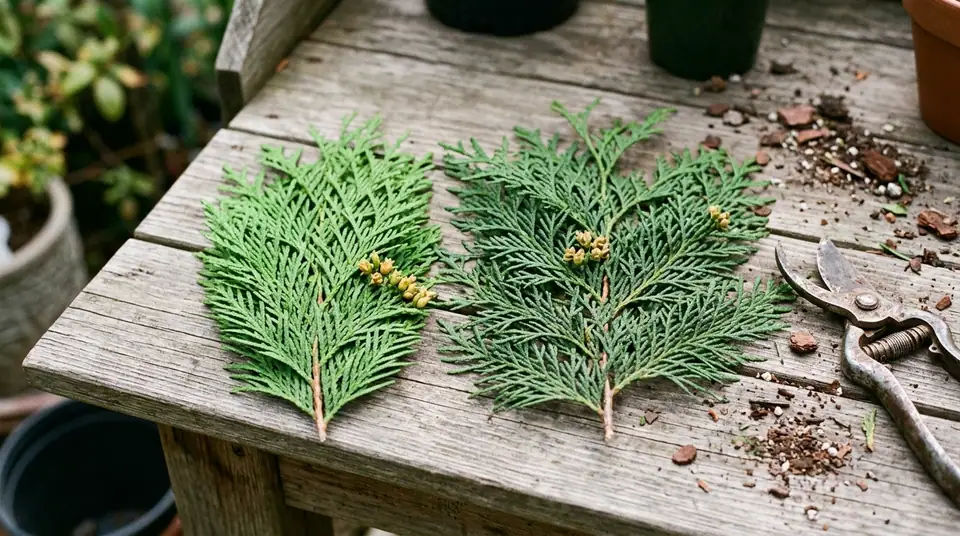
Freshly cut arborvitae foliage branches and pruners on a weathered wooden potting bench
1. Botanical Overview & Natural Habitat
To understand how these two evergreens behave in a residential landscape, we have to look at their genetic lineage and native environments. Both belong to the Cupressaceae family, but their parentage diverges significantly.
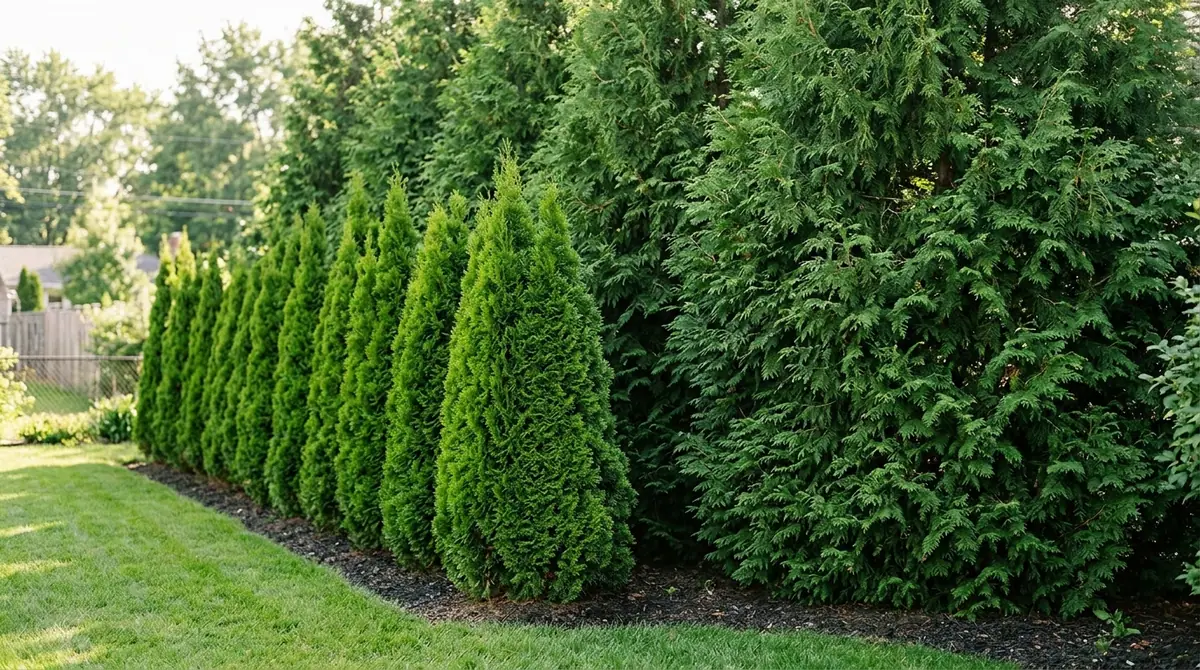
Thuja occidentalis 'Emerald Green' (often sold as 'Smaragd') is a distinct cultivar of the Northern White Cedar, native to the cold, limestone-rich wetlands and rocky uplands of northeastern North America and southern Canada. In the wild, the species adapts to fluctuating water tables and bitter sub-zero winters. The 'Emerald Green' cultivar was selected in Denmark around the mid-20th century for its tight, pyramidal habit and its refusal to bronze into a dull, winter-brown color. It stays a crisp, vibrant emerald green even when temperatures drop to -40°F (-40°C). Botanically, it is a slow-to-moderate grower, maxing out at a mature height of 10 to 15 feet (3 to 4.5 meters) and a slender width of 3 to 4 feet (0.9 to 1.2 meters).
Thuja 'Green Giant', on the other hand, is an interspecific hybrid. It is a cross between the Western Red Cedar (Thuja plicata) and the Japanese Arborvitae (Thuja standishii), developed at the Horticultural Research Institute in Boskoop, Netherlands, in 1967. Because of its hybrid vigor (heterosis), it displays explosive growth. In optimal conditions, it pushes out 3 to 5 feet (0.9 to 1.5 meters) of new growth annually. It matures into a massive, dense, conical specimen reaching 50 to 60 feet (15 to 18 meters) tall and 12 to 20 feet (3.6 to 6 meters) wide.
Understanding this heritage explains why your neighbor's 'Green Giant' outgrew their garage while your 'Emerald Green' hedge looks polite and contained. Their genetic blueprints demand completely different spatial allocations.
2. Essential Environmental & Care Requirements
While both conifers thrive in full sun, their soil, moisture, and nutritional demands diverge based on their root mass and transpiration rates.
Parameter
Optimal Condition
Common Mistake
Why It Matters
Soil Drainage
Loamy, well-draining soil with a pH between 6.0 and 7.5
Planting in heavy, waterlogged clay without amendment
Root rot (Phytophthora) thrives in stagnant, oxygen-depleted soil.
Watering Volume
1 inch (2.5 cm) of water per week via rainfall or deep irrigation
'Emerald Green': 2–3 ft apart; 'Green Giant': 5–8 ft apart
Planting too close for instant privacy
Overcrowding restricts airflow, triggering fungal dieback and lower-branch browning.
Sun Exposure
Full sun (6+ hours of direct light daily)
Planting in deep, heavy shade
Deep shade causes interior needle drop, sparse branching, and structural leaning.
For both varieties, establishing a robust root zone requires rigorous moisture management during the first 365 days after planting. For deeper guidance on maintaining vibrant plant health, look at our principles for How to Make Grass Green Fast, where soil biology and hydration intersect similarly.
💡 Pro-Tip: When planting an Emerald Green hedge, dig your trench 6 inches (15 cm) wider than the root ball, but never deeper. Planting an arborvitae too deep is the number one cause of silent decline, as the root flare suffocates beneath dense topsoil.
Successful establishment of either arborvitae cultivar relies on precise timing and physical execution. Follow this strict protocol to ensure your landscape investment thrives.
Site Selection and Soil Testing: Test your soil pH 30 days before planting. Ensure the site receives a minimum of 6 hours of direct sunlight. Amend heavy clay with 20% by volume of well-rotted compost to improve structural porosity.
Excavation: Dig a planting hole 2 to 3 times wider than the nursery container, but keep the depth equal to the height of the root ball. The top of the root flare must sit 1 inch (2.5 cm) above the surrounding grade to account for settling.
Root Teasing: Gently score the outer root mass with a clean utility knife or your fingers if the plant is root-bound. Unwind any circling roots to prevent girdling later in life.
Placement and Backfilling: Center the tree in the hole. Backfill halfway with native soil, tamp down gently with your hands to remove large air pockets, and water thoroughly to settle the soil around the roots. Finish backfilling.
Mulching: Apply a 3-inch (7.5-cm) layer of shredded hardwood mulch across the root zone. Keep the mulch pulled back 2 inches (5 cm) from the actual trunk bark to prevent collar rot and rodent nesting.
Initial Irrigation Cycle: Deliver 5 gallons (19 liters) of water per plant immediately after planting. Maintain a schedule of 1 inch (2.5 cm) of water every 7 days for the first growing season, increasing to twice weekly during periods when ambient temperatures exceed 90°F (32°C).
For academic validation on conifer establishment, consult the USDA Forest Service Silvics Manual regarding conifer root development in varied soil profiles.
4. Common Problems, Pests & Troubleshooting
Even resilient evergreens run into trouble when environmental stress compromises their natural defenses.
Bagworms (Thyridopteryx ephemeraeformis): These caterpillars spin spindle-shaped silk bags camouflaged with arborvitae foliage. They strip leaves rapidly. Hand-pick bags in winter and destroy them, or apply Bacillus thuringiensis (Bt) in late spring when larvae are actively feeding.
Spider Mites: Thriving in hot, dry conditions, these microscopic pests cause foliage to take on a dusty, yellow-bronze stippling. Blast the canopy with a forceful jet of cold water from a garden hose to break their webs, or apply insecticidal soap.
Winter Burn and Desiccation: Occurs when frozen ground prevents roots from replacing moisture lost through transpiration on windy, sunny winter days.
Phytophthora Root Rot: Caused by poor drainage. Needles turn a dull gray-green, then brown, starting from the base up. There is no cure once advanced; improve site drainage immediately if planting replacement specimens.
⚠️ Important Caution: Never apply high-nitrogen synthetic lawn fertilizers within the root zone of your arborvitaes to force fast growth. Excess nitrogen burns delicate feeder roots, invites sap-sucking insects like aphids, and forces weak, succulent growth that collapses under heavy winter snow loads.
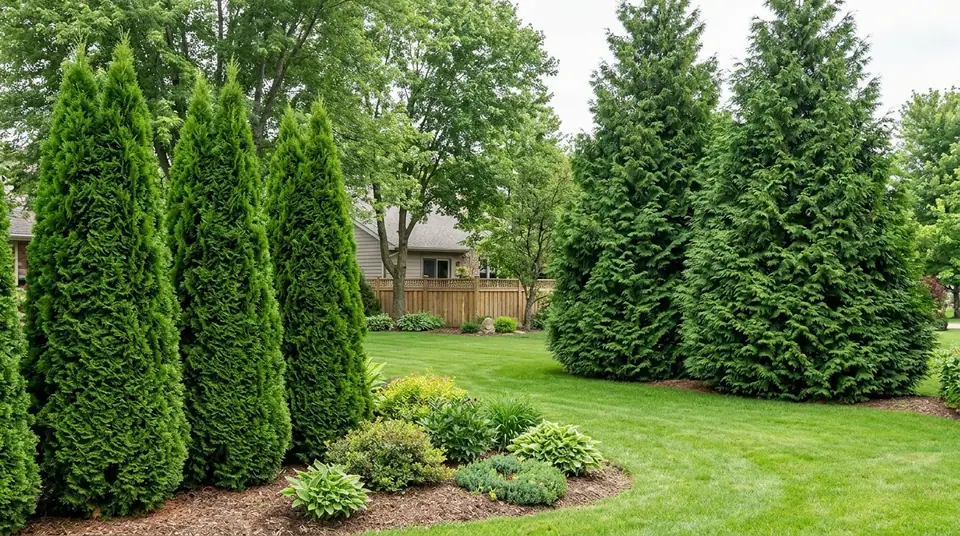
Tall Emerald Green Arborvitae and Thuja Green Giant trees in a grassy suburban yard
5. Frequently Asked Questions
Which grows faster, Emerald Green Arborvitae or Thuja Green Giant?
The Thuja 'Green Giant' grows significantly faster, adding 3 to 5 feet (0.9 to 1.5 meters) of vertical growth per year. The Emerald Green Arborvitae is much slower, averaging only 6 to 12 inches (15 to 30 cm) of annual growth. If you need privacy immediately, the 'Green Giant' wins, but require patience with 'Emerald Green'.
How close to a fence or foundation should I plant a Green Giant?
Plant Thuja 'Green Giant' at least 8 to 10 feet (2.4 to 3 meters) away from foundations, property lines, and fences. Because they can reach a mature width of up to 20 feet (6 meters), planting them too close will result in structural damage to hardscaping and property disputes with neighbors as the massive lower branches expand.
Do deer eat Emerald Green Arborvitae and Thuja Green Giant?
Yes, both varieties are favorite food sources for white-tailed deer (Odocoileus virginianus), especially during harsh winters when other browse is scarce. However, 'Green Giant' exhibits moderate resistance and recovers from browsing damage much faster due to its rapid growth rate, whereas 'Emerald Green' can be permanently disfigured by a single hungry herd.
Can I keep a Thuja Green Giant small with heavy pruning?
You can prune 'Green Giant' to control its size, but it requires diligent, routine maintenance. You must prune only soft, green growth; never cut back into old wood where needles fail to regenerate. For a naturally small, narrow space, it is always botanically wiser to select Emerald Green rather than fighting the genetic programming of a 'Green Giant'.
For a broader perspective on sustainable landscaping practices and plant selection, visit the Royal Horticultural Society Plant Finder for global horticultural standards. When planning your broader garden ecosystem, matching your microclimate to the correct plant species ensures long-term vitality, much like tracking seasonal yields when evaluating When is Green Bean Season.
PlantSavvyWorld is an independent botanical education project. Articles are drafted with AI assistance, then edited and checked against university extension services, botanical garden collections and other published horticultural sources.