

When to Start Seeds in Greenhouse
Written with AI assistance, edited and checked against horticultural sources.
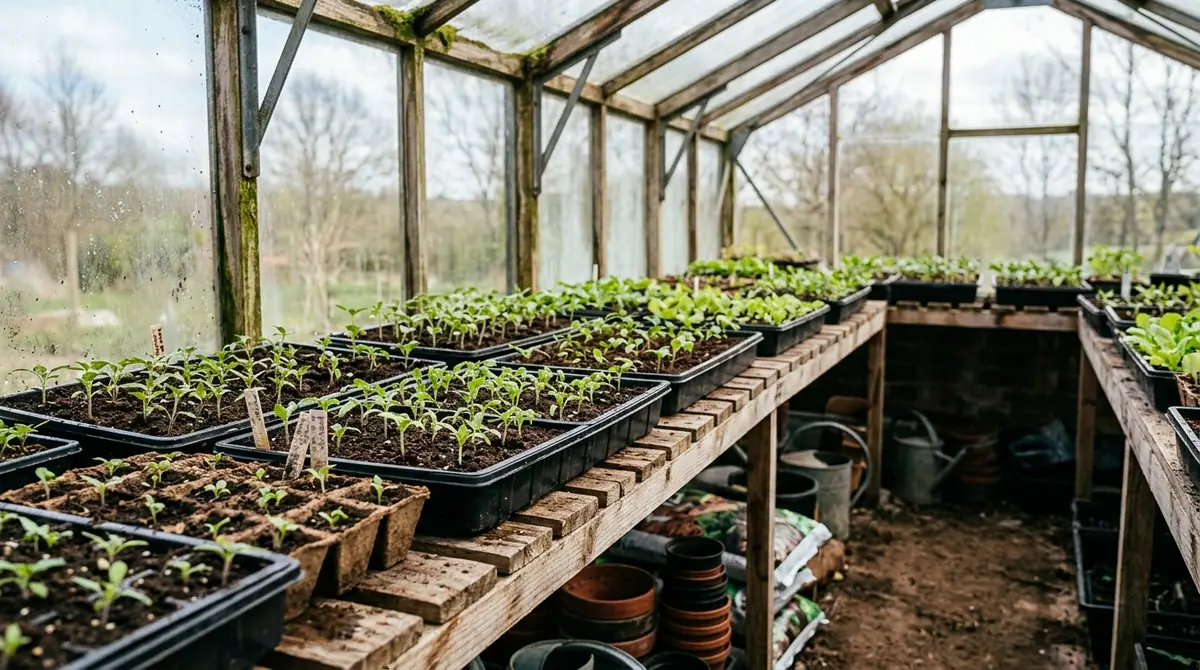
Last March, on a freezing Tuesday morning when the outside ambient thermometer read a biting 22°F (-5.6°C), I stepped into my glass-paneled greenhouse and watched condensation bead on the polycarbonate roof. Down on the propagation bench, trays of indeterminate heirloom tomato seeds—sown precisely six weeks before our region's average last frost date—were already pushing up sturdy, emerald-green cotyledons. Getting the timing right inside a controlled environment is an art balanced entirely on plant physiology, thermal dynamics, and solar radiation. If you start too early, you end up with root-bound, leggy seedlings starving for light; if you start too late, you miss the optimal window for maximum seasonal yield. Mastering when to start seeds in greenhouse structures requires looking past the calendar on your wall and paying close attention to soil temperatures, photoperiods, and your specific hardiness zone.
1. Botanical Overview & Natural Habitat

When we bring seeds into a greenhouse, we artificially compress and optimize these natural triggers. Most annual vegetables and tender perennials originate from subtropical or temperate climates where spring brings a reliable combination of warming soil (consistently above 60°F or 15.5°C) and increasing daylight hours. In a greenhouse setting, you manipulate these variables long before the outdoor ecosystem stabilizes.
However, a greenhouse is not a magic box; it is a modified microclimate. Unheated greenhouses experience wild temperature swings between sunny afternoons and freezing nights. Therefore, calculating when to start seeds in greenhouse environments depends heavily on whether your structure is actively heated, passively solar-gained, or simply a cold frame extension. For warm-season crops like nightshades (Solanaceae), germination demands ambient soil temperatures between 75°F and 85°F (23.9°C to 29.4°C), while cool-season brassicas and greens emerge readily at 50°F to 65°F (10°C to 18.3°C).
For a deeper dive into accelerating germination for specific heat-loving vegetables, consult this guide on How to Germinate Eggplant Seeds Fast: Heat, Moisture & 7-Day Protocol. Furthermore, if you are managing delicate herbs that require specialized pre-treatment, review the protocols in How to Germinate Parsley Seeds Fast: Hot Water Soak & 7-Day Trick.
2. Essential Environmental & Care Requirements
Success in greenhouse seed starting relies on controlling four core environmental pillars: temperature, moisture, light, and air circulation. Miss the mark on any single parameter, and you risk fungal pathogens like Pythium (damping-off) or weak, etiolated growth.
| Parameter | Optimal Condition | Common Mistake | Why It Matters |
|---|---|---|---|
| Soil Temperature | 70°F–85°F (21°C–29°C) for warm crops; 55°F–65°F (13°C–18°C) for cool crops | Relying on unheated greenhouse air instead of soil temp | Cold soil stalls enzymatic activity, causing seeds to rot before emergence. |
| Moisture / Humidity | 85%–95% relative humidity pre-emergence; evenly moist, sponge-like media | Letting seed flats dry out or keeping them permanently waterlogged | Drought halts cell division; waterlogging deprives developing roots of oxygen. |
| Light Duration | 14 to 16 hours of high-intensity light daily | Placing trays in shaded greenhouse corners or relying solely on weak early spring sun | Insufficient light causes seedlings to stretch rapidly, creating weak, spindly stems. |
| Air Circulation | Gentle, continuous horizontal air movement via oscillating fans | Stagnant air in sealed greenhouse domes | Airflow strengthens stem caliper and deters airborne fungal spores. |
Managing these elements requires vigilance, especially during transitional spring weeks. For comprehensive external benchmarks on controlled-environment agriculture and plant physiology, consult the University of California Agriculture and Natural Resources publications or the botanical guidelines provided by the Royal Botanic Gardens, Kew.
💡 Pro-Tip: Never rely on air temperature gauges alone when deciding when to start seeds in your greenhouse. Buy a digital probe soil thermometer. Seeds do not care how warm the air is near the ceiling; they only care about the thermal conditions within the top 0.5 inches (1.2 cm) of the growing medium.
3. Step-by-Step Cultivation, Feeding & Propagation
When timing your sowings, count backward from your region's average last spring frost date. Tender annuals like tomatoes and peppers typically go into the greenhouse 6 to 8 weeks before that date, while cool-season crops like brassicas start 8 to 10 weeks prior. Follow this rigorous step-by-step propagation protocol to ensure high germination rates and robust seedling vigor.
- Sanitize and Prepare Containers: Wash all reused cell trays, flats, and domes in a 10% household bleach solution or horticultural disinfectant, rinsing thoroughly to eliminate persistent fungal spores and insect eggs.
- Mix and Moisten the Substrate: Utilize a fine-textured, sterile seed-starting mix composed of peat moss, perlite, and vermiculite. Pre-moisten the medium in a wheelbarrow or bucket until it reaches field capacity—it should feel like a wrung-out sponge, releasing only a single drop of water when squeezed tightly.
- Fill and Compact: Fill your cell trays loosely to the brim, then tap the tray firmly on your workbench once or twice to settle the mix and eliminate large air pockets. Strike the surface flat with a straightedge.
- Sow at the Correct Depth: Plant seeds at a depth equal to two to three times their width. As a general rule, sow fine seeds (like lettuce or snapdragons) on the surface pressed lightly into the soil, medium seeds (like tomatoes) at 0.25 inches (0.6 cm), and large seeds (like squash or beans) at 0.5 inches to 1.0 inch (1.2 cm to 2.5 cm).
- Apply Gentle Irrigation: Mist the planted surface using a fine-rosed watering can or a pressure sprayer to avoid displacing seeds. Cover trays with clear humidity domes or plastic wrap to lock in moisture.
- Provide Bottom Heat: Place trays on propagation heating mats set to 75°F (23.9°C) for warm-season crops. Monitor daily.
- Transition to Light and Air: The exact moment 50% to 75% of your seedlings break the soil surface, remove the humidity domes immediately and turn on your overhead LED grow lights or adjust greenhouse shading. Keep lights positioned 2 to 3 inches (5 cm to 7.6 cm) above the foliage.
- Initiate Feeding: Once the first set of true leaves appears—replacing the initial smooth cotyledons—begin feeding weekly with a balanced organic liquid kelp or fish emulsion fertilizer diluted to one-quarter strength.
- Harden Off for Transplanting: Approximately 10 to 14 days before your intended outdoor planting date, begin the hardening-off process by exposing greenhouse seedlings to outdoor wind and filtered sun for incrementally longer periods. For insights on executing this phase smoothly for sensitive crops, read this guide on When to Transplant Cucumber Seedlings: Stop Root Shock & Boost Growth.
⚠️ Important Caution: Never expose tender greenhouse-started seedlings to direct, unfiltered midday sun and heavy spring winds without an acclimation period. The sudden UV shock and rapid transpiration will scorch the leaves and permanently stunt the vascular system within hours.
4. Common Problems, Pests & Troubleshooting
Even in a well-managed greenhouse, managing seed-starting schedules and young plants comes with distinct challenges. Below are the most frequent issues growers encounter and how to correct them immediately.
- Leggy, Spindly Seedlings: If your stems look translucent, pale, and stretch past 3 or 4 inches before true leaves develop, your plants are suffering from light starvation combined with excess ambient warmth. Lower your artificial grow lights closer to the canopy, reduce nighttime greenhouse temperatures by 5°F to 10°F (3°C to 6°C), and ensure you haven't started your seeds too early for the natural day length.
- Damping-Off Disease: Caused by soil-borne fungi such as Pythium, Rhizoctonia, or Fusarium, this condition manifests as seedlings suddenly pinching at the soil line and collapsing overnight. Prevent this by using sterile media, avoiding over-watering, running an oscillating fan to keep air moving across the soil surface, and watering from the bottom up via tray soaking.
- Fungus Gnats (Sciaridae): Adult gnats flitting around your seed flats indicate overly wet, organic-rich topsoil. While adult gnats are mostly a nuisance, their larvae feed on tender root hairs. Let the top 1 inch (2.5 cm) of your growing medium dry out completely between waterings, apply biological larvicides like Bacillus thuringiensis israelensis (BTI), and deploy yellow sticky cards near the tray base.
- Stalled Growth / Purple Stems: If seedlings remain frozen in size after germination and develop a purplish tint on the underside of their leaves, your greenhouse soil temperature is likely too low, locking out essential phosphorus uptake. Install heating mats or adjust your greenhouse heating system to maintain a minimum night temperature of 60°F (15.5°C) for warm-season varieties.

5. Frequently Asked Questions
Can I start seeds in an unheated greenhouse in early spring?
Yes, but strictly for cold-hardy crops such as kale, spinach, cabbage, onions, and hardy annual flowers. Unheated greenhouses will protect plants from hard freezes and heavy snow, but ambient temperatures can still dip close to outdoor lows at night. Do not attempt to start tropical annuals like tomatoes, peppers, or cucumbers in an unheated greenhouse until nighttime temperatures consistently remain above 50°F (10°C).
How do I know when a greenhouse seedlings are ready to be potted up?
Seedlings are ready to be stepped up from small cell plugs into larger 3-inch or 4-inch pots when they develop at least two sets of true leaves and their root systems have filled the cell plug sufficiently to hold the soil ball together as a cohesive unit. Gently pop one seedling out of its cell; if you see a fine, white web of roots wrapping the perimeter of the medium, it is time to transplant.
Do greenhouse-started seeds need artificial grow lights, or is natural sunlight enough?
Depending on your geographic latitude and the time of year, natural sunlight through greenhouse glazing may not be sufficient. In late winter and early spring, day lengths are short, and the sun sits at a low angle. If you start warm-season crops before mid-March in temperate zones, supplementing natural sunlight with full-spectrum LED grow lights for a total photoperiod of 14 to 16 hours is essential to prevent weak, stretched growth.
How do I prevent algae and green moss from forming on top of my seed-starting soil?
Algae and moss thrive in environments that are perpetually wet, humid, and exposed to light with poor air circulation. To prevent this, water your trays from the bottom by setting them in a shallow basin of water until the moisture wicks upward, rather than watering heavily from overhead. Ensure your greenhouse ventilation fans are running continuously on low speed to dry the very surface of the soil between waterings.
Related Guides
- Floor Greenhouse
- Insulating Greenhouse
- How to Heat Greenhouse in Winter
- Glass for Greenhouse
- When to Start Fertilizing Seedlings
📋 Table of Contents ▼ Click to expand
Tags:
Keep reading
🌿 Related Plants You Might Like


PlantSavvyWorld
Editorial team
PlantSavvyWorld is an independent botanical education project. Articles are drafted with AI assistance, then edited and checked against university extension services, botanical garden collections and other published horticultural sources.