

How to Heat Greenhouse in Winter
Written with AI assistance, edited and checked against horticultural sources.

1. Botanical Overview & Natural Habitat
To understand winter greenhouse heating, you must first understand the native habitats of the plants you are trying to keep alive. Most ornamental and food crops grown in protected structures originate from USDA Hardiness Zones 9 through 12, where seasonal temperature drops are minimal and frost is biologically nonexistent.
When ambient outdoor temperatures plunge below 32°F (0°C), unheated greenhouses drop rapidly because glass and twin-wall polycarbonate possess low R-values (typically R-1.5 to R-3.0). Without active heat inputs, the interior temperature mirrors the exterior within hours. This chilling causes cell walls to freeze. Ice crystals form intracellularly, puncturing cell membranes. When the sun hits the frozen plant the next morning, the thawed cells collapse, resulting in the classic black, water-soaked tissue damage known as frost burn.
Maintaining a stable microclimate mimics the natural canopy buffers of tropical understories or subtropical plateaus. For structural management, pairing proper heating with strategies similar to those detailed in our guide on How to Protect Backyard Fruit Orchard from Winter Frost ensures your woody perennials and sensitive crops transition safely through dormancy without root-zone freezing.
2. Essential Environmental & Care Requirements
Heating a greenhouse is not just about turning up a thermostat; it requires balancing temperature, relative humidity, and airflow to prevent fungal pathogens like Botrytis cinerea and powdery mildew.
| Parameter | Optimal Condition | Common Mistake | Why It Matters |
|---|---|---|---|
| Minimum Night Temp | 45°F to 55°F (7.2°C to 12.8°C) for tender perennials | Letting temperatures drop below 38°F (3.3°C) | Prevents chilling injury and root shock in subtropical species. |
| Relative Humidity | 50% to 70% | Allowing humidity to exceed 85% | High humidity combined with cold glass creates leaf-wetness, inviting fungal spores. |
| Thermal Mass Storage | Water barrels absorbing daytime heat | Using black plastic containers without tight lids | Uncovered water evaporates, raising ambient humidity to dangerous levels. |
| Air Circulation | 0.5 to 1.0 air exchanges per minute | Stagnant air pockets in corners | Prevents thermal stratification where heat pools at the ceiling while frost forms at floor level. |
💡 Pro-Tip: Never point your primary greenhouse heater directly at plant foliage. Direct radiant heat blasts cause rapid transpiration, desiccating leaf margins within hours even if the soil is damp. Always use oscillating HAF (Horizontal Air Flow) fans to distribute warmed air evenly across the floor perimeter.
For advanced insights into maintaining your heating apparatus and mechanical distribution systems during freezing weather, consult the recommendations provided by the University of Minnesota Extension on Greenhouse Management.
3. Step-by-Step Cultivation, Feeding & Propagation
Implementing an efficient winter heating system requires a methodical approach that addresses structural insulation before adding active BTU capacity. Follow this 6-step protocol to winterize and heat your growing space effectively:
- Seal and Insulate the Envelope: Inspect all glazing panels, weatherstripping, and door seals. Apply a double layer of 4-6 mil UV-treated polyethylene sheeting to the interior framing, leaving a 1-to-2-inch (2.5 to 5 cm) dead air gap to boost your insulation value by R-1 or R-2.
- Calculate Your BTU Load: Determine your heating requirement using the formula: $BTU = Area (sq. Ft.) \times Temperature Difference (°F) \times 1.1$ (for glass/polycarbonate). If you need to heat a 200 sq. Ft. Greenhouse with a 50°F differential (from 0°F outside to 50°F inside), you require approximately 11,000 BTUs.
- Install Thermal Mass Storage: Place fifty-gallon (189-liter) black plastic barrels filled with water along the north-facing interior wall. During sunny winter days, the water absorbs solar radiation; at night, it radiates that stored thermal energy back into the space, reducing peak heater runtimes by up to 25%.
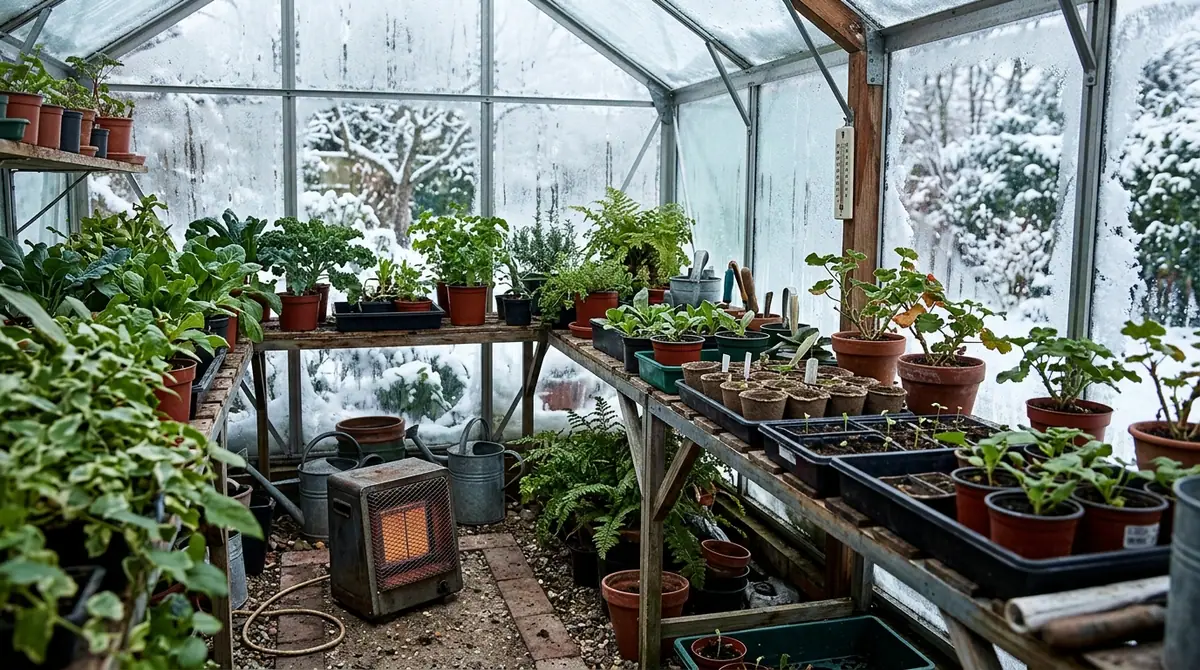
- Position Your Primary and Backup Heaters: Install an electric or gas thermostat-controlled heater at floor level near the center. Wire a secondary, independent propane or kerosene convection heater set 5°F lower as an emergency backup in case of grid failure.
- Set Up HAF Circulation Fans: Mount at least two small oscillating fans near ceiling height, angled downward at 45 degrees, running continuously to eliminate thermal stratification and keep foliage dry.
- Adjust Watering and Fertilization Schedules: Because cooler temperatures reduce plant metabolism, cut winter watering frequency by 50% to 75%. Allow the top 2 inches (5 cm) of soil to dry completely between waterings, and cease all nitrogen fertilization until natural day lengths exceed 12 hours in early spring.
⚠️ Important Caution: Never use unvented kerosene or propane heaters inside a tightly sealed greenhouse. They release carbon monoxide, ethylene gas (which causes flower bud drop and leaf deformation), and massive quantities of water vapor that will saturate your structure.
To ensure your mechanical tools, thermostats, and fuel lines remain in working order throughout the freeze, refer to our Complete Garden Tool Maintenance Checklist for Winter.
4. Common Problems, Pests & Troubleshooting
Winter heating brings unique physiological and pathological challenges. When plants are pushed into an artificial microclimate, pests that normally die back outdoors can thrive.
- Edema and Water-Soaked Blisters: Caused by warm, wet soil paired with cold foliage and stagnant air. Reduce soil moisture, run your HAF fans 24/7, and raise nighttime ambient temperatures slightly.
- Aphid and Whitefly Explosions: Protected from freezing winds, overwintering pests multiply rapidly on stressed, nutrient-dense winter tissue. Introduce beneficial insects like Encarsia formosa or apply horticultural dormant oils on non-freezing afternoons when internal temps reach 50°F (10°C).
- Rapid Temperature Swings: If your heater cycles on and off violently every 5 minutes, your unit is oversized or your thermostat is placed too close to the heat source. Relocate the sensor to plant canopy height in the center of the greenhouse.

5. Frequently Asked Questions
What is the cheapest way to heat a greenhouse in winter?
The most cost-effective heating strategy combines passive solar thermal mass (water-filled barrels) with heavy bubble-wrap insulation. If active heat is required, natural gas or propane heaters are generally cheaper to run per BTU than electric resistance heaters, though electric units require zero ventilation installation.
How do I keep a greenhouse warm without electricity?
You can utilize off-grid thermal mass strategies, such as burying compost bins or hotbeds beneath your staging benches where aerobic microbial breakdown generates steady bottom heat. Additionally, burning bio-fuels in masonry rocket mass heaters or utilizing chemical exothermic packs can provide temporary off-grid warmth.
What temperature should a greenhouse be kept at in winter?
It depends entirely on your plant inventory. Hardy vegetables like kale and spinach survive at 35°F (1.7°C), while standard greenhouse operations for mixed ornamentals require a minimum night temperature between 45°F and 50°F (7.2°C to 10°C). Tropicals demand a strict minimum of 60°F (15.6°C).
How do I prevent condensation in a heated winter greenhouse?
Condensation occurs when warm, moisture-laden air hits cold structural glazing. Combat this by running continuous horizontal air flow fans, venting the greenhouse for 15 minutes during the warmest part of bright days to exchange humid air, and ensuring your soil surfaces are topped with grit or landscape fabric to limit direct soil evaporation.
Related Guides
- Heat Tolerant Dahlias
- Floor Greenhouse
- Insulating Greenhouse
- Glass for Greenhouse
- When to Start Seeds in Greenhouse
📋 Table of Contents ▼ Click to expand
Tags:
Keep reading
🌿 Related Plants You Might Like






PlantSavvyWorld
Editorial team
PlantSavvyWorld is an independent botanical education project. Articles are drafted with AI assistance, then edited and checked against university extension services, botanical garden collections and other published horticultural sources.